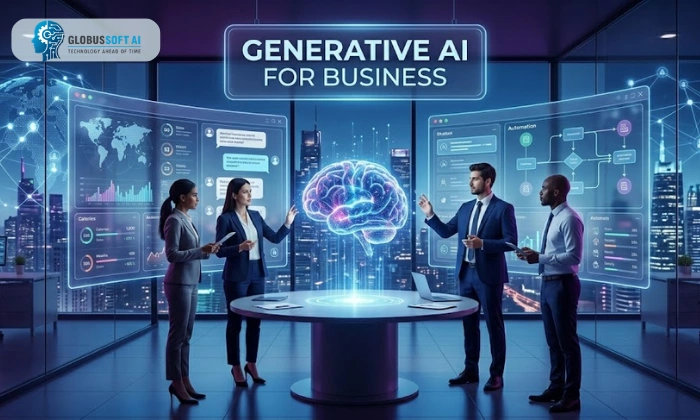
Generative AI for business is no longer a futuristic concept. It is a present-day competitive advantage that separates market leaders from companies still catching up. This guide breaks down everything you need to know, from foundational concepts to practical implementation strategies.
And the timing has never been more critical. In 2026, generative AI for business has moved beyond pilot projects and experimental budgets. Organizations across every sector are now treating it as core infrastructure, the same way they treat cloud computing or cybersecurity. Waiting to adopt is no longer a neutral decision. It is an active choice to fall behind.
Hit ‘Play’ Button & Tune Into The Blog!
Why Generative AI For Business Matters Right Now?
The business landscape has changed. Companies that embraced generative AI for business early are already reporting measurable results: reduced operating costs, faster product cycles, and significantly better customer experiences. Those on the sidelines are losing ground every quarter.
According to McKinsey’s Global AI Report, 48% of companies say generative AI for business is already delivering a positive ROI. That number is only going to climb as AI models become more capable and implementation costs fall.
Generative AI for business refers to AI systems that can produce content, code, images, data analysis, and decisions, outputs that previously required skilled human professionals. These systems are trained on massive datasets and can mirror the reasoning patterns of domain experts at scale and speed.
How Generative AI Actually Works In A Business Context?

Before diving into applications, it helps to understand the engine underneath. “Generative AI” refers to machine learning models trained to generate new content, text, images, audio, and code, based on patterns in training data.
For business use, the most relevant category is large language models (LLMs). These models understand instructions written in plain English and respond with business-relevant outputs: drafting a proposal, summarizing a contract, answering a customer query, writing a Python function, and much more.
What makes generative AI for business particularly powerful is that it can be fine-tuned on your company’s specific data. That means an LLM can learn your product catalog, your tone of voice, your compliance policies, and your internal processes, giving you an AI that works like a highly trained employee, not a generic assistant.
Also Read:
What Is Generative AI & How To Use It?
Real-World Generative AI Examples Across Industries: What Is Actually Working?
The most convincing argument for adopting generative AI for business comes from real-world deployments. These generative AI examples illustrate how diverse the impact actually is.
Customer Support Automation:
E-commerce brands are deploying AI chatbots that handle returns, order tracking, product questions, and complaints, 24/7, without increasing headcount.
The AI knows the entire product catalog and company policy, resolves up to 80% of tickets autonomously, and escalates complex issues to human agents with full context already included.
Legal and Compliance Document Review:
Law firms and insurance companies are using generative AI for business to analyze contracts, flag compliance risks, extract key clauses, and generate summaries. Tasks that once took paralegals days are done in minutes. The accuracy rate, especially with fine-tuned models, rivals that of junior associates.
Marketing and Content at Scale:
Marketing teams use generative AI for business to produce product descriptions, blog posts, ad copy, and email sequences in a fraction of the time. AI drafts the content; humans review and approve. Output volume increases tenfold without proportional cost increases.
Healthcare Administration:
Clinics and hospitals deploy generative AI for business to handle patient intake, appointment scheduling, insurance verification, and billing follow-ups. The reduction in administrative overhead frees clinical staff to focus on patient care.
Recruitment and HR Automation:
Staffing firms use generative AI for business to screen resumes, schedule interviews, send status updates to candidates, and generate onboarding documents. High-volume hiring cycles that once required large coordination teams now run efficiently with a fraction of the manual effort.
How Do You Choose The Right Generative AI Models For Language Tasks?
Not all generative AI models are built for the same purpose. When selecting generative AI models for language-specific business applications, a few key factors determine fit.
First, consider context window size. Business documents, contracts, and reports are often lengthy. A model with a large context window can process and respond to entire documents at once rather than working through fragments.
Second, think about fine-tuning capability. Off-the-shelf models are impressive, but the real competitive advantage comes when you train the model on your own business data. Industry-specific jargon, proprietary processes, and company tone all become embedded in the model’s responses.
Third, evaluate integration readiness. The best generative AI models for language come with robust APIs and connectors to existing business systems, CRMs, ERPs, helpdesk platforms, and databases. A model that cannot talk to your existing stack delivers limited value.
Key insight: Generative AI for business works best when it is not a standalone tool. Its value multiplies when integrated into existing workflows, customer service platforms, internal knowledge bases, project management systems, and data pipelines.
Also Read:
How AI Development Services Are Transforming The Digital Age
Which Essential Generative AI Tools Should Every Business Know About?

The market for generative AI tools has expanded rapidly, and for businesses just getting started, it can feel overwhelming. The key is not to chase every new tool, but to understand the essential categories that actually drive results.
Here’s a practical breakdown of the most important generative AI tools every business should know about, with a clear focus on AI development.
Conversational AI and Chatbot Platforms:
These generative AI tools allow businesses to build customer-facing and internal chatbots powered by LLMs. They handle queries, capture leads, provide support, and maintain brand voice consistently across thousands of simultaneous conversations.
AI Coding Assistants:
Development teams use generative AI tools to write, debug, review, and document code. This dramatically shortens software development cycles and reduces the cost of building custom business applications.
AI Content Generation Platforms:
Marketing and communications teams leverage generative AI tools to produce first drafts of blog posts, email campaigns, social media content, product descriptions, and press releases, compressing weeks of work into hours.
Document Analysis and Knowledge Management Tools:
These generative AI tools extract meaning from documents, summarize reports, answer questions based on internal knowledge bases, and surface relevant information on demand. They are particularly powerful for professional services firms with large internal knowledge repositories.
AI/ML Pipeline Automation Tools:
As businesses evaluate generative AI for business solutions, one name that stands out for its enterprise-focused capabilities is Globussoft.AI. Rather than being a standalone platform, Globussoft.AI operates as a dedicated AI services provider, helping organizations design, build, and deploy their own custom AI solutions.
It enables companies to develop tailored AI tools, intelligent systems, and AI agents that align with their specific business needs. With a team of experienced developers and AI/ML experts, it supports organizations throughout the entire journey, from identifying opportunities to building scalable, production-ready solutions.
Working across industries such as healthcare, real estate, e-commerce, logistics, legal, recruitment, and marketing, Globussoft.AI combines deep technical expertise with practical implementation. Its approach focuses on delivering end-to-end AI services, ensuring businesses not only adopt generative AI but successfully integrate it into their core operations.
What Are The Key Features And Capabilities Of Globussoft.AI?
Globussoft.AI offers a comprehensive suite of generative AI solutions designed to help businesses automate processes, enhance customer experiences, and scale operations efficiently. Here’s a quick look at its core capabilities:
Globussoft.AI helps businesses move beyond AI experimentation by delivering practical, scalable solutions tailored to real-world needs, combining expert development, strategy, and seamless integration into existing workflows.
AI Agent Development:
Globussoft.ai builds intelligent AI agents that automate repetitive tasks, reduce errors, and enhance both customer interactions and internal operations, leading to improved efficiency and productivity.
LLM-Powered Chatbots with Custom Knowledge Bases:
Develops advanced chatbots trained on your business data to ensure accurate, context-aware, and brand-consistent responses while handling high volumes of queries effortlessly.
Testing and Fine-Tuning LLM :
Continuously refines and optimizes AI models to improve accuracy, reduce bias, and ensure alignment with evolving business requirements and industry standards.
AI/ML Pipeline Replication:
Replicates and adapts capabilities of leading AI systems, including ChatGPT-style models, enabling faster deployment and cost-effective development without starting from scratch.
Consulting AI/ML:
Provides strategic guidance to identify the most valuable AI opportunities, create actionable roadmaps, and ensure implementations deliver measurable business impact.
Integration AI/ML :
Seamlessly integrates AI into existing systems, building adaptive solutions that evolve over time and automate processes at scale.
How Do You Build A Generative AI Strategy That Sticks?
Many businesses adopt generative AI for business reactively, chasing a specific tool because a competitor is using it. That approach rarely works. A sustainable strategy starts with a different question: where in my business does slow or inconsistent information processing cost the most?
Answer that question, and you have your first use case. From there, generative AI for business adoption follows a logical sequence: pilot the use case with a small team, measure the impact, refine the implementation, and then scale across the organization.
Change management is as important as the technology itself. Teams that understand what the AI is doing and what it is not doing adopt it faster and use it more effectively.
Transparency about AI’s role builds trust and prevents over-reliance that leads to quality problems downstream.
The Industries Where Generative AI For Business Is Growing Fastest
While generative AI for business applies broadly, certain sectors are seeing faster adoption and more dramatic results.
- Professional services, law, and accounting.
- Consultants benefit enormously from AI’s ability to process and synthesize large volumes of documents quickly.
- Healthcare organizations deploy generative AI for business across administrative workflows, freeing clinical resources for patient care.
- E-commerce companies use it to personalize recommendations, generate descriptions, and automate customer service at scale.
- Real estate firms rely on generative AI for business to qualify leads, coordinate transactions, and manage listing updates across multiple platforms.
- Logistics companies use it to track shipments, handle exception management, and coordinate carrier communications, all without expanding operations teams.
The common thread across all these industries is clear: wherever there are high volumes of information-intensive, repetitive tasks, generative AI for business delivers disproportionate value.
What Separates Successful Implementations From Failed Ones?
Generative AI for business projects that succeed share a few common characteristics. They start small and specific, with clearly defined success metrics. They involve the end users in the design process. They maintain human oversight, especially in the early months of deployment.
Failed implementations tend to go the opposite direction. They try to automate too much too fast, skip change management entirely, and treat AI outputs as infallible. When quality disappoints, adoption collapses.
The most durable generative AI for business deployments treat AI as a collaborator, not a replacement. Humans set the standards, review outputs, and provide continuous feedback that improves model performance over time. This human-in-the-loop model separates transformative adoption from expensive experiments.
Final Thoughts
Generative AI for business has crossed the threshold from emerging technology to business-critical infrastructure. The companies investing in it today are not doing so because it is fashionable. They are doing so because the productivity gains, cost reductions, and customer experience improvements are real and compounding.
Whether you are exploring your first use case or scaling an existing deployment, the path forward is the same: identify the high-friction, information-intensive processes in your business, match them with the right generative AI tools and models, and implement with clear metrics and human oversight.
Platforms like Globussoft.AI make that journey significantly faster and lower-risk, providing the consulting, development, and integration expertise that turns AI strategy into AI results. If your business is serious about staying competitive in the next three to five years, the time to act on generative AI for business is now.
FAQs
Q1. How much does it cost to implement generative AI for business?
It depends on scale. Basic tools start at a few hundred dollars monthly. Custom enterprise solutions can range from $10,000 to $100,000+.
Q2. Do I need a technical team to adopt generative AI for business?
Not always. Many platforms are no-code-friendly. Having one technically informed person on your team is enough to get started.
Q3. How long does it take to see results from generative AI?
Most businesses see measurable results within 60 to 90 days when starting with a focused, high-volume use case.
Q4. Is generative AI safe to use with sensitive business data?
Yes, if deployed correctly. Private cloud and on-premise models keep your data fully isolated from public systems.