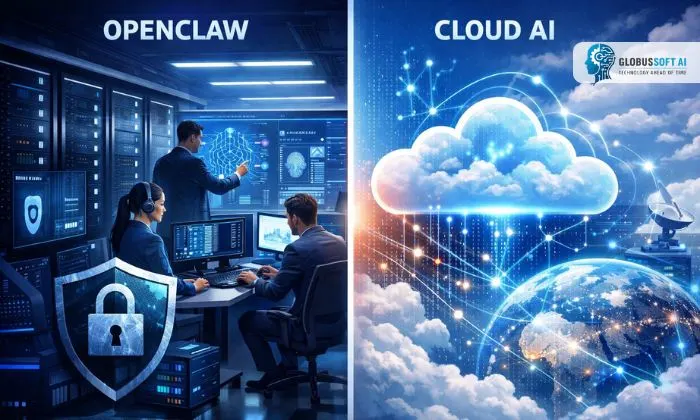
When it comes to choosing the right AI infrastructure for your business, OpenClaw Skill has emerged as a powerful and flexible contender, challenging traditional cloud-based models. OpenClaw is a locally deployable, open-source AI framework that gives organizations full ownership over their data, models, and deployment environments. As enterprises increasingly evaluate their AI options, understanding how it stacks up against conventional platforms becomes essential. The debate isn’t just about raw technology; it is about privacy, data governance, cost efficiency, and long-term strategic control. This blog dives deep into the key differences in privacy, control, and capabilities, helping you make an informed, well-rounded decision for your business.
Listen To The Podcast Now!
What Is Openclaw and Why Does It Matter?
It is an open-source AI deployment framework designed specifically for organizations that need complete control over their AI environments. Unlike most commercial platforms, Openclaw runs on-premises or within private infrastructure entirely, meaning your data never leaves your servers. This makes it especially attractive for industries with strict compliance requirements, such as finance, healthcare, and legal services. Openclaw supports a wide range of large language models (LLMs) and can be fine-tuned to match specific business use cases.
Its modular architecture allows developers to plug in different AI components, making it highly adaptable to evolving needs. Businesses deploying it do not need to rely on external API calls, which reduces latency and eliminates dependency on third-party uptime. For companies prioritizing data sovereignty, this framework is increasingly becoming the go-to solution for scalable, secure, and cost-predictable AI deployments.
What Is Cloud AI? Understanding the Basics:
Many businesses often ask: What is cloud AI, and how does it differ from on-premise alternatives? Simply put, cloud AI refers to artificial intelligence services delivered over the internet through remote servers maintained by third-party providers. These platforms handle the heavy computational lifting, model training, inference, and scaling without requiring users to manage any physical hardware. Cloud AI services are generally accessible on a subscription or pay-per-use basis, making them convenient to get started with.
They offer scalability, frequent updates, and access to cutting-edge models without significant internal engineering investment. However, this convenience comes with trade-offs: your data is processed and often stored on external servers, raising concerns around privacy, compliance, and data residency. This fundamental tension is precisely what makes comparing cloud-hosted platforms with self-hosted frameworks so relevant for modern enterprises navigating their AI strategy today.
What Is Google Cloud AI? A Closer Look:
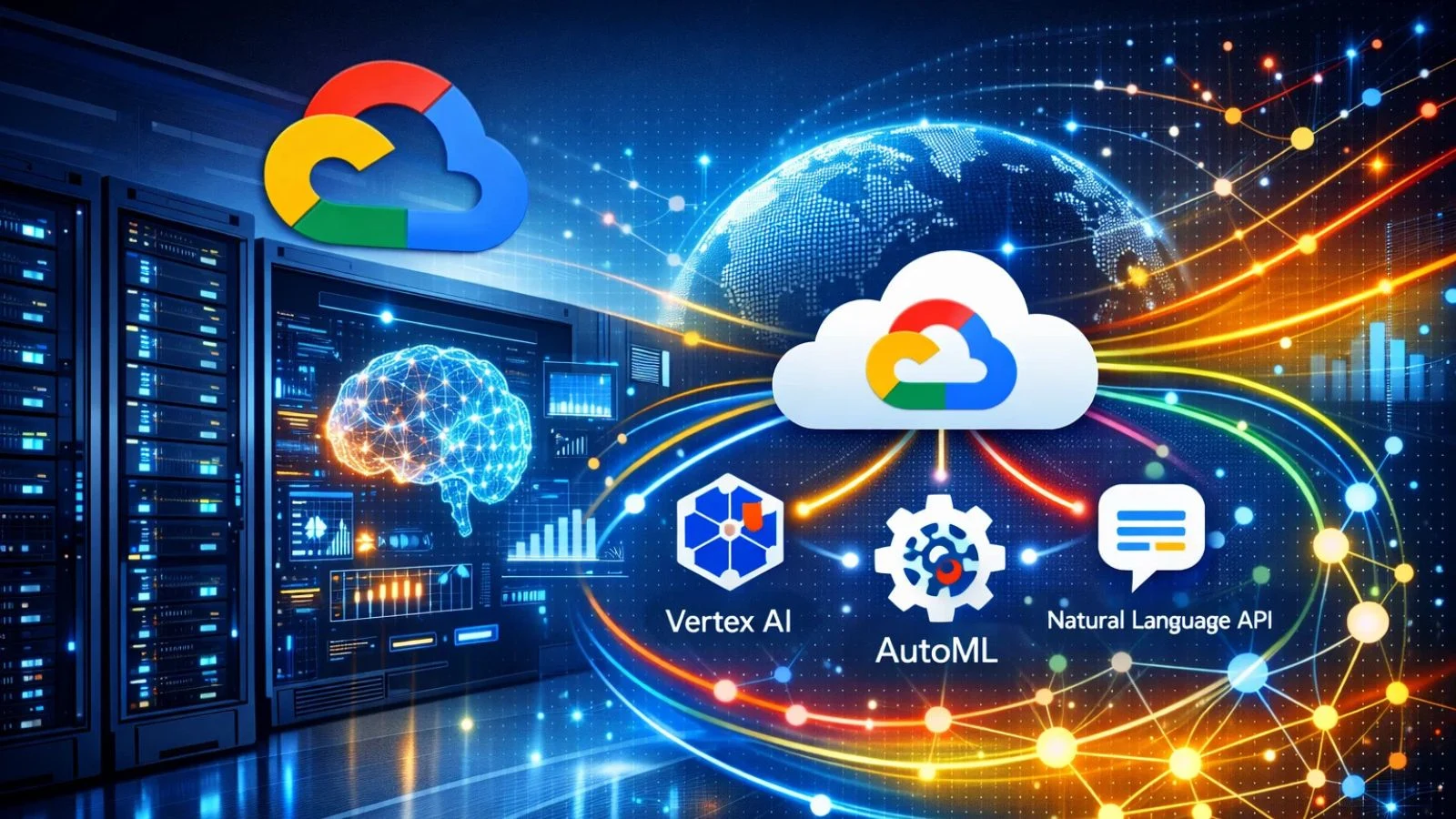
Another frequently asked question among business leaders is: What is Google Cloud AI, and how does it fit into enterprise strategy? Google Cloud AI is Google’s comprehensive suite of managed AI and ML services offered through Google Cloud Platform (GCP). It includes powerful tools such as Vertex AI, AutoML, Vision AI, and the Natural Language API, along with a broad library of pre-trained models accessible via APIs. Google Cloud AI is well known for its robust global infrastructure, deep integration with Google’s data ecosystem, and competitive pricing for large-scale workloads.
Enterprises already using Google Workspace or BigQuery often find it a natural extension of their existing environment. However, like all cloud AI platforms, data is processed on Google’s infrastructure, meaning businesses must place significant trust in a third-party provider with sensitive information. For regulated industries, this dependency can present compliance challenges that self-hosted alternatives are specifically designed to solve.
Is AI a Part of Cloud Computing? The Relationship Explained:
A common question among business and technology teams is: Is AI a part of cloud computing, or are they entirely separate disciplines? The short answer is that they are deeply intertwined. Cloud computing provides the infrastructure, scalable storage, processing power, and global networking hat makes large-scale AI feasible and commercially accessible for most organizations. AI, in turn, has significantly enhanced cloud services themselves, powering intelligent features like anomaly detection, cost optimization, and automated resource scaling.
They are genuinely symbiotic technologies. However, this dependency also means that AI systems hosted purely in the cloud inherit the privacy and control limitations inherent in shared environments. This is why many enterprises are now exploring hybrid approaches, combining the convenience of cloud services with the security of on-premise frameworks to achieve both flexibility and data sovereignty simultaneously.
Privacy: How Openclaw Compares to Cloud AI Platforms:
Privacy is perhaps the single most significant factor driving businesses toward this framework. When you use a cloud AI platform, your data, including queries, documents, and outputs, is transmitted to and processed on external servers. Even with strong encryption and contractual commitments, businesses can never be entirely certain how their data is being used or retained by the provider. Openclaw processes all data locally; nothing leaves your network.
This is a game-changer for industries dealing with personally identifiable information (PII), medical records, or confidential financial data. Compliance with regulations such as GDPR, HIPAA, or India’s DPDP Act becomes significantly more manageable, since data sovereignty is built directly into the architecture. For enterprises where privacy is non-negotiable, it consistently delivers what no cloud provider can fully match: absolute, verifiable control over where and how sensitive data is processed at every step.
Control and Customization: Where Openclaw Excels:
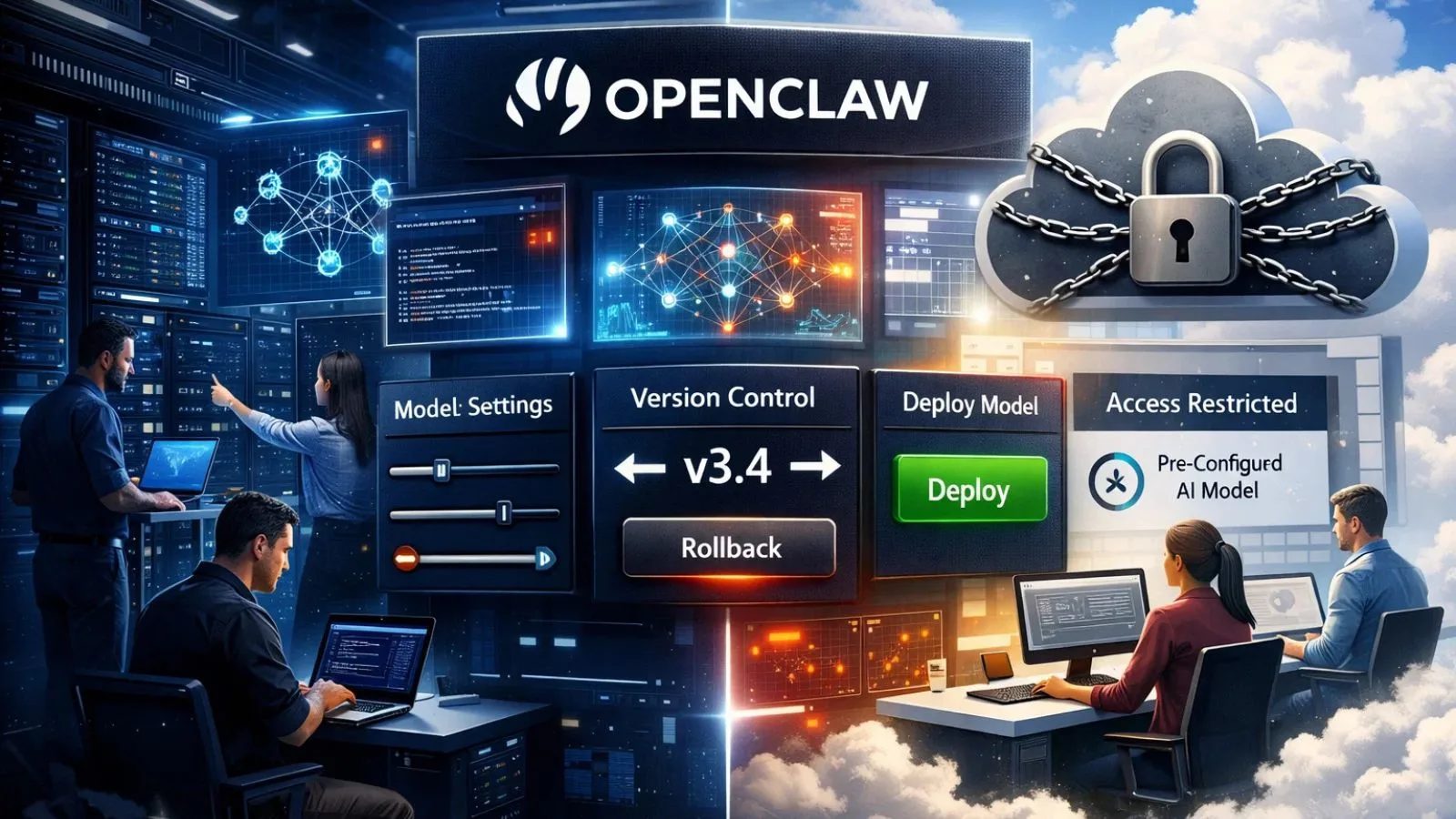
Control is another critical dimension where Openclaw offers a decisive advantage over cloud-hosted alternatives. Cloud AI platforms typically offer limited customization; you can adjust parameters and fine-tune within their systems, but the underlying infrastructure, model governance, and update schedules remain firmly in the provider’s hands. Your team controls everything: the exact model versions deployed, the hardware it runs on, the rate of updates, and specific configurations used for inference.
If a model update disrupts a workflow, you can roll it back immediately. You can also deploy proprietary models that you would never expose to a third-party API endpoint. This level of control makes it ideal for organizations with specialized compliance needs, unique data pipelines, or AI workflows requiring precise, repeatable behavior. It removes a significant layer of dependency that cloud platforms inherently introduce into your production environment.
Capabilities Compared: Openclaw vs Cloud AI Platforms:
On raw capabilities, cloud AI platforms still hold some advantages, primarily around access to the latest frontier models, globally distributed infrastructure, and managed services that significantly reduce engineering overhead. For quick prototyping and low-maintenance deployments, cloud options remain highly practical. However, the gap is rapidly closing. Modern OpenCLAW deployments support a wide variety of open-source LLMs, multimodal workflows, RAG pipelines, and custom fine-tuning all within your own environment.
The key difference is ownership: you own the model weights and the entire inference stack. While cloud platforms work well for experimentation, Openclaw truly shines in production environments where consistency, privacy, and long-term cost predictability are paramount. For organizations scaling AI responsibly beyond proof-of-concept, it represents a mature and enterprise-ready alternative worth serious consideration.
Also Read:
OpenClaw Consulting Services: What Companies Actually Pay For
Why GlobussoftAI Is the Right Partner for Your AI Journey?
Whether you are exploring Openclaw or evaluating other AI deployment strategies, having the right technology partner makes all the difference. GlobussoftAI is a specialized AI and ML services company helping modern enterprises design, build, and deploy generative AI solutions tailored to their unique operational needs.
Here is what GlobussoftAI brings to the table:
- AI Agent Development, Intelligent agents that automate workflows, reduce human error, and boost team efficiency
- LLM-Powered Chatbots, Context-aware, human-like chatbots that handle high query volumes while maintaining brand consistency
- LLM Testing & Fine-Tuning, Continuous model refinement to reduce bias, improve accuracy, and align outputs with business goals
- AI/ML Consulting Expert guidance to identify opportunities, build AI roadmaps, and drive measurable impact
- AI/ML Integration: Combine generative AI with existing ML frameworks to create adaptive, scalable automation
- 20% Faster Deployment Agile delivery approach with minimal disruption to existing workflows and maximum day-one ROI
With ISO, CMMI, NASSCOM certifications and a growing global client base, GlobussoftAI is a trusted partner for enterprise AI transformation at scale.
Conclusion:
Choosing between Openclaw and cloud AI platforms ultimately comes down to what your organization values most. If privacy, data sovereignty, and granular control are top priorities, it is a compelling and mature enterprise solution. Cloud platforms remain useful for fast prototyping and lean teams. Evaluate both based on your compliance needs, budget, and long-term AI roadmap. With the right partner, you can confidently deploy AI that is powerful, secure, and built to scale.
FAQ’s:
Q1: Is it suitable for small businesses?
Ans: Yes, but it requires technical expertise. Small businesses may benefit from partnering with an AI services provider for smoother deployment.
Q2: Can cloud AI fully guarantee data privacy?
Ans: Not entirely. Data is still processed on third-party servers, which may not meet all regulatory or data residency requirements.
Q3: Is it free to use?
Ans: The framework is open-source and free. However, infrastructure costs and engineering maintenance should be factored into your total budget.
Q4: Does it support advanced models like LLMs?
Ans: Yes. It supports open-source LLMs, RAG pipelines, and multimodal workflows entirely within your private infrastructure.
Q5: How do I choose between the two options?
Ans: Prioritize control and privacy? Go self-hosted. Need quick deployment with minimal setup? A cloud AI platform is the easier starting point.