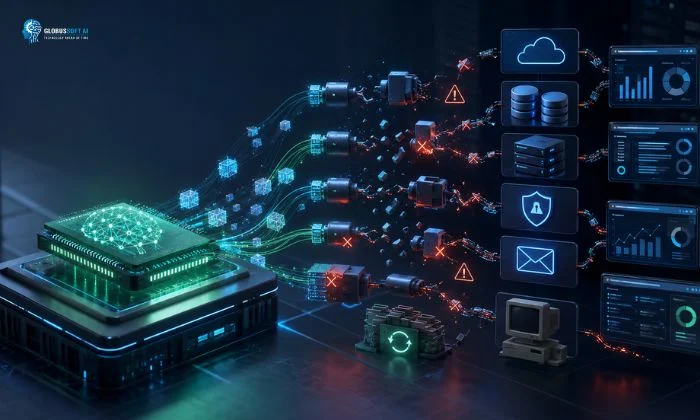
Ninety-five percent of organizations deploying generative AI fail to reach production or deliver ROI, according to MIT Project NANDA’s July 2025 findings, and the root cause isn’t the model.
It’s the integration. McKinsey confirms the pattern from a different angle: only 6% of organisations capture meaningful enterprise-wide value from AI. The gap between “the demo worked” and “it runs reliably inside our ERP” is where most custom AI development engagements collapse.
Buyers don’t see it coming because they’re evaluating vendors on the wrong signals: portfolio depth, headcount, brand-name client logos. None of those predict whether a shop can wire a fine-tuned LLM into your legacy Oracle stack without breaking your SOC 2 audit trail.
This is the mistake I want to unpack, because it’s costing mid-market companies months of rework and tens of thousands of dollars in hidden re-scoping fees.
Listen To The Podcast Now!
The Seductive Power of the AI Demo:
Every AI dev shop worth its retainer can produce a polished proof of concept. Impressive response latency. Clean UI. A model that classifies or predicts exactly what you asked it to.
The demo is not the product. The integration is the product.
The failure pattern repeats across industries: an operations team contracts an AI shop to build a document-extraction tool. The POC pulls structured data from PDFs without a hitch. Weeks later, the tool is live, and it crashes intermittently because nobody mapped the vendor’s output schema to the existing warehouse management system. The AI worked. The plumbing didn’t. The project goes back to scoping, and the original timeline is doubled.
This is not a technology failure. It’s a methodology failure.
What ‘Integration Readiness’ Actually Means:

When I say integration, I mean four distinct layers that most vendor RFPs never ask about:
1. Data Pipeline Continuity:
Where does the AI system get its inputs in production? Batch jobs? Real-time event streams? Most shops prototype against static CSV files or sanitized sample data. Then production arrives with noisy, schema-drifting, permission-gated data from three departments who don’t talk to each other.
If the CRM has stale contacts and blank fields, AI predictions will be weak, and that failure mode kills the reported productivity gains before they ever materialize. A vendor who hasn’t mapped your data lineage before writing the first model call will hand you a fragile artifact.
2. Auth and Compliance Handshakes:
Custom AI tools don’t float in isolation. They touch sensitive data, which means they sit inside your identity and access management perimeter. SAML, OAuth 2.0, RBAC policies, audit logging-, these are not afterthoughts. A vendor who treats security as a “Phase 2” deliverable is telling you something important about their project sequencing. Regulated industries- healthcare, fintech, legal- have learned this the hard way under HIPAA, SOC 2 Type II, and the EU AI Act’s conformity assessment requirements.
3. Observability from Day One:
How will you know when the model degrades? AI systems don’t break the way traditional software breaks. They drift. Accuracy slips quietly over weeks as production data diverges from training distribution. If your vendor isn’t baking in evaluation pipelines, model monitoring hooks, and human-review queues during the build phase, not after go-live, you’re operating blind.
4. Rollback and Graceful Degradation:
What happens when the AI component fails mid-workflow? Does the business process halt entirely? The best builds include fallback logic: rule-based defaults, human escalation triggers, or cached prior outputs. Most vendors skip this because it’s unglamorous. It’s also what separates production-grade AI from expensive demos.
Why the Talent Signal Is Misleading:
The custom AI development market has expanded dramatically. AI’s share of U.S. tech talent postings jumped from 8.8% in 2019 to 14.3% in 2024, with roughly 72% of those roles concentrated in software development and programming. The supply of developers who can fine-tune a model or call an API has never been larger.
The shortage is in engineers who understand both the ML layer and the enterprise systems layer simultaneously. That profile-, someone who can reason about transformer attention mechanisms and also debug a Kafka consumer group offset problem- is genuinely rare. Shops that staff these projects with ML specialists who hand off to “integration engineers” after model training create seam risk at exactly the wrong moment.
When evaluating vendors, the question to ask isn’t “how many AI projects have you delivered?” It’s: “show me the architecture for the last project where the AI had to authenticate against an on-premise system and write back to a third-party database.” The answer reveals everything.
A Four-Question Integration Audit for Your Next Vendor Call:
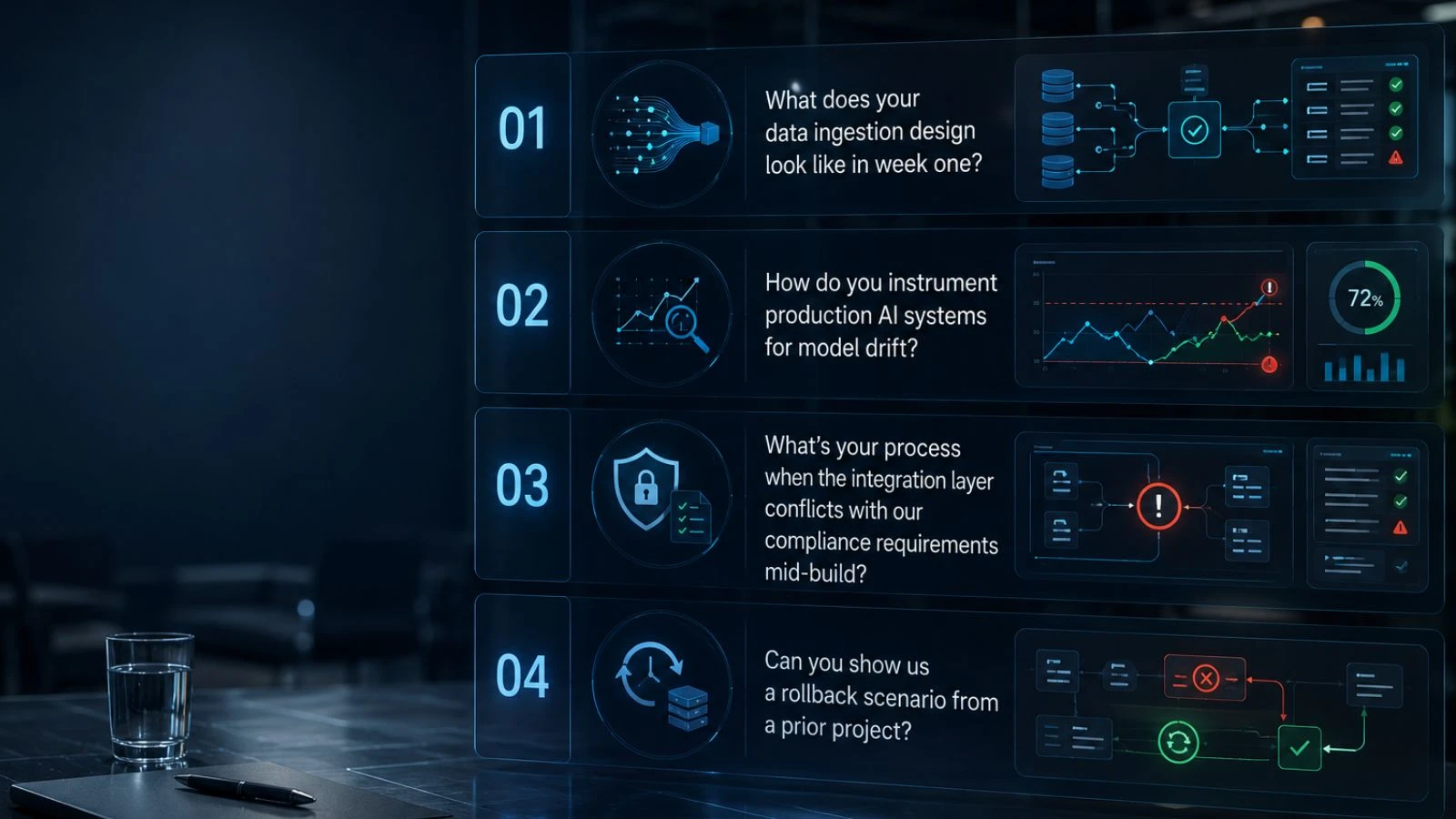
Run through these before you sign anything:
1. What does your data ingestion design look like in week one?
You want specifics about schema validation, source system access, and how they handle data quality issues. Vague answers about “ingesting your data” are red flags.
2. How do you instrument production AI systems for model drift?
Listen for mentions of evaluation harnesses, shadow scoring, and alerting thresholds, not just “we’ll monitor it.”
3. What’s your process when the integration layer conflicts with our compliance requirements mid-build?
This tests whether they’ve encountered real enterprise constraints before, or only greenfield projects.
4. Can you show us a rollback scenario from a prior project?
Specifically, what happened when a model output caused a downstream error in a production system. The answer matters less than whether they have one.
What Good Looks Like?
Consider a sales team running daily pipeline reviews manually. The first thing Globussoftai‘s co-design week surfaces is the state of the CRM data itself: which deal stages are actually progressing, which contacts have blank email fields, which phone numbers are stale. That audit is unglamorous. It is also what makes a CRM audit and priority-ranked call list agent viable; without it, the system surfaces dead leads as hot, and the output is worse than the spreadsheet it replaced.
The integration architecture, API auth to the CRM, output schema, escalation rules for deals past a certain stage, get signed off during weeks one and two. The agent doesn’t go into build until the team knows exactly what it must read and write. By week three, the first version is deployed to real users, not sitting in staging. The model never encounters a schema surprise at go-live.
That sequencing sounds obvious. It is the opposite of how most AI shops work: rk, model first, integration later, chaos always. The practical payoff is real. Setting a 5-minute response goal on web leads with AI-drafted first replies produced an 18% jump in booked demos in week two with zero additional ad spend, but only because the data feeding the system was clean before the agent touched it.
The same logic applies to inbox triage. Globussoftai’s spam false-positive rescue agent rescues 100+ misclassified messages per day. That result isn’t model magic. It’s because the integration into the inbox was precise from day one: category labels, archive rules, and the morning digest format were all defined in co-design, not discovered during QA.
When the integration layer is solid, teams report up to a 40% drop in operating costs and a 30% rise in productivity after adding AI to core workflows. Those numbers require clean inputs. They do not happen by accident.
This matters especially for industries with complex technology stacks. A custom AI solution for an insurance underwriter looks nothing like one for a media production company, even if both are “using LLMs.” The compliance surface, the legacy system footprint, and the human workflow they’re augmenting are entirely different.
RAND’s root-cause analysis of AI project failures identifies exactly this mismatch, treating structurally different deployments as variations on the same template, as one of the primary drivers of underdelivery.
The Reframe Buyers Need:
Stop evaluating AI development partners on model quality. Assume model quality is a solved problem, and for the vast majority of business applications, it mostly is. The model will work. Evaluate instead on integration philosophy, observability practices, and how they handle complexity that emerges mid-project.
Ask for architecture diagrams, not demo videos. Ask for post-mortems on failed integrations, not testimonials from successful launches. Ask whether their senior integration engineers are on the project team from day one or parachuted in at go-live.
The companies that have figured this out are getting durable AI systems that compound in value over time. The ones still chasing demo quality are on their third vendor and wondering why AI isn’t working for them.
One More Thing on Vendor Selection:
The market for custom AI development has consolidated around recognizable names. Being on a shortlist reflects general reputation and marketing reach, not fit for your specific stack. The best custom AI development companies treat machine learning, computer vision, NLP, and generative AI not as standalone offerings but as components within a larger systems context. That framing- AI as a component, not a product- is the mental model that separates shops who deliver from those who demo.
Globussoftai has shipped 40+ products reaching 100M+ users, including Chingari, a social platform that has operated at scale for six years. Scale like that only holds when the integration layer was built to last, not bolted on after the demo closed.
Frontier-lab FDE programs that promise similar outcomes start at $250k contract minimums and run $500k–$2M per engineer per year. The embedded pod model starts in two weeks at roughly one-tenth that cost, because the methodology, not the price point, is what makes production AI work.
The integration is the product. Evaluate accordingly.
Ready to pressure-test your vendor shortlist? Talk to the Globussoftai engineering team about what an integration-first AI build actually looks like for your stack before you sign a statement of work that makes the demo the destination.