
According to deployment data across 40+ enterprise AI budgets, a Series B fintech founder burned through $2.3 million building an AI agent in-house before calling it quits, and that story is not unusual. The problem is not ambition. It is math. Most teams compare a vendor quote against a hiring cost and never account for the 60–70% of expenses that live in neither column.
This piece is not a neutral “pros and cons” breakdown. I have watched enough custom AI agent projects succeed and fail to have a strong opinion: the decision of what to build versus what to buy is rarely about capability. It is about where your irreplaceable knowledge actually lives, and most teams get that wrong from the start.
Listen To The Podcast Now!
Why the Standard Cost Comparison Fails?
Here is how the calculation usually goes: someone pulls a vendor’s pricing page, compares it to a senior engineer’s annual salary, and decides that building is cheaper. It rarely is.
The missing spend shows up in categories that appear on neither a vendor quote nor a job description. Model fine-tuning cycles. Prompt versioning and regression testing when a foundation model updates underneath you. Monitoring infrastructure so you know when an agent starts hallucinating in production. Integration maintenance when an upstream API changes its schema. Security audits before you can pass compliance review. These are not edge cases; they are the recurring cost of operating any AI system at real scale.
For 90% of enterprise use cases, the practical argument for buying or outsourcing is not that vendors build better software. It is that the hidden operational tax on in-house AI is punishing unless you have already staffed and funded it deliberately.
That said, buying everything wholesale is its own trap. And this is where the decision gets genuinely interesting.
What You Must Never Outsource?
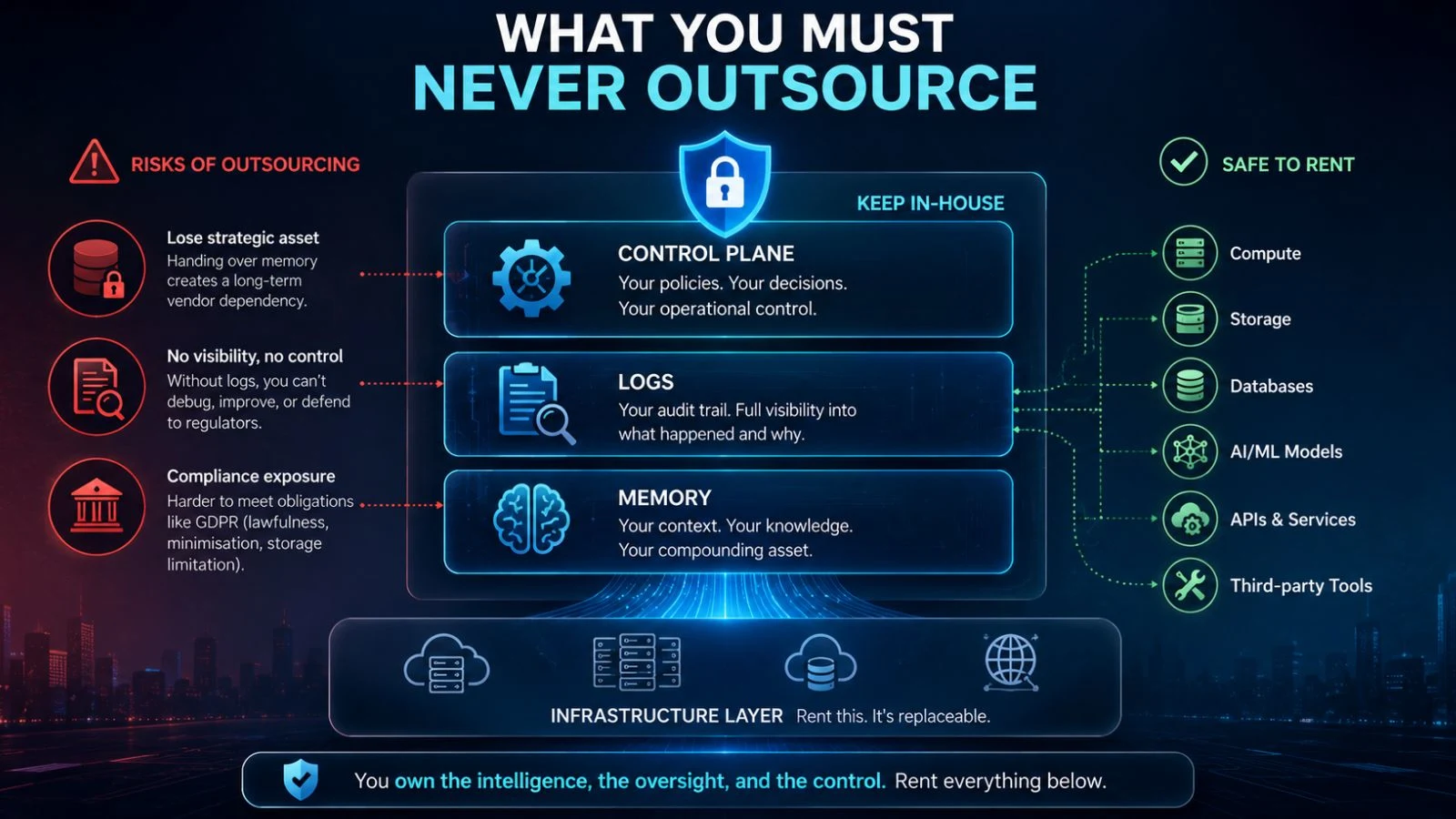
There is a principle worth tattooing somewhere visible: rent the plumbing, keep the memory, logs, and control plane in-house.
What does that mean in practice? Your agent’s memory the context it accumulates about customers, deals, and internal processes- is a compounding asset. Every week it operates, it becomes harder to replicate and more valuable to your business. Hand that to a vendor and you have handed over a strategic dependency.
Logs are your audit trail and your debugging surface. If you cannot read exactly what your agent did, why it did it, and what data it touched, you cannot improve it, and you cannot defend it to a regulator. Data residency control is not a compliance checkbox; it is tied to real obligations like GDPR Article 5 principles around lawfulness, data minimisation, and storage limitation. Outsourcing your control plane to a SaaS product that lives in someone else’s cloud makes those obligations much harder to satisfy.
The control plane- the logic that decides which agent runs, when, on what data, with what escalation rules is your operational policy. That should be yours. Everything below it is fair game to rent.
The Real Cost of Each Path
On the SaaS end: HubSpot’s AI Pro tier starts at $800/month; their Enterprise tier starts at $3,600/month. Those are recurring costs before per-seat pricing, integration development, or the customization work that kicks in when the platform’s defaults don’t match your workflow.
On the self-hosted open-source end: running something like OpenClaw on a VPS costs roughly $5/month in infrastructure, with total cost including model usage staying under $10/month. That number is real but incomplete. It excludes engineering time for CI/CD pipeline management, ongoing operational checks, and hand-wired integrations. OpenClaw, for instance, has no native Shopify plugin; teams must build webhook and API connections from scratch.
On the frontier-lab end: the biggest AI labs offer Foundational Development Engineer programs. Globussoftai has done the research; those programs run $500,000 to $2 million per year per FDE, with contract minimums starting at $250,000. A legitimate option for companies with sufficient scale. For everyone else, it is not.
A Framework for Making the Decision:
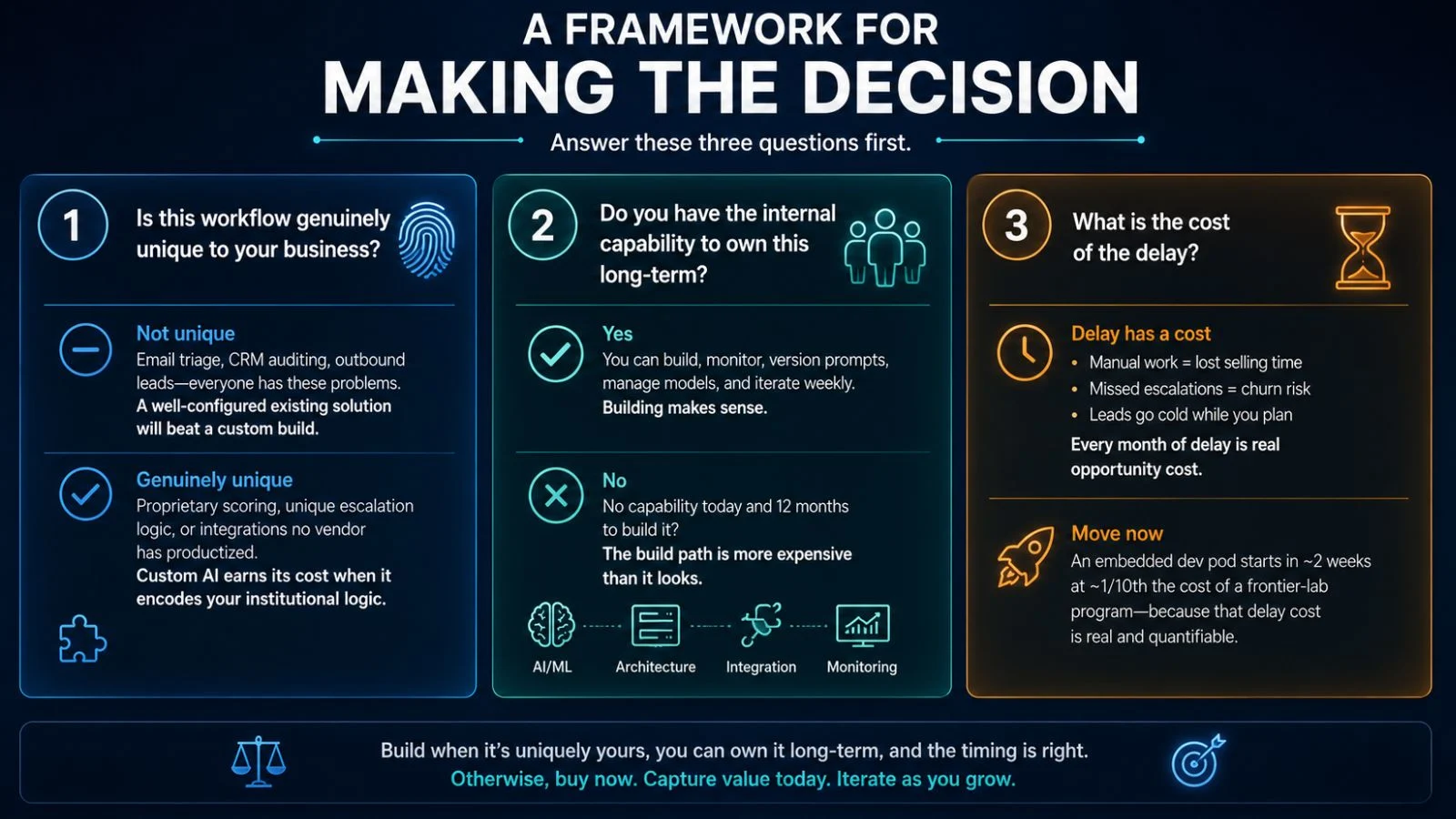
Before you answer “build or buy,” answer these three questions first.
1. Is this workflow genuinely unique to your business?
Email triage, CRM pipeline auditing, and outbound lead generation are not unique. Every company with a sales function has some version of these problems. The recommended sequencing for custom AI work always starts with defining the specific business problem, and if that problem is generic, a well-configured existing solution will almost always beat a custom build on time-to-value.
Where custom development wins is when the workflow is genuinely yours: a proprietary scoring model, a multi-step escalation path that reflects how your team actually works, or an integration between systems that no vendor has productized. AI agent automation earns its cost when it encodes institutional logic that no off-the-shelf tool can replicate.
2. Do you have the internal capability to own this long-term?
Custom AI agent development requires expertise across machine learning, system architecture, and integration, and when in-house capability is absent, engaging a technical partner is the named fallback, not a Plan B. This is not a knock on internal teams. It is an acknowledgment that the skill set is genuinely cross-functional and expensive to staff fully.
If your team can maintain a production agent, monitor its outputs, version its prompts, manage model updates, and iterate on its logic weekly, then building makes sense. If that capability doesn’t exist today and you need 12 months to build it, the build path is actually more expensive than it looks, not less.
3. What is the cost of the delay?
This one gets ignored most often. A multi-year build-it-ourselves roadmap carries a real opportunity cost. Every month your sales team spends on manual CRM updates is a month not spent selling. Every escalation your support team misses because no one is watching chat queues is a churn signal gone undetected. Leads go cold while you’re still in sprint planning.
The practical alternative to a frontier-lab program- an embedded development pod that starts in two weeks at approximately one-tenth the cost exists precisely because that delay cost is real and quantifiable.
What This Looks Like in Practice:
The right architecture for most companies in 2026 is not pure build or pure buy. It is a deliberate split. Rent the commodity plumbing: model APIs, email connectors, CRM integrations, monitoring dashboards. Own the logic layer above it, the decision rules, escalation paths, memory structures, and logs.
That split is achievable in a 4-week sprint engagement. Not a prototype. A working agent, deployed to real users, with metrics you can review the following week.
Having shipped 40+ products reaching over 100 million users, including platforms operating at scale for six years, the pattern is consistent. Teams that close deals fastest are the ones who got a working agent into production first, then iterated. Waiting for a perfect internal build is how you lose the window.
The teams that get this right start with a tight scope, ship fast, and expand from a working foundation. The teams that get it wrong spend the first year on infrastructure and never reach the part that matters.
If you are at the decision point right now, weighing a build, a vendor, or an outsourced team,m talk to Globussoftai about scoping a working agent in four weeks. The co-design week is free. The clarity is immediate.