

Most founders make their decision about AI talent backwards, and by the time they realize it, they’ve burned six months and a hiring budget on an engineer who’s still configuring environments.
Here’s the uncomfortable truth: LinkedIn ranked “Artificial Intelligence Engineer” as the #1 fastest-growing job category in early 2025. That signal has sent every mid-market company scrambling to post a job req. But “fastest-growing demand” also means fastest-growing scarcity and fastest-growing compensation expectations. Senior AI talent is scarce, and local time-to-hire now stretches from months into quarters. The company that waits for its perfect full-time hire is the company that ships nothing this year.
The mistake isn’t wanting AI capability. It’s assuming a headcount addition is the fastest path to it.
Listen To The Podcast Now!
Why the Three Obvious Options All Fail
When a founder finally decides to “do AI properly,” they typically look at three doors.
Door one: hire a full-time AI engineer. Takes four to six months to recruit someone credible. Then three to six more months before they’ve learned your codebase, your domain, and your customers well enough to ship something meaningful. You’re twelve months in before you have a validated agent in production.
Door two: a frontier-lab FDE program. Microsoft Frontier, Google Cloud FDEs, Anthropic Solutions- these programs exist, and they do deliver. They also cost $500,000 to $2 million per year, with contract minimums starting at $250,000. For a Series A startup or a mid-market team, that’s not a budget line, that’s a revenue target.
Door three: an offshore dev agency. Fast to spin up, cheap on paper. Offshore wins on cost and dedicated focus versus a freelancer’s divided attention. But a generalist offshore shop selling “AI services” often means repackaging off-the-shelf prompts with a thin API wrapper. You get a demo. You rarely get a deployed, monitored agent solving a real business problem.
None of these fail because the people are bad. They fail because the model is wrong for the problem.
What “Ship in 30 Days” Actually Requires?
The embedded engineering model that Globussoftai runs is built around one constraint: a working agent deployed to real users within thirty days. That sounds like marketing language until you understand what it demands structurally.
It requires an engineer who drops directly into your Slack and your codebase, not a project manager relaying tickets to an offshore team. No handoffs between a solutions architect, a delivery lead, and a developer three time zones apart. One person, your tools, your repo, from scoping call to production deployment.
It also requires a team that has already solved the boring-but-critical production problems. Production readiness in AI agent work covers API key security, access control, rate limits, retries, and graceful downtime handling– the stuff that kills a promising prototype the moment real traffic hits it. A newly hired full-time engineer learns this on your dime. An embedded pod has already learned it across prior deployments.
And critically: it requires treating prompt changes as a discipline, not a conversation. Prompt versioning no random changes to live systems- is a production constraint that most teams discover only after a bad update silently degrades agent output for a week before anyone notices. By the time the embedded engineer ships your agent, that discipline is already in place.
The Agents That Actually Move Metrics:
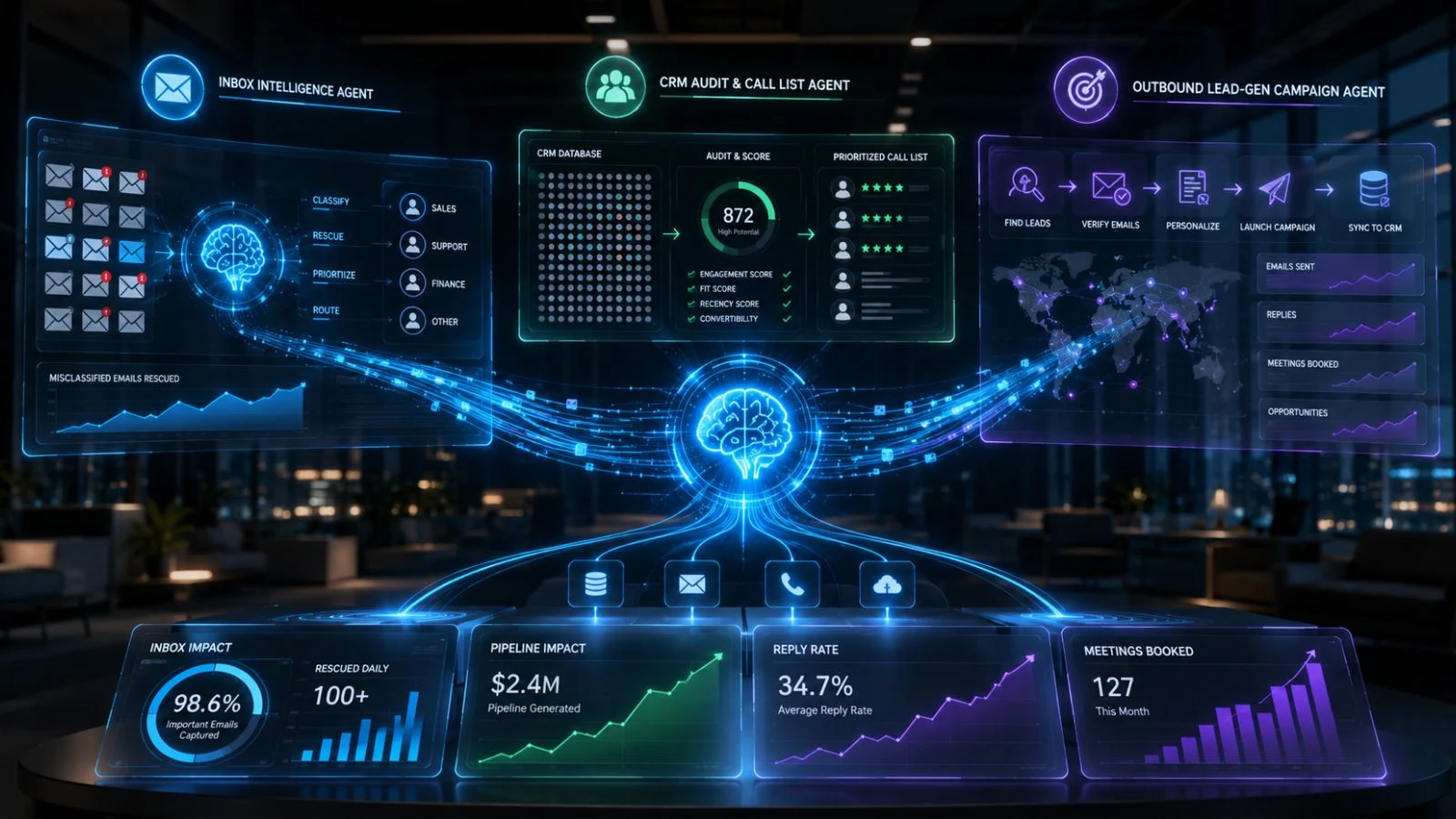
Abstract capability descriptions don’t help founders make decisions. Concrete agent types do.
The inbox intelligence agent handles the classification and routing problem that every sales and support team eventually hits at scale. Globussoftai’s spam false-positive rescue agent, a specific implementation of this pattern, rescues more than 100 misclassified messages per day, messages that would otherwise disappear from a rep’s view entirely.
The CRM audit and call list agent addresses a different failure mode: CRM data that exists but isn’t being used. Most mid-market teams have thousands of contacts sitting in a system that no one has touched since the last SDR left. An agent that audits those records, scores them, and surfaces a prioritized call list converts a static database into an active pipeline.
The outbound lead-gen campaign agent handles the full sequence: finding leads, verifying email addresses, generating personalized copy, and syncing results back to CRM. Not a tool that assists a human doing those steps, but an agent that runs the loop and hands the human a result to review.
These aren’t hypothetical. Globussoftai’s agent deployment track record spans 1,000+ AI automation deployments, with a 24-hour setup time for most activations. That speed is possible because the underlying integrations, across Claude, GPT, Gemini, and Qwen, have been built and stress-tested already.
The Ongoing Work Most Teams Forget to Budget For
Shipping the agent is roughly half the job. The other half is what happens in weeks five through fifty.
Model providers update APIs. A prompt that worked well last quarter starts drifting. A new model release means the cost-quality tradeoff your agent was optimized for has shifted. Without someone actively watching this, agent quality degrades silently while the team assumes everything is fine because no one filed a bug report.
The weekly review cadence metrics, prompts, and model choices are the structural answer to this. It’s not a status meeting. It’s a calibration loop that keeps a deployed agent performing at the level it shipped at. The monthly executive review with founder Sumit Ghosh is where those calibrations connect back to business priorities. Has the agent’s output actually changed what the sales team does? Or is it still producing reports no one acts on?
This is also where human-in-the-loop checkpoints matter in practice. The design decision of when to escalate versus automate isn’t made once at build time; it gets revisited as you learn more about where the agent’s judgment is reliable and where it isn’t. Teams that skip this review cycle end up automating decisions the agent shouldn’t be making, then spend weeks untangling the consequences.
The Cost Math That Changes the Conversation:
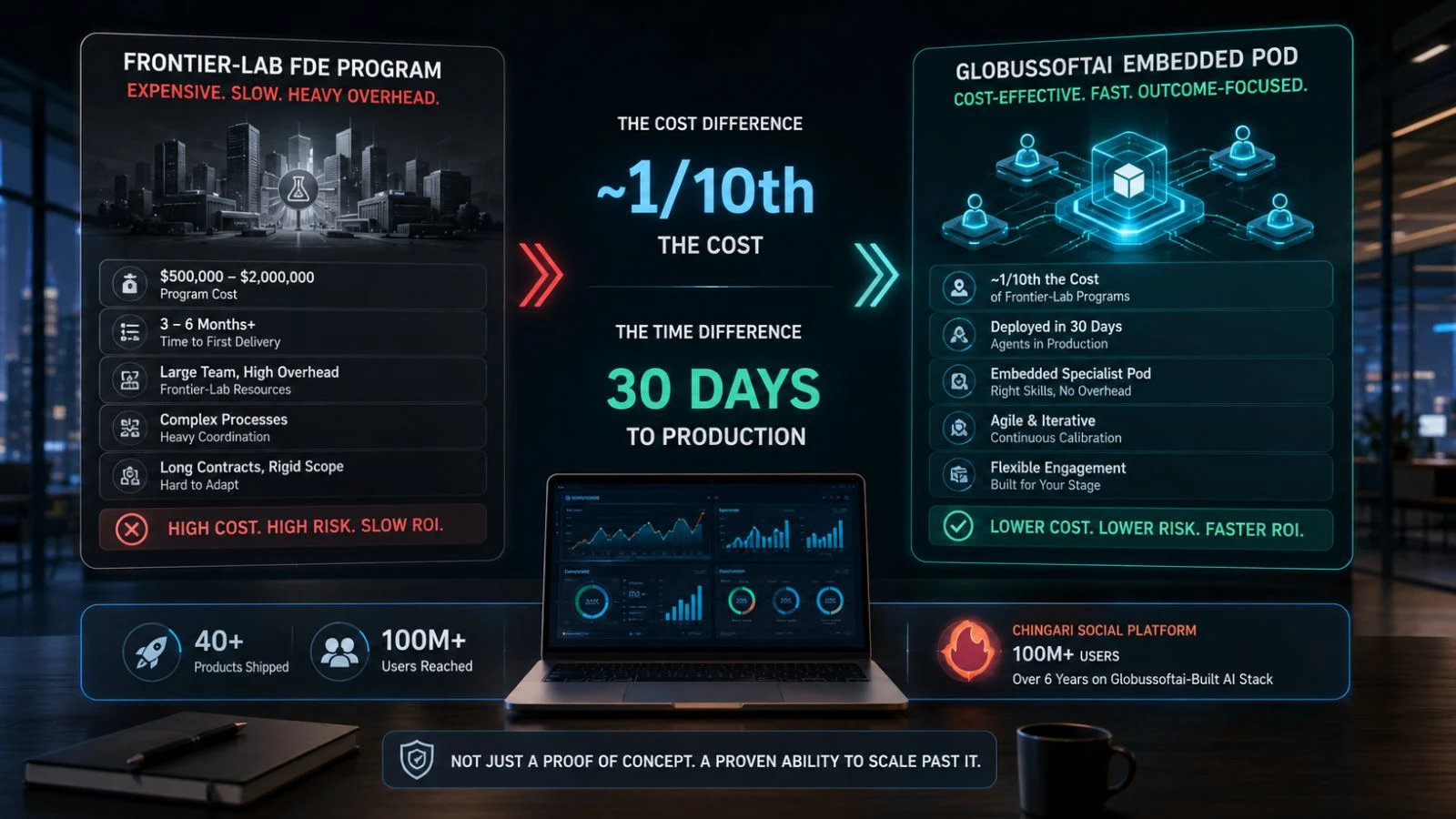
The embedded pod model is priced at approximately one-tenth the cost of a frontier-lab FDE program. Against the $500,000-to-$2-million range of those programs, that’s a structural difference, not a minor discount.
For a mid-market team or a founder who cannot justify a frontier-lab contract minimum, it also means the choice isn’t “expensive AI program or nothing.” It means a deployed agent in production within thirty days, with ongoing calibration built into the engagement, for a budget that fits the actual stage of the business.
Globussoftai has shipped more than 40 products, reached 100 million-plus users, and led 300-plus engineers across engagements. The Chingari social platform reached 100 million-plus users over six years on a Globussoftai-built AI stack. That track record isn’t a guarantee, but it is evidence that the embedded model scales past the proof-of-concept stage.
What to Do Before You Post That Job Req
Before you open a headcount request for an AI engineer, answer three questions honestly.
- Do you have a specific agent use case defined -not “we want to use AI,” but a concrete task with measurable output- or are you hiring someone to figure that out?
- Can your recruiting pipeline realistically close a senior AI engineer in under ninety days, at a comp range you can sustain?
- If the answer to either is no: what would it cost to have something deployed and validated in production before that hire even starts?
The goal isn’t to neve in-house AI capability. It’s to not spend a year in planning mode while your competitors ship. An embedded engagement that gets an agent into production gives you something a job posting cannot: real data on what AI actually does for your specific workflow, before you make a permanent headcount decision around it.
That’s a better foundation for hiring than a job description written by a committee that hasn’t shipped an agent yet.
Ready to move from planning to production? Work with Globussoftai’s embedded engineering team and ship your first agent in 30 days, without the frontier-lab price tag or the six-month hiring cycle.