

Ninety days into an AI agent project, most teams have a beautiful requirements document and zero working code in production. That is not a resourcing problem. It is an architecture-of-work problem, and it kills more AI initiatives than bad models ever will.
I’ve watched this pattern repeat across enough engagements that I now treat it as a law: the longer the planning phase, the worse the deployed agent. Not because planning is evil, but because AI agent behavior cannot be fully specified in advance. Reality corrects your assumptions faster than any workshop.
Listen To The Podcast Now!
Where the Planning Trap Comes From
Traditional software delivery rewarded front-loaded design. You could write a spec for a CRUD app and be reasonably confident it would survive contact with users. AI agents don’t work that way. An agent’s failure modes, wrong confidence thresholds, prompt drift under edge cases, mand odel-switching behavior only surface once real users are pushing real inputs through it.
Yet most teams import the old mental model wholesale. Six weeks in requirement-gathering, four in vendor selection, two in security review, and by month three they’re still arguing about which LLM to use.
Three Failure Modes (and What They Actually Cost)
- Budget burn before first code ships. Long planning cycles consume the runway that should fund iteration. Companies that do ship report average 171% ROI from agentic deployments, but that clock starts on day one of production, not day one of planning. Every week spent in requirements review is a week of compounding returns you don’t get back.
- Silent specification drift. When your AI architect is three meetings removed from the ops team actually using the agent, the spec diverges from reality in silence. The gap surfaces at a demo usually badly, usually after months of confident building. This is the most common and least visible failure mode. The one that makes teams feel productive right up until they aren’t.
- Runaway cost from under-instrumented deployment. A startup deployed a research agent without cost limits. A buggy retry loop ran for 14 hours overnight, making 47,000 API calls and racking up ₹3,47,000 in a single night. Company credit card maxed. Payroll delayed. Two employees lost. The planning document did not prevent that failure. Two weeks of live feedback would have.
The 30-Day Counter-Model:
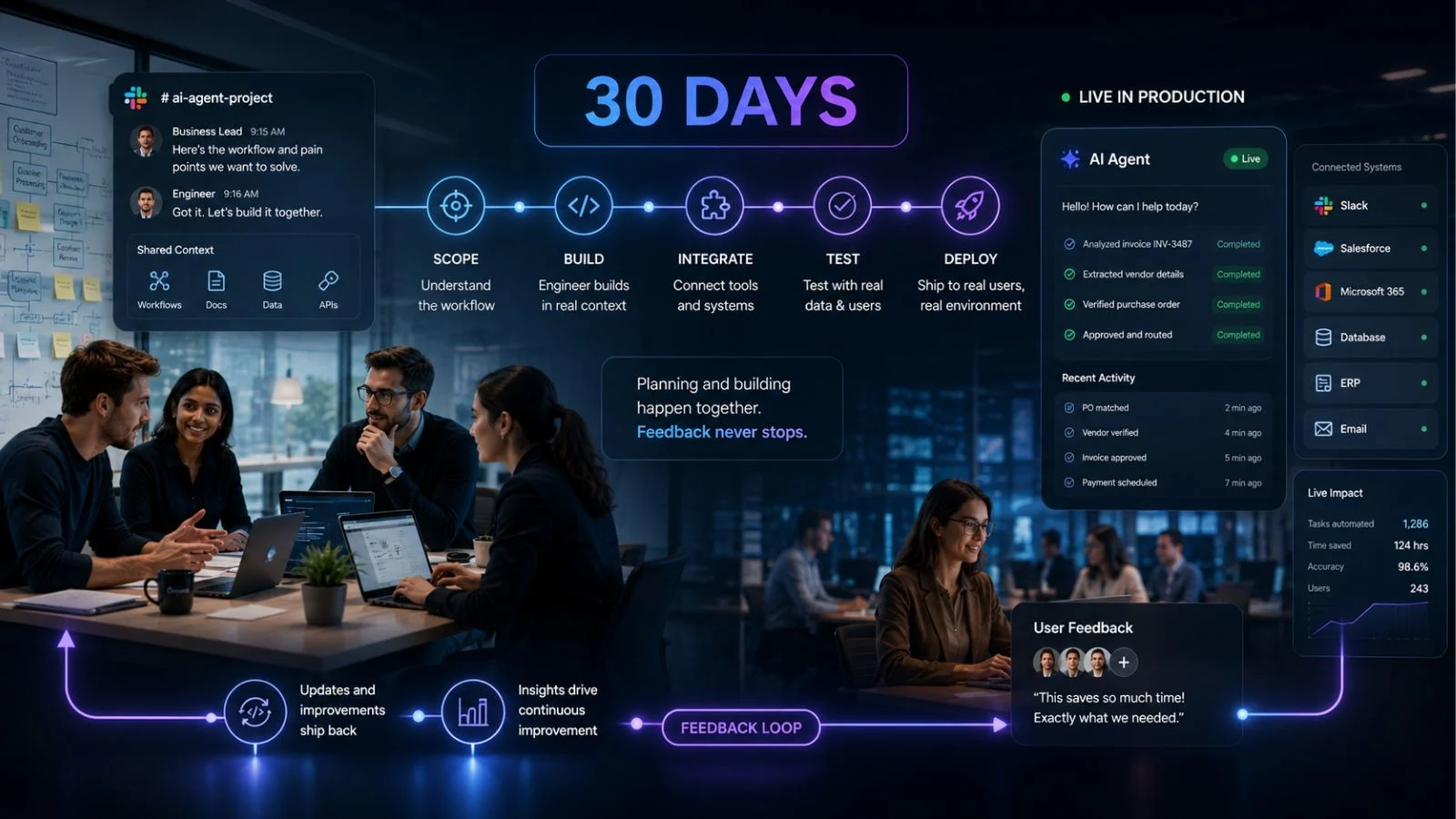
The alternative is not “move fast and break things.” It is compressing the feedback loop until planning and building are the same activity.
Globussoftai operationalizes this as a single commitment: ship the first agent within 30 days, deployed to real users. Not a prototype behind a staging URL. Not a demo environment with curated inputs. Real users, real data, real feedback.
What makes this possible is the embedded structure. An engineer drops into the client’s Slack and codebase at the scoping stage, not after scoping is complete. There are no offshore handoffs, no translation layers between “what the business wants” and “what the engineer builds.” The people who understand the workflow are in the same conversation as the people writing the prompts and wiring the integrations.
This matters because AI tools used only as assistants with restricted access cannot surface where improvements are needed across an enterprise’s complete workflow. You need someone inside the workflow, not observing it from a dashboard. Without that proximity, you are optimizing for the spec, not for outcomes. For a deeper look at how this plays out in practice, the AI agent solutions for business automation guide covers how embedded agents differ from bolted-on automation in real production environments.
What “Deployed in 30 Days” Actually Looks Like:
Take outbound sales automation. The use case sounds simple: find leads, verify emails, write personalized copy, sync to CRM. In practice, it involves four distinct failure surfaces: lead-quality scoring, email deliverability, copy that doesn’t read as machine-generated, and CRM field mapping that survives real sales rep behavior. You cannot fully anticipate any of those failure surfaces from a spec. You find them by running the agent against a real pipeline segment and watching what breaks.
Or consider the inbox intelligence agent, which triages and routes incoming messages. The spam false-positive rescue agent built on this logic rescues 100+ misclassified messages per day. That number didn’t come from a planning document. It came from running the agent, measuring the misclassification rate, and tuning until the number moved.
The feedback loop is the whole point of the 30-day model. The goal is not a finished product in a month; it is a learning artifact. Something deployed to real users that improves week over week instead of sitting in review. Meanwhile, 40% of agentic AI projects are projected to be cancelled by 2027. Same tools as the teams that succeed. Opposite results, because of how they were deployed, not which model they chose.
The Model and Vendor Lock-In Problem Nobody Talks About
Here is a planning-phase mistake with real teeth: choosing one model vendor and architecting around it before you’ve run a single real workload. By month three, you’ve built an abstraction layer so tied to one provider’s API shape that switching is a rewrite.
Multi-model usage, across Claude, GPT, Gemini, and Qwen, is not a nice-to-have. An ML pipeline for AI classification of workforce activity at enterprise scale tolerates longer batch-processing windows but demands near-perfect recall across a high-variance input distribution.
A multi-model ad classification system for a SaaS product needs sub-second latency but can trade some recall for speed. Those are opposite optimization targets. You discover which model actually fits your specific distribution only by running both against real inputs, not by reading benchmark leaderboards in a planning document.
Locking to one vendor before that measurement exists is a planning-phase failure with a very expensive correction. The embedded model gives you a standing process to avoid it. Weekly review of metrics, prompts, and model choices, structured into the retainer cadence, not treated as an afterthought, means the decision is revisited as evidence accumulates.
The prompt that worked in week two may not work in week eight when your input distribution shifts. Without a scheduled review forcing the question, teams default to whatever was decided months earlier. That decision is already wrong.
For teams exploring the self-hosted route, the SMB self-hosted agent setup guide walks through how to structure multi-model deployments without locking into a single provider’s cost structure from day one.
When You Need a Fractional CTO, Not Just Engineers:

AI agent projects fail at the board level too, and in a different way. Founders and mid-market teams face a specific credibility problem: the project is technically complex enough that non-technical stakeholders cannot evaluate it, but expensive enough that they need to. An engineer explaining agent architecture to investors is not the same as a fractional CTO who attends board and investor updates and can translate technical decisions into risk and ROI language.
This is part of why frontier-lab FDE programs, running $500k–$2M per year per FDE, with contract minimums starting at $250k, are inaccessible to most companies that would benefit from them. The embedded pod model, priced at approximately one-tenth of those programs, includes a monthly executive review with founder Sumit Ghosh. That is not a support tier. It is accountability at the strategic level, not just the implementation level.
Proof That the Iteration Model Compounds
The Chingari social platform reached 100M+ users over six years on a Globussoft-built AI stack. The same iteration-first model that scaled that AI infrastructure from early product to platform is what the embedded pod applies from day one on your project. Forty-plus products shipped, 300-plus engineers led, that track record exists because the model forces honest feedback early, not because the planning documents were unusually good.
The One Question That Predicts Success
Before any planning document gets written, ask this: who on the engineering team will be in the same Slack channel as the end users of this agent within the first two weeks?
If the answer is “nobody yet” or “we’ll set that up after launch,” you already know how month three ends.
The 30-day deployment model is not aggressive optimism. It is a forcing function that prevents the most common and most expensive AI project failure: building the right thing for the wrong version of the problem.
Ready to ship your first agent in 30 days?
The embedded pod has done this across 40+ products and 100M+ users. Book a scoping call with the Globussoftai team →
Start your AI agent deployment with Globussoftai, and have something real in users’ hands before the next board meeting.