
A vendor scopes a project, runs a tight proof-of-concept, and hands you a proposal with a number that feels defensible. Stakeholders nod. The contract gets signed. And then, somewhere between pilot and production, the budget quietly doubles. This pattern repeats across hundreds of AI vendor engagements — not as an exception but as the structural norm. Research from Pertama Partners puts a hard number on it: hidden AI costs add 30–70% to project budgets, with 68% of projects exceeding initial estimates by an average of 42%. For mid-size engagements in the SGD $350K–$1.5M range, overruns land between 40–45%. Larger projects — SGD $1.5M to $10M — routinely exceed budgets by 50–60%.
Those aren’t anomalies. They’re the median outcome.
The question worth asking isn’t “why did our project overrun?” It’s “what structural feature of the typical vendor engagement makes overrun almost inevitable?” Once you see that, the fix becomes obvious.
Listen To The Podcast Now!
Where the Money Actually Goes
There’s a reason vendors don’t surface these costs upfront — not always bad faith, sometimes just structure. The proposal covers the build. It rarely covers what the build requires.
RiseUp Labs breaks this into categories: upfront infrastructure and setup runs $15,000–$35,000 per month during the build phase alone. One-time development team costs for a mid-size project range from $270,000 to $340,000+. Ongoing infrastructure at production scale adds another $25,000–$35,000 per month. None of that includes prompt iteration, model swaps, or the rework cycle that follows the first real user cohort.
Enterprise teams are absorbing this at scale. MIT Technology Review data shows average enterprise monthly spending on AI-native applications reached $85,521 in 2025 — a 36% increase over 2024. The share of enterprises planning to invest over $100,000 per month doubled from 20% to 45%. That’s not investment confidence. That’s budget creep normalizing.
The categories that kill projects are rarely the obvious ones. They’re:
- Model selection drift. A model that worked in the pilot costs differently at scale, and often behaves differently too. Switching mid-project — which happens constantly as the model landscape shifts — requires re-evaluation of prompts, outputs, and latency assumptions. This work is invisible in most contracts.
- Integration debt. The pilot ran against a cleaned dataset. Production runs against your actual CRM, your actual Slack history, your actual edge cases. The gap between the two is where weeks disappear.
- Prompt rot. A prompt that performs well in month one degrades as usage patterns shift and the underlying model updates. Nobody budgets for ongoing prompt maintenance because it doesn’t appear on a Gantt chart.
- Handoff friction. Offshore or multi-vendor arrangements require synchronization that burns time and introduces errors. Every offshore handoff is a translation layer — context gets lost, decisions get re-litigated, timelines slip.
The Frontier-Lab FDE Mirage
For well-funded teams, the instinct is to go upstream. Microsoft Frontier, Google Cloud FDEs, Anthropic Solutions — these programs promise embedded expertise at the highest level. Globussoftai has documented what they actually cost: $500K–$2M per year per FDE, with contract minimums starting at $250K. For a founder or a mid-market product team, that’s not a budget line — it’s the whole company’s runway.
The embedded model these programs sell is real. The pricing is just calibrated for a different buyer.
What founders and mid-market teams actually need is the same structural advantage — an engineer who is inside the codebase, inside the decisions, inside the client Slack — without the frontier-lab fee. The embedded pod model at Globussoftai is priced at approximately one-tenth that cost. It operates on the same embedded principle: the engineer drops into the client’s Slack and codebase from scoping to production. No offshore handoffs. No translation layers.
The first agent ships within 30 days to real users. That’s not a marketing claim — it’s the constraint that forces prioritization. A team that has to ship something real in 30 days doesn’t spend six weeks in architecture review.
What “Embedded” Actually Prevents:
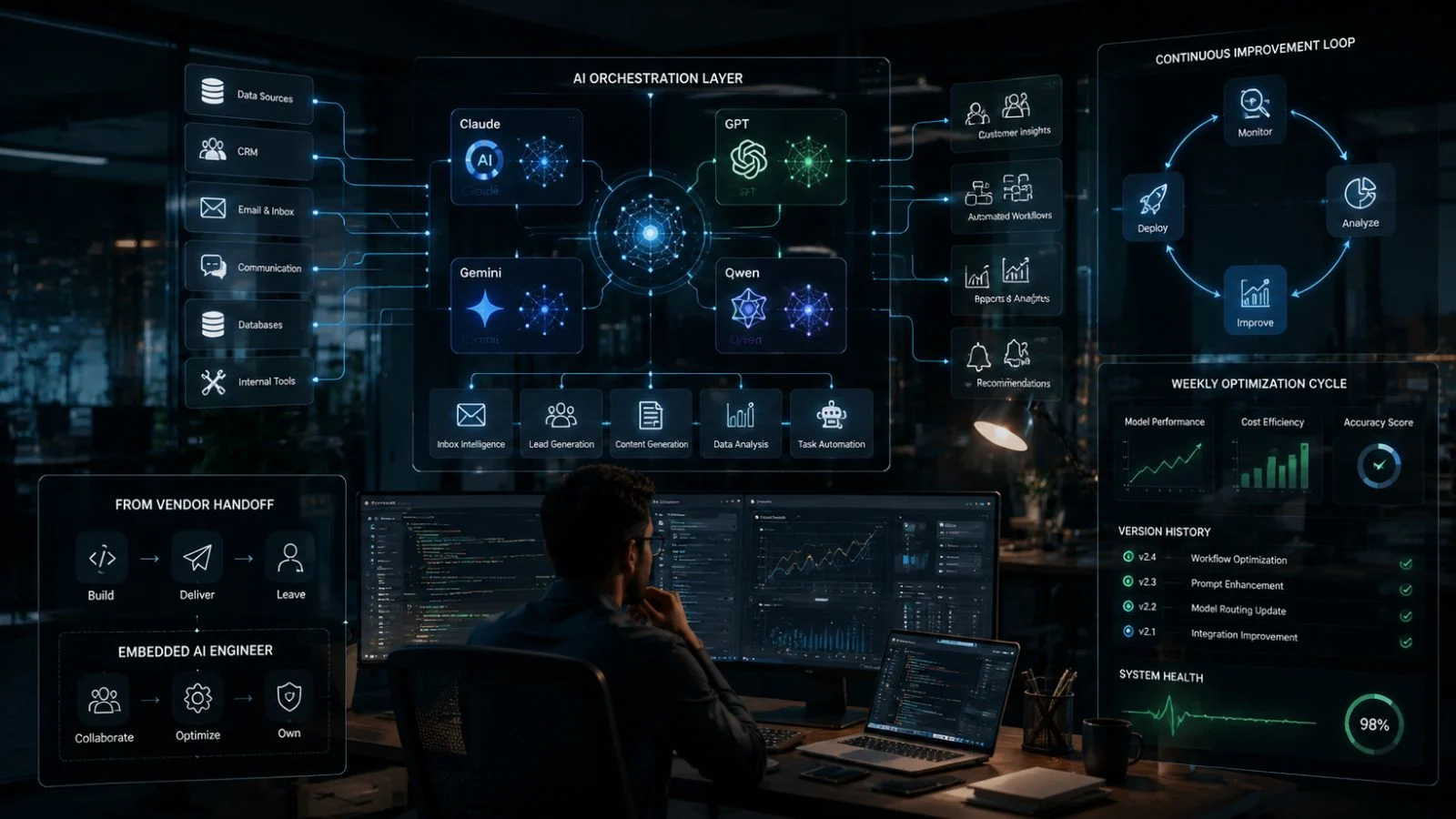
Most of the hidden costs described above share a root cause: the vendor doesn’t live inside your system. They build against a spec, hand it over, and charge for every deviation from that spec. When the model changes, that’s a deviation. When the integration surface is messier than expected, that’s a deviation. When the first users behave differently than the pilot group, that’s a deviation.
An embedded engineer doesn’t have deviations in that sense. They’re inside the problem continuously. When the weekly review of metrics, prompts, and model choices surfaces a regression, they fix it that week — not in the next sprint cycle, not after a change-order negotiation.
This also changes how model selection works in practice. Globussoftai’s embedded pod supports multi-model usage across Claude, GPT, Gemini, and Qwen. That matters because no single model dominates every task type. An outbound lead-gen campaign agent that drafts personalized copy might perform better on one model. The same team’s inbox intelligence agent — the one rescuing 100+ misclassified messages per day from spam false-positives — might run best on another. A vendor who ships and leaves can’t make those calls. An embedded engineer who owns the weekly review can.
The Framework: Three Questions Before You Sign
If you’re evaluating an AI development engagement — your own or a vendor’s — these three questions will surface the hidden cost risk before it lands on your P&L.
- What happens when the model changes? If the answer is “we re-evaluate,” ask who pays for that re-evaluation and how long it takes. If there’s no clear answer, you’re absorbing that cost by default.
- Who owns prompt performance post-launch? A shipped agent is not a finished agent. Prompts degrade. If the engagement ends at deployment, budget for a separate retainer or expect gradual quality erosion.
- What does the handoff look like? If the answer involves more than one timezone or more than one team, add a buffer. Not because offshore teams can’t do excellent work — they can — but because handoff friction compounds across every iteration cycle.
Globussoftai structures its engagements to answer all three cleanly. The embedded pod runs weekly metric and prompt reviews on retainer. Model choices stay live and adjustable. The fractional CTO attends board and investor updates, keeping AI strategy tethered to the business decisions that drive it. The monthly executive review with founder Sumit Ghosh keeps accountability at the principal level, not the project-manager level.
Scale Is the Proof, Not the Promise
It’s worth grounding this in what shipped. Sustainable AI development at scale requires more than a good pilot — it requires a track record that shows what happens when real users arrive. Chingari, the social platform, reached 100M+ users over six years on a Globussoftai-built AI stack. Across the portfolio: 40+ products shipped, 100M+ users reached, 300+ engineers led, 8 open-source flagships.
For a founder who can’t afford a frontier-lab program, that track record matters more than the sales deck. The question isn’t whether the vendor can demo a working pilot. Almost anyone can. The question is whether they’ve ever navigated what happens after — the prompt rot, the model drift, the integration edge cases, the moment the first real user cohort reveals everything the spec got wrong.
Those aren’t surprises. They’re the job. Understanding how AI agents behave in real business automation environments — not controlled pilots — is what separates an engagement that stays on budget from one that quietly doubles.
If you’re past the pilot phase and wondering why the numbers aren’t adding up, the structure of the engagement is usually where to look. See how Globussoftai’s embedded pod model keeps AI projects on time and on budget.