

Six weeks stretches to eighteen months. That is not a metaphor; it is the single most common failure pattern in AI outsourcing, and almost nobody talks about it honestly. The vendor demos look sharp. The contract looks reasonable. Then the first sprint produces a Jupyter notebook nobody can deploy, and the timeline quietly begins to slip.
I have watched this happen enough times to know it is rarely the model’s fault. It is rarely a technology problem at all. It is a scoping problem wearing a technology costume.
Listen To The Podcast Now!
The Real Failure Mode: Scope That Looks Like a Plan
The research is blunt about this. Saigon Technology’s analysis of AI outsourcing puts it plainly: the most common failure isn’t picking the wrong vendor; it’s poor scoping. CTOs who outsource everything end up with a system nobody on their team can maintain. CTOs who outsource too little never get the velocity they were promised. Both groups paid for an outcome they didn’t get.
What makes this particularly frustrating is that the mistake is invisible at contract time. A scope that says “build a lead-scoring model” sounds specific. It isn’t. It doesn’t say what data exists, whether that data is clean, which CRM the model writes back into, who owns the threshold decisions, or what “production” means- a cron job? A real-time API? A human-in-the-loop queue?
Every one of those blanks becomes a negotiation mid-project. And mid-project negotiations kill timelines.
The Budget That Disappears Before Any AI Work Starts
Here is the number that consistently shocks buyers. Data readiness alone can consume 30–40% of the project budget before a single model is trained or a single prompt is written. Duplicate records. Undocumented status codes. PII buried in free-text fields. These are not edge cases; they are the standard state of enterprise data.
When a vendor scopes your project without auditing your data first, they are quoting you a price for the clean version of your data that doesn’t exist yet. The audit arrives in week three. The timeline shifts. The budget conversation starts over.
The fix isn’t complicated. But it requires a vendor willing to ask an uncomfortable question before signing: what does your data actually look like, who owns it, and how long will it take to get into shape? If your prospective partner skips that question, leave.
What “30 Days to First Agent” Actually Requires?
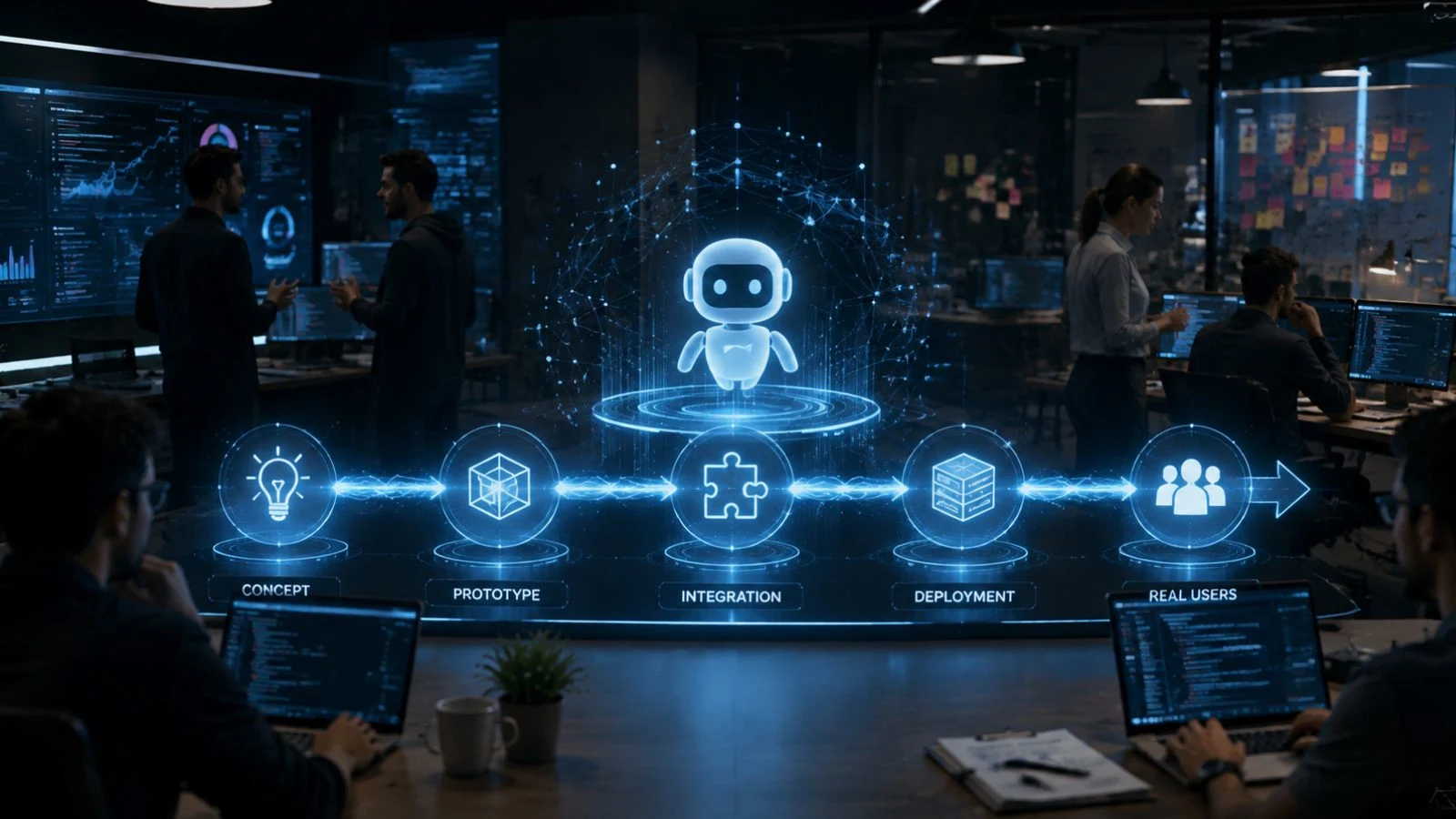
Globussoftai ships a first agent within 30 days, deployed to real users. That is not marketing copy; it is a workflow constraint that forces discipline at the scoping stage. You cannot hit that deadline with a vague brief. You have to pick one narrow use case, confirm one integration, and define what success looks like in a sentence, not a paragraph.
The proof-of-concept engagement structure makes this concrete: 6–10 weeks, low tens of thousands of dollars, one narrow use case, one integration. That is not a stripped-down version of the “real” project; it is a deliberate mechanism for surfacing scope problems before they become schedule problems.
A production MVP engagement, hardened data pipelines, authentication, monitoring, real UI takes 3–4 months. An enterprise platform covering multiple models, role-based access, audit logging, and deep integration into systems of record takes 6–12 months. The progression is real, but only if each phase has a clear exit criterion. Without that, you are not running phases; you are running one continuous negotiation.
The Specific Scoping Questions That Actually Matter:
Before any statement of work gets signed, you need honest answers to these:
- What is the baseline metric? “Faster invoice processing” is not a spec. “Invoice-processing time from 9 minutes to under 90 seconds” is a spec. One of those can be measured on day one of production. The other cannot be measured at all.
- Where does the data live and who can access it? If the answer involves three teams, a legacy ERP, and a legal review, budget for that before you budget for the model.
- What does “deployed” mean? A model in a sandbox is not deployed. Define the environment AWS, Azure, GCP) and the integration point before the project starts, not after.
- Who owns decisions the model cannot make? Every production AI system has edge cases. Scoping should name the human who handles them, not assume the model will eventually handle everything.
- What is the weekly review cadence? Metrics, prompts, and model choices all drift. A project with no review loop is a project that will need a rescue six months in.
That last point matters more than most buyers realize. Custom AI agents require ongoing tuning; prompts age, upstream data changes, mand odel providers update their APIs. The scoping conversation should include who owns that work after go-live, not just who builds the first version.
Agentic AI Raises the Scoping Stakes Further:
Deloitte predicts 25% of enterprises using GenAI will deploy AI agents by the end of 2025, rising to 50% by 2027. Agents are not chatbots. They take actions, writing to CRMs, sending emails, triggering workflows. A scoping mistake on a chatbot produces a bad answer. A scoping mistake on an agent produces a bad action, at scale, repeatedly, until someone notices.
The Globussoftai outbound lead-gen campaign agent is a useful example of what proper agent scoping looks like in practice: lead finding, email verification, personalized copy, and CRM sync are each discrete steps with their own failure modes. Each one needs its own success criterion and its own fallback when it fails. That is four scoping conversations, not one.
The inbox intelligence agent works because the scope was narrow and the mechanism was defined before the build started. It rescues 100+ misclassified messages per day by running a secondary classification layer that scores borderline-rejected emails against the user’s historical engagement patterns before archiving. “Reduce spam false positives” is not in scope. “Score borderline-rejected emails against historical engagement before archiving” is in scope.
Why the Cost of Getting This Wrong Is Higher Than It Looks
The sticker price on a stalled AI project is obvious: you paid for something that didn’t ship. The real cost is subtler. Your team spent six months in weekly calls that produced nothing deployable. Your competitors shipped. And now you have to explain to the board why the AI initiative produced a demo.
This cost asymmetry is why the frontier-lab FDE program price range of $500K–$2M per year per engineer, with contract minimums starting at $250,000, is so dangerous for mid-market buyers. At that price, a stalled project is not just a missed opportunity; it is a material budget event. The embedded pod model, priced at approximately one-tenth the cost of frontier-lab FDE programs, exists precisely because most founders and mid-market teams cannot absorb a multi-hundred-thousand-dollar scoping failure.
The Globussoftai embedded engineering model drops an engineer into a client’s Slack and codebase from scoping to production, with no offshore handoffs. Monthly executive reviews run directly with founder Sumit Ghosh. That cadence catches scope drift weekly, not quarterly, and it is the mechanism that keeps the 30-day ship target real instead of aspirational.
One Heuristic Worth Keeping:
If a vendor cannot describe your first agent’s success criterion in one sentence before the contract is signed, they cannot build it in thirty days. Push until you have that sentence. Not a paragraph about “transforming your workflow”, one sentence with a number in it.
That sentence is the scope. Everything else is negotiation.
For a broader look at where custom AI development fails at the integration layer, a separate and equally common trap that post is worth reading alongside this one.
If your AI outsourcing project is already running behind, or you haven’t started yet and want to avoid the scoping trap entirely, get a scoped engagement from Globussoftai and ship your first agent in 30 days.