
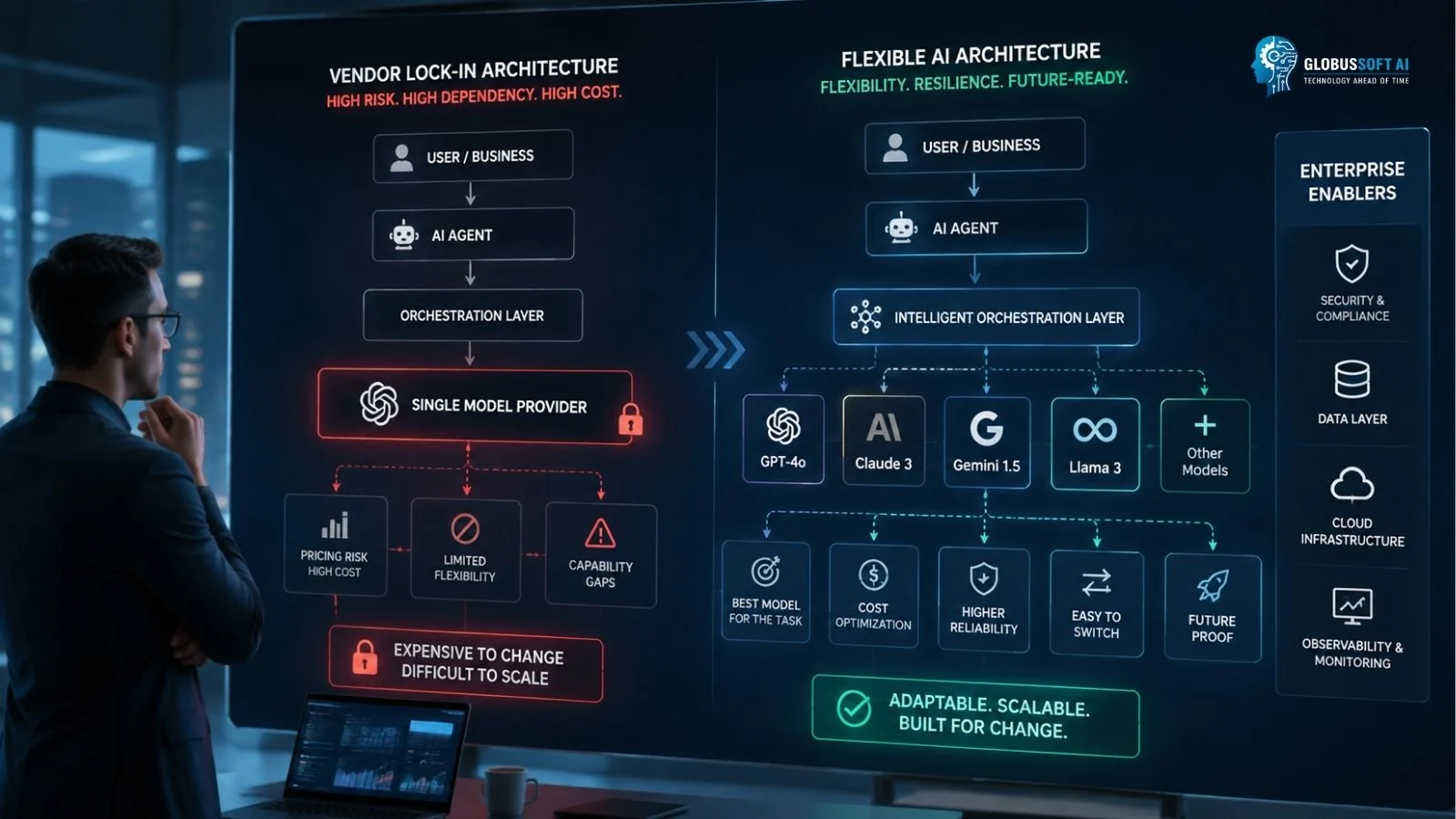
Sixty-seven percent of organizations say they actively want to avoid high dependency on a single AI provider. Most of them are building that dependency anyway — one API key at a time, one hardcoded model name per endpoint, until the day a pricing change or a capability gap makes the whole stack expensive to fix.
This is not a procurement failure. It is an architecture failure. And it happens at a specific, predictable moment: when a team locks their agent to one model before they have run a single real workload through it.
Listen To The Podcast Now!
Why Lock-In Happens Before Anyone Notices
The mechanics are subtle. A developer picks a model — say, a frontier reasoning model — because it performs best in a demo. They build the prompt chain around that model’s exact output format. They rely on its specific tool-calling syntax, its context window, its latency profile. Six weeks later, the abstraction layer is so tightly coupled to that one provider’s API shape that switching requires a full rewrite, not a configuration change. That is not a hypothetical risk — it is the documented failure pattern in the majority of agent projects that stall before production.
And stalling is common. Forty percent of agentic AI projects are projected to be cancelled by 2027. Vendor lock-in is rarely the headline cause — it surfaces as “too expensive to maintain,” “model updated and broke our prompts,” or “we can’t move fast enough.” But underneath each of those is the same structural problem: a stack built for one model’s current behavior, not for a workload’s actual requirements.
AI vendor lock-in is the dependency an organization creates when its workflows, agents, and integrations are built around a single AI model or provider. The danger is not theoretical. Builder.ai’s reported collapse in 2026 showed the real cost: companies that had built their entire development workflow on a single vendor faced the prospect of rebuilding from scratch. The same risk applies at the model layer inside your own stack.
The Two Workloads That Prove the Point:
Here is a concrete example of why model-agnosticism is not an ideology — it is an engineering requirement.
Consider two real workloads. An ML pipeline doing AI classification of workforce activity at enterprise scale needs near-perfect recall. A missed classification is a compliance gap. The batch-processing windows are long — hours, not milliseconds — so latency is not the constraint. Now consider a multi-model ad classification system for a SaaS product: it needs sub-second response times per request, and can trade some recall for speed because a missed ad category costs less than a slow user experience.
These are opposite optimization targets. The model that wins on the first workload will lose on the second. If you have committed your infrastructure to a single provider before understanding which workload you are actually running, you will either overspend on latency you don’t need or underinvest in recall you do. A multi-model architecture — one that can route to Claude, GPT, Gemini, or Qwen depending on task type — gives you the option to match model to workload. A single-vendor stack does not.
According to a 2026 enterprise survey, 45% of enterprises say vendor lock-in has already hindered their ability to adopt better tools. That number will grow as agents become more deeply embedded in operations and the cost of switching rises with each passing quarter.
The Four Points Where Lock-In Bites Hardest
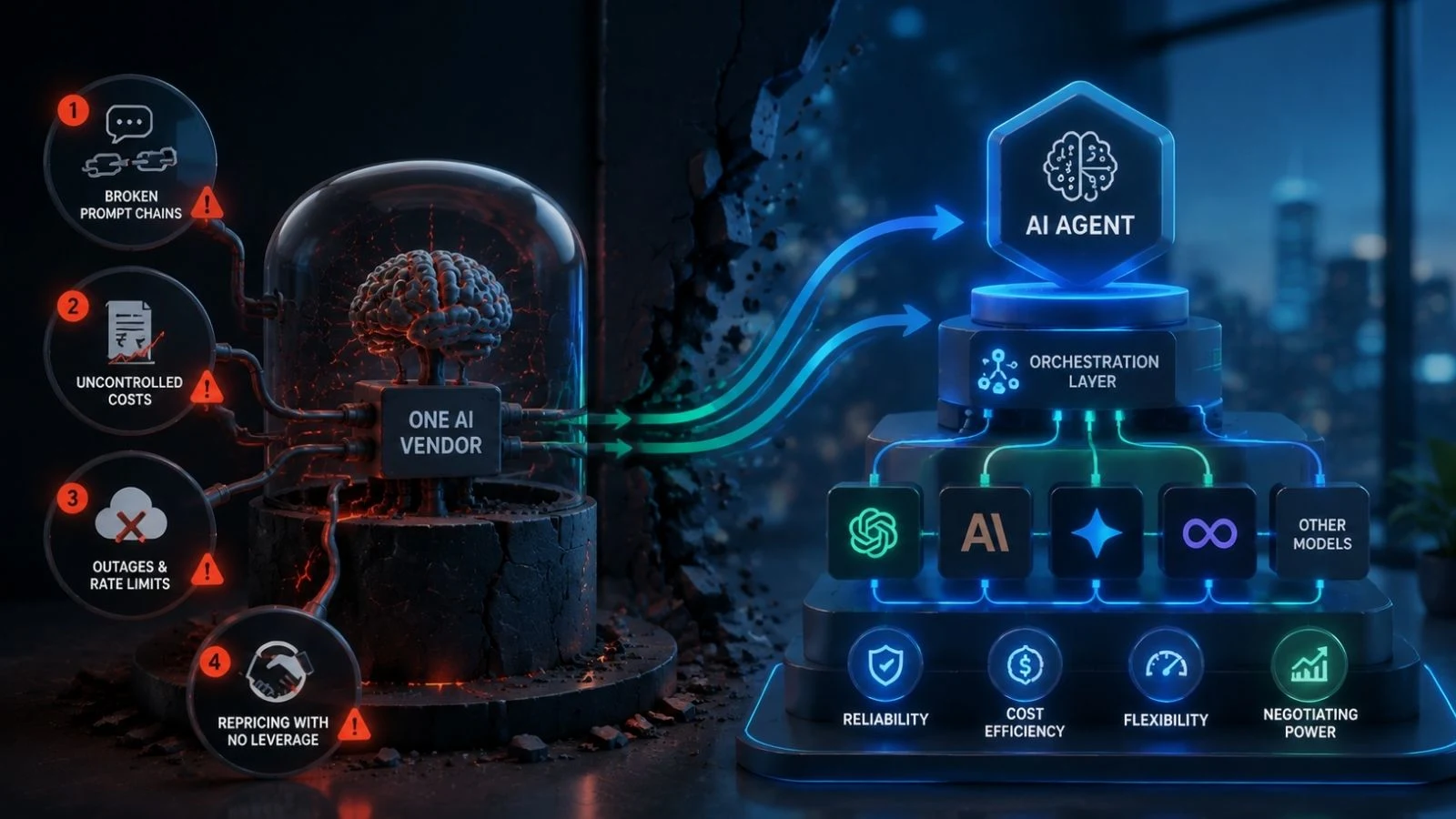
Not all agent components carry equal lock-in risk. These are the four places where single-vendor dependency does the most damage:
- Prompt chains hardcoded to one model’s output format. When the model updates — and it will — prompts that relied on a specific phrasing pattern, tool call structure, or reasoning trace format break silently. A prompt that worked in week two may not work in week eight when the input distribution shifts and there is no scheduled review forcing the question. If your prompts are untestable against a different model, you have no migration path.
- Cost exposure with no routing fallback. A startup deployed a research agent without cost controls. A buggy retry loop ran for 14 hours overnight. It made 47,000 API calls and incurred ₹3,47,000 in a single night — the company’s credit card maxed out, payroll was delayed, and two employees were lost. A multi-model setup with a cheaper fallback model for retry scenarios would have cut that bill by an order of magnitude. A single-vendor setup has nowhere to route.
- Reliability risk when one provider has an outage or rate-limit spike. If your entire agent fleet points at one endpoint, a 20-minute outage is a 20-minute business interruption. Multi-model routing makes that outage survivable.
- Repricing with no negotiating power. Enterprise AI pricing is not stable. When a vendor reprices a tier — or discontinues a model — a single-vendor customer renegotiates from a position of weakness. A customer with a working multi-model abstraction can point to a real alternative and mean it.
What a Lock-In-Resistant Architecture Actually Looks Like
The pattern is not complicated, but it requires discipline from day one.
First: treat the model as a runtime parameter, not a dependency. Every agent call should specify model, temperature, and fallback in a config layer — not in the prompt chain itself. This is the difference between a rewrite and a one-line change when you need to swap providers.
Second: run your actual workload, not a demo, before you commit to a model. Demos favor reasoning-heavy frontier models. Real production traffic usually reveals that most tasks run fine on faster, cheaper models — the frontier model earns its cost only for the subset that genuinely needs deep reasoning. You will not know which tasks fall into which category until you have real data. Commit to a model before that data exists and you are guessing.
Third: build evaluation harnesses that are model-agnostic. Your eval should score outputs against a ground-truth dataset, not against “how the current model tends to respond.” If your eval breaks when you swap models, your eval is measuring model familiarity, not task performance.
Fourth: schedule model reviews. The prompt that worked at launch may drift as input distributions shift, as model updates roll out, or as your product evolves. A weekly review of metrics, prompts, and model choices — baked into your retainer or hand-off schedule — is the operational practice that catches this before it becomes a rewrite.
Why Most Teams Skip This Until It’s Expensive
The honest answer is speed. Single-vendor lock-in is fast. Picking one API, one SDK, one set of docs, and shipping — that is the path of least resistance in week one. The cost lands in week sixteen, when you realize the model that made your demo sing is the wrong choice for your production workload, and unwinding it requires touching every agent in the stack.
The teams that avoid this share one trait: an embedded engineer who has built enough agents to recognize the pattern early. Someone who has seen what happens when a classification pipeline and a chat agent both point at the same frontier model — not because it was the right call, but because it was the default. That operational judgment is not in documentation. It comes from having shipped across domains where the wrong model choice is a production incident, not a benchmark footnote.
That is the architecture behind Globussoftai’s embedded pod model. An engineer drops into your Slack and codebase from scoping to production — no offshore handoffs. The first agent ships within 30 days, deployed to real users. Weekly reviews of metrics, prompts, and model choices are built into the retainer. Lock-in decisions get caught in week one, when fixing them costs an afternoon, not a quarter. The track record behind that model: 40+ products shipped, 100M+ users reached.
Frontier-lab FDE programs — Microsoft Frontier, Google Cloud FDEs, Anthropic Solutions — run $500k–$2M per year per FDE, with contract minimums starting at $250k. The embedded pod runs at approximately one-tenth that cost, with no locked-in model and no locked-in vendor.
Companies that do ship well-architected AI agents report an average 171% ROI from agentic deployments. That number assumes the stack stays maintainable. Vendor lock-in is the tax that erodes it.
If you are at the architecture stage — or already suspect your current setup is more brittle than it looks — understanding how multi-model agent development works in production is a practical starting point before you commit to a provider. For a broader view of what sits alongside lock-in risk, the honest breakdown of AI technology benefits and risks is worth the thirty minutes.
Lock-in is never catastrophic on day one. That is what makes it dangerous. Work with Globussoftai to build an AI agent stack you can actually evolve — before the rewrite becomes the only option.