
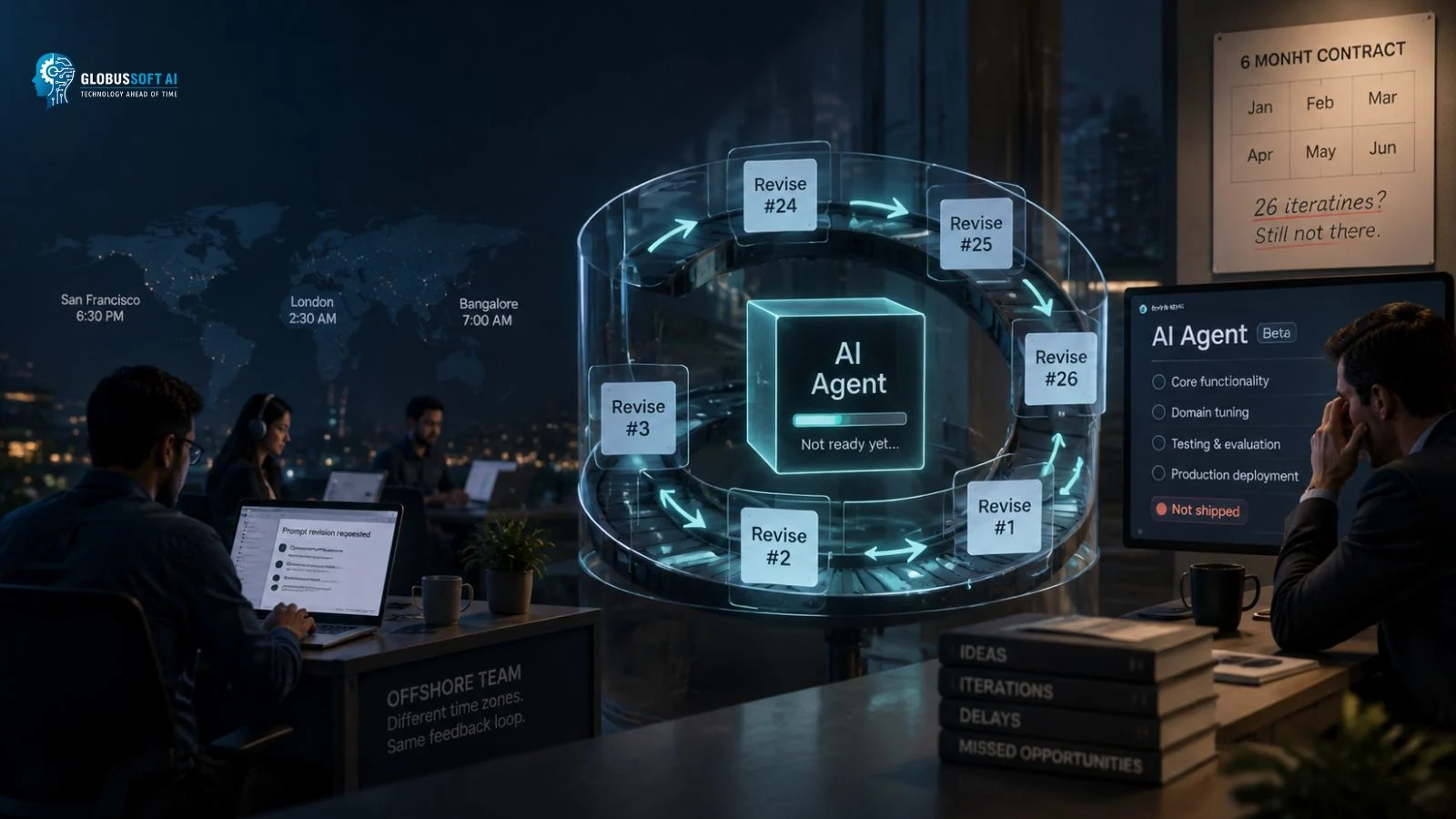
Twenty-six. That’s the maximum number of prompt revision cycles you get inside a six-month offshore AI contract if every single async ticket resolves in exactly one week. In practice, you get fewer. And that number explains more failed AI engagements than any talent shortage or budget overrun ever will.
Most post-mortems blame the wrong thing. Teams point at model quality, or scope creep, or a contractor who “didn’t understand the domain.” The real culprit is structural: async offshore development creates a feedback loop so slow it is physically impossible to iterate a working agent into production inside a typical contract window.
Listen To The Podcast Now!
Why the Math Is Brutal?
Prompt engineering for a real production agent is not a one-shot task. You write a prompt, run it against real data, observe the failure mode, revise, re-test. The cycle repeats dozens of times before behavior stabilizes. Anyone who has shipped an agent to real users knows this: the gap between “it demos well” and “it handles the 11 p.m. edge case without hallucinating” is almost entirely iteration count.
Route that iteration through an async ticket queue and you lose a week per cycle. Globussoftai’s own analysis of offshore AI engagements found exactly this: one week per prompt revision, compounded across a six-month engagement, is the structural explanation for why so many offshore AI contracts end without a deployed agent. Not a staged demo. Not a prototype sitting in a sandbox. A deployed agent, one that real users actually depend on.
Twenty-six iterations is not enough. A non-trivial agent, say, one that classifies inbound messages, decides on an action, and writes a response, might need sixty or eighty prompt-plus-logic cycles before it stops embarrassing you in production. Offshore async development structurally cannot deliver that. The math rules it out before the first kickoff call.
The Hidden Cost Nobody Puts in the Spreadsheet:
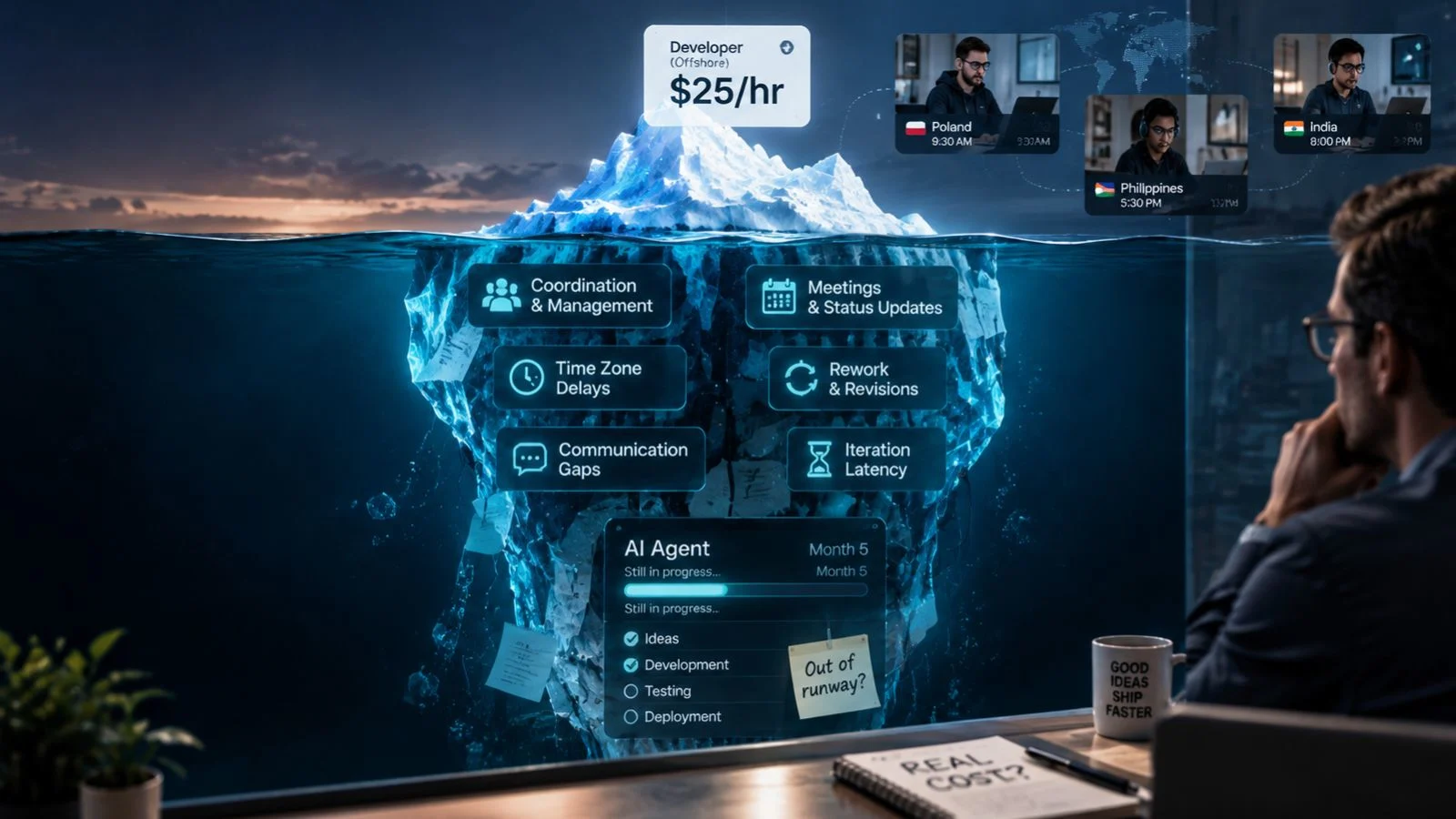
When teams evaluate offshore AI development, they compare hourly rates. A Polish developer bills $40–$100/hour; a Philippine QA engineer runs $18–$35/hour. Those are real numbers, and they are not wrong.
What the spreadsheet misses is coordination tax. A £25/hour developer often lands closer to £60/hour once coordination, management, and rework are factored in. That’s before you account for iteration latency, the weeks lost to ticket queues that don’t show up as a line item anywhere. They show up instead as a project that is still “in progress” at month five and suddenly out of runway at month six.
Offshore is not useless. It is still viable for well-scoped, stable workloads: QA, UI implementation, API integration against a tight spec. The problem is applying that model to AI agent development, which is the opposite of well-scoped and stable. It is inherently exploratory. You cannot write a tight spec for a system whose behavior you are discovering through iteration.
The Other End of the Spectrum Is Also Wrong:
The obvious counter-argument is: hire a frontier-lab embedded engineering team. Microsoft Frontier, Google Cloud FDEs, Anthropic Solutions -these programs exist, and they do solve the iteration-speed problem by putting engineers inside your company. But the price tags are $500k–$2M per year per engineer, with contract minimums starting at $250k. That is not a viable option for a founder building their first revenue-generating agent, or a mid-market team trying to automate outbound sales before a competitor does.
The developer shortage compounds this. Most companies take four to six months from posting a senior AI role to first day, and then another three months for the new hire to ramp. That nine-month window before a new hire is producing is a real operational constraint, not a planning failure. You simply cannot wait that long if the AI opportunity in front of you is time-sensitive.
What Actually Breaks the Iteration Bottleneck?
The fix is not a better offshore vendor. It is not a different ticket-management tool. It is co-location of the iteration loop: an engineer who is inside your Slack, inside your codebase, making decisions in the same timezone, on the same call. Someone who can revise a prompt, run it, observe the failure, and revise again inside an afternoon rather than a week.
This is the model Globussoftai runs. An embedded engineer drops into client Slack and codebase from scoping to production with no offshore handoffs. The engagement carries a hard constraint: first agent deployed to real users within 30 days. Not a demo environment. Not a staging server. Real users, real workload, real feedback. That constraint forces the iteration loop to run fast by design because it has to.
The agents that come out of this model are concrete. An inbox intelligence agent that surfaces what actually needs a human response. A CRM audit and call list agent that rebuilds stale pipeline data automatically. A customer chat monitor agent that catches failure patterns before they become churn. A spam false-positive rescue agent that, by Globussoftai’s own claim, recovers 100+ misclassified messages per day. An outbound lead-gen campaign agent that handles finding, verification, personalized copy, and CRM sync end to end. These are not hypothetical; they are the product of fast iteration cycles, not slow ticket queues.
The Model Choices Compound Too:
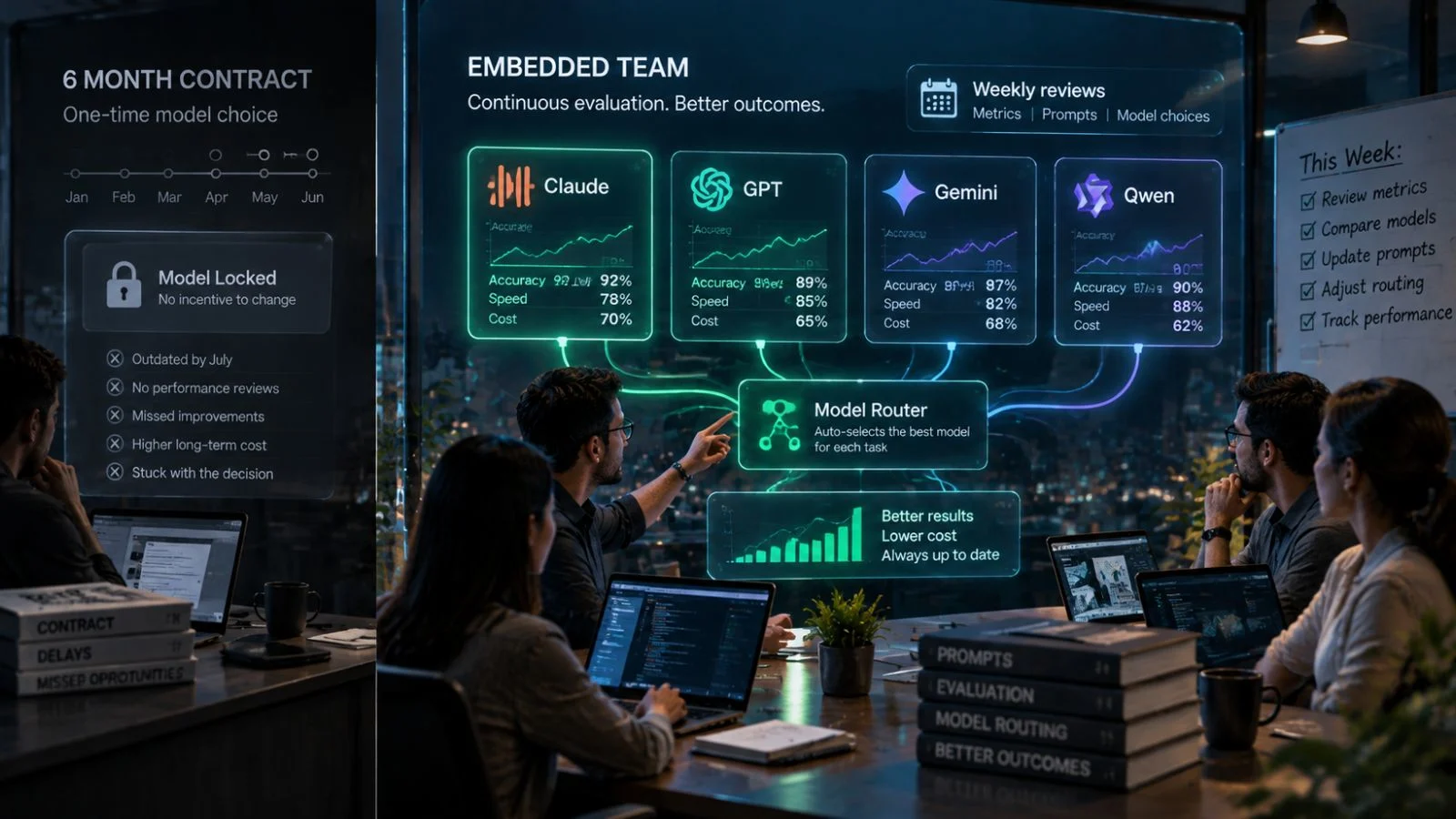
Here is something the async model gets especially wrong: model selection is not a one-time decision. The LLM landscape in 2026 changes fast enough that the right model for your classification task in January may not be the right model in July. A good embedded team runs weekly reviews of metrics, prompts, and model choices, adjusting across Claude, GPT, Gemini, and Qwen as the tradeoffs shift. That weekly cadence is only possible if the engineer is close enough to the work to actually see the drift.
An offshore contractor on a six-month contract has zero incentive to reopen model selection mid-engagement. A frontier-lab FDE charges you for the privilege of doing so. An embedded pod treats it as maintenance, which is what it is.
Who This Model Is Actually For?
The embedded pod is priced at roughly one-tenth the cost of a frontier-lab FDE program, and it is not for every company. It is specifically designed for founders and mid-market teams who cannot afford the frontier-lab programs but also cannot afford to spend six months and a full contract budget getting zero deployed agents. The LLM observability market is growing toward $9.26 billion by 2030 precisely because teams are learning that per-component metrics don’t explain system-level failures at component boundaries, and that lesson is expensive when you are iterating at one cycle per week.
Want to understand how the offshore iteration trap plays out in practice? Start with the comparison between embedded AI teams and offshore dev shops before you sign any contract. Then read the deeper analysis of what actually goes wrong at AI handoff points, because the prompt loop problem is often where handoff failures originate.
The 26-iteration ceiling is not a vendor problem. It is an architecture problem. Fix the architecture first.
Ready to ship your first agent to real users in 30 days? See how Globussoftai’s embedded pod model works and what it costs compared to your current options.