
For fintech teams, self-hosted ai agent deployment comes down to security, orchestration, and cost. In 2026, self-hosted ai agent deployment favors OpenClaw for secure, low-cost rollouts, while AutoGen excels for complex research-style multi-agent flows and Python-native extensibility.
Answer first: If you need security-first defaults, messaging-based ops, and minimal infra, OpenClaw is the practical choice. If you want advanced multi-agent conversation patterns and you’re fine with heavier setup, AutoGen is strong.
GlobussoftAI’s deployment data shows businesses that add AI services report up to a 40% cut in operating costs and a 30% productivity lift (Source: GlobussoftAI). That upside is real, but fintech buyers also face strict rules on data, audit trails, and vendor risk. You need a framework that doesn’t only “work,” but one that stands up to threat models, regulators, and long-term scale.
Therefore, this review scores OpenClaw and AutoGen across six criteria: data sovereignty/compliance, encryption and access controls, multi-agent orchestration, integration with core financial systems, cost at scale, and deployment complexity. You’ll see where each wins, plus a clear decision guide at the end.

What Fintech Teams Actually Need from a Self-Hosted AI Agent Framework
Fintech teams don’t buy demos; they buy risk reduction and results. You need a framework that protects data, scales under load, and plugs into your stack without months of rework. You also need a path to prove value fast, then expand safely.
First, treat data sovereignty and compliance as table stakes. You should keep sensitive data within your own VPC or data center, with clear lines for cross-border transfer and retention. For reference, GDPR and PCI DSS define strict duties on storage, access, and audits. If a tool makes that hard, it’s a non-starter.
Second, demand encryption and fine-grained access. End-to-end encryption and role-based access controls for security protect both data in motion and at rest. In addition, you need audit logs per role and per action, so your risk and compliance teams can trace “who did what, when, and why.
The six criteria that matter
- Data sovereignty and compliance: Host where you choose, document flows, and pass audits without duct tape.
- Encryption and access controls: End-to-end crypto, RBAC, and strong audit trails as defaults, not extras.
- Multi-agent orchestration: Clear patterns for agent roles, tools, and handoffs that avoid loops and drift.
- Integration with financial systems: Native or simple hooks for CRMs, analytics, and core banking rails.
- Cost at scale: Predictable spend for transaction-heavy traffic, not spiky bills.
- Deployment complexity: A setup path measured in days, not quarters, with sane ops after launch.
Moreover, your agents should work where your users already are. Instructions execution through WhatsApp, Telegram, and email helps teams act on alerts and approvals fast. Finally, system integration with CRMs and analytics tools turns conversations into workflows and reports you can trust.
“Security and speed matter in fintech. Tools that respect both get adopted. The rest stall in review.” — Product lead, UK payments firm
OpenClaw Overview: Strengths and Weaknesses for Fintech
OpenClaw is an open-source AI agent framework designed for self-hosted, autonomous workflows. It runs on your server, so your data stays under your control. The core is free, and a typical VPS costs about $5 per month, with total costs usually under $10 per month including model usage (Source: GlobussoftAI). For fintech, that low TCO pairs well with audit needs.
Security is a first-class focus. OpenClaw ships with a security-focused setup including access control and encrypted communication. That means end-to-end encryption and role-based access out of the box, plus the guardrails risk teams expect. In addition, OpenClaw supports instructions execution through WhatsApp, Telegram, and email, which fits real operations like approvals, fraud alerts, or balance checks.
Furthermore, the framework supports Multi-Agent Orchestration and custom agent design. Teams can define roles and tools, then stitch agents into flows that handle escalations or specialist tasks. Backed by AI/ML pipeline development for scalable deployment, OpenClaw also addresses testing: ability to handle high-volume loads, concurrent sessions, and failure injection scenarios, along with run-comparison and an expressive assertion engine for precise checks.
Strengths and trade-offs
OpenClaw’s ecosystem is newer, so you’ll find less community documentation than long-standing Python libraries. However, it has strong momentum, having reached 100,000 GitHub stars in under eight weeks (Source: GlobussoftAI). Over 1,000 hours of testing data were used to explore OpenClaw’s features, which shows a focus on reliability at scale.
On the other hand, if you want exotic research-style agent loops or niche academic patterns, you may do more custom work. Yet for fintech operations, alerts, KYC checks, account updates, the security defaults and messaging hooks tend to matter more than novel agent dialogue tricks.
For a deeper dive on strengths, see the internal guide on OpenClaw GitHub benefits. It explains how teams turn chat-based actions into safe, traceable workflows.
AutoGen Overview: Strengths and Weaknesses for Fintech
AutoGen, backed by Microsoft, offers mature multi-agent conversation patterns and a strong developer community. It’s Python-native, which will feel natural if your team already builds data tools and services with that stack. In research and prototyping, AutoGen helps teams model complex agent roles, debate, and tool-use logic.
Moreover, the project’s samples and papers show clear thought on agent-to-agent dialogue. If you want to explore advanced reasoning or compare different multi-agent strategies, AutoGen gives you a well-known playground. For data science teams that prefer notebooks and code-first design, this can speed up early experiments.
However, production in fintech asks for more than elegant patterns. Heavier infrastructure needs can creep in, given multiple agents, tool chains, and memory stores. In addition, security defaults are less turnkey, so you may spend more time on encryption, RBAC, and audit logging wrappers. Finally, there’s no native managed deployment option, so ops and monitoring land on your plate.
Where AutoGen shines—and where it doesn’t
- Shines: complex, research-style agent workflows; Python integration; large community examples.
- Trade-offs: more setup for security hardened configs; messaging channels not baked in; higher infra overhead for multi-agent runs.
As a result, AutoGen is a great fit for teams that prize flexibility and research depth, and that have the ops maturity to harden and host it safely.
Also Read!
How to Set Up a WhatsApp AI Automation Bot for Your Ecommerce Store
OpenClaw vs Wati for Ecommerce: Which Is Better for WhatsApp AI Automation?
Feature-by-Feature Comparison: OpenClaw vs AutoGen for Financial Services
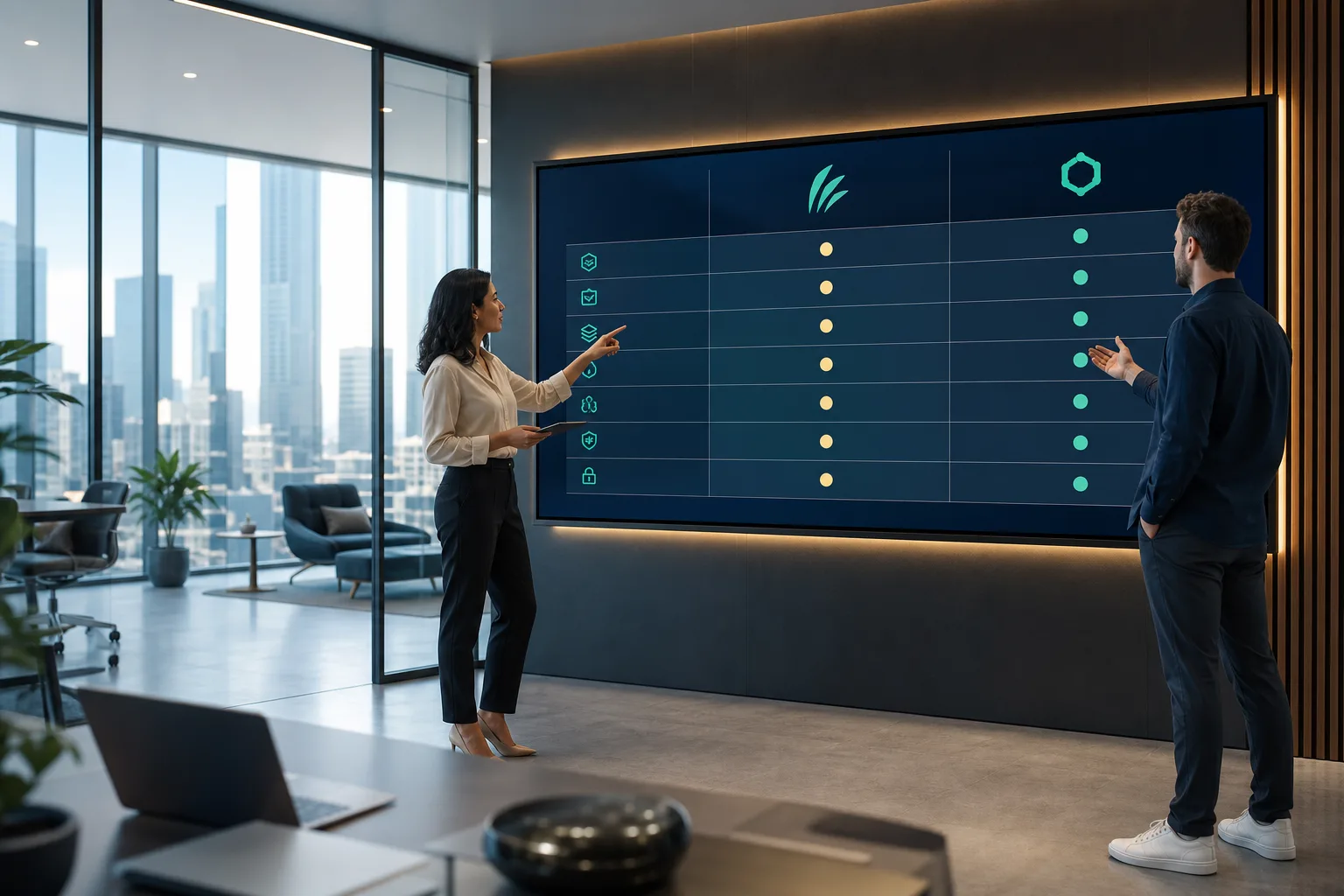
Both tools can run self-hosted, but their defaults, integrations, and ops stories diverge. The table below compares them on the six criteria that matter most to fintech buyers and adds messaging support and integration depth.
| Criterion | OpenClaw | AutoGen | Winner & Why |
|---|---|---|---|
| Data sovereignty | Self-hosted by design; keep data in your VPC or DC. | Self-hosted possible; more DIY around storage patterns. | OpenClaw, clearer self-hosted path for prod ops. |
| Encryption & RBAC | End-to-end encryption and role-based access controls included. | Needs more custom security configuration. | OpenClaw, security-first defaults speed audits. |
| Multi-agent orchestration | OpenClaw custom multi-agent designing and deployment with guardrails. | Mature conversation patterns and research depth. | Tie. OpenClaw for ops-grade flows; AutoGen for research loops. |
| Messaging channel support | Instructions via WhatsApp, Telegram, and email are built-in. | Not a native focus; requires extra services. | OpenClaw, operations live in chat and email. |
| Financial system integration | System integration with CRMs and analytics tools emphasized. | Python-native; integrations are DIY or library-based. | OpenClaw, faster path to business systems. |
| Compliance readiness | Security-focused setup plus audit-friendly testing tools. | Requires additional work to meet audit needs. | OpenClaw, safer baseline for regulated teams. |
In addition, OpenClaw’s AI/ML pipeline development for scalable deployment and ability to handle high-volume loads, concurrent sessions, and failure injection scenarios make it easier to prove resilience under stress. Those tests matter for fraud monitoring, vendor payouts, or batch statement runs.
Real-world fintech patterns
- Alerts and approvals: Chat-first flows through WhatsApp and Telegram help on-call teams act in minutes.
- Fraud detection triage: Multi-agent designs route signals to specialist agents, then to humans with context.
- Reporting: Email summaries and analytics hooks turn agent work into audit-ready records.
For more context on building production agents, the article on AI agent solutions covers common automation wins and how to link them to KPIs.
Pricing Comparison: Total Cost of Ownership for Fintech Deployments
OpenClaw’s free core framework and a typical VPS at about $5 per month keep fixed costs low. Total costs are usually under $10 per month with AI model usage (Source: GlobussoftAI). That matters when you scale to dozens of agents or thousands of daily actions. You spend where it counts, on models and throughput, rather than on control plane overhead.
AutoGen, as a free framework, doesn’t charge license fees either. However, multi-agent runs can be compute-heavy, and you’ll spend more time on hardening, monitoring, and policy wrappers. Those hours add up in regulated teams. In addition, the lack of a managed deployment option means your SRE staff carries more risk and toil.
Moreover, the business upside is real. Businesses implementing AI services report up to a 40% reduction in operational costs and 30% increase in productivity (Source: GlobussoftAI). But to realize that, you must keep infra simple, prove tests fast, and avoid rework during audits. OpenClaw’s security-first setup and messaging integrations reduce that drag.
As you budget for 2026, include compliance review time, pen tests, and model spend. Also plan for growth: burst loads at quarter-end, statement generation, and fraud peak hours.
For teams that need expert guidance, see our page on custom AI agent development. It covers deployment patterns, testing, and integration tips for live systems.
Verdict: Which Self-Hosted AI Agent Framework Should Your Fintech Team Choose?
OpenClaw wins for security-first config, lower TCO, and built-in messaging integrations that match how fintech ops actually work. End-to-end encryption and role-based access controls reduce audit time, and channel support turns alerts into action. In short, it’s built for on-call teams, compliance reviewers, and steady growth.
AutoGen wins for ecosystem maturity and complex, research-style agent dialogue. If your data science team wants to push multi-agent reasoning and you can invest in hardened hosting, it’s an excellent lab-to-codebase option. However, be ready to own security wrappers, chat integrations, and more ops work.
Furthermore, GlobussoftAI supports Managed AI Operations, scalability planning for long-term growth, and custom development for workflow automation and AI-driven reporting. Those services help you pass audits, keep SLAs, and tie agent work to business results. Paired with OpenClaw’s testing focus, high-volume loads, concurrent sessions, and failure injection, you can prove reliability before launch.

Quick Decision Guide
- Choose OpenClaw if you need security-first defaults, chat/email operations, and predictable low costs in production.
- Choose AutoGen if you need advanced research-style agent patterns and have the engineering depth to harden and host it.
- Consider blending both if you want AutoGen for R&D prototypes and OpenClaw for audited, customer-facing flows.
As a final note, hosting in your own region and encrypting data at every hop helps with both GDPR and PCI DSS reviews. That’s why the best framework is the one that ships secure-by-default and still scales.
Start secure deployment today →
For more comparisons in production contexts, you may also find this analysis useful: OpenClaw vs n8n for Ecommerce. While it’s retail-focused, the deployment lessons carry over to payments and lending in 2026.