
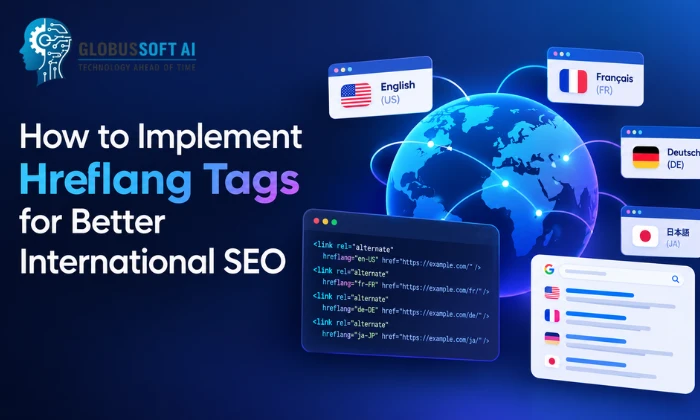
Targeting users across multiple countries or languages is a fast way to grow organic reach. It only works when search engines can serve the right version of your content to the right audience. That’s exactly what Hreflang SEO solves.
Without correct implementation, Google may show your English pages to Arabic-speaking users in Riyadh. It may also show your UAE content to users in London. The result is wasted crawl budget, confused visitors, and weaker ranking signals in every market.
Hreflang SEO is the technical bridge between your content strategy and your international audience. This guide covers how it works and how to implement it correctly. It also explains the common mistakes that quietly break multilingual performance. Finally, it shows how to apply hreflang for Arabic and Middle East markets, where the stakes are high.
Listen to this podcast!
What Is Hreflang SEO, and Why Does It Matter?
Hreflang SEO refers to the correct use of hreflang attributes. These HTML tags tell search engines which page version is meant for which language and region. A properly tagged site serves the French version to users in Paris. Users in Riyadh get the Arabic version, and users in Dubai see the English UAE version.
Without these tags, search engines guess, and they’re often wrong. Common consequences include duplicate content issues, incorrect regional rankings, and split link equity. For any site targeting more than one language or country, correct hreflang tag SEO is foundational, not optional.
How Hreflang Tags Work: The Technical Basics
Each hreflang attribute specifies two things. These are the language of the page content and the country it targets. The format is lang-COUNTRY. For example, en-gb targets English in the UK. Similarly, ar-sa targets Arabic in Saudi Arabia, and en-ae targets English in the UAE.
Every page in a multilingual set must carry hreflang tags pointing to all versions, including itself. This self-reference is the most commonly missed element in international SEO hreflang implementation. Tags can be placed in the HTML head, in HTTP headers, or in an XML sitemap. For most sites, the HTML head method is the most practical and easiest to validate.
Hreflang Tag SEO: Step-by-Step Implementation
Correct hreflang tag SEO follows a consistent process regardless of site scale.
Step 1: Map your language and country variants: List every page version by language and country code. Take a site serving the UAE and Saudi Arabia in two languages. It needs four hreflang values per page: en-ae, ar-ae, en-sa, and ar-sa.
Step 2: Add bidirectional hreflang tags: Every page must reference all other language versions and itself. A missing self-reference is a frequent reason Google ignores hreflang.
Step 3: Include an x-default tag: This value sets the fallback page for users with no targeted version. It is typically a global English page or a language selector.
Step 4: Validate before deploying: Use Google Search Console and dedicated hreflang validators. Confirm that every tag pair is reciprocated before the changes go live.
Step 5: Monitor after deployment: Index coverage errors in Search Console reveal implementation gaps. Some only become visible after Google crawls the updated pages.
International SEO Hreflang: Common Mistakes That Break Performance
Even technically proficient teams make recurring mistakes in international SEO hreflang implementation. Knowing them in advance prevents the most expensive errors.
- Non-canonical pages carrying hreflang tags: Tags on paginated, filtered, or parameter-based URLs create conflicting signals. Only canonical versions should carry hreflang attributes.
- Missing return tags: Suppose Page A references Page B in Arabic, but Page B doesn’t link back. Google then treats the relationship as invalid and ignores both tags.
- Inconsistent URL format: Mixing absolute and relative URLs breaks the connection between versions. Always use full absolute URLs in every hreflang attribute.
- Wrong language codes: Using “ar” when “ar-sa” is needed sends incorrect signals. Omitting country codes when regional targeting is the goal has the same effect. Both produce wrong regional rankings.
- Applying hreflang to non-translated pages: Running hreflang on machine-translated or identical pages creates the duplicate content issues the tags should prevent.
Hreflang Tags for Arabic Websites: Specific Considerations
Arabic creates unique technical challenges that Latin-script sites don’t face. Getting these right separates sites that rank correctly across the GCC from those that send conflicting signals.
- Right-to-left language direction: Arabic pages must declare in the HTML element. Without it, pages can render poorly. That hurts engagement metrics and indirectly harms rankings.
- Dialect and regional variation: Tag Arabic content by country for Saudi Arabia, ar-ae for the UAE, and ar-kw for Kuwait. Avoid the generic ar code. Search engines use country codes to serve the most locally relevant version.
- Script quality affects ranking independently: Hreflang points Google to the correct page. The content quality of that page determines its ranking. Machine-translated Arabic consistently underperforms native-written content, even with perfect hreflang.
- Canonical and hreflang alignment: Each Arabic page needs a self-referencing canonical tag. It must match the hreflang URL exactly. Any mismatch can cause the implementation to be silently ignored.
Local SEO for the Middle East: Beyond Hreflang
Hreflang SEO handles language and regional signalling. Local SEO for Middle East markets needs additional signals that work alongside it.
Country-code domains or subfolders with correct geotargeting set the regional signal at server level. Google Business Profile listings for each GCC market reinforce local intent matching for commercial queries. Local schema markup in Arabic provides machine-readable authority signals, including address, phone number, and opening hours.
Together with correct hreflang, these signals form the complete technical foundation. They help a multilingual site rank for geo-modified queries across Saudi Arabia, the UAE, Kuwait, Qatar, and Bahrain.
How Globussoft AI Builds Intelligent Systems for International SEO Operations
Implementing Hreflang SEO across a large multilingual site creates ongoing workflow challenges. This is especially true for sites serving multiple GCC markets in Arabic and English. Manual processes can’t sustain that at scale. Globussoft AI builds systems that keep international SEO operations running without manual effort at every step.
Here’s what Globussoft AI builds for international SEO and multilingual content operations:
- Web Research Reader Agent – Monitors competitor page structures, hreflang implementations, and SERP changes across target markets. It uses Playwright for JS-heavy pages and delivers live competitive intelligence without manual research.
- Content Pipeline Watcher – Tracks Arabic and English content across your CMS. It flags pages with missing translations, stale content, or hreflang mismatches before they become ranking losses.
- Outbound Lead-Gen Campaign Agent – An on-demand, plugin-based outbound platform. It finds GCC prospects via Apollo, RocketReach, and Prospeo, and verifies emails through NeverBounce. It then drafts personalized Arabic and English outreach, sends via Gmail, and tracks replies. Finally, it syncs activity to your CRM.
- Executive Briefing Agent – Reads all agent outputs daily. It delivers the 3–5 SEO actions that need attention each morning. Examples include coverage gaps, hreflang errors, competitor movements, and new indexation signals.
Conclusion
Correct Hreflang SEO is the technical foundation for competing in international search. In Middle East markets, bilingual Arabic-English content and country-level targeting add complexity. The competitive advantage is just as large for sites that get it right.
Also Read!
Technical SEO Guide: How To Boost Your Website Rankings
How Core Web Vitals Boost SEO and Rankings For Small Businesses in the UAE.
Frequently Asked Questions
Q1. What is Hreflang SEO?
Hreflang SEO is the practice of using hreflang attributes to tell search engines which language and regional version of a page to serve. It prevents incorrect regional rankings and duplicate content issues on multilingual sites.
Q2. Do hreflang tags directly affect rankings?
Hreflang tags don’t directly boost rankings. They ensure the correct page version ranks for the correct audience. Incorrect implementation puts the wrong page in the wrong market, which indirectly harms performance.
Q3. Are hreflang tags required for Arabic websites?
Yes. For sites serving Arabic-speaking audiences in Saudi Arabia, the UAE, Kuwait, and other GCC markets alongside English content, hreflang tags are essential. They ensure correct regional targeting and prevent duplicate content signals.
Q4. Can Globussoft AI help automate international SEO monitoring?
Yes. Globussoft AI builds custom agents, including content pipeline watchers and competitive intelligence monitors. These automate the monitoring workflows that keep Hreflang SEO implementations healthy at scale.