
Arya has spent seven years auditing AI deployments across sales, ops, and enterprise data teams, and previously contributed to applied-ML research on production drift in NLP pipelines.
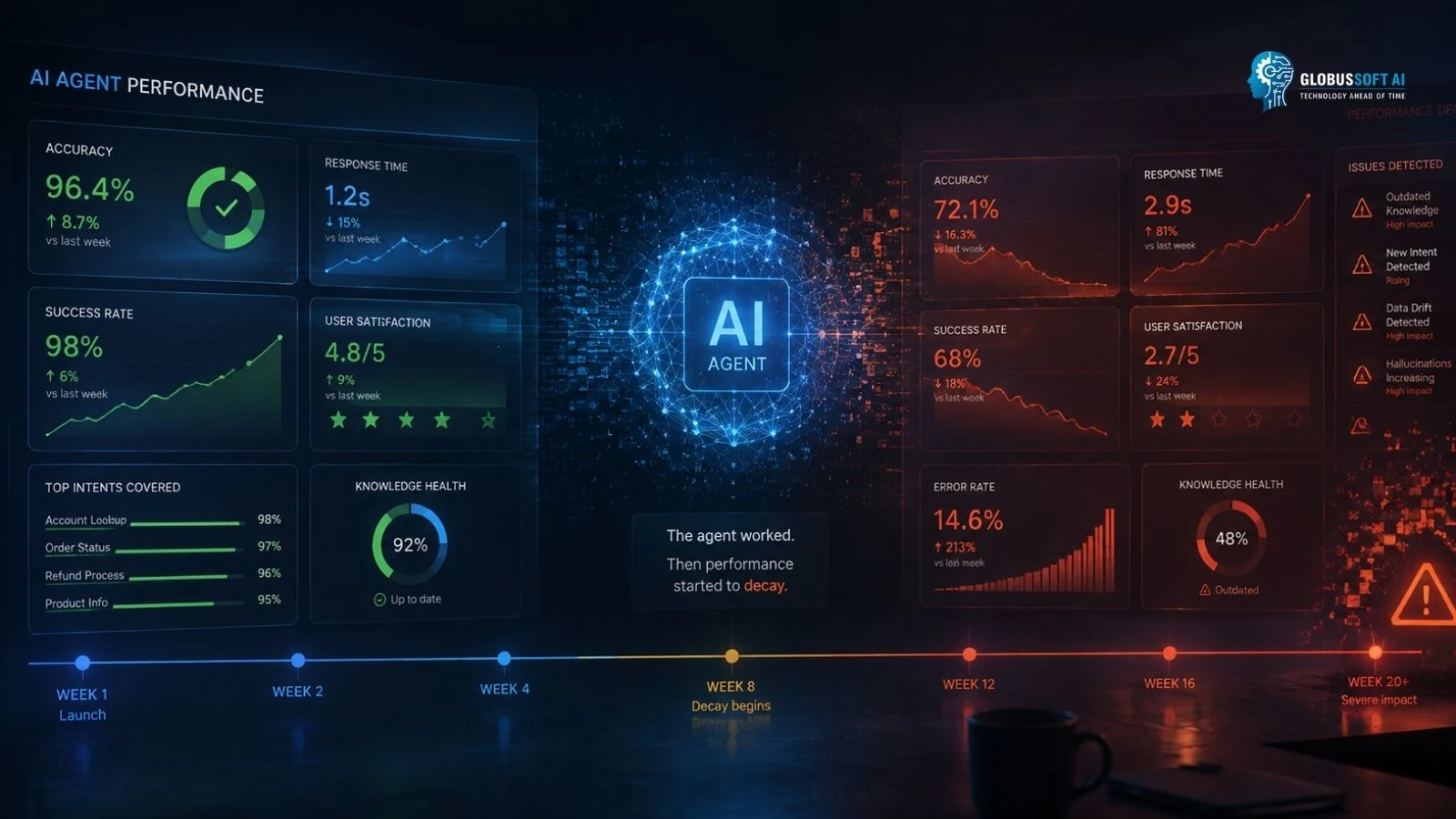
The agent worked. You saw it with your own eyes in week two — responses accurate, latency acceptable, the team visibly relieved. Then, somewhere around week eight, it started quietly failing. Not dramatically. Just a little worse every week, until somebody finally noticed the numbers and asked what happened.
This is the most common post-launch failure pattern in applied AI right now. Not a bad model. Not a bad prompt. A good agent that nobody maintained.
Listen To The Podcast Now!
The Decay Nobody Warned You About
AI agent maintenance is not a post-launch checkbox. It is the actual job. Agents are living systems with a dependency on three things that all shift over time: the prompt, the model, and the input distribution. When any one of those moves — and they always move — agent performance degrades. The degradation is usually gradual enough to be invisible in any single week, and dramatic enough to be embarrassing by month three.
Input distribution shift is the quietest killer. The emails your inbox intelligence agent was classifying in February look different from the ones arriving in August. Seasonal language, new competitors, evolving customer phrasing — none of this is in the original prompt. The model wasn’t trained on it. The evaluation set didn’t include it. In practice, the agent’s precision slips across quarters as vocabulary shifts, routing misclassified messages with confidence rather than flagging uncertainty — because nothing in its prompt told it to flag uncertainty about new patterns.
As we’ve documented in our CRM agent production notes, a scoring prompt that worked in January may classify contacts differently in April due to unversioned edits, with bad updates running undetected for weeks. The term for what follows — prompt drift — describes a failure mode distinct from agents that never reach production at all. It’s the agent that reached production and then silently degraded. Without a scheduled weekly review of metrics, prompts, and model choices, teams default to decisions made months earlier.
That is a slow bleed. Most teams don’t catch it until a customer complains or a metric collapses.
The Failure Nobody Sees Coming — and What It Actually Teaches
The dramatic failure gets more attention than the slow one, which is understandable. A retry loop without cost-limit guardrails can run for hours before anyone wakes up to stop it, accumulating thousands of API calls and a bill nobody approved. That story travels because the consequences are immediate and traceable. The slow failure is arguably worse: it doesn’t announce itself. It just erodes the ROI from an asset the company already paid to build.
Globussoftai‘s deployment retainer includes cost-limit guardrails by default and catches retry-loop failure modes before they hit production. The silent month-three degradation requires something different: a structured review cadence that runs whether or not anyone raises a flag.
Three Things That Actually Shift — and How Fast
Being specific about what decays helps you build a review process that catches problems early.
1. The Prompt
Prompts encode assumptions about the input — about vocabulary, about task shape, about what “good output” looks like. As inputs drift, those assumptions become stale. A prompt written to classify ad copy from one vertical will handle a new vertical poorly. A scoring prompt that worked in January may classify contacts differently in April due to a well-meaning edit that introduced an untested edge case. Nobody rewrites the prompt until performance tanks. By then you’ve got weeks of bad outputs to explain, and reps are already describing the call list as feeling “off” without being able to say why.
Without prompt versioning, degradation is invisible. Prompt versioning is a hard production constraint — on the same level as API key security and rate limits — not an optional practice.
2. The Model
Model providers update, deprecate, and replace models constantly. The cost/quality tradeoff you locked in at launch is almost certainly not the best available tradeoff today. Staying on the same model because it’s familiar costs real money and real quality.
More critically, the right model for your specific workload can only be determined by running multiple models against real inputs — not reading benchmark leaderboards. Production data published in 2026 shows a roughly 37% performance drop between benchmark scores and enterprise deployment for comparable tasks — the gap is real, and it widens when you’re optimizing for the wrong signal. An ML pipeline for AI classification of workforce activity at enterprise scale tolerates longer batch-processing windows but demands near-perfect recall across a high-variance input distribution. A multi-model ad classification system for a SaaS product needs sub-second latency but can trade some recall for speed. These are opposite optimization targets, and no leaderboard resolves them for your data.
3. The Vendor Abstraction
Locking to one vendor before measuring real workload performance is a planning-phase failure that becomes a rewrite problem by month three. Supporting multi-model usage across Claude, GPT, Gemini, and Qwen — selected per subtask (scoring vs. copywriting vs. verification) rather than by provider relationship — isn’t a nice-to-have. It’s the architecture decision that keeps your options open as the model landscape shifts every quarter.
What a Weekly Review Actually Contains?
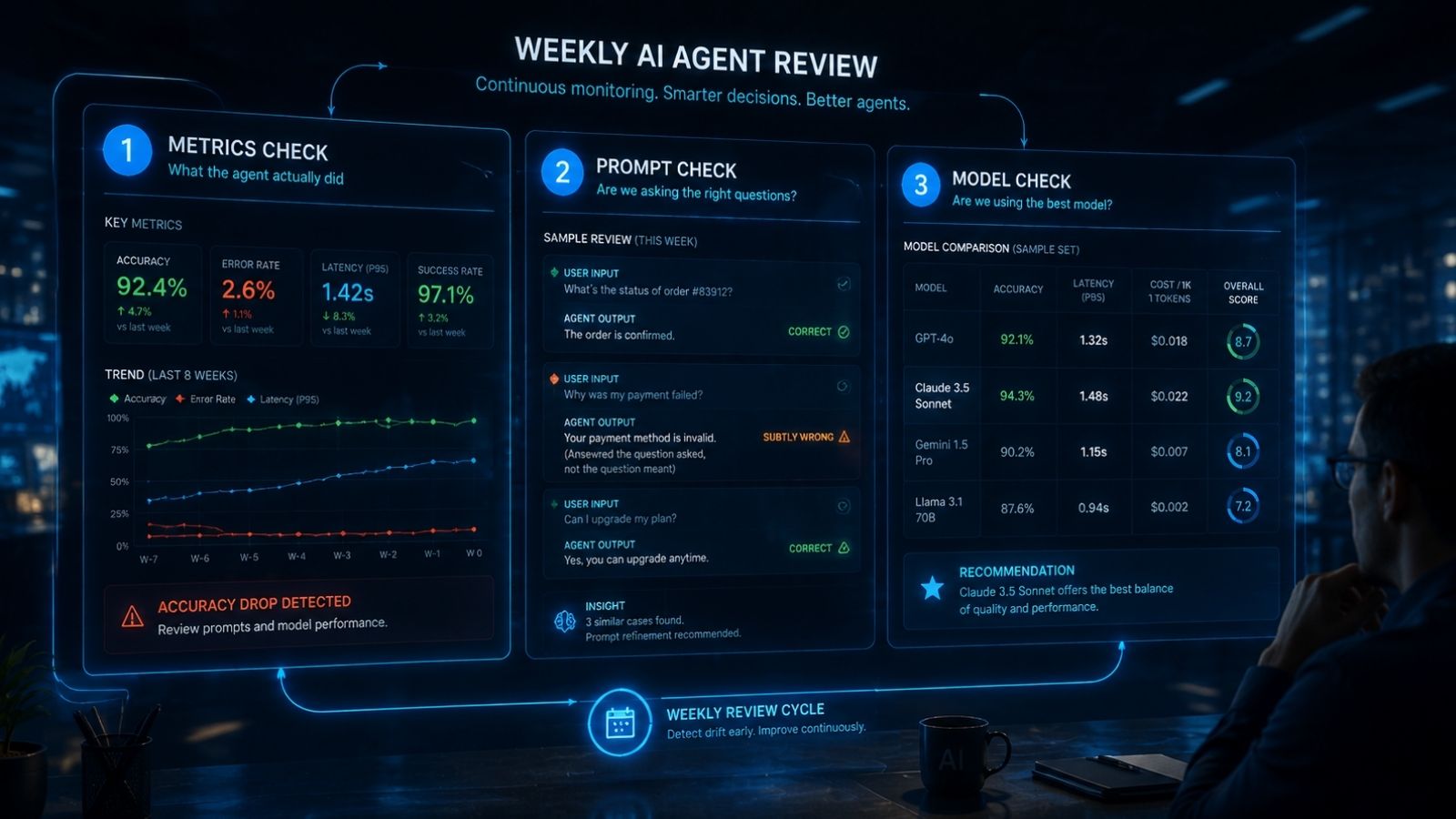
A weekly review isn’t a status meeting. It’s three specific checks run against production data.
Metrics Check:
What did the agent do this week? Not what it was supposed to do — what it actually did. Accuracy against a labeled sample, error rate, latency distribution. If any metric moved more than a defined threshold, that triggers a prompt review. A weekly cadence for metrics, prompt performance, and model selection is the standard that catches drift before it compounds. Monthly is usually too slow.
Prompt Check:
Pull a sample of inputs and outputs from the week. Read them. Look for cases where the output was technically correct but subtly wrong — the model answered the question asked rather than the question meant. Those cases are the early signal of prompt drift.
Model Check:
Is there a newer version of the primary model? Has a competing model dropped in cost at comparable quality? Run a side-by-side on a representative input sample. This takes an hour and can save months of degraded performance. The math on skipping it is brutal: AI agents fail between 70% and 95% of the time in real-world settings, with failures compounding fast in multi-agent chains — a three-agent chain where each agent succeeds only 70% of the time succeeds just 34% of the time end-to-end. Weekly model checks are how you stay ahead of that curve.
The Production Gap Most Teams Don’t Close:
The gap between “deployed” and “working well in production six months later” is almost entirely an AI agent maintenance gap. The review has to be scheduled — not triggered by a complaint — because by the time the complaint arrives, the problem is already weeks old.
The inbox intelligence agent recovers more than 100 misclassified prospect emails per day from spam filters back into the active sales queue. That figure isn’t from a planning document. It comes from running the agent live and reviewing what it actually caught. The weekly review is what produced the number. Without it, there is no number — just a vague sense that it’s “working.”
The CRM data tells the same story from a different angle. 76% of 602 CRM users surveyed in 2025 said less than half of their organization’s CRM records are accurate. In that same survey, 37% reported losing revenue directly as a result of poor data quality. Agents built on top of that data inherit its failures. An agent that isn’t reviewed weekly for prompt drift will amplify bad data quietly, not loudly.
What Good Looks Like?
Globussoftai builds this cadence into every engagement by design. The embedded pod puts engineers in your Slack and codebase from scoping to production, with no offshore handoffs. Weekly review of metrics, prompts, and model choices is a standing deliverable — not an optional add-on. The monthly executive review with founder Sumit Ghosh keeps agent performance visible at the leadership level. That’s the structure that catches week-eight drift before it becomes month-three failure.
The alternative is a retainer or hand-off arrangement where the same cadence transfers to your internal team. Either way, the cadence has to exist. If you want to see how this review structure is built before committing to a full engagement, see how Globussoftai’s embedded pod structures the weekly review.
Teams running the weekly review cadence on their inbox intelligence agent surface the 100+ daily spam rescues as a measurable output — a number that doesn’t exist without the review structure because no one is looking. Teams running prompt checks on their CRM audit and call-list agent catch scoring drift before it poisons the call list that reps actually dial. In both cases, the agent didn’t improve. The visibility did. That’s the difference between month two and month eight.
Shipping an agent in 30 days is achievable. Keeping it performing well in month eight requires a different kind of discipline — one that most teams don’t build until something breaks. Build it before something breaks.
Work with Globussoftai to ship and maintain AI agents that hold their performance over time — from the first deploy through the weekly reviews that keep them sharp.