
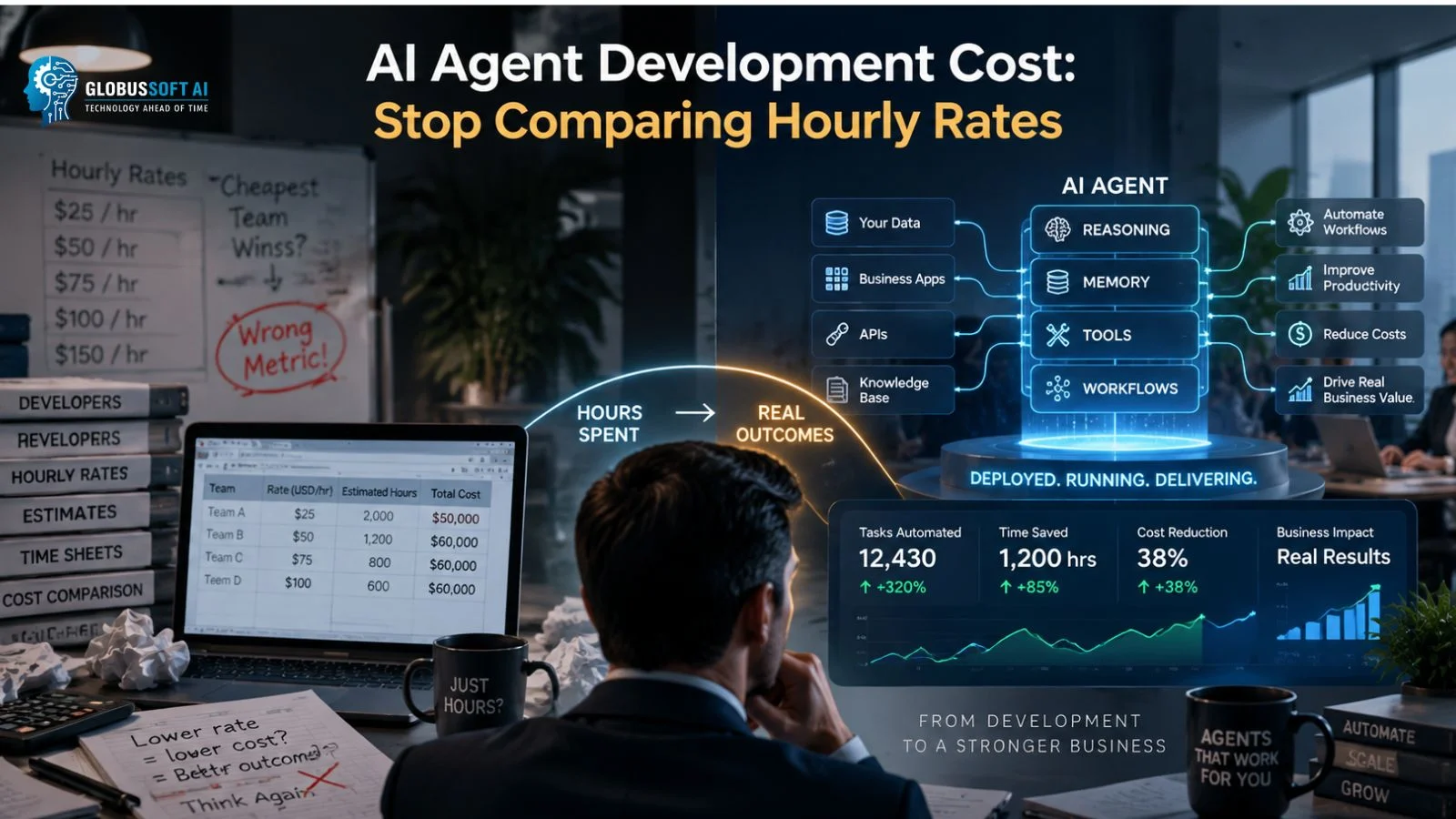
Most mid-market founders optimise for the wrong number. They open a spreadsheet, plug in hourly rates, and declare a winner — the cheapest team wins. Clean math. Wrong question.
The real cost of AI agent development is not what you pay per hour. It’s what you pay per deployed agent — running in production, doing real work, before your runway or your patience runs out.
Listen To The Podcast Now!
What the Rate Cards Don’t Show You
Here’s what the spreadsheet misses. Hiring a senior AI engineer in-house costs $200K–$350K all-in per year in the US. A production-ready agent typically takes one to two engineers four to nine months to build. That’s $300K–$700K before a single maintenance cycle — and that assumes you can find the person. In 2026, the hiring cycle for AI engineers runs four to eight months on top of build time. You could be over a year from idea to deployment before a real user touches your product.
Offshore teams solve the cost problem but not the time problem. US-based senior AI engineers bill at $150–$250/hour; offshore teams in India and Southeast Asia range from $30–$70/hour. For a multi-channel agent with CRM and ticketing integrations, a mid-market company should budget $35K–$100K at offshore rates for the build alone — before integration rework, before model-choice pivots when inference costs spiral, and before the weeks of lag every time a requirement changes mid-sprint.
Rate arbitrage saves you money per hour. It rarely saves you money per outcome.
The Metric That Actually Matters: Days to First Deployed Agent
There’s a specific milestone worth obsessing over: the day a real user interacts with your agent in production. Not a demo. Not staging. Production.
That milestone determines whether you learn fast enough to course-correct. It determines whether your board sees momentum or a burn chart. It determines whether the agent gets adopted or quietly abandoned six weeks after launch.
Globussoftai‘s embedded pod model is built around exactly this constraint. An embedded engineer drops into your Slack and codebase — from scoping through production — with no offshore handoffs. The commitment is shipping a first agent within 30 days, deployed to real users. Not a prototype. A deployed, maintained agent.
Compare that to the 4–9 month offshore build timeline. Month one of an offshore engagement, you’re still negotiating specifications. Month one of the embedded model, you’re reading production metrics.
Where Agent Builds Actually Bleed Money?

The real failure modes in custom AI agent development rarely trace back to the hourly rate. They cluster in three places:
Model-Choice Lock-In:
Teams pick a model early — usually GPT-4 because it’s familiar — and architect around it. Months later, costs are higher than projected, a newer model handles their specific task better, and a rewrite is expensive. Projects that avoid this build for multi-model flexibility from day one. Globussoftai’s embedded pod runs across Claude, GPT, Gemini, and Qwen — not because variety is virtuous, but because weekly review of model choices is how you keep inference costs rational as the landscape shifts every quarter.
Integration Underestimation:
Agents that touch real business systems — CRMs, ticketing, knowledge bases — take longer than agents that don’t. Standard estimates assume clean APIs. Production systems have dirty data, undocumented rate limits, and legacy authentication schemes nobody ever wrote down. The cost of integration rework typically exceeds the cost of the agent logic itself. Custom AI agent development requires expertise across machine learning, system architecture, and integration simultaneously — these disciplines rarely coexist in a single offshore hire, which means each gap becomes a coordination bottleneck.
The Prompt-Maintenance Gap
Most cost estimates end at deployment. They don’t account for ongoing prompt tuning as real-user behaviour diverges from design assumptions. Globussoftai’s retainer model includes weekly review of metrics, prompts, and model choices — because a deployed agent that isn’t maintained degrades on a timeline measured in weeks, not months. “We’ll hand it off after launch” is where AI projects quietly die.
A Framework for Sizing Your AI Agent Budget
Rather than anchoring to a rate card, size the investment against three variables:
- Integration depth. How many external systems does the agent need to read from or write to? Each additional integration adds real engineering time regardless of how clean the API documentation looks — and the integration surface is where most cost overruns originate.
- Acceptable time-to-production. If you need a deployed agent in 30 days, the offshore model is structurally incompatible with that constraint — the coordination overhead alone can exceed the timeline. If you can absorb six months, offshore becomes viable for certain workflow types where requirements are stable and handoffs are infrequent.
- Ongoing iteration cadence. Agents that handle customer interaction or high-stakes data — sales outreach, inbox triage, lead classification — require continuous prompt and model tuning. Businesses that build in that iteration loop report up to a 40% reduction in operational costs and a 30% rise in productivity. Budget for maintenance explicitly, or the agent will drift.
For context on what production-scale agents actually do: Globussoftai’s spam false-positive rescue agent rescues 100+ misclassified messages per day. Their outbound sales automation covers lead finding, email verification, personalised copy, and CRM sync as a single integrated pipeline. These aren’t demos — they’re maintained production systems with defined weekly review cadences.
The Frontier-Lab Comparison Most Founders Miss:

At the top of the market, there’s another option worth understanding — if only to understand what you’re not buying. Frontier-lab FDE programs from Microsoft, Google Cloud, and Anthropic run $500K–$2M per year per FDE, with contract minimums starting at $250K. These programs exist, and they deliver — but they’re priced for enterprises with multi-year AI transformation budgets, not for founders or mid-market teams moving fast.
Globussoftai’s embedded pod is priced at approximately one-tenth that cost. The trade-off is not capability — it’s enterprise account management infrastructure. If you need a dedicated lab architect at every quarterly business review, you need the enterprise contract. If you need a first agent in production this quarter, you need a different model entirely.
What a Realistic First 90 Days Looks Like
The embedded pod workflow runs in a specific sequence. Scoping happens inside your actual Slack and codebase, not inside a discovery document that gets handed to a separate build team. The first agent ships to real users within 30 days. Weeks five through twelve are iteration based on real usage data — prompt tuning, integration edge cases, model-choice adjustments driven by what the production logs show. A monthly executive review with founder Sumit Ghosh keeps strategy aligned with what the live data is telling you.
That structure exists because the hidden cost of offshore AI development is almost always coordination, not code. Handoffs kill momentum. Weekly reviews prevent drift. The 30-day deployment target imposes scope discipline that protects the budget far more reliably than any rate negotiation.
If you’re evaluating AI agent development options right now, the most useful thing you can do is reframe the question. Don’t ask what the hourly rate is. Ask: what does it cost to have a deployed agent in the hands of real users within 30 days? That number — total, not hourly — is the one that will determine whether your AI investment pays off.
Work with Globussoftai’s embedded pod to get your first AI agent into production within 30 days — and find out what the right metric actually costs.