
The model worked. The demo was clean. Then it hit production and crashed inside a week — not because the AI was bad, but because nobody mapped its output schema to the warehouse management system. The project timeline doubled.
That story is more common than most vendors admit. Per MIT Project NANDA’s July 2025 findings, 95% of organizations deploying generative AI fail to reach production or deliver ROI. The number is shocking until you understand the mechanism. It’s rarely a model problem. It’s a handoff problem.
Listen To The Podcast Now!
Where AI Projects Actually Break
Here’s how most AI engagements are structured. An ML team trains or prompts a model, gets it working in isolation, then hands it off to a separate group of “integration engineers” who connect it to real systems. Sounds reasonable. It isn’t.
The seam between those two teams is where projects die. ML specialists know the model’s quirks — its edge cases, its failure modes, the prompts that stabilize it. Integration engineers know the CRM, the auth layer, the legacy Oracle DB sitting underneath everything. Neither group fully knows both. And at exactly the moment you need tight coordination — when model output must hit a real endpoint, authenticate against SAML or OAuth 2.0, and log every action for a SOC 2 Type II audit — you get a game of telephone instead.
Offshore arrangements compound this. Add eight hours of timezone offset and the feedback loop that should take twenty minutes now takes a day. A blocked integration question sits overnight, gets answered with incomplete context, then generates a follow-up that sits overnight again. Teams that underestimate this consistently blow their timelines in week five.
The FDE Program Alternative — and Why Most Teams Can’t Use It
Frontier Labs spotted this problem and built an answer: dedicated field deployment engineering programs. Microsoft Frontier, Google Cloud FDEs, Anthropic Solutions. Elite engineers, embedded deeply, moving fast. They work.
They also cost $500k–$2M per year per FDE, with contract minimums starting at $250k. That’s not a line item most founders or mid-market operators can justify — especially not before they’ve proven the AI use case delivers value in the first place. These programs are built for enterprises that have already committed, not for teams still in discovery.
So the market ends up with a gap. On one side: offshore shops with handoff-heavy processes and timezone drag. On the other: frontier-lab programs priced for F500 budgets. Between them: most of the companies actually trying to ship AI products.
What the Embedded Model Actually Means in Practice
The embedded approach is structurally different — not in the technology it uses, but in how the engineering work is organized.
An embedded engineer drops into your Slack and your codebase. Not a project manager who relays requirements. Not a QA engineer who checks work after the fact. An engineer who reads your existing code, asks clarifying questions in the same channel where your product decisions happen, and owns the full path from scoping to production with no offshore handoffs.
That single structural difference eliminates the seam risk. The person who understood the model’s output format is the same person who maps it to your CRM’s API schema and writes the escalation logic for deals past a defined stage. Authentication, output validation, error handling, logging — all done by someone with full context, not assembled by committee.
Globussoftai‘s embedded pod is priced at approximately one-tenth the cost of a frontier-lab FDE program. That delta matters most not because it’s cheap, but because it makes the model economically viable for the projects that need it most — the ones still proving the case, running the first pilot, shipping the first agent.
The 30-Day Milestone That Changes the Conversation
One of the more counterintuitive results of eliminating handoffs: actual speed. Not “we move fast” marketing speed — a first agent deployed to real users within 30 days.
That timeline is achievable because the embedded model collapses decision latency. Take the chunking question that comes up in every RAG build. Chunking strategy and embedding quality drive more accuracy gains than the choice of foundation model — so when it surfaces, it needs a fast answer. In an embedded setup, it gets resolved in a thread, same day. No project manager relay, no ticket queue, no overnight wait for a standup that starts in a different timezone.
A focused pilot — one workflow, one integration — typically lands in the low tens of thousands and takes six to ten weeks. That’s a number founders can absorb. It also produces a real artifact: an agent running in production, measured against an evaluation set, generating data about what works.
What Gets Built — and How It Gets Measured:
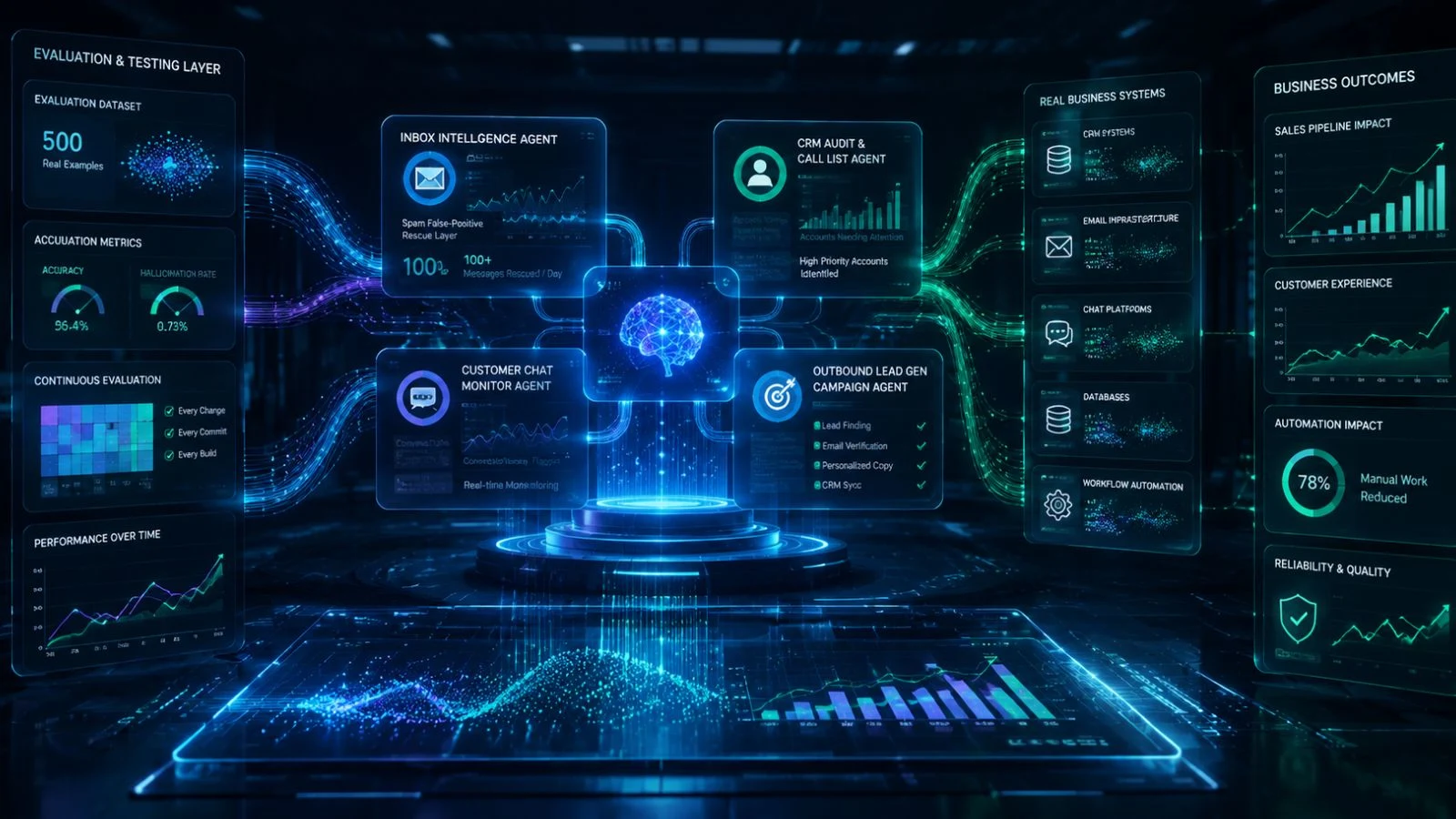
The agents that come out of this process aren’t demos. The inbox intelligence agent includes a spam false-positive rescue layer that catches 100+ misclassified messages per day — a failure mode that only surfaced because an evaluation harness was built to measure it. Without the eval, that problem would have stayed invisible until a user noticed and filed a complaint.
That’s the practical case for production-grade evaluation: not theoretical rigor, but catching real failure modes before they reach users. Evaluation sets of 100–500 real examples, measured for accuracy and hallucination rate on every change, are standard for the same reason your test suite runs on every commit.
Other agents in production span the full sales stack. The CRM audit and call list agent surfaces which accounts need attention. The customer chat monitor agent flags conversations based on configurable rules. The outbound lead-gen campaign agent covers lead finding, email verification, personalized copy, and CRM sync — end to end. Each one touches real systems: CRMs, chat platforms, email infrastructure. Each required exactly the kind of tight integration work that handoff-based development consistently gets wrong.
The Multi-Model Question Nobody Asks Early Enough:
One thing that surprises teams new to embedded AI development: the choice of foundation model is rarely the most important decision. The embedded pod supports multi-model usage across Claude, GPT, Gemini, and Qwen — and the weekly review process includes revisiting model choices explicitly. Not because models don’t matter, but because they’re one variable among many, and the right answer changes as capabilities evolve and costs shift.
What matters more, in order: the quality of your data, the design of your integration layer, your evaluation harness, and your escalation logic. Only 6% of organizations capture meaningful enterprise-wide value from AI, per McKinsey — and the ones who do tend to have gotten those fundamentals right before worrying about which model sits in the middle.
When the Embedded Model Doesn’t Fit
Worth saying plainly: the embedded approach isn’t right for every situation.
If you’re an enterprise with existing FDE relationships and deep internal platform teams already committed to a single frontier provider’s stack, a program integrated into that provider’s roadmap may serve you better. The embedded model is optimized for teams that need to move fast, stay flexible across model choices, and can’t carry a $500k-plus annual commitment before value is proven.
It’s also not a fit if your AI ambitions require months of foundational data work upfront. When data arrives unstructured or unlabeled, expect 30–40% of total project budget to go to data engineering before any model work begins. The embedded model handles that — but it needs to be scoped honestly. A dataset that isn’t ready will blow timelines regardless of how the team is structured.
The Review Cadence That Keeps It Honest
Beyond the initial build, the embedded pod includes a weekly review of metrics, prompts, and model choices on retainer or hand-off — plus a monthly executive review with founder Sumit Ghosh. That cadence exists because AI systems aren’t static. A prompt that worked in January behaves differently in August. A model that was cost-effective at launch may have a better option six months later.
The weekly review surfaces those shifts before they become problems. The monthly executive review gives founders and board members the visibility they need to make resource decisions — including fractional CTO support for board and investor updates where AI capability is increasingly part of the growth narrative.
Forty-plus products shipped, 100M+ users reached — the Chingari social platform alone reached 100M+ users over six years with a Globussoft-built AI stack — and the embedded pod model is the structural reason that’s possible without frontier-lab overhead.
The handoff is where projects die. If you’re evaluating vendors and the offshore-plus-handoff model is the default assumption, it’s worth understanding what production-grade custom AI agents actually require before you sign anything. The right questions to ask in a vendor conversation are different once you see where the seam risk lives.