

Ten blue links ruled search for two decades. Then something shifted. You type a question today and, before you’ve touched the scroll wheel, you’re reading a direct answer sourced, synthesized, and conversational. That’s AI search, and it isn’t a future trend. It’s happening right now, every time someone asks Google a question and gets an AI Overview instead of a results page.
If you’ve used Perplexity AI, tried ChatGPT Search, or noticed Google summarizing medical questions at the top of the screen, you’ve already lived through this transition. This guide explains exactly what AI search is, which engines are leading it, how the technology works beneath the surface, and, critically, what it means for any business that depends on being found online.
Listen To The Podcast Now!
What Is AI Search, Actually?
AI search uses large language models (LLMs) to interpret what you’re really asking. It retrieves relevant information from the web or a knowledge base, then returns a synthesized, readable answer, not a ranked list of pages you have to click through yourself. The experience feels closer to asking a knowledgeable colleague than querying an index.
The core difference from traditional search isn’t speed alone; it’s comprehension. A keyword search treats “best running shoes flat feet overpronation” as a string of tokens to match. An AI search engine understands you have a specific biomechanical need, have probably already ruled out neutral shoes, and want recommendations with reasons attached, not a list of review articles to sift through.
The AI Search Engines You’re Already Using:
Google AI Overviews:
Google’s AI Overviews appear at the top of results for a large share of informational queries. They draw on Google’s Search Generative Experience infrastructure and pull from indexed web content to create paragraph-length summaries with cited source cards. Google has continued refining which query types trigger them; factual and how-to searches see them most consistently, while navigational and transactional queries surface them less often.
ChatGPT Search:
OpenAI integrated real-time web search into ChatGPT and expanded it significantly through 2024 into 2025. It handles multi-step reasoning well. Ask it to compare three SaaS pricing models, and it reads across live sources, returning a structured comparison, not a set of links to vendor pages. Follow-up questions build on the thread without starting over. ChatGPT crossed 900 million weekly users in early 2026, roughly double its count a year earlier, which is the clearest signal yet that this shift is structural, not cyclical.
Perplexity AI
Perplexity is arguably the purest AI-native search experience available right now. Every answer includes numbered inline citations. The Pro Search mode runs multiple sub-searches before composing a response, surfacing source material that a single query pass would miss. That kind of deliberate architecture tells you something about where user behavior is heading.
Microsoft Copilot (Bing)
Microsoft embeds AI answers into Bing through its Copilot integration, powered by GPT-4-class models. Copilot is deeply woven into Microsoft 365 workflows, making it the AI search layer millions of enterprise users encounter first, often without thinking of it as “search” at all.
How AI Search Works Under the Hood?
Understanding Intent, Not Just Keywords
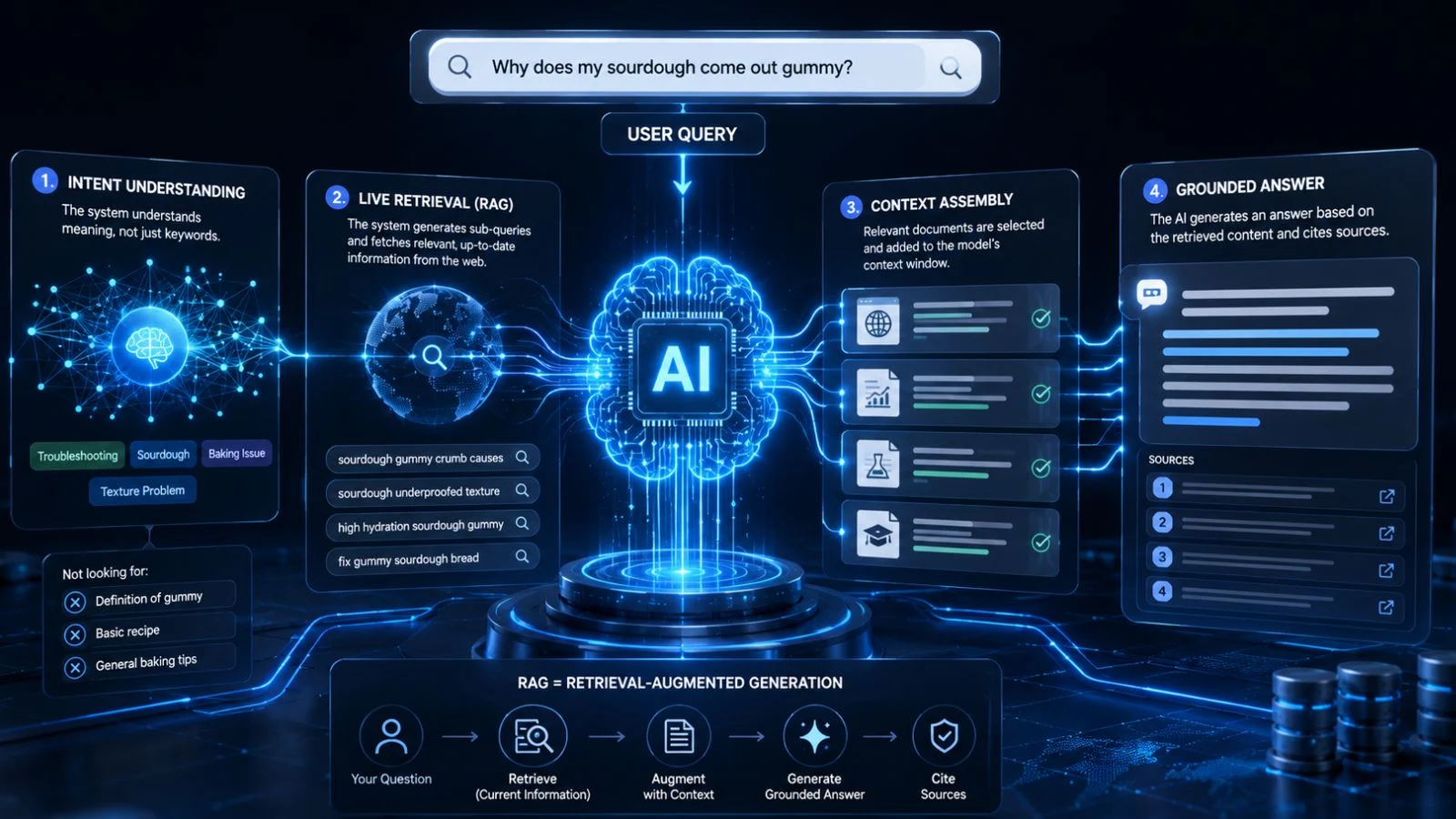
The system doesn’t scan for your words; it models your intent. If you ask “why does my sourdough come out gummy,” the model recognizes you’re troubleshooting a baking problem, not requesting a definition of gumminess or a basic recipe. That disambiguation happens before any retrieval begins. It’s why the answers feel so much more targeted than keyword-matched results.
Retrieval-Augmented Generation (RAG)
RAG is the architecture that powers most modern AI search, and it’s worth understanding properly rather than just dropping the acronym. A standard language model answers from its training data knowledge frozen at a cutoff date. RAG changes that by adding a live retrieval step between your question and the model’s answer.
Here’s how it plays out in practice. You ask a question. The system generates sub-queries and fetches current documents from the web. Those documents get inserted into the model’s context window alongside your question. The model then generates an answer grounded in that freshly retrieved content, not in what it memorized during training.
Concrete example: ask Perplexity what the current federal funds rate is, and it doesn’t guess from training data. It fetches a live Federal Reserve page, reads it in context, and answers from that document. The training data provides language understanding. The retrieval step provides current facts. Strip the retrieval out,t and you’re back to a static model that confidently tells you last year’s numbers.
Generating and Citing the Answer:
The final step is synthesis, turning multiple retrieved fragments into one coherent response. Quality varies across tools here. Perplexity shows numbered citations inline. Google AI Overviews displays source cards you can expand. ChatGPT Search uses clickable footnotes. The citation layer is what separates trustworthy AI search from a confident-sounding black box: without it, you have no way to verify a claim or trace it to its origin.
Traditional Search vs. AI Search: Side by Side:
The two approaches diverge at almost every layer of how they process and return information.
| Feature | Traditional Search | AI-Powered Search |
|---|---|---|
| Output | Ranked list of links | Synthesized, conversational answer |
| Intent handling | Keyword matching | Context and nuance understanding |
| Follow-up questions | New search required | Remembered within session context |
| Citations | Implied by rank position | Explicitly linked inline |
| Research speed | Multiple tabs, manual synthesis | Single thread, structured summary |
Where AI Search Changes the Experience in Practice?
The shift looks different depending on context. Here are specific use cases that show how far it’s moved from the old model:
- Healthcare triage: A search for “sharp chest pain left side when breathing” now surfaces a structured differential faster than navigating NHS or WebMD pages, with appropriate guidance to see a doctor.
- E-commerce research: “Noise-canceling headphones under $200 for calls” returns an AI-generated shortlist with comparative reasoning, one answer instead of ten affiliate roundups each contradicting the last.
- Developer workflows: A query like “Python asyncio timeout pattern with error handling” returns working, annotated code in seconds. Three Stack Overflow tabs used to be the minimum viable approach.
- Business intelligence: A competitive research task that once meant twenty open browser tabs, pricing pages, trade press, and LinkedIn signals can now be threaded into a single Perplexity Pro session. You get traceable citations and a structured summary.
The Limitations That Don’t Get Enough Attention:
AI search has real failure modes, and knowing them matters.
- Hallucinations remain a genuine risk. Models can produce confident, fluent answers that are factually wrong. This happens less with strong RAG pipelines but still occurs, particularly for niche topics where source material is sparse or contradictory. If the answer carries consequences (medical, legal, financial), verify it against the cited source.
- Recency gaps exist even with retrieval. Not all tools fetch live data for every query type. Some rely on recently indexed snapshots rather than real-time feeds. For breaking news or fast-moving data, interest rates, regulatory changes, live stock prices, treat AI answers as a starting point, not the final word.
- Citation quality is uneven. A cited source is only as good as the original document. AI search can reference a thin blog post as confidently as a peer-reviewed study. Source credibility still requires human judgment.
- Privacy carries real considerations. Queries on some platforms inform product personalization and, in certain cases, model training. For sensitive research, legal matters, personnel decisions, and competitive intelligence, read the data handling policies of whatever tool you’re using before you type.
What AI Search Means for Business Visibility?
This is where the stakes become serious for anyone running a business online. In traditional search, ranking in the top three positions drove most of the traffic. In AI search, rank position is almost secondary. The question isn’t where you appear on the page; it’s whether you get cited in the answer at all.
Google AI Overviews, Perplexity, and ChatGPT Search don’t show ten results. They show one answer, typically citing a small handful of sources. The businesses that appear in those citations get seen. Everyone else gets skipped, even if they rank on page one below the AI summary. McKinsey’s analysis of AI search frames this plainly: AI is becoming the new front door to the internet, and what walks through that door is a cited source, not a ranked page.
Being cited in AI-generated answers depends on factors that partly overlap with traditional SEO but diverge in important ways:
- Content structure: AI models parse well-organized content more reliably. Clear headings, explicit answers to specific questions, and defined terminology increase the probability your content gets retrieved and cited.
- Topical authority: Models favor sources that cover a subject consistently and in depth. A site with ten substantive articles on AI-powered search is more likely to be cited than a site that mentioned it in passing.
- Factual grounding: Content that itself cites credible sources tends to perform better in retrieval; the signal cascades.
- Schema and structured data: Structured markup helps models interpret what a page is actually about, especially for product, FAQ, and how-to content.
Businesses already adapting for AI retrieval are pulling visibility away from competitors still optimizing purely for keyword density. The gap widens faster than most realize. For a deeper look at how AI capabilities map to specific business functions, this breakdown of AI applications by capability is worth reading alongside this piece.
How Globussoftai Helps Businesses Get Found in AI-Generated Answers?
Globussoftai builds the kind of tooling that makes this concrete rather than theoretical. One capability directly relevant here: the web research reader, a keyless reader spanning Twitter, Reddit, YouTube, GitHub, and the open web, with a Playwright fallback for JavaScript-heavy pages. It surfaces exactly what AI search engines are pulling from across the web, mapped against what a client has actually published.
That mapping is the deliverable most businesses are missing. In a Week 1–2 co-design engagement, the reader produces a structured report showing which pages are being retrieved and cited by AI engines, and which aren’t. A common finding: an AI engine is citing an outdated product page, a competitor press release, or a third-party summary rather than the client’s own authoritative content. That’s a fixable problem, but only once you can see it. Most businesses can’t, because they’re still measuring keyword rankings rather than citation presence, two entirely different signals.
The first working agent ships into the client’s stack within 30 days. From there, the Improve phase runs weekly reviews of metrics, prompts, and model choices so the tooling adapts as AI search behavior evolves, not just at setup. Globussoftai has shipped 40+ products reaching over 100 million users, which means the retrieval and monitoring patterns used here have been stress-tested at real scale, not just prototyped in a sandbox.
For teams wondering how AI agent solutions can automate the operational work that frees bandwidth for content and visibility, that’s the conversation worth having now, before the citation gap widens further.
Frequently Asked Questions:
Q1: Is AI search replacing traditional search engines?
Ans: Not replacing, reshaping. Google, Bing, and others are integrating AI into their existing infrastructure rather than being displaced by it. Standalone tools like Perplexity are growing fast, but traditional search still handles the majority of queries globally. The two are converging more than competing.
Q2: How accurate are AI search answers?
Ans: Accuracy depends heavily on the tool and query type. Tools with strong RAG pipelines and clear citation practices- Perplexity and Google AI Overviews among them -perform well on factual, well-documented topics. Accuracy drops for niche subjects, very recent events, and anything where source quality on the web is thin. Treat every answer as a starting point until you’ve checked the cited source.
Q3: What is RAG and why does it matter?
Ans: Retrieval-Augmented Generation (RAG) is the architecture that lets AI search tools answer with current information rather than relying solely on frozen training data. It matters because it’s what makes AI search practically useful for time-sensitive questions, a nd it’s the reason citations can point to real, live documents rather than a model’s internal approximation.
Does AI search affect SEO?
Significantly. Content that earns citations in AI-generated answers gains visibility whether or not it ranks highly in the traditional results below. That changes what “good SEO” means: topical depth, content structure, factual accuracy, and schema markup matter more than ever; raw keyword density matters less. Our AI search guide covers the content-side tactics in more depth.
Your business is either being cited in AI-generated answers or iisn’tt nd right now, most teams don’t know which. Book a free AI visibility audit with Globussoftai and find out exactly where you stand before a competitor does.