

A Bilingual marketing strategy is becoming a major discussion point among brands targeting diverse audiences across the Middle East. With customers interacting in both Arabic and English, Businesses are questioning whether bilingual communication is only a marketing trend or a genuine growth opportunity. In markets like the UAE, Saudi Arabia, and Qatar, language plays a strong role in trust, engagement, and purchasing decisions.
A well-planned approach helps brands connect emotionally while maintaining global consistency. Instead of simply translating content, companies need to understand cultural preferences, customer behavior, and local expectations. This makes language-focused marketing more than a creative choice; it becomes a strategic business advantage.
Listen To The Podcast Now!
Why Language Matters in Middle East Marketing?
The Middle East is a region with diverse cultures, traditions, and consumer behaviours. Businesses cannot rely on one communication style when targeting both residents and international audiences. A Bilingual marketing strategy helps brands create messages that feel relevant to different customer groups without losing their core identity.
Arabic audiences often value cultural connection, while English remains widely used in business, technology, tourism, and professional communication. Brands that understand this balance can improve customer relationships and create stronger brand recognition.
This approach is especially important for industries such as real estate, hospitality, healthcare, education, finance, and e-commerce, where trust directly influences buying decisions.
Bilingual Marketing: More Than Simple Translation:
Many businesses assume bilingual campaigns mean converting English content into Arabic. However, effective communication requires much more than direct translation.
A successful Bilingual marketing strategy focuses on adapting messages according to cultural context. Words, visuals, emotions, and examples need to match audience expectations.
For example, a promotional message created for European customers may not create the same impact in Gulf countries. Local references, cultural sensitivity, and customer preferences need to be considered during campaign planning.
This is where Arabic and English marketing becomes valuable. It allows businesses to maintain a consistent brand voice while making customers feel understood in their preferred language.
How Bilingual Marketing Creates Real Growth
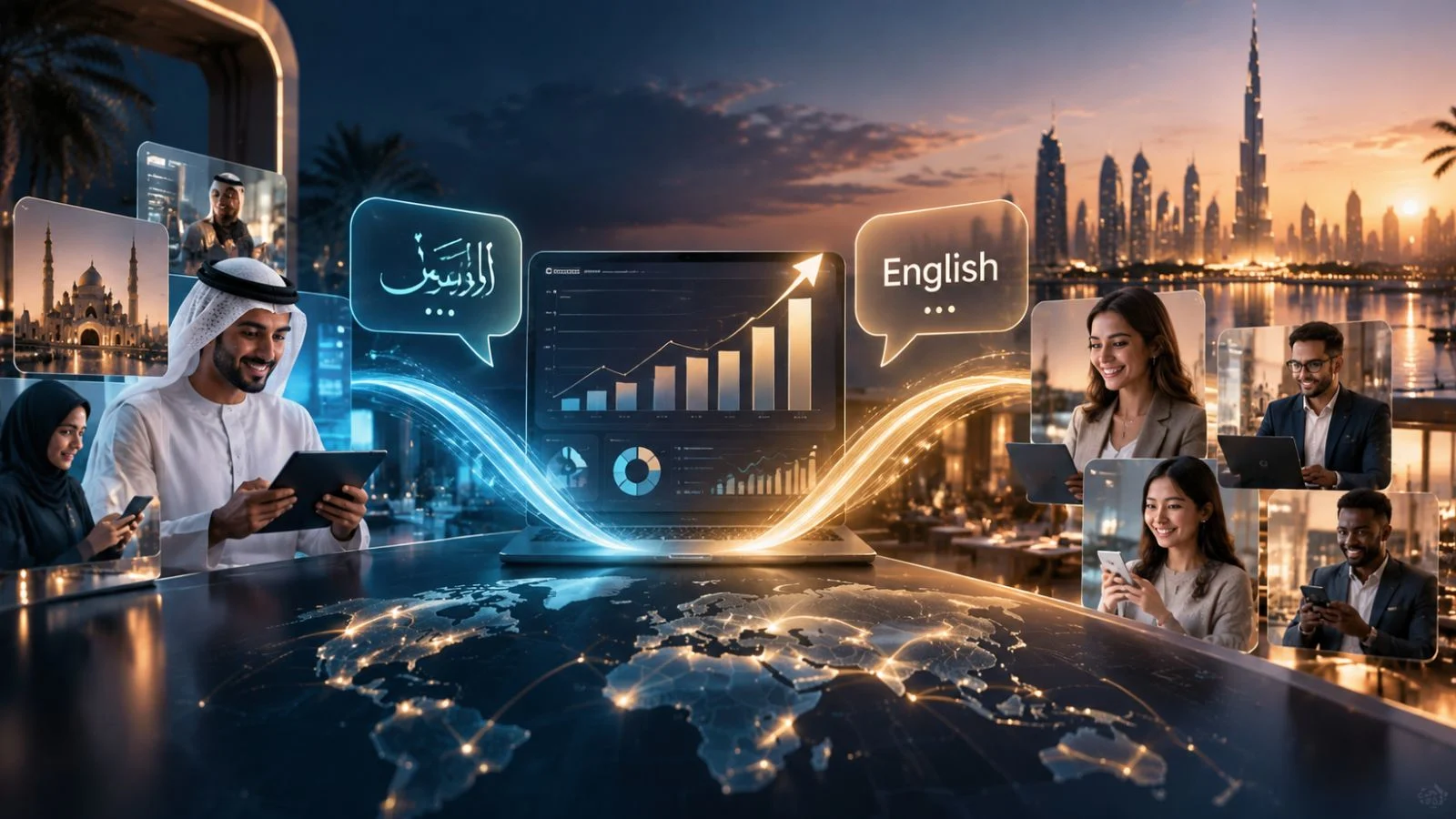
A Bilingual marketing strategy can influence multiple areas of business growth. It improves customer experience, increases engagement, and helps brands reach wider audiences.
Some key benefits include:
- Better customer trust through familiar communication
- Higher engagement on websites and social media platforms
- Improved search visibility among local audiences
- Stronger brand reputation in multicultural markets
- Increased conversion opportunities
For businesses operating in the UAE, language adaptation is not only about reaching more people. It is about creating meaningful connections with customers who expect brands to understand their environment.
The Role of Culture in Marketing Success:
Language and culture are closely connected. A message can be grammatically correct but still fail if it does not match cultural expectations.
A strong Bilingual marketing strategy includes cultural research before launching campaigns. Companies need to understand local celebrations, buying habits, social values, and communication styles.
A cross-cultural marketing strategy helps businesses avoid mistakes that may reduce customer confidence. It ensures campaigns respect differences while creating a unified brand experience.
For example, a luxury brand targeting Gulf customers may focus on exclusivity and heritage, while a technology company may highlight innovation and efficiency. The message changes based on audience expectations, not just language.
Digital Growth Opportunities in the UAE:
The UAE has become one of the most advanced digital markets in the Middle East. Businesses are investing heavily in online platforms, social media, and personalised customer experiences.
A Bilingual marketing strategy helps companies compete effectively in this environment by making digital communication more accessible.
From websites and advertisements to email campaigns and social media posts, businesses can create experiences that serve both Arabic- and English-speaking users.
Companies following digital marketing trends in Abu Dhabi and other regional markets are increasingly focusing on localisation, customer personalisation, and AI-powered marketing tools to improve campaign performance.
Building an Effective Dual Language Approach:
A successful campaign requires planning across different channels. Businesses should avoid creating separate messages that feel disconnected.
A dual-language marketing approach should include:
- Consistent brand messaging across languages
- Professional localisation instead of basic translation
- Audience research before campaign creation
- Native language review for accuracy
- Performance tracking for each audience segment
Modern customers expect brands to communicate naturally. When businesses invest in quality language experiences, they create stronger relationships and improve long-term loyalty.
Common Mistakes Businesses Should Avoid:
Many companies fail because they treat language adaptation as a last-minute task. A Bilingual marketing strategy should be included from the beginning of campaign planning.
Common mistakes include:
- Using automated translations without human review
- Ignoring cultural differences
- Creating inconsistent brand messages
- Focusing only on language instead of customer intent
Another challenge is maintaining the right balance. Some brands translate everything, while others ignore local audiences completely. The best approach combines global branding with regional understanding.
How Can AI Improve Multilingual Marketing?
Technology is changing how businesses create and manage multilingual campaigns. AI tools can help analyse customer behaviour, generate content ideas, and optimise communication.
A modern Bilingual marketing strategy can use AI for faster content creation, audience segmentation, and campaign testing.
AI does not replace cultural understanding, but it helps marketing teams work more efficiently. Businesses can analyse which messages perform better, identify customer preferences, and improve campaigns based on real data.
This combination of technology and human creativity creates a stronger foundation for international marketing growth.
How Globussoft AI Helps Businesses Build Smarter Marketing Systems:

Bilingual campaigns don’t fail from bad content; they fail from bad infrastructure and zero visibility. Globussoft AI fixes both:
Build the systems:
- Custom AI agents that handle repetitive marketing workflows end-to-end.
- Automation that turns fragmented manual processes into scalable pipelines.
- Generative AI embedded into content and creative production.
- Seamless integrations with the business tools you already run on.
Get found — by people and by AI:
- SEO built for Arabic-English search behavior across the Middle East.
- GEO (Generative Engine Optimization) to show up in AI-generated answers, not just search rankings.
- AEO (Answer Engine Optimization) tuned for how audiences now ask questions instead of typing keywords.
- Bilingual content structured to rank and get cited by AI engines
Why it’s one discipline, not two:
- Globussoft AI works hands-on with Claude, GPT, Gemini, and Qwen.
- That same model fluency is what makes its GEO/AEO strategy actually work; you can’t optimize for AI answer engines without understanding how those models retrieve and rank content.
- The result: systems that run the business and visibility that gets it noticed in both languages, across both search and AI.
Measuring the Success of Your Strategy:
A Bilingual marketing strategy should always be measured through clear performance indicators. Businesses need to track whether language adaptation is creating real business value.
Important metrics include:
- Website engagement from different language audiences
- Conversion rates
- Customer inquiries
- Social media interaction
- Search performance
Data helps companies understand what works and where improvements are needed. Instead of assuming bilingual campaigns are effective, brands can continuously optimize their approach based on customer behavior.
The Future of Multilingual Business Growth:

The demand for personalized communication will continue to increase. As businesses expand across borders, language flexibility will become a competitive advantage.
The next generation of marketing will combine cultural intelligence, AI automation, and customer-focused experiences. Companies that understand local audiences while maintaining global standards will have stronger opportunities for sustainable growth.
A Bilingual marketing strategy will continue evolving as technology improves and customer expectations become more personalized.
Conclusion:
Ultimately, a Bilingual marketing strategy is not just a temporary marketing trend. It is a practical growth method for businesses targeting multicultural regions like the Middle East. When brands combine language accuracy, cultural understanding, and technology, they create stronger customer connections.
FAQs:
Q1: What is bilingual marketing and why do businesses in the Gulf need it?
Bilingual marketing means creating campaigns, content, and communication in more than one language — typically Arabic and English in the Gulf context — to reach a wider, more diverse audience. Businesses in the region need it because the GCC has a mix of Arabic-speaking nationals and a large expat population, and a single-language approach risks excluding a significant part of the market.
Q2: How do I start implementing a bilingual marketing strategy for my business?
Start by identifying which language your core customers actually use day-to-day — not just what’s “official,” but what they respond to. From there, prioritise your highest-traffic channels first (usually your website and top-performing social platform) rather than trying to translate everything at once. Working with people who understand both the language and the local culture, not just direct translators, makes a significant difference in how the content lands.
Q3: Is it necessary to have a fully Arabic version of my website?
It’s not always mandatory, but it’s highly recommended for most consumer-facing businesses in the Gulf. An Arabic version signals that a brand takes the local market seriously, and many customers actively prefer browsing in Arabic even if they’re comfortable in English. At minimum, key pages — homepage, product/service pages, and contact details — should be available in Arabic, even if you can’t localise the entire site immediately.
Q4: What are common mistakes businesses make with bilingual marketing?
The most common one is direct, literal translation instead of proper localisation — this often makes content feel awkward or culturally off. Another frequent mistake is treating Arabic content as secondary, publishing it later or with less effort than the English version. Businesses also sometimes ignore regional dialect differences, using the same Arabic content across all GCC countries without adjusting tone for local audiences.
Q5: Does bilingual marketing actually improve customer trust and sales?
Yes — communicating with customers in their preferred language consistently improves trust, engagement, and conversion rates. Customers are more likely to purchase from and stay loyal to brands that make the effort to communicate clearly in their own language, rather than expecting them to adapt to a single-language experience. In a region as diverse as the Gulf, this personalised approach is often what sets one brand apart from a competitor offering a similar product or service.