Most founders making their first serious AI hire are choosing between two options that are both, in different ways, traps. The first costs too little and delivers too late. The second costs more than their engineering budget for the year. Neither is designed for the company they’re actually running.
Here are the mechanics of each, because the failure modes are specific — and avoidable.
Listen To The Podcast Now!
Option One: The Offshore Dev Shop:
The pitch is familiar. A fixed-price contract, a project manager in your timezone, engineers billing at $15–$70/hour depending on region. Sounds like the smart, scrappy move.
The reality is messier. Research shows approximately 35% of fixed-price offshore projects experience scope disputes, with change orders that eat the savings you thought you were banking. For AI projects, this is worse than average — because AI scopes are inherently fuzzy at the start. You don’t know what the model will and won’t do until you’ve run it against real data. Locking that ambiguity into a fixed-price contract is asking for a dispute.
There’s a structural problem underneath the commercial one. Shops that staff with ML specialists who hand off to “integration engineers” after model training create seam risk at exactly the wrong moment. The document-extraction POC that pulls structured data from PDFs perfectly in staging, then crashes in production because the output schema was never mapped to the existing warehouse management system. Timeline doubled. Not because the ML work was bad. Because nobody owned the handoff.
MIT Project NANDA’s July 2025 findings put the production failure rate for generative AI at 95%. McKinsey found only 6% of organisations capture meaningful enterprise-wide value from AI. Offshore shops are not the only reason those numbers are so grim — but the handoff seam is a significant contributor.
Option Two: Frontier-Lab FDE Programs:
At the other end of the spectrum sit the embedded engineering programs from Microsoft Frontier, Google Cloud FDEs, and Anthropic Solutions. These are legitimately excellent. They also cost $500,000 to $2,000,000 per year per engineer, with contract minimums starting at $250,000.
For a Series B company trying to ship one or two AI workflows into production, that pricing structure makes no sense. You’re paying for a level of infrastructure, compliance, and enterprise support that your current scale doesn’t require. And you’re locked into a minimum spend before you’ve validated that the use case even works.
The founders and mid-market teams who need real AI capability — not a chatbot, but actual ML pipelines, multi-model orchestration, agents that touch CRM and email and lead data — are priced out of this tier entirely.
The Third Option Most Founders Miss:
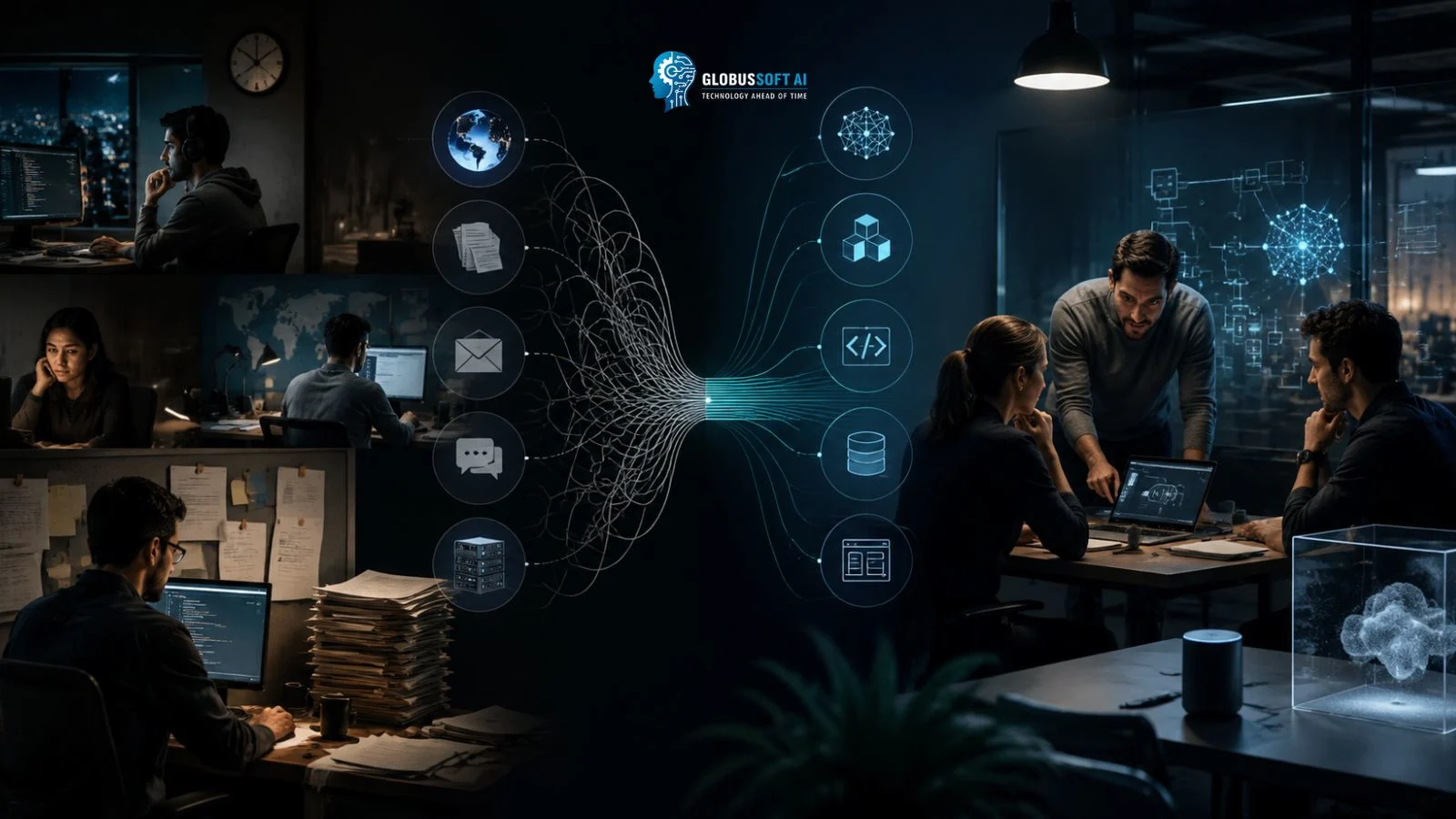
This is where Globussoftai‘s embedded pod model sits. The commercial position is deliberate: approximately one-tenth the cost of a frontier-lab FDE program, with the same embedded structure — engineers who drop into your Slack and codebase from scoping through production, no offshore handoffs.
That last part is the structural difference. No handoff means no seam. The same engineers who scoped the problem are the ones mapping the output schema to your warehouse system. The four integration layers that most vendor RFPs never ask about — data pipeline continuity, auth and compliance handshakes, observability from day one, rollback and graceful degradation — get built in, not bolted on later.
The pace commitment is concrete: first agent shipped within 30 days, deployed to real users. Not a demo. Not a staging environment. Real users.
What “Embedded” Actually Means in Practice:

The word gets overused. Here’s what it means operationally in this engagement model.
An embedded pod runs weekly reviews of metrics, prompts, and model choices — not monthly, not quarterly. That cadence matters because AI systems degrade in ways that look like user behaviour problems until you look at the prompt logs. A model that was accurate in January may be returning different outputs by March because the underlying foundation model was updated, or because input distribution shifted. Weekly review catches that. Monthly review often doesn’t catch it until a user complains.
The pod supports multi-model usage across Claude, GPT, Gemini, and Qwen. That’s not a bullet point — it’s a practical necessity. Different tasks have different cost and accuracy profiles across models. For RAG systems specifically, chunking strategy and embedding quality drive more accuracy gains than the choice of foundation model — but you still need engineers who can make that call without starting a three-week vendor evaluation.
The engagement also includes a fractional CTO who attends board and investor updates, and a monthly executive review with founder Sumit Ghosh. For a seed or Series A company without a technical co-founder, that access matters when you’re explaining your AI strategy to investors who have heard too many vague promises.
The Agents That Ship:
The concrete examples from this model are worth naming because they illustrate what “production” actually means.
The inbox intelligence agent includes a spam false-positive rescue layer that catches 100+ misclassified messages per day — a real operational problem for any business running outbound email at volume. The CRM audit and call list agent, the customer chat monitor agent, and the outbound lead-gen campaign agent all follow the same design principle: they connect to real systems, they run against real data, and they fail gracefully when something upstream breaks. The web research reader agent is no different. These are not demos waiting for a production environment — they are the production environment.
The outbound sales automation workflow covers lead finding, email verification, personalized copy, and CRM sync as a connected pipeline, not four separate tools that someone has to manually stitch together.
The track record behind the model: 40+ products shipped, 100M+ users reached, 300+ engineers led across eight open-source flagships. The Chingari social platform, reaching 100M+ users over six years, was built on a Globussoft-built AI stack. Those numbers exist because the embedded model forces accountability — the engineers who shipped it are the engineers who own it.
The Decision Framework:
If you’re evaluating AI development options right now, the decision is less about cost per hour and more about where you are on the risk curve.
Early stage, one workflow, uncertain requirements: a focused pilot — one workflow, one integration — typically lands in the low tens of thousands and takes 6–10 weeks. That’s the right starting point regardless of which model you use. Killing a bad idea in week two costs three weeks; killing it in week eighteen costs a quarter and credibility.
Validated use case, multiple systems, real user load: this is where the offshore handoff model breaks. The integration surface is too complex, the feedback loop is too slow, and the fixed-price contract will blow up on scope. An embedded pod that owns the full stack from model choice to observability is the safer spend, even if the line-item looks higher.
Enterprise scale with frontier compliance requirements: frontier-lab FDE programs are priced for a reason. If you need HIPAA, EU AI Act conformity assessments, and SOC 2 Type II baked into every layer, the premium buys real infrastructure. Most mid-market companies don’t need that yet — and paying for it before you’ve shipped anything is a category error.
The custom software development market is projected to grow from $53 billion in 2025 to $334 billion by 2034. More vendors will flood this space. The question isn’t whether you can find an AI dev shop — it’s whether the engagement model they’re selling you actually eliminates the seam where AI projects fail, or just moves it somewhere less visible.
To understand how custom AI agents get built from scratch, read the full breakdown on our site. Then talk to the Globussoftai team about shipping your first agent in 30 days.