
The AI platform is one of the most consequential technology decisions a business can make in 2026. The market is crowded, the terminology is confusing, and the gap between what vendors promise and what actually ships is wider than most companies realise. Whether you’re exploring a conversational AI platform for customer support, a generative option for content workflows, or a fully autonomous agent system that runs operations end-to-end, the framework for choosing well is the same. In this guide, we break down the key solution types, the questions worth asking before you commit, and how to match the right tool to your actual business problem rather than the loudest trend.
Listen to the podcast!
What Is an AI Platform, and Why Does It Matter?
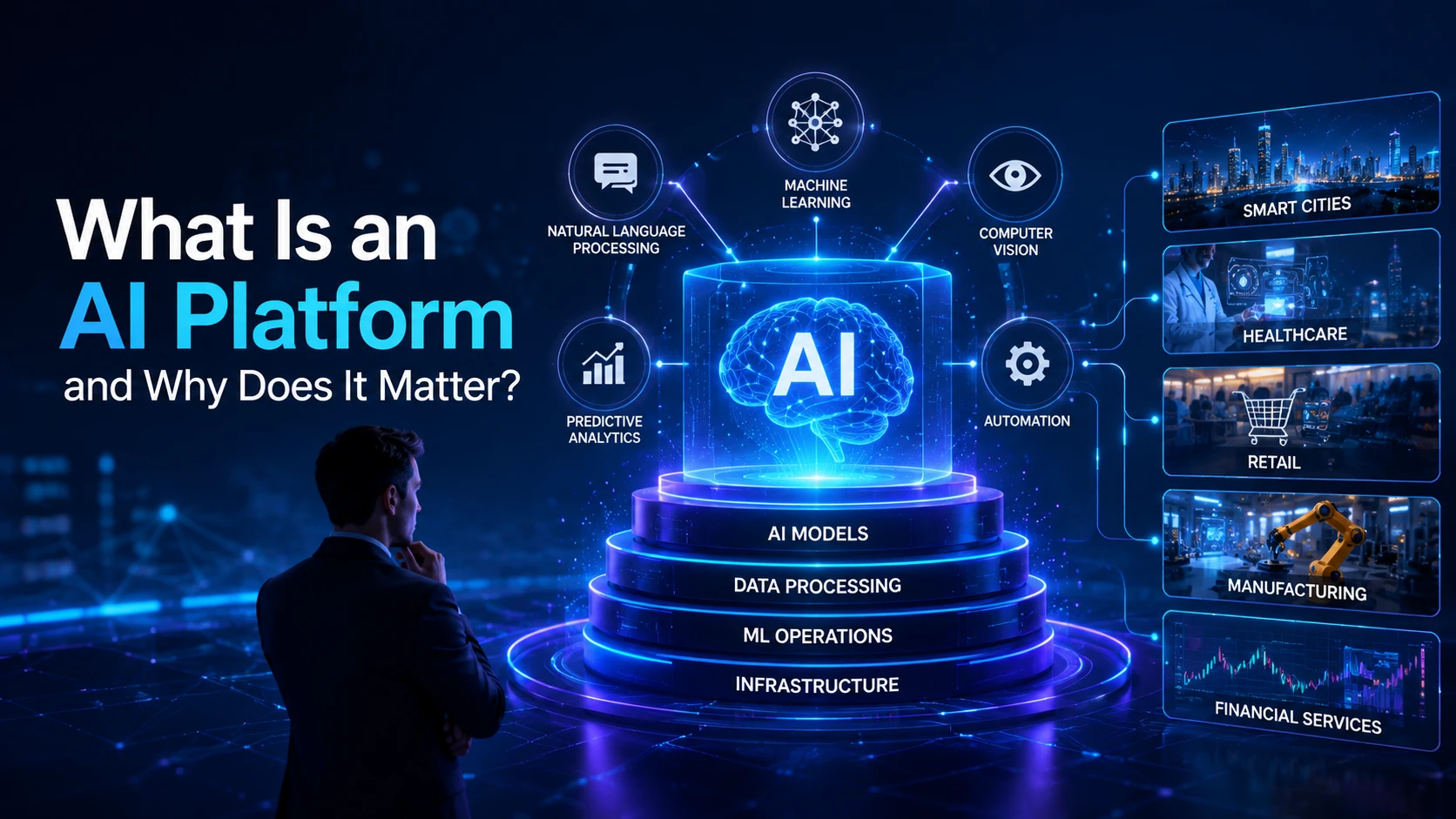
An AI platform is a software environment cloud-based or self-hosted that provides the infrastructure, models, and tooling needed to build, deploy, and operate AI-powered systems at scale. It is the foundation on which AI applications are built, not the application itself.
Why does the choice matter so much? Because the wrong AI platform creates technical debt that is expensive to undo. You may spend months building on a system that cannot integrate with your CRM, cannot scale to your volume, or locks you into a single model provider with no exit path. Choosing well from the start saves money and months of misdirected engineering effort.
The Main Solution Categories in 2026
Understanding the main categories helps you match your need to the right solution class rather than being sold something that sounds right but is not designed for your use case.
- Generative AI platform: Built around large language models that produce text, images, code, or structured data from prompts. Best suited for content creation, code assistance, summarisation, and document generation where the primary output is new content rather than autonomous action.
- Conversational AI platform: Designed specifically for dialogue-based interactions. Powers customer support bots, sales qualification flows, voice agents, and any use case where the AI must conduct coherent, multi-turn conversations with a human.
- AI agent platform: The most operationally powerful category. Agent systems enable AI to plan, take actions, call tools, and complete multi-step workflows autonomously, going far beyond generating text or answering questions.
Difference Between Conversational AI and Generative AI
Understanding the difference between conversational AI and generative AI prevents one of the most common mistakes in selecting the right AI platform. The two are often confused, but they serve fundamentally different purposes.
Generative AI creates content. You provide a prompt; it produces an output: a blog post, a code snippet, or a product description. The interaction is typically single-turn.
Conversational AI manages ongoing dialogue. It tracks context across multiple exchanges, handles follow-up questions, and maintains a coherent thread throughout an entire conversation. Many modern systems combine both: a conversational layer that manages dialogue, powered by a generative model that produces the responses. Knowing which layer your problem lives in is the key to choosing correctly.
Conversational AI Platform: When Dialogue Is the Product
If your primary use case involves customer interaction support, onboarding, qualification, or retention, a conversational AI platform is the right foundation. These systems are optimised for dialogue management: tracking context, handling interruptions, managing sentiment, and escalating to humans when needed.
Key evaluation criteria for a conversational AI platform include language support, integration with your CRM and ticketing systems, multi-channel capability across voice, chat, and WhatsApp, and the ability to train the system on your specific knowledge base. Generic chatbot builders fall short on all of these when volume and complexity exceed basic FAQ handling.
AI Agent Platform: When You Need AI That Acts, Not Just Talks
The most significant evolution in the AI platform space in 2026 is the rise of agent-first architectures. An AI agent platform goes beyond conversation or content generation; it enables AI systems to take autonomous actions across your tools, data, and workflows without waiting for a human prompt at each step.
Agents read your CRM, prioritise lead lists, send emails, monitor customer conversations, and generate daily briefings all autonomously. For businesses where operational leverage matters more than a front-end chatbot, an AI agent platform delivers a fundamentally different class of value. Autonomous workflows running 24 hours a day are what separate AI as a tool from AI as infrastructure.
Generative AI Platform: When Content and Code Are the Priority
For businesses whose primary investment is in content production, code assistance, or knowledge synthesis, a generative AI platform is the appropriate starting point. These systems provide access to large language models GPT, Claude, Gemini, and others with APIs and tooling that make it practical to build generation workflows into existing products and processes.
Key considerations when evaluating any generative AI platform include model quality for your specific content type, cost at your expected volume, latency for real-time use cases, and whether the system allows fine-tuning on your proprietary data. Avoid options that lock you into a single model; the landscape shifts fast, and portability matters enormously.
Key Questions Before Committing to Any Solution
Regardless of which category fits your use case, these questions produce the most useful evaluation data before selecting any AI platform:
- Does it integrate with your existing stack? CRM, ERP, messaging, and data platforms must connect without heavy engineering overhead.
- Is it multi-model or single-model? Single-model lock-in is a growing risk as quality and pricing shift monthly.
- Who owns the IP and data? Critical for businesses handling sensitive customer or operational data.
- What does deployment actually look like? Ask for references from businesses at your scale; demos are easy; production is harder.
- How does it handle failure? Monitoring, fallback logic, and human escalation paths matter enormously once you are live.
Learn More!
Outbound Sales AI Agents: The Mistake Killing Your Pipeline
Why Google Cloud Platform Is Key for AI Development?
How Globussoft AI Builds the Right AI Platform for Your Business
If off-the-shelf options don’t fit because your workflows are too specific, your data too sensitive, or your integration requirements too complex, Globussoft AI is the embedded AI engineering team that builds the right AI platform solution from the ground up and ships it in weeks, not quarters.
Founded by Sumit Ghosh (Chingari, EmpMonitor, PowerAdSpy- 40+ products, 100M+ users, 300+ engineers led), Globussoft AI embeds a senior pod directly into your stack and Slack, with the same team from scoping to production, no offshore handoffs, and no black boxes.
Here’s what Globussoft AI builds and ships:
- Multi-Model Architecture – Claude, GPT, Gemini, and self-hosted Qwen; the right model for each task, with no lock-in to any single provider.
- Inbox Intelligence Agent – Reads every message, applies priority labels, archives noise, and delivers a morning digest of items that need your attention.
- CRM Audit + Daily Call List Agent – Cross-references pipeline data and posts a priority-ranked lead list to your sales channel with owner assignments daily.
- Customer Chat Monitor – Watches WhatsApp, Telegram, and in-app threads every 15 minutes, flagging silent threads and sentiment shifts before customers churn.
- Outbound Lead-Gen Campaign Agent – Finds leads, verifies email addresses, drafts personalised copy, sends via Gmail, tracks replies, and automatically syncs to the CRM.
- Executive Briefing Agent – Reads all agent outputs, your calendar, and priority queues, delivering the 3–5 things that need your attention each morning.
- Three Engagement Tiers – Sprint (4-week fixed scope), Embedded Pod (rolling 3-month minimum), and Fractional CTO (1 day/week with Sumit personally).
- Full IP Transfer – You own all source code. No vendor lock-in, no black boxes, no ongoing platform fees after delivery.
- Starts in 2 Weeks – The first agent ships to production within 30 days of scoping. No offshore handoffs. No discovery-doc theatre.
Conclusion
The right AI platform for your business depends on your specific use case, existing tech stack, and operational priorities. Generative systems excel at content and code. Conversational tools power dialogue-heavy interactions. Agent platforms deliver the deepest operational leverage. And when off-the-shelf options do not fit, a purpose-built solution from an embedded team like Globussoft AI is often the fastest and most cost-effective path.
Frequently Asked Questions (FAQs)
Q1. What is an AI platform?
An AI platform is the foundational infrastructure of models, APIs, tooling, and deployment environments that businesses use to build, run, and scale AI-powered systems and workflows.
Q2. What is the difference between conversational AI and generative AI?
Generative AI creates content from prompts. Conversational AI manages multi-turn dialogue with context tracking. Many modern systems combine both layers in a single product or solution.
Q3. What is an AI agent platform?
An AI agent platform enables AI to take autonomous actions across tools and workflows, planning, executing, and completing multi-step tasks without human initiation at each step.
Q4. How quickly can Globussoft AI deliver a custom solution?
Sprint engagements start in 2 weeks and deliver a working agent in production within 30 days. Embedded pod engagements begin in 4 weeks with a rolling weekly ship cadence thereafter.