As software becomes more complex, traditional testing methods often struggle to keep pace.
AI testing offers a smarter approach by automating repetitive tasks, detecting bugs faster, and improving test accuracy and coverage. In this blog, we’ll explore how AI is transforming software testing and how GlobussoftAI can help businesses build more reliable and efficient AI-powered solutions.
What Do You Mean By AI Testing?
AI testing refers to the process of testing artificial intelligence systems, models, and AI-powered applications to ensure they work accurately, reliably, securely, and as expected. Unlike traditional software testing, AI testing also evaluates factors such as model accuracy, data quality, bias, robustness, performance, and the consistency of AI-generated results.
It helps identify incorrect predictions, unexpected outputs, security vulnerabilities, and potential biases before an AI solution is deployed. By using automated testing tools and AI-driven testing techniques, businesses can improve software quality while reducing manual testing effort and making the overall testing process faster and more efficient.
What Is The Need For Testing With AI?
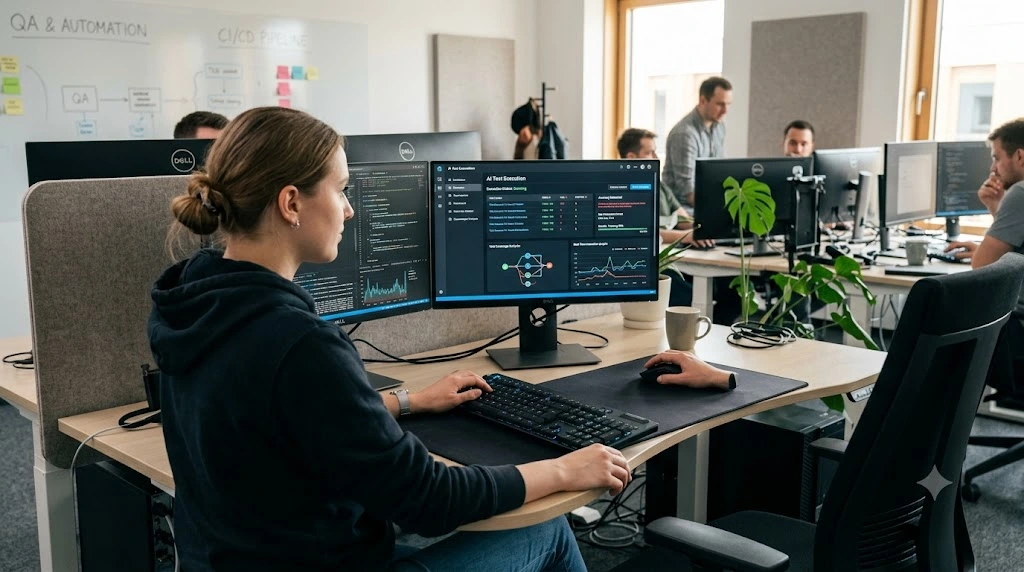
Testing with AI is important because modern software applications are becoming more complex and require faster, smarter, and more reliable testing processes. AI can analyze large amounts of data, identify patterns, detect potential bugs, generate test cases, and automate repetitive testing tasks with greater efficiency.
It can also help testers identify defects that may be difficult to find through traditional methods. By integrating AI into software testing, businesses can reduce testing time, improve test coverage, detect errors earlier, minimize manual effort, and enhance overall software quality. This makes AI-powered testing particularly valuable for organizations that need to deliver reliable software quickly while maintaining high performance and user satisfaction.
How Does AI Testing Enhance Your Software Quality?
AI testing can significantly improve software quality by making the testing process faster, more accurate, and comprehensive. It uses AI algorithms to analyze application behavior, identify patterns, detect defects, and automatically generate relevant test cases. Key benefits include:
- Improved Test Coverage: AI can identify different scenarios and edge cases that might be missed during manual testing.
- Faster Bug Detection: AI-powered tools can quickly analyze large volumes of data and detect potential issues early in the development cycle.
- Reduced Human Errors: Automating repetitive testing tasks minimizes mistakes caused by manual processes.
- Continuous Testing: AI can support automated testing throughout the development lifecycle, helping teams identify problems before they become costly.
- Better Performance: AI can analyze application performance and highlight bottlenecks, failures, or unusual behavior.
- Smarter Test Maintenance: AI can adapt test cases when application features or interfaces change, reducing maintenance efforts.
- More Reliable Software: By combining broader test coverage with faster defect detection, AI testing helps businesses deliver stable and high-quality software.
How To Use AI In Software Testing Correctly?

Using AI correctly in software testing requires a balanced approach where AI tools support testers rather than completely replacing human expertise. Businesses can follow these practices:
- Identify Suitable Testing Areas: Start with repetitive and time-consuming tasks such as test case generation, regression testing, and bug detection where AI can provide the most value.
- Use High-Quality Test Data: AI depends heavily on the quality of its training and testing data. Clean, diverse, and relevant data helps produce more reliable results.
- Keep Human Oversight: Testers should review AI-generated test cases, results, and recommendations to identify errors or misleading outputs.
- Combine AI With Traditional Testing: Use AI alongside functional, performance, security, and manual testing instead of relying entirely on automated AI testing.
- Monitor AI Performance: Regularly evaluate the accuracy and reliability of AI testing tools and update them as the application changes.
- Prioritize Security and Privacy: Ensure that sensitive application data is handled securely when using AI-powered testing platforms.
- Choose the Right AI Testing Tool: Select a solution based on your application’s requirements, testing environment, scalability, and integration needs.
When implemented strategically, AI can reduce testing time, expand test coverage, improve defect detection, and help QA teams deliver better-quality software more efficiently.
AI for Software Testing: The Future Of Testing
AI is rapidly transforming software testing by making the process smarter, faster, and more adaptive. Traditional testing often requires significant manual effort, whereas AI can automate repetitive tasks, generate test cases, analyze application behavior, detect defects, and identify potential risks.
AI-powered testing can also learn from previous test results and adapt to changes in applications, helping QA teams maintain test suites more efficiently. As software becomes increasingly complex, organizations can leverage AI to achieve greater test coverage, reduce testing time, and identify issues earlier in the development cycle. With the right combination of AI automation and human expertise, AI for software testing is set to become an important part of modern quality assurance and the future of software development.
About GlobussoftAI
GlobussoftAI is an AI engineering company that helps businesses build and deploy practical, production-ready AI solutions. With 40+ products shipped, 100M+ users reached, and 300+ engineers led, GlobussoftAI combines AI engineering expertise with an embedded development approach to help businesses move from idea to working AI systems faster. Its services cover AI agents, LLM applications, machine learning, AI automation, integrations, and production deployment, with solutions designed around real business requirements rather than generic demos.
GlobussoftAI also focuses on evaluations, monitoring, guardrails, and continuous improvement, making it a strong technology partner for businesses looking to adopt AI while maintaining reliability, scalability, and performance.
GlobussoftAI offers a range of AI engineering and automation capabilities designed to help businesses build, deploy, and manage practical AI solutions. Some of its key features include:
- AI Agent Development: GlobussoftAI builds intelligent AI agents that can automate repetitive business tasks, support customers, monitor workflows, and perform multi-step operations with limited human intervention.
- LLM Integration & Fine-Tuning: Businesses can integrate models such as GPT, Claude, Gemini, and Qwen into their applications and optimize them according to specific business requirements.
- AI-Powered Chatbots: The platform supports context-aware, LLM-powered chatbots that can use business knowledge bases to provide more relevant and personalized responses.
- Workflow Automation: AI can automate repetitive processes across areas such as customer support, sales, content operations, and internal business workflows, helping reduce manual effort and improve efficiency.
- AI Testing, Evals & Monitoring: GlobussoftAI incorporates evaluations and monitoring into AI deployments to assess model performance, identify problems, and continuously improve AI systems after deployment.
- Multi-Model Approach: Instead of depending on a single AI provider, GlobussoftAI works with multiple models, including Claude, GPT, Gemini, and self-hosted Qwen, allowing businesses to select models based on quality, cost, and latency.
- Enterprise Knowledge Integration: AI systems can be connected with an organization’s internal knowledge and data so that applications can provide more business-specific and contextually relevant outputs.
- End-to-End AI Development: GlobussoftAI supports the complete AI journey—from co-design and development to deployment, monitoring, and ongoing improvement—rather than simply delivering a standalone AI tool.
- Scalable AI Solutions: Its AI and ML capabilities are designed for real-world applications, including recommendation systems, content moderation, ad classification, workforce analytics, and business automation.
- Full Source & IP Ownership: According to its website, engagements include full source-code and IP transfer, helping businesses avoid vendor lock-in and retain ownership of their developed systems.
Conclusion
AI is transforming software testing by making it faster, smarter, and more efficient. From automated test case generation and early bug detection to continuous testing and performance monitoring, AI can help businesses improve software quality while reducing manual effort.
However, achieving the best results requires the right technology, strategy, and human expertise. GlobussoftAI helps businesses leverage AI engineering, automation, testing, monitoring, and intelligent solutions to build more reliable and scalable software systems. With the right AI partner, businesses can embrace the future of software testing with greater confidence, efficiency, and quality.
Frequently Asked Questions
1. What is AI testing?
AI testing uses artificial intelligence to automate testing, identify bugs, generate test cases, and improve software quality.
2. How does AI improve software quality?
AI helps detect errors faster, increase test coverage, reduce human mistakes, and identify potential issues early.
3. Can AI testing reduce manual testing efforts?
Yes, AI can automate repetitive testing tasks, allowing testers to focus on more complex and critical areas.
4. Is AI testing better than traditional testing?
AI testing can make testing faster and more efficient, but it works best when combined with traditional testing and human expertise.
5. How can businesses start using AI for software testing?
Businesses can start by using AI for repetitive tasks such as test case generation, regression testing, bug detection, and performance analysis.