
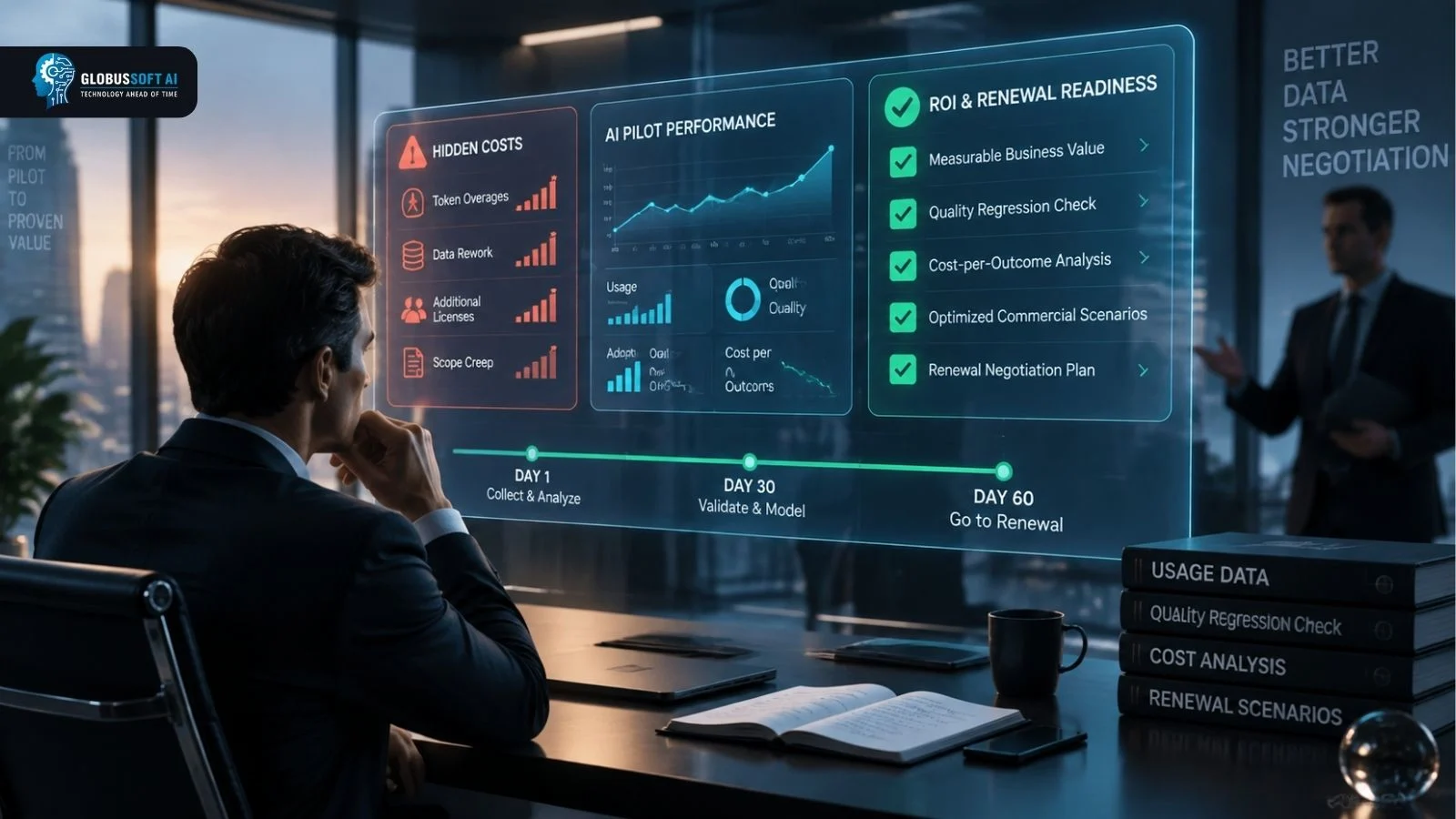
Teams signed AI pilots in 2024 and 2025 based on anticipated value. The demos were clean. The pilots ran fine. Then the real bill arrived, not in one line item, but across token overages, data rework, and a vendor who wants to double the contract because the proof of concept “showed promise.” If you are heading into a renewal conversation without a clear AI ROI position, you are negotiating in the vendor’s frame, not yours.
Here is what goes wrong, and what a disciplined pre-renewal audit actually looks like. Below is a 60-day framework you can run before the vendor sets the agenda, covering cost-per-outcome analysis, quality regression checks, and the commercial scenario modeling most teams skip entirely.
Listen To The Podcast Now!
The Bill You Didn’t Budget For:
Most teams get the model cost roughly right. What destroys AI budgets is everything else.
Data preparation is the worst offender. Teams treat it as a small line item at project start, something to sort before the interesting work begins. In practice, it consumes a disproportionate share of total project cost. The gap between what gets estimated and what gets spent is not a project management failure; it is a structural mispricing that shows up again at renewal when the data has shifted and nobody budgeted for re-labeling.
Token-based billing compounds the problem. A proof of concept running on fifty hand-picked conversations does not predict what happens when five thousand customers hit the same agent simultaneously, with edge cases the demo set never included. The cost-per-outcome number you thought you had is almost certainly wrong.
Add vendor pressure at renewal, and you have the full picture. Vendors arrive with expansion proposals framed around anticipated upside. You need to arrive with demonstrated downside protection, a clear map of what the system actually does, what it costs per unit of output, and where it fails.
The Three Questions Your Renewal Audit Must Answer:

This is not a financial audit. It is a technical-plus-commercial review that happens 60–90 days before the renewal date, not 60–90 minutes before.
1. What is the actual cost per outcome, not cost per token?
Token cost is the wrong unit. If your outbound sales agent is sending thousands of emails but booking only a handful of meetings, the cost per booked meeting is what matters, and it is almost certainly higher than your sponsor’s slide deck suggested. Run the real math. If the number is defensible, you have your AI ROI case. If it is not, you need to know that before the vendor does.
For teams using multi-model setups, this math gets messier. Mixing Claude, GPT, Gemini, and Qwen, increasingly standard for cost and capability trade-offs in production, means aggregating billing across multiple providers with different rate structures. That is not inherently a problem, but you need one place that rolls it all up. ROI only becomes defensible once you can trace a dollar of output back to a specific model, task, and prompt version.
2. Has the model drifted from what it was doing at pilot?
AI systems degrade quietly. Our research on AI agent decay in production documents a roughly 37% performance drop between benchmark scores and enterprise deployment for comparable tasks. Degradation typically becomes visible around week eight. By month three, it is dramatic enough to be embarrassing.
Prompts that worked in January behave differently in September because the underlying model was updated, your product data changed, or customer language shifted. A CRM scoring prompt that worked in January can classify contacts differently in April due to unversioned edits, with bad updates running undetected for weeks. If nobody has been doing weekly reviews of output quality, prompt performance, and model choices, there is a real chance the agent you are renewing is meaningfully worse than the one you approved. Weekly review is the standard for catching drift; monthly is usually too slow.
A disciplined weekly review covers three specific checks. First, a metrics check: accuracy against a labeled sample, error rate, latency distribution. Second, a prompt check: manual review of a sample of inputs and outputs. Third, a model check: side-by-side comparison on a representative input sample. If yours has not been running, schedule one before the renewal conversation.
3. Are you locked into pricing you can’t escape?
Frontier-lab embedded programs, Microsoft Frontier, Google Cloud FDEs, and Anthropic Solutions are priced at $500,000 to $2 million per year per engineer, with contract minimums starting at $250,000, per Globussoftai’s own published figures. Those numbers reflect the real cost of that tier of talent and infrastructure. They also mean your room to renegotiate is narrow. The contract structure is designed for long commitments and expansion, not for a founder who needs to right-size after an honest AI ROI review.
What a Retainer-Model Engagement Looks Like Instead
Globussoftai takes a structurally different approach. An embedded engineer drops into your Slack and codebase directly, from scoping through production with no offshore handoffs. The first agent ships within 30 days, deployed to real users. Weekly review of metrics, prompts, and model choices keeps the system from drifting. Monthly executive reviews with founder Sumit Ghosh keep the work accountable at the leadership level.
The concrete proof is in the failure surfaces that only become visible once you are in production. Outbound sales automation surfaces four distinct failure modes that no pilot exposes: lead-quality scoring, email deliverability, copy naturalness, and CRM field mapping under real sales rep behavior. The embedded model catches these in week two or three. A handed-off engagement catches them at renewal, after you have already paid for a year of degraded performance. For a closer look at how the CRM failure mode plays out specifically, this breakdown of AI-driven CRM audit agents covers the operational patterns that separate a healthy call list from one reps describe as feeling “off.”
Globussoftai’s inbox intelligence agent is engineered to rescue 100+ misclassified messages per day from spam false-positive errors. That number only holds when prompt performance is reviewed weekly, not quarterly. The deployment stewardship model that makes this sustainable is what separates a system worth renewing from one you are renewing out of sunk-cost inertia.
The cost structure reflects the model: approximately one-tenth the cost of a frontier-lab FDE program, by Globussoftai’s own account. That ratio matters at renewal time. If the work is delivering value, the retainer math is easy to defend. If the economics need to change, the contract structure allows it.
The multi-model flexibility matters here too. Running across Claude, GPT, Gemini, and Qwen is not a sales feature; it is a negotiating position. When one provider’s pricing shifts or a model update breaks an existing prompt, you are not locked into a single vendor’s roadmap. For a broader look at the structural risks of single-vendor architecture, our piece on AI agent vendor lock-in covers the failure modes worth understanding before any renewal signature.
The Data Problem Doesn’t Go Away at Renewal
One thing the renewal conversation rarely surfaces: the ongoing data cost. Teams treat data preparation as a one-time project expense. In practice, it is a recurring operational line. New SKUs, policy changes, updated compliance requirements -all of it requires re-labeling, re-evaluation, or re-training to determine whether the existing system still applies. If your renewal budget does not include that ongoing data work, the number you are signing is wrong before the ink dries.
The risk of under-resourcing this is not abstract. A retry loop without cost-limit guardrails can run for hours, accumulating thousands of API calls before anyone intervenes. That is not a cautionary tale about scale; it is what happens when production systems run without the weekly stewardship that catches drift before it compounds.
Treat prompt versioning as a hard production constraint, on the same level as API key security and rate limits. That discipline is what separates a drift event caught in week one from one discovered at renewal, after months of degraded output.
The Framework: A 60-Day Pre-Renewal Sprint
Here is what a serious pre-renewal audit covers, in rough sequence:
- Weeks 1–2: Cost-per-outcome analysis. Pull actual billing data and map it to business outcomes, not usage metrics. Token cost is an input, not a result. Build the AI ROI number you will defend in the renewal meeting.
- Weeks 3–4: Quality regression check. Run the current system against a sample of the original pilot conversations. If output quality has dropped, document exactly where and why before the renewal negotiation starts.
- Weeks 5–6: Data pipeline review. Audit what is feeding the model and when it was last updated. If the answer is “we’re not sure,” that is a risk item for the renewal conversation, not something to discover post-signature.
- Weeks 7–8: Commercial scenario modeling. Model three scenarios, re:w as-is, right-size, replace with actual cost and capability numbers for each. The vendor will arrive with one scenario. You should have three.
This is not a heroic undertaking. It is the kind of ongoing stewardship that should have been running since deployment. If it wasn’t, the 60-day sprint is how you catch up before the conversation happens in the vendor’s frame instead of yours.
For a deeper look at why agentic projects fail to survive to a second renewal cycle, this breakdown of why AI agents never reach production covers the structural failure patterns worth knowing before you sign anything.
The Position You Want to Be In:
The teams that come out of 2026 renewal cycles well can answer four questions cold: What does the system actually do? What does it cost per unit of real output? Where does it go next? What should that cost? Building that case requires months of disciplined tracking, not a document assembled the week before the renewal call.
If you are still designing what to build, the framing matters even more. A system that is auditable, multi-model, and structured around weekly checkpoints is dramatically easier to renew or replace than one built by a single vendor for a single platform with a proprietary evaluation layer. Getting the architecture right from the start is the cheapest form of renewal insurance.
The renewal cliff was never a surprise; it was visible from the day the pilot contract was signed. The question is whether you built a system worth renewing, and whether you can prove it.
Ready to build AI infrastructure you can actually defend at renewal? Book a free 30-minute renewal audit call with Globussoftai; bring your current contract and cost data; leave with a clear position before the vendor sets the agenda.