
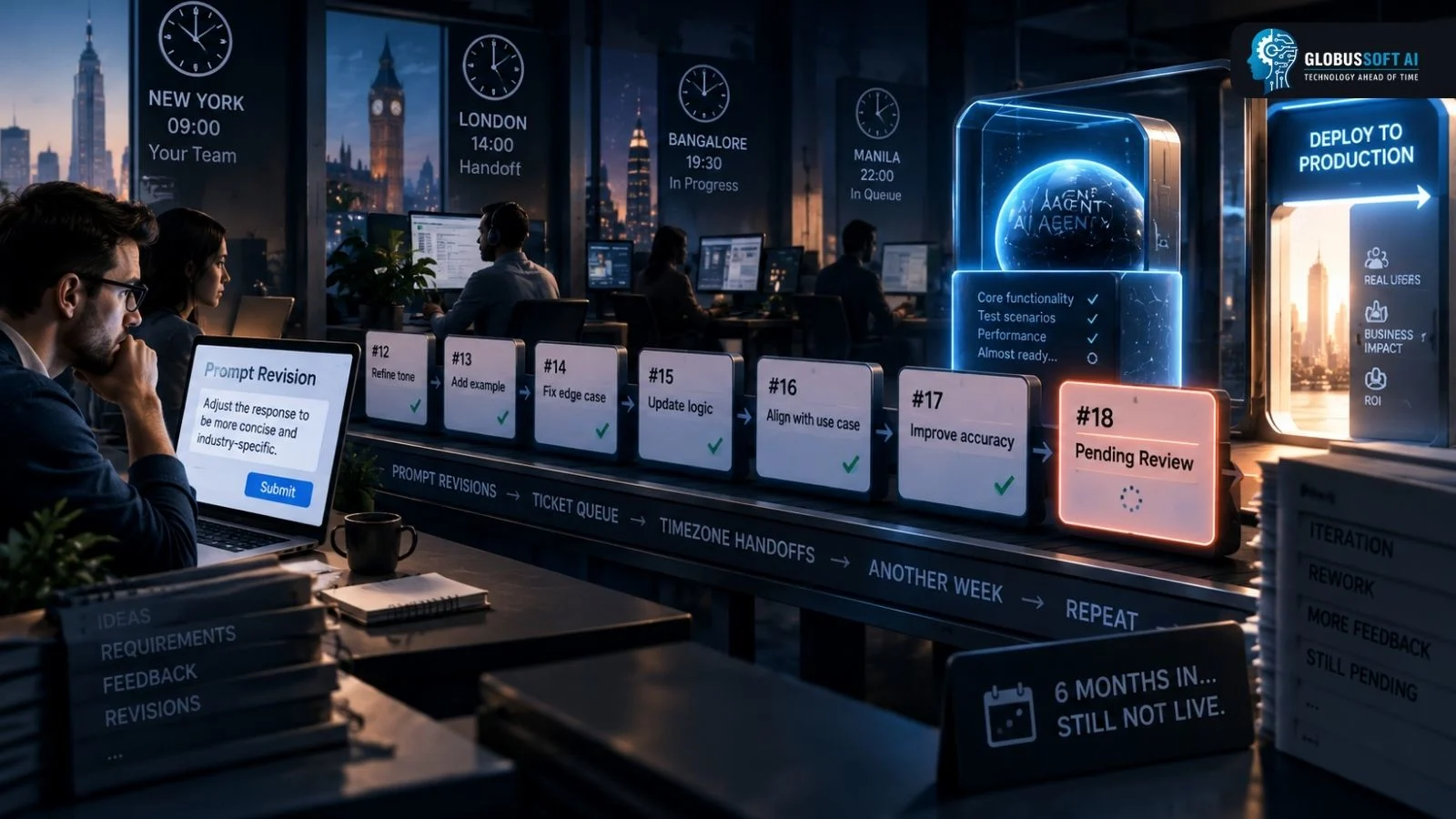
Six months in, your AI agent still isn’t live. The vendor keeps saying it’s “almost there.” Your team has filed seventeen ticket updates and received eleven revised demos. What went wrong? Probably nothing dramatic — just arithmetic.
Every prompt-revision cycle routed through an async offshore ticket queue takes about one week. That is not an estimate or a worst-case figure — it is the structural reality of timezone-gated handoffs. Analysis drawn from deployment data across 40+ enterprise AI budgets shows this weekly cadence, compounded across a six-month engagement, is the primary reason most offshore AI contracts end without a deployed agent. Twenty-four iteration cycles sounds like plenty until you account for scope alignment, environment setup, and the inevitable rework after the first demo reveals the agent doesn’t match what the business actually needed.
This is the prompt lag problem. It is killing more AI projects than bad models ever will.
Listen To The Podcast Now!
The Math Nobody Does Before Signing the Contract
According to Gartner’s latest enterprise research, 88% of AI agent projects never make it from pilot to production. Not 88% fail to demo. Not 88% fail during testing. 88% fail to actually deploy into the real world where real people depend on them. Gartner’s 2025 AI deployment survey puts overall project failure rates at 85%, and McKinsey’s 2025 State of AI report found fewer organisations than ever are scaling pilots to production — despite record spending.
Most buyers assume model quality is the variable to optimise. They spend weeks evaluating GPT-4o against Claude, benchmarking latency, comparing token costs. That is not wrong. It is just not the bottleneck.
The bottleneck is iteration speed. AI agents are not CRUD applications. You cannot write a complete specification before you see the first live version behave on real data. The scope of an agent emerges from what the first deployed version surfaces — edge cases the business didn’t know existed, failure modes that only appear at production volume, prompt sensitivity that no staging environment will reveal. That discovery process requires tight feedback loops. Specifically, it requires the person adjusting the prompt to be in the same context as the person who just watched it fail.
An async ticket queue is structurally incompatible with that requirement.
What Offshore Is Actually Good For
This is not an argument against offshore development. It is an argument for using it on the right problems.
Offshore teams excel at well-scoped, stable workloads: QA against a fixed spec, UI implementation from detailed wireframes, API integration where the contract is frozen. The work is parallelisable, the requirements don’t shift mid-sprint, and the quality bar is measurable in advance. That is exactly the environment where async lag is manageable, because the feedback loop doesn’t need to be tight.
AI agent work is the opposite. It is inherently iterative, emergent, and dependent on business context that lives in someone’s head, not a Confluence page. When you route that work through an offshore queue, you are not saving money — you are paying more than you think for slower output. Fully 60–70% of in-house and outsourced AI agent costs fall outside both vendor quotes and headcount line items — model fine-tuning cycles, prompt versioning, monitoring infrastructure, integration maintenance, security audits. The headline rate discount evaporates fast.
There is also a model-drift problem that compounds over time. When a provider changes pricing or alters model behaviour — and they do, regularly — the migration cost lands on the client, not the vendor. The offshore team has no incentive to track those changes proactively. Prompt regression when a foundation model updates, agent hallucination in production with no monitoring surface, upstream API schema changes breaking integrations: these are the named failure modes. You find out when something breaks in production, not before.
The Architecture That Fixes It:

The embedded engineering model exists specifically because the prompt lag problem is structural, not accidental. Globussoft AI runs what it calls an embedded pod: a small team that drops directly into the client’s Slack and codebase, from scoping through to production, with no offshore handoffs. The engineer who writes the prompt is in the same channel as the person who watched it misclassify a message ten minutes ago. The iteration cycle collapses from one week to hours.
The practical consequence of that compression: the embedded pod commits to a first agent deployed to real users within 30 days. Not a demo. Not a staging build. Real users, real data, real feedback — the baseline from which iteration actually starts being useful.
Compare that to the frontier-lab alternative. Microsoft Frontier, Google Cloud FDEs, and Anthropic Solutions programs run $500k–$2M per year per engineer, with contract minimums starting at $250k. For most founders and mid-market teams, that range is not a negotiation — it is a disqualification. Globussoft AI’s embedded pod is priced at approximately one-tenth that cost, starting in as little as two weeks. That puts it within reach for exactly the buyers who need tight iteration most — and can least afford to burn six months on a dead pilot. See how the embedded pod engagement works.
What Weekly Review Actually Changes
One of the less-discussed advantages of embedded teams is what becomes possible when model selection is treated as an ongoing decision rather than a kickoff commitment. In the embedded pod model, the model choice — across Claude, GPT, Gemini, and Qwen — is reviewed weekly based on task fit, not locked in at contract start. That sounds like overhead. In practice, it is the difference between an agent that keeps performing and one that silently degrades as a model provider makes a quiet update.
This matters more than most buyers realise. An outbound lead-gen agent calibrated on one model in January may behave differently on the same prompts in August. A spam false-positive rescue agent that — per Globussoft AI’s own product claims — rescues 100+ misclassified messages per day doesn’t maintain that performance without someone watching it. Weekly prompt and metric reviews are not a premium feature. They are the minimum viable maintenance for a production agent.
The offshore model has no equivalent mechanism. Reviews happen at sprint boundaries, through status reports, filtered through project managers optimising for the appearance of progress rather than the reality of it. By the time a performance collapse surfaces in a sprint report, weeks of bad output have already shipped. There is no channel where the person who noticed the problem and the person who can fix the prompt are in the same room at the same time.
Choosing the Right Engagement Before You Sign:

The decision framework is simpler than most buyers make it. Ask one question before you evaluate any vendor: is the scope of this work knowable in advance?
If yes — if you can write a complete spec, define acceptance criteria, and measure success without seeing the first live version — offshore is a legitimate option. It will likely be cheaper, and the lag won’t cost you much.
If no — if you are building an agent that will touch live customer data, real sales conversations, or operational decisions that shift based on what the agent surfaces — you need embedded iteration. The prompt lag will kill the project otherwise. Not dramatically, not all at once, but week by week, one deferred revision at a time, until you are six months in and still showing demos to the same stakeholders who approved the budget in January.
The Globussoft AI track record — 40+ products shipped, 100M+ users reached, and 300+ engineers led across engagements — includes the AI stack that powered Chingari’s growth to 100M+ users over six years. The embedded pod follows a defined sequence: business assessment, strategy development, custom AI agent deployment, integration support, and performance optimisation, with monthly executive reviews run by founder Sumit Ghosh. That structure exists because the teams who built it learned firsthand what the prompt lag problem costs. A Series B fintech founder, for instance, spent $2.3 million building an AI agent in-house before abandoning the project — a cautionary data point drawn from real deployment analysis, not a composite scenario.
The Only Metric That Matters at Month Six
Not lines of code shipped. Not demos delivered. Not tickets closed.
Is the agent in production? Is it running on real data? Has anyone outside your internal team used it?
If the answer is no, the model choice was not the problem. The iteration architecture was. Fix that before you sign the next contract.
Ship your first AI agent to real users within 30 days with Globussoft AI’s embedded pod.