
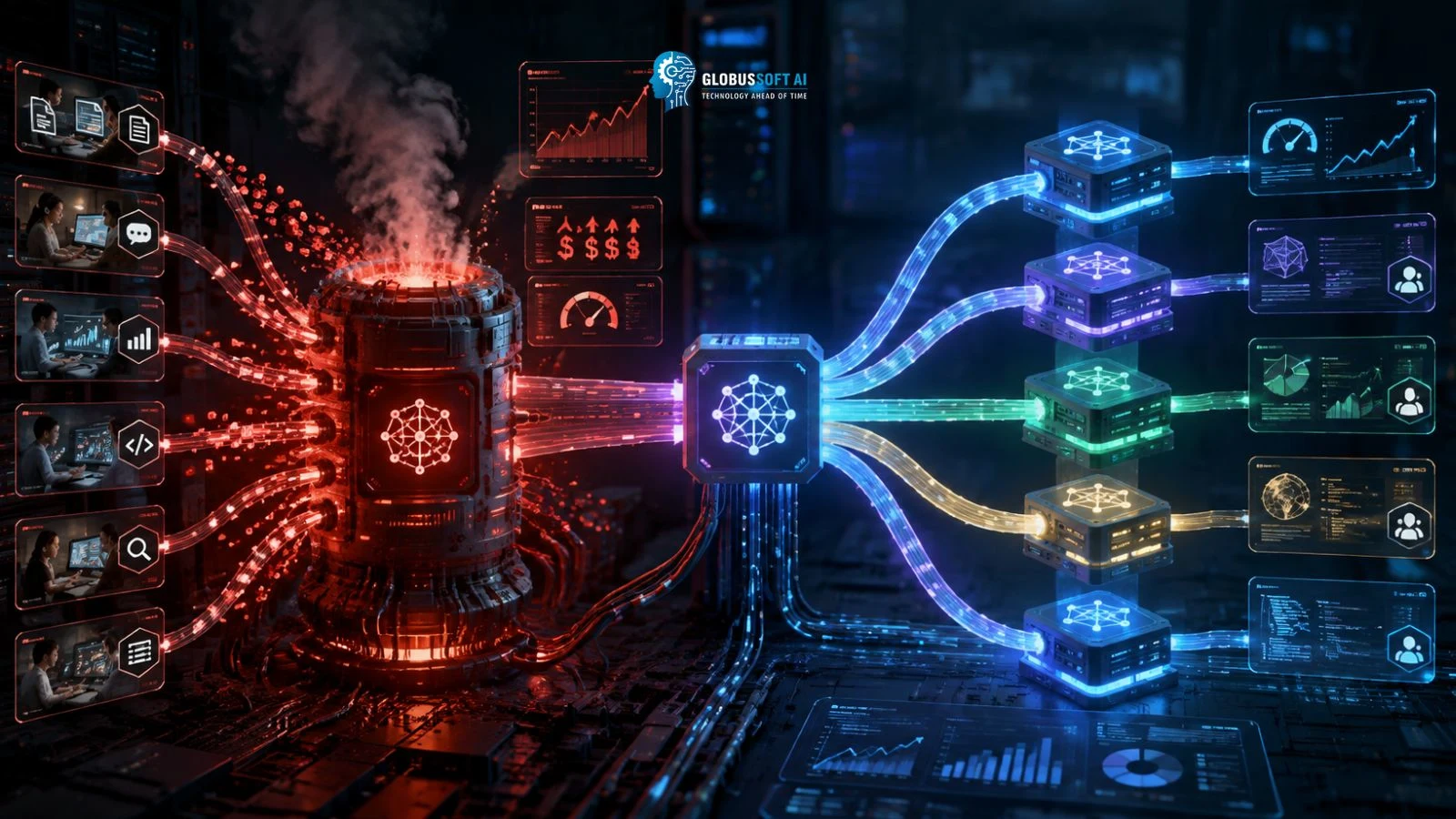
Gartner forecasts that 40% of AI agent projects will be cancelled by 2027 — not because they failed technically, not because the market shifted, but purely because of economics: runaway inference bills that make the ROI case impossible to close. Deloitte documented the same pattern in Q4 2025, with teams discovering tens of millions of dollars in monthly charges from agentic loops nobody had stress-tested at production volume.
The root cause is almost always the same decision made on day one: pick one frontier model, point every agent task at it, ship fast. It feels responsible — frontier quality, no complicated routing logic, predictable behavior. By the time the bills arrive, the architecture is load-bearing.
This is the single-model trap. And it’s avoidable, if you build the routing layer before you need it.
Listen To The Podcast Now!
Why Teams Default to One Model
The instinct makes sense early. You’re prototyping. You want the smartest model available because you don’t yet know which tasks are hard and which are trivially easy. A frontier model handles both without surprises. You ship something that works.
The problem: a frontier model costs an order of magnitude more per token than a capable specialist model. When you’re running a single demo, that ratio is invisible. When you’re running an AI agent handling thousands of business automation tasks per day — email triage, CRM lookups, lead enrichment, outbound copy generation — it becomes the entire cost structure of your product.
Agentic workflows amplify this further. A single user action often triggers a chain: one agent calls another, which calls a tool, which calls another agent. Each hop sends tokens to your frontier model. The bill compounds in ways that simple per-request pricing models completely hide until month-end.
The 80/20 Insight Most Teams Ignore
Mature production systems in 2026 route roughly 80% of requests to cheaper specialist models, reserving frontier models for the hardest 20%. Not because they’re cutting corners — because the 80% genuinely doesn’t need frontier capability.
Consider what an outbound sales agent actually does moment to moment. It verifies an email address. It looks up a company name. It checks whether a lead is already in the CRM. It generates a subject line variant. Most of these steps are classification, lookup, or light text generation — tasks a well-prompted smaller model handles at a fraction of the cost, with quality that’s measurable and sufficient for the job.
The genuine hard work — crafting a personalized cold email that references a specific funding round, reasoning through an ambiguous customer complaint, deciding whether a support ticket needs escalation — that’s your 20%. That’s where the frontier model earns its cost.
The teams who figure this out early build an orchestration layer that classifies each incoming request by complexity before routing it anywhere. The teams who don’t build that layer learn the lesson from their cloud bill.
What Multi-Model Routing Actually Looks Like?
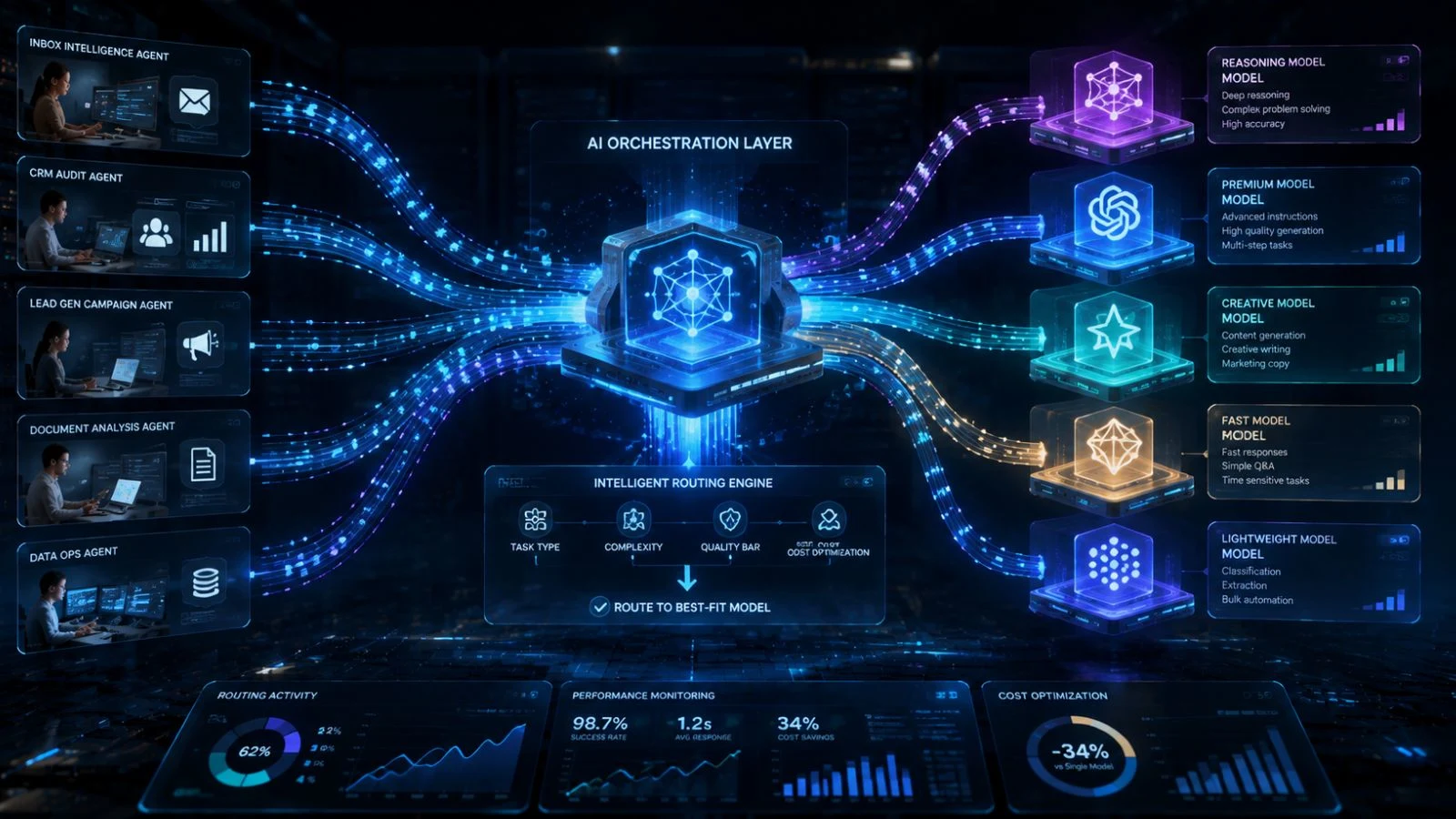
At Globussoftai, the embedded engineering approach to agent stacks is explicitly multi-model. The platform supports Claude, GPT, Gemini, and Qwen running in parallel. An orchestrator decides which model handles which step — not as a feature, but as a design principle that forces the routing question to be answered before any task is assigned.
The routing logic lives at the orchestration layer, not inside individual agents. Each agent in the stack — whether it’s the inbox intelligence agent triaging emails, the CRM audit agent building call lists, or the outbound lead-gen campaign agent generating personalized copy — has a complexity envelope defined up front. Tasks within that envelope go to the cheapest model that passes a quality bar for that task type. Tasks outside the envelope escalate.
This matters more than most builders realize, because the common failure mode isn’t “wrong model for the job.” It’s “no one ever defined what the job was precisely enough to know which model to use.” Vague task definitions collapse into “just send it to the frontier model” by default.
The Four Questions That Define Your Routing Logic
Before you can route intelligently, you need honest answers to four questions about each task your agent handles:
- Is the output verifiable? Email address validity, CRM field matching, URL extraction — these have ground truth. A cheaper model that hits an acceptable quality bar on verifiable tasks is measurable and often sufficient. Open-ended reasoning has no ground truth, which makes quality harder to proxy with cost savings.
- What’s the consequence of a wrong answer? A misclassified support ticket that goes to the wrong queue is recoverable. A misclassified legal clause in a contract review is not. Route by consequence, not just by apparent complexity.
- How many tokens does this step consume? Some tasks are cheap per-call but run thousands of times per hour. The aggregate matters more than the per-call cost. Steps that run at high frequency compound quickly — savings at that layer are where routing pays back fastest.
- Does this step require cross-task context? Steps that reason across multiple prior agent outputs — synthesizing findings, resolving contradictions, making a judgment call — tend to need frontier capability. Steps that operate on a single well-scoped input usually don’t.
Work through these for each node in your agent graph. What emerges is a routing map, not a routing algorithm. The map tells you where the 80% actually lives in your specific workflow. The algorithm can be surprisingly simple once the map exists.
What Goes Wrong Even When You Route Well
Routing isn’t a one-time architecture decision. This is where most teams get overconfident. They build a routing layer, it works, they move on.
Two things break it over time. First, model providers update their models. A smaller model that was accurate on your classification task in January may behave differently after a silent update in April. If you’re not running weekly reviews of per-model quality metrics, you won’t catch the drift until it’s causing real failures downstream.
Second, your task distribution shifts. The mix of easy and hard requests changes as your product evolves and your user base grows. A routing layer calibrated for an early-stage product with mostly simple queries may be dangerously under-routing to frontier models six months later when enterprise users are sending genuinely complex inputs.
This is why the embedded pod model — with a dedicated team doing ongoing custom AI agent development that includes weekly review of metrics, prompts, and model choices — exists. The routing layer is not infrastructure you set and forget. It’s a living decision system that needs calibration as the world around it changes.
The Economics, Plainly Stated
Frontier-lab FDE programs — Microsoft Frontier, Google Cloud FDEs, Anthropic Solutions — run $500k–$2M per year per embedded engineer, with contract minimums starting at $250k. For most founders and mid-market teams, that pricing model forecloses the option entirely.
The alternative isn’t to skip the embedded expertise. It’s to find it at a different price point. Globussoftai’s embedded pod is priced at approximately one-tenth of a frontier-lab FDE program — with the same first-principles approach to routing, model selection, and weekly calibration. The track record behind that approach: 40+ products shipped, 100M+ users reached, 300+ engineers led — built without nine-figure lab backing.
None of this matters if your agent stack is burning money faster than it creates value. The single-model trap is how that happens quietly, before you have the data to diagnose it. The routing layer — built before you scale, calibrated weekly, mapped to real task complexity — is how you stay out of the 40% Gartner says won’t survive to 2027.
If you’re building an agent stack and haven’t yet defined your routing logic, that’s the conversation worth having now. Talk to the Globussoftai team about building your multi-model agent architecture before the first production bill tells you what it should have cost.