
Most AI projects die quietly in week six, not because the model underperformed, but because nobody looked at the data first. After watching this pattern repeat across dozens of engagements, the single sharpest predictor of a failed AI project isn’t the model choice, the architecture, or even the team. It’s whether anyone ran a real data audit before the first sprint began.
This piece is about that audit: what it catches, what happens when you skip it, and how to scope it in a way that actually protects your budget.
Listen To The Podcast Now!
The 30–40% Budget Trap Nobody Warns You About
Here is the number that surprises almost every buyer. Data readiness alone can consume 30–40% of a project’s total budget before a single line of model code is written. On a $200K engagement, that’s $60–80K spent cleaning, restructuring, and validating data that was supposed to be “ready.”
Nobody budgets for this. Vendors scope against what the data is supposed to look like, not what it actually looks like once someone opens the tables.
Globussoftai describes the standard failure trajectory with uncomfortable precision: a six-week proof-of-concept deadline that “quietly stretches to eighteen months.“ The mechanism is almost always the same. The data audit phase, ideally weeks two through four, surfaces duplicate records, undocumented status codes, and PII buried in free-text fields. Each one becomes a negotiation. Each negotiation costs time. The clock keeps running.
What a Real Data Audit Actually Catches
Three failure modes dominate. Understanding them before you sign a contract changes the negotiation entirely.
1. Duplicate Records
A CRM used for five years across two regional sales teams will almost certainly contain duplicate customer records. That’s not a data quality failure; it’s a structural artifact of how CRMs get used. The problem surfaces hard when you try to train a classification model or build an inference pipeline on top: the model learns inconsistency as signal. Deduplication requires human judgment on ambiguous matches, business rules for which record wins, and a verification pass. Budget weeks, not days.
2. Undocumented Status Codes
Every system accumulates fields whose meaning has drifted. A status field that once had four values now has seventeen, and only two people remember what codes 9 and 11 mean. One of those people left the company. When an AI model ingests these fields, it either ignores them (losing signal) or learns a mapping that no longer reflects reality (introducing noise). The audit has to produce a living data dictionary. This takes time to get right and is rarely scoped into the original statement of work.
3. PII in Free-Text Fields
This one carries legal weight. Notes fields, support ticket descriptions, and email threads frequently contain names, phone numbers, account numbers, and health information typed in by humans over years. If your use case touches HIPAA, SOC 2, GDPR, or SEC rules, that PII cannot flow into model training or inference without specific controls. Discovery and remediation before any model work begins is not optional; it’s a compliance precondition. Missing it doesn’t just slow you down; it can terminate the project entirely.
The Evaluation Harness Step Amateurs Skip
Once data is clean, most teams rush straight to model selection. That’s the second mistake. Before you scale anything, you need a labeled test set, typically 100–500 examples, built by humans against real business criteria, that becomes your permanent benchmark. Every model choice, every prompt change, every architecture decision gets measured against that harness.
Without it, you’re flying blind. You’ll ship a version that “feels better” in demo and regresses on the cases that actually matter in production.
The harness is what lets you confidently swap prompts and model choices in hours rather than weeks. That speed is the production architecture pattern that actually works: a strong frontier model for generation, paired with a smaller task-specific classifier for routing and triage. The harness tells you when you’ve broken something. Without it, you’re guessing.
This is one of the practices that separates shops that ship in 30 days from shops that ship in 18 months. It isn’t glamorous. It doesn’t show up in any architecture diagram. But it’s the mechanism that makes rapid iteration safe.
RAG or Fine-Tune? Wrong Question If Your Data Isn’t Ready:
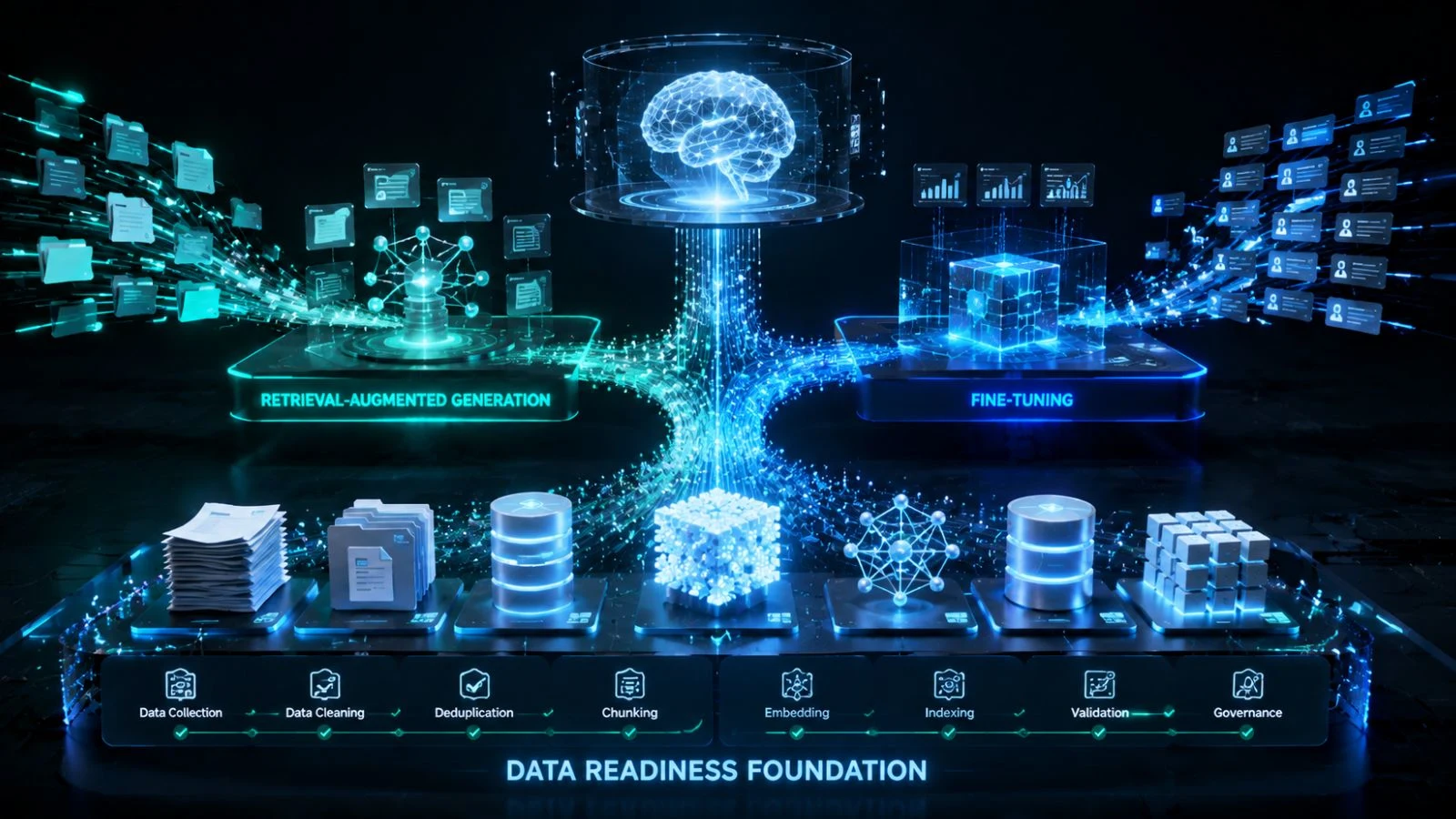
The buyer debate that consumes the most pre-sales time RAG versus fine-tuning- becomes almost irrelevant if you haven’t resolved data readiness first. But for what it’s worth, the decision rule is cleaner than most vendors admit.
Use RAG for fresh, changing documents: policy manuals, product catalogs, support ticket histories. The content changes faster than you can retrain. Use fine-tuning for fixed tasks with stable formats, classifying support tickets into a known category set, for instance, where the schema doesn’t shift and labeled examples are plentiful.
What moves RAG accuracy more than model choice? Chunking strategy and embedding quality. Most teams obsess over which foundation model to use and under-invest in how documents are split and indexed. The foundation model is rarely the bottleneck. The retrieval pipeline usually is.
How to Scope a Project That Won’t Blow Up
A few concrete things to demand before signing any AI development engagement:
- Explicit data audit phase in the SOW. Weeks two through four, with defined deliverables: a data dictionary, a PII inventory, a list of fields excluded from model input and why. If the vendor skips this or folds it into “discovery,” push back.
- A labeled evaluation harness before any model runs in production. Ask who builds it, who validates the labels, and how it gets maintained as the business logic evolves. Vague answers here predict expensive rework later.
- A clear POC timeline with a realistic milestone gate. A proof-of-concept should run 6–10 weeks and cost in the low tens of thousands, not stretch open-endedly into a second quarter. The gate question at week six is simple: does this work on real data from your environment, not on a cleaned demo dataset?
- Multi-model flexibility from day one. Lock-in to a single model provider is a risk that compounds over time. Production systems need the ability to swap or route across models as capabilities and pricing shift.
The outbound sales automation use case illustrates this well. An agent that handles lead finding, email verification, personalized copy generation, and CRM sync touches four distinct data sources, each with its own quality problems. A project scoped without auditing all four upfront will stall. The email verification layer eventually discovers that a significant share of CRM records carry invalid or outdated domains. By the time that surfaces, the personalization layer is already built on top of bad inputs. That’s the failure pattern, and it’s avoidable with a front-loaded audit.
The Real Cost of Frontier-Lab Programs vs. Embedded Engineering
One more budget reality that rarely gets stated plainly. Frontier-lab FDE programs from Microsoft, Google Cloud, and Anthropic Solutions run $500K–$2M per year per engineer, with contract minimums starting at $250,000. That’s before any data remediation work, which those programs don’t typically absorb into their fees.
An embedded engineering model, where the team drops into your Slack and codebase from scoping to production with no offshore handoffs, runs at roughly one-tenth that cost. The embedded pod model at Globussoftai is structured to ship a first agent within 30 days, deployed to real users, with weekly review of metrics, prompts, and model choices on retainer or hand-off. That cadence is what keeps data debt from accumulating silently into a second-phase crisis.
The production track record: 40+ products shipped, 100M+ users reached, 300+ engineers led. One concrete example is a spam false-positive rescue agent that recovers 100+ misclassified messages per day. It does this through a secondary classification layer that scores borderline-rejected emails against historical engagement patterns. That kind of production specificity doesn’t come from a team that skipped the data audit.
A Practical Pre-Engagement Checklist
Before your next AI development kickoff, get answers to these questions in writing:
- Which data sources feed the model, and when was each last audited for quality?
- Are there free-text fields in scope? Who owns PII remediation?
- What does the evaluation harness look like, who labels it, and how is it maintained?
- What is the contract milestone that gates the POC from the production build?
- Which models are in scope, and what is the process for swapping or routing across them?
If a vendor struggles to answer these, that’s diagnostic information. The teams that answer without hesitation are the ones who have learned from production failures, not just demos.
For a deeper look at how these decisions compound across the full build lifecycle, the custom AI software development buyer’s guide covers the build-vs-buy framework in detail. And if integration failure is your specific worry, why custom AI development fails at integration is worth reading before you scope the next phase.
Data readiness is unglamorous. It doesn’t make a good demo slide. But it is the single most reliable indicator of whether your AI project ships in 30 days or 18 months and whether the thing that ships actually works on the data your business actually has.