
If you have ever spent hours pulling data, formatting charts, and writing summaries just to produce one report, you already know how exhausting that process can be. An AI report generator changes the game entirely. Instead of grinding through repetitive tasks, you let intelligent software handle the heavy lifting, and you focus on decisions that actually matter.
This guide breaks down everything you need to know about using an AI report generator, from how it works to the best tools available today.
In a hurry? Listen to the blog instead!
What Is An AI Report Generator?
An AI report generator is a software tool powered by artificial intelligence that automatically collects, analyzes, and presents data in a structured report format. Whether you need a business summary, a financial update, a project progress log, or a research paper,a report making AI can produce it in a fraction of the time it would take a human to do manually.
The technology behind these tools typically involves natural language processing (NLP), machine learning models, and data integration APIs.
Together, they allow the system to understand raw inputs, spreadsheets, databases, survey results, web analytics, and transform that information into readable, professional documents.
Why Businesses Are Turning To AI For Report Generation?
Reporting has always been a pain point for teams across every industry. Marketing agencies produce weekly performance summaries. Finance teams deliver monthly P&L reports. Project managers track milestones, delays, and budgets, often all at once.
Manual reporting drains time and introduces human error. A single data entry mistake can throw off an entire quarterly review. This is exactly why the demand for a reliable AI report generator has grown so sharply over the past two years, especially with deeper AI integration across business systems.
Using a report generator AI gives organizations several clear advantages. Speed is the most obvious one, what once took a team two days can now be done in minutes. Accuracy improves because the system pulls directly from source data. Consistency also increases because templates and formatting remain uniform across every report produced.
Beyond efficiency, there is a strategic benefit. When teams spend less time on reporting, they spend more time on interpretation, planning, and action. That shift alone can have a measurable impact on business performance.
What Are The Key Features To Look For In An AI Report Generator?
Not every report making ai is built the same way. Before choosing a platform, it helps to understand what separates a good tool from a great one.
Data Integration:
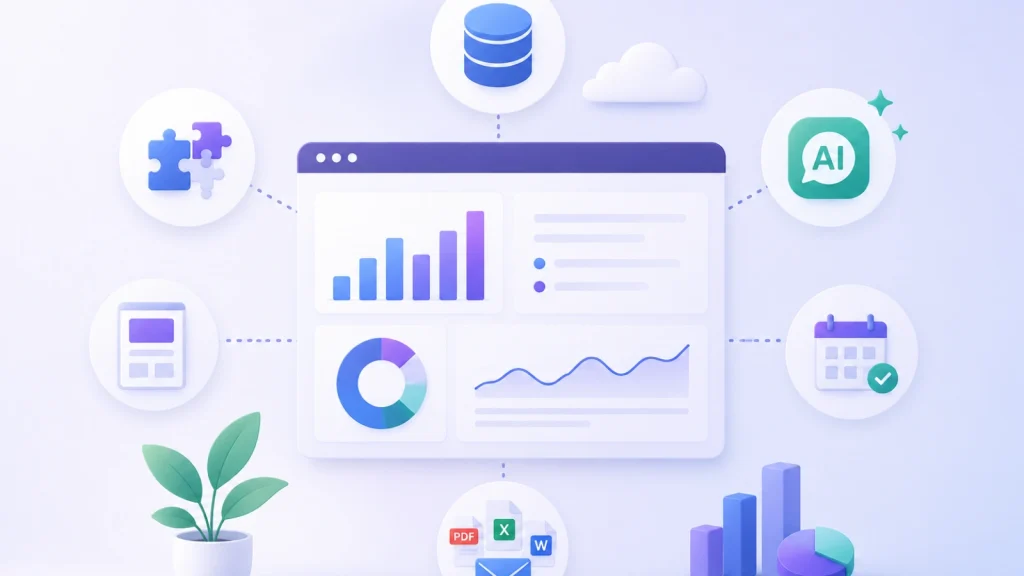
A strong report making AI should connect seamlessly with the data sources your team already uses. That includes Google Analytics, CRM platforms, spreadsheets, databases, and project management tools. The fewer manual imports you need to make, the better.
Customizable Templates:
Good tools let you design report templates that match your brand, structure, and audience. Whether you are sending a client-facing marketing report or an internal operations review, the format should adapt to your needs, not the other way around.
Natural Language Generation:
The best ai report generator platforms use natural language generation (NLG) to write human-readable narratives around your data. Instead of dumping numbers on a page, they explain trends, highlight anomalies, and surface insights in plain English.
Automated Scheduling:
Instead of manually triggering each report, modern tools allow you to schedule automatic generation and delivery. Your team receives fresh reports every Monday morning without lifting a finger.
Export and Sharing Options:
Reports need to reach different audiences in different formats. The right report making ai should export to PDF, Word, Excel, and web-based formats, and ideally support sharing via email or collaboration platforms.
Also Read:
AI Integration: How to Bring AI Into Your Workflows
How Do Artificial Intelligence Services Drive Business Growth?
How An AI Report Generator Works: Step By Step?
Understanding the workflow helps you get the most out of these tools.
1 — Connect Your Data Sources You link the tool to the relevant data streams, your CRM, analytics platform, database, or uploaded files.
2 — Define the Report Structure You select a template or create a custom layout. You specify what sections you want, what metrics to highlight, and what comparisons to draw.
3 — Let the AI Process the Data The report making AI pulls the data, applies calculations, identifies patterns, and structures the findings into the report layout you defined.
4 — Review and Edit Most platforms allow you to review the output and make manual adjustments before finalizing. A good tool makes this step optional, not necessary.
5 — Export and Distribute You send the finished report to stakeholders in whatever format works best for them.
The entire process, which once required hours of work, now takes minutes.
Are Free AI Report Generators Worth It?
Many people search for a free AI report generator when they are just getting started. And yes, free options do exist, but they come with trade-offs.
Most free tools limit the number of reports you can generate per month, restrict template customization, or cap the volume of data you can process. They may also lack advanced features like automated scheduling, multi-source integration, or natural language narrative generation.
If you are testing the concept for the first time, a free AI report generator is a perfectly reasonable place to start. For teams with ongoing reporting needs, however, investing in a more capable platform almost always pays off quickly. The time savings alone justify the cost within weeks.
How Does A Project Report AI Generator Improve Project Management Efficiency?
Project management is one of the areas where a project report AI generator delivers the most obvious value. Project reports serve multiple audiences, clients want progress updates, internal teams need task tracking, and executives want budget visibility. Producing all three versions manually from the same underlying data is time-consuming and prone to inconsistency.
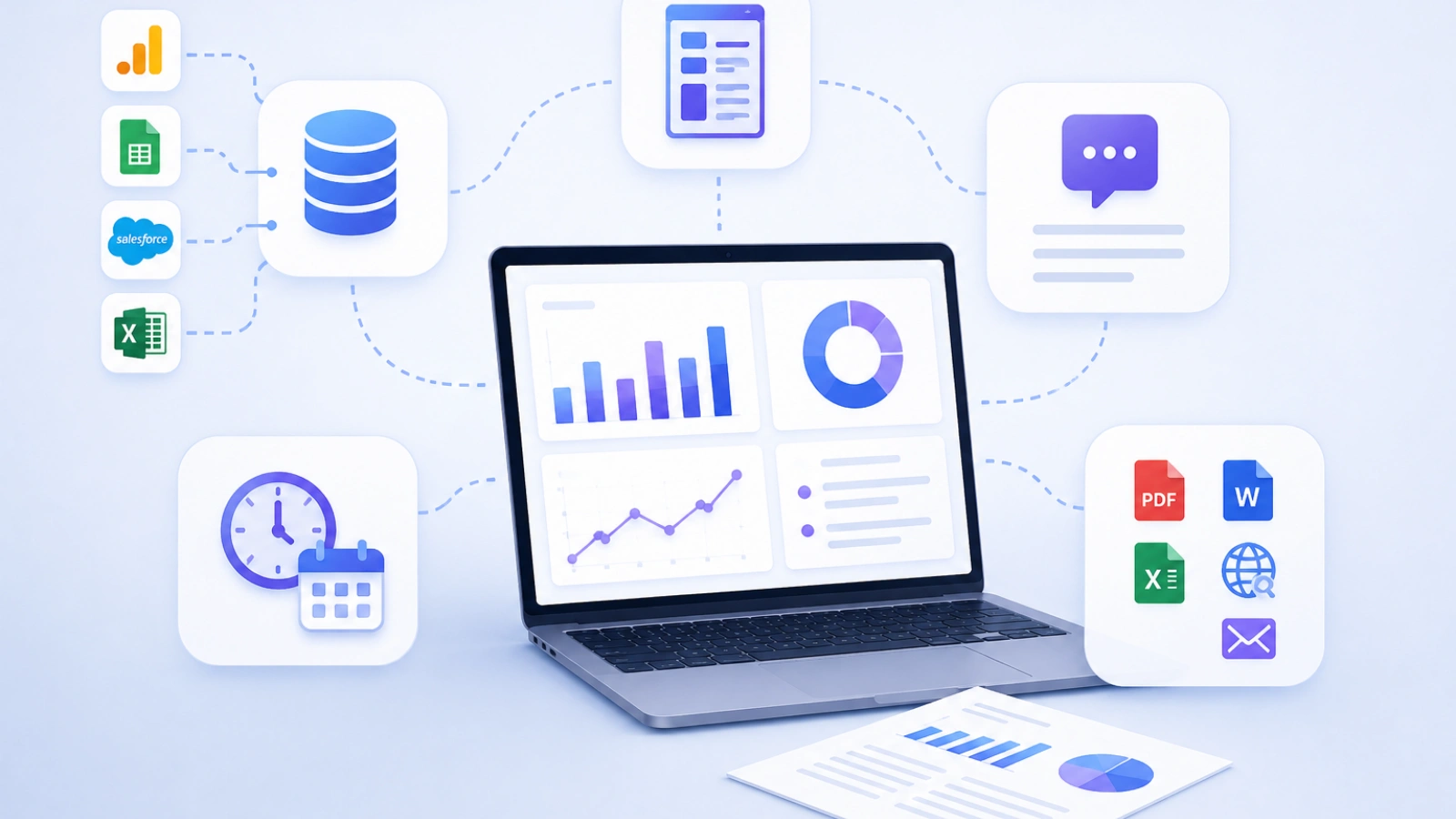
A project report ai generator solves this by letting you define different report views from a single data source. The project manager gets a detailed task-level breakdown. The client receives a polished summary with milestone progress and next steps. The executive sees a high-level budget and timeline overview.
All three come from the same input, generated automatically, and delivered on schedule. That is the kind of operational efficiency that transforms how teams work.
As the adoption of AI tools accelerates, businesses are increasingly looking beyond off-the-shelf solutions toward platforms that can truly integrate intelligence into their workflows. This is where Globussoft.AI enters the picture.
Globussoft.AI is an enterprise-grade AI and machine learning services company that builds intelligent agents and custom solutions for modern businesses. While it is well known for its broader AI capabilities, its approach to automation, including data processing, workflow intelligence, and document generation, makes it a powerful ally for organizations looking to elevate their reporting processes.
Rather than offering a one-size-fits-all AI report generator, Globussoft.AI takes a consultative, customized approach, building AI systems that understand your specific data environment, your reporting goals, and your team’s workflow.
Globussoft.AI: Features Built For Real Business Impact

Here is a closer look at what Globussoft.AI brings to the table and why it stands out for businesses that take reporting and workflow automation seriously.
Intelligent AI Agent Development:
Globussoft.AI designs and deploys AI agents that can automate repetitive, rule-based workflows, exactly the kind that make up most of a reporting process.
From data collection and classification to summarization and delivery, these agents operate continuously without human intervention, reducing errors and freeing your team to focus on higher-value analysis.
LLM-Powered Knowledge Systems:
The platform leverages large language models (LLMs) to build systems that understand context, interpret data, and generate human-readable outputs. For reporting purposes, this means your generated content does not read like a machine wrote it, it reads like a knowledgeable analyst summarized it.
AI/ML Pipeline Replication:
Globussoft.AI can replicate and adapt proven AI capabilities, including those from leading models, to fit your specific business requirements. This dramatically reduces development time and cost, giving you faster access to enterprise-grade reporting automation.
LLM Fine-Tuning for Domain Accuracy:
Generic AI tools often miss the nuance of industry-specific language and data. Globussoft.AI fine-tunes models against your domain, your terminology, and your reporting standards. The result is outputs that are not just accurate, they are relevant and contextually appropriate.
Seamless Integration into Existing Systems:
One of the biggest challenges with adopting a new ai report generator is integration. Globussoft.AI specializes in connecting AI capabilities to existing tech stacks without disruption. Whether your data lives in a CRM, an ERP, a database, or a spreadsheet, their team builds the connectors that bring it all together.
End-to-End Enterprise Support:
Globussoft.AI does not drop a solution and walk away. Their five-phase engagement model covers strategic discovery, data preparation, model development, fine-tuning, and ongoing deployment support. For organizations that need a long-term reporting partner rather than a plug-and-play tool, this kind of support is invaluable.
Which Industries Use AI Report Generators And How Do They Benefit?
AI report generators are being widely adopted across different industries because they simplify complex reporting tasks and save significant time. By automating data collection and analysis, they help organizations produce accurate, consistent, and insightful reports with minimal manual effort.
- Marketing & Advertising:
Automate campaign performance reports by pulling data from multiple ad platforms and creating unified client and leadership summaries.
- Finance & Accounting:
Generate profit and loss statements, budget variance reports, and cash flow analysis without manual spreadsheet work.
- Healthcare:
Summarize patient data, track operational performance, and support compliance reporting with higher accuracy and speed.
- Real Estate:
Create property performance reports, lead pipeline tracking, and market trend analysis automatically.
- Education:
Produce student performance reports, enrollment analytics, and institutional reporting with minimal administrative effort.
Tips For Getting The Most Out Of An AI Report Generator
Even the most powerful tool requires thoughtful use. Here are a few practical ways to maximize results.
Start with clean data. An ai report generator is only as good as the data it processes. Before automating your reporting, audit your data sources for completeness and accuracy.
Define your audience before your template. Who reads this report and what decision do they need to make? Start there, then build your structure around that goal.
Use narrative generation features. The most valuable thing a good AI report generator does is explain what the numbers mean, not just display them. Enable and customize the narrative output for maximum impact.
Iterate on your templates. The first version of any automated report is rarely the final version. Collect feedback from stakeholders and refine your templates regularly.
Automate delivery. Set up scheduled distribution so reports reach the right people at the right time without anyone having to remember to send them.
The Future Of AI Report Generation

The technology behind the AI report generator continues to advance rapidly. Multimodal AI systems, which can analyze images, audio, and video alongside text and numerical data, are beginning to reshape what a report can include.
Real-time reporting is also becoming standard. Rather than generating reports at the end of the week or month, teams increasingly want live dashboards powered by the same AI intelligence that drives their automated reports, often delivered through advanced AI services integrated into business workflows.
Personalization is another frontier. Future systems will generate different versions of the same report automatically for different roles, executives, managers, frontline teams, without any additional manual effort from the report creator.
The AI report generator of 2026 is already far more capable than it was just two years ago. The tools available today represent a genuine leap forward in how businesses understand and communicate their performance.
Final Thoughts
Reporting is not going away. If anything, the demand for more frequent, more accurate, and more insightful reports is growing across every industry. The question is no longer whether to use an AI report generator, it is which one to use and how to integrate it effectively into your workflow.
For teams that need a straightforward automation tool, many solid platforms are available at various price points, including free options for getting started. For organizations that want to build something more sophisticated, a reporting system that truly understands your data, your language, and your business, a partner like Globussoft.AI offers the depth, customization, and ongoing support to make that happen.
The time you save with a well-implemented AI report generator is time you can reinvest in the analysis, strategy, and leadership decisions that actually move your business forward. That is an investment worth making.
FAQs
- Can it replace human analysts completely?
No, it automates data processing and reporting, but human analysts are still needed for strategy, decision-making, and context interpretation. - Is my data safe when using it?
Most trusted platforms use encryption and secure APIs. However, data safety depends on the provider, so always choose tools with strong security and compliance standards. - Do these tools work with real-time data?
Yes, many advanced systems can connect to live data sources and update reports in real time or near real time depending on integration support. - Can I use it without technical skills?
Yes, most modern tools are designed for non-technical users with drag-and-drop interfaces and pre-built templates. - What industries benefit the most from it?
Industries like marketing, finance, healthcare, SaaS, education, and logistics benefit heavily due to their high reporting needs and data complexity.