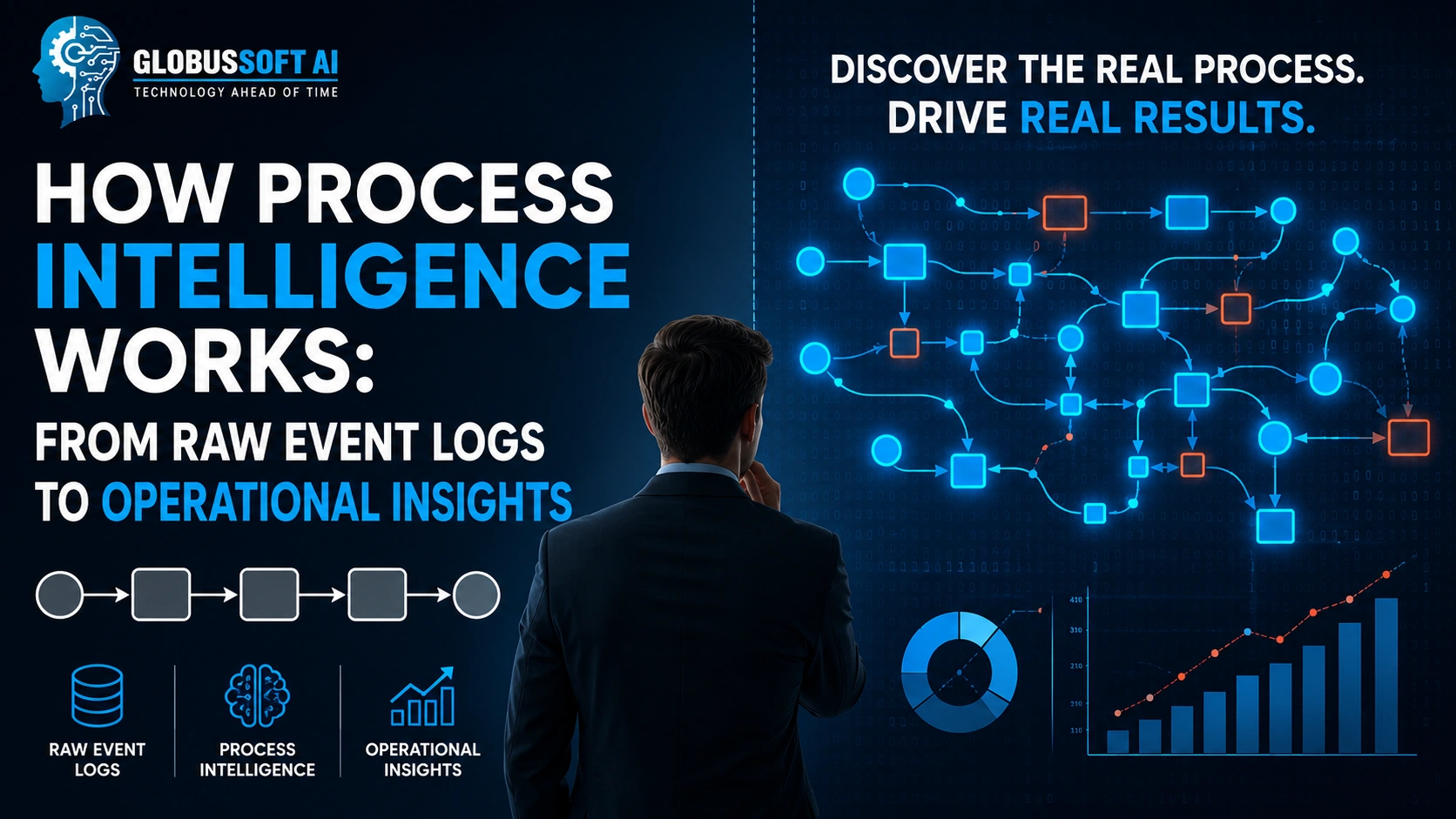
Every CEO has a mental model of how their business operates. And almost every CEO is wrong. The gap between the process leadership writes down and the process that actually runs, what practitioners call the “process reality gap”, is where margin, speed, and compliance quietly leak away. Process intelligence is the discipline that closes that gap
Process intelligence is the technology that reconstructs how business processes actually run by analyzing event data from enterprise systems. It helps organizations identify bottlenecks, compliance risks, and improvement opportunities in real time, turning raw event logs into actionable operational insights.
What Is Process Intelligence? A Modern Definition
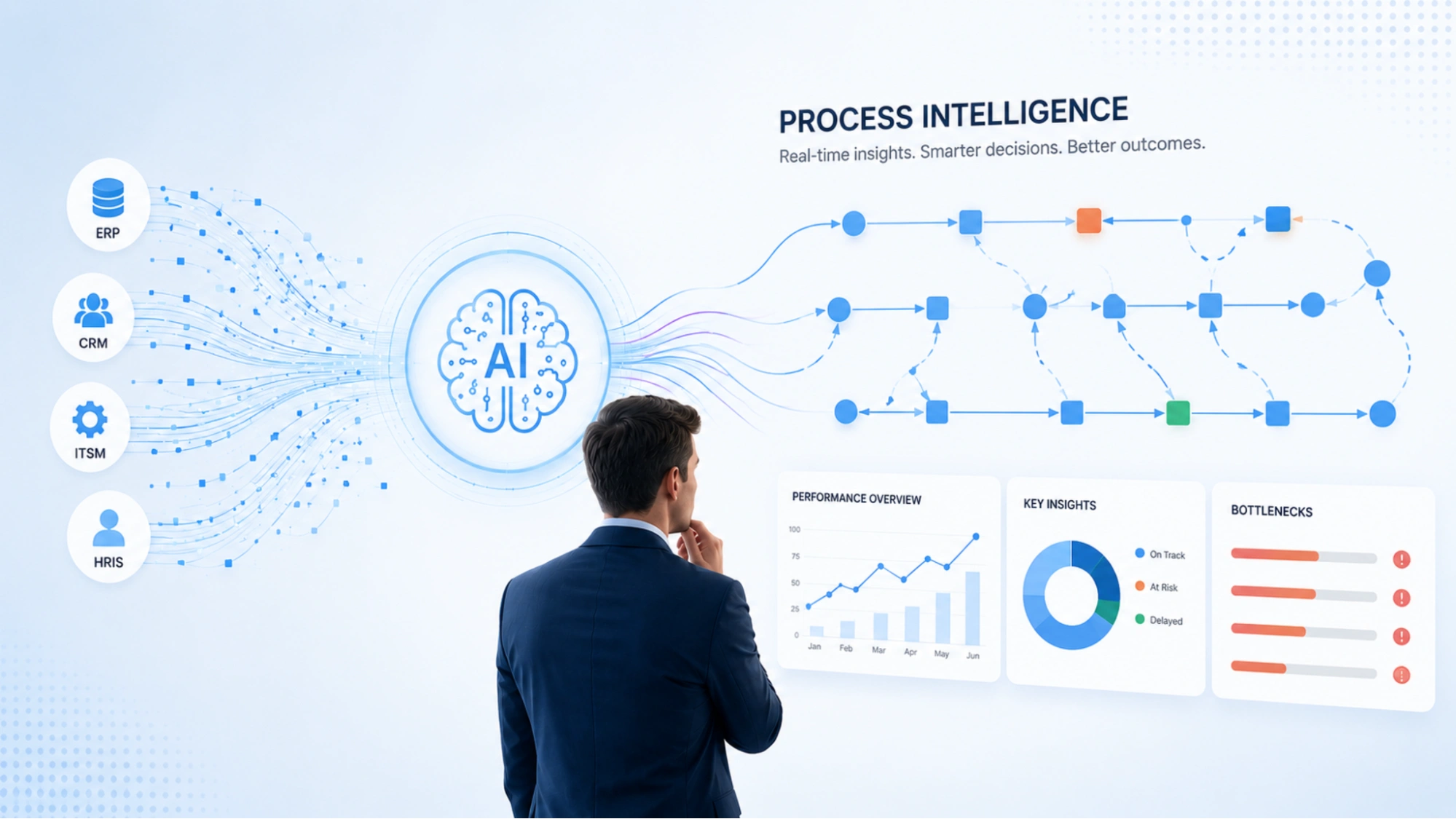
Process intelligence combines traditional process mining with real-time event data and AI-driven analysis to give organizations a continuously updated, evidence-based view of how work flows through their systems.
Process Mining vs. Business Process Intelligence: What’s the Difference?
The two terms are often used interchangeably, but the distinction matters. Process mining is retrospective: it analyzes completed cases to reconstruct what happened. Business process intelligence is the broader, continuous, predictive layer built on top; it doesn’t just describe the past, it monitors the present and forecasts where the next bottleneck will appear. Process mining tells you the invoice approval took 14 days. Business process intelligence tells you which invoice currently in the queue will breach SLA tomorrow, and why.
Where Process Intelligence Software Fits in the Modern Stack
Intelligence software sits between source systems, ERP, CRM, ITSM, HRIS, and execution tools like RPA, workflow automation, and BI dashboards. It’s the diagnostic layer that tells the AI automation layer where to point.
The Foundation: How Event Logs Power Process Intelligence
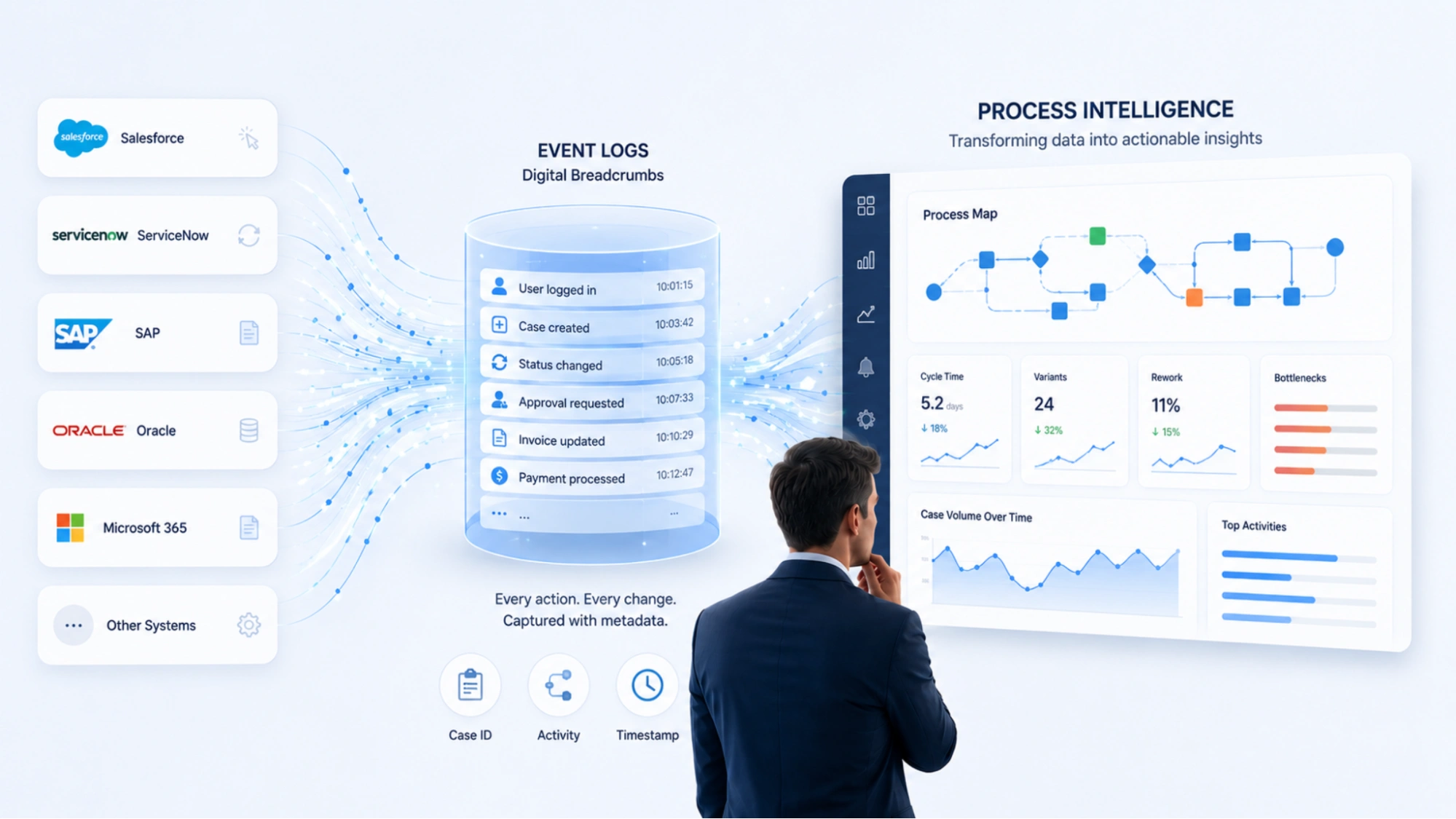
Every modern enterprise system leaves a trail. Every click in Salesforce, every status change in ServiceNow, every line-item update in SAP gets logged with metadata. These digital breadcrumbs are the raw material of process intelligence.
The Three Required Fields
To reconstruct any process, only three data points are non-negotiable:
Case ID, the unique identifier that ties events to a single journey (e.g., Order #4471, Ticket INC-9982).
Activity Name, the discrete step that occurred (“Invoice Approved,” “Order Shipped”).
Timestamp, the exact moment the activity happened, which lets the engine measure duration and sequence.
With these three fields across millions of cases, the system can rebuild the actual process map, including every variant, loop, and shortcut your teams have invented but never documented.
Continue Reading
Explore more insights on AI, automation, and digital transformation.
How Process Intelligence Works in 4 Steps
Once event data is available, every modern process intelligence platform runs the same four-stage pipeline.
Step 1: Data Extraction and Ingestion
Pre-built connectors pull event data from SAP, Salesforce, ServiceNow, Workday, Oracle, and dozens of other systems via API. Modern platforms stream this data in near real time rather than waiting for nightly batches, which means the process map you’re looking at reflects what happened minutes ago, not last week.
Step 2, Automated Process Discovery
Discovery algorithms reconstruct the actual flow of work without human input. The system shows you the “happy path”, the ideal sequence, alongside every real variant. A purchase-to-pay process documented as having 6 steps often turns out to have 200+ variants in production. Seeing them all on one map is usually the first uncomfortable moment of a process intelligence project.
Step 3, Conformance Checking
The platform compares actual execution against your documented standard operating procedure. Every deviation is flagged: skipped approvals, out-of-order steps, and manual workarounds that bypass system controls. This is where compliance, audit, and risk teams find evidence they previously had to assume existed.
Step 4, Root-Cause and Predictive Analysis
The AI layer surfaces the why. Why do this supplier’s invoices take 3x longer? Why do German cases loop back through credit review more often? And, looking forward, which open cases will breach SLA in the next 48 hours? This is the step that converts a process map from a diagnostic artifact into an operational decision-making tool.
Benefits and Real-World Use Cases of Process Intelligence
Measurable Business Benefits
Mature process intelligence deployments typically deliver:
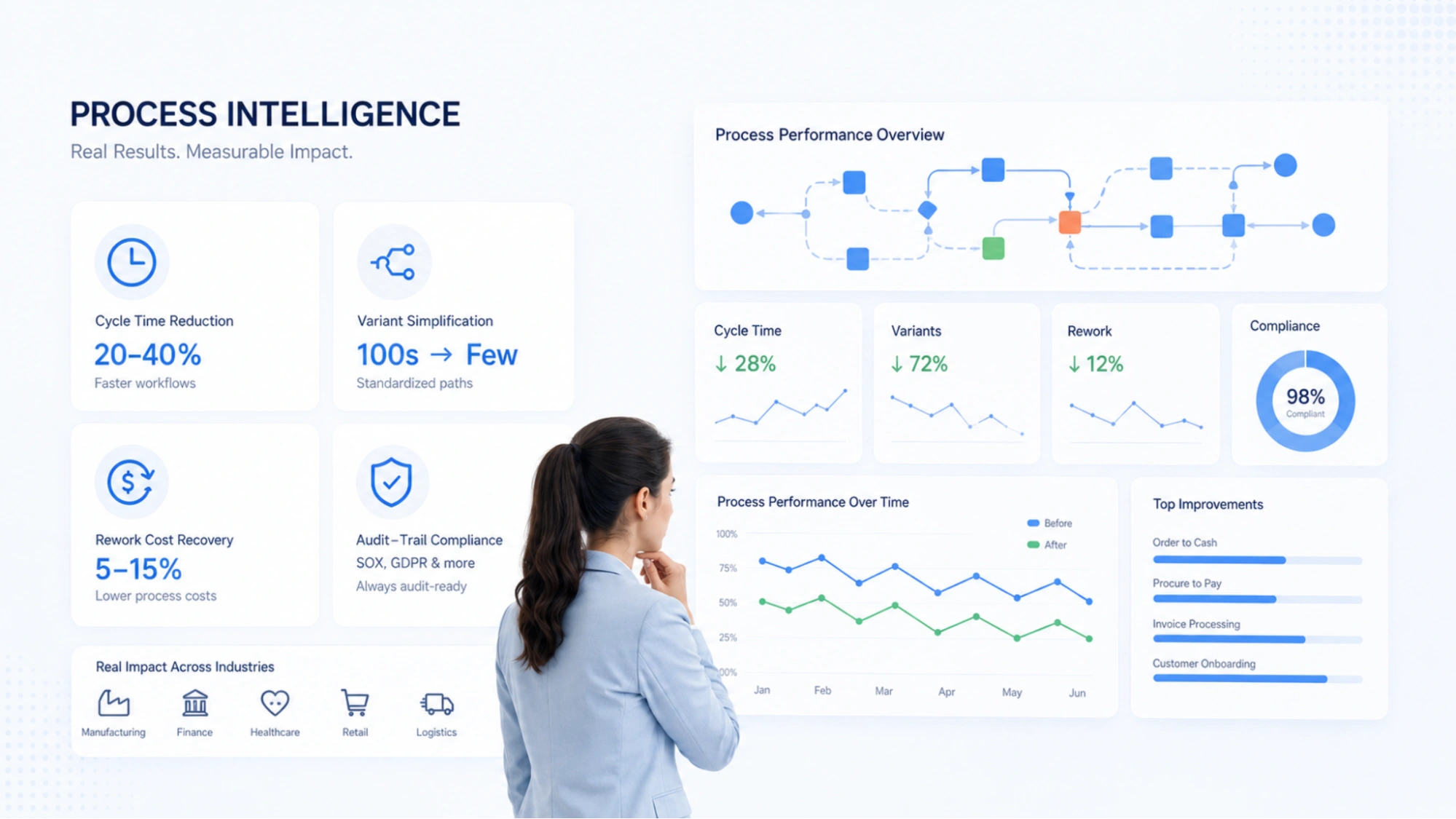
Cycle time reduction of 20–40% in order-to-cash and procure-to-pay workflows.
Variant simplification, collapsing hundreds of process variants into a handful of standardized paths.
Rework the cost recovery of 5–15% of process-related operating costs by eliminating loops and double-handling.
Audit-trail compliance that satisfies SOX, GDPR, and industry-specific frameworks without manual evidence collection.
Use Cases by Industry
Manufacturing: Siemens uses process intelligence to monitor production-line throughput and overall equipment effectiveness across global plants.
Financial services: Banks use it to compress KYC, AML, and credit-decision cycle times, often cutting onboarding from weeks to days.
Healthcare: Hospital networks use it to map patient flow and accelerate claims processing.
Shared services: Uber and Vodafone have publicly described using intelligence to recover working capital leakage in procure-to-pay.
The common thread: process intelligence converts ambient operational data into specific, dollar-denominated improvement targets.
Read Next
What Are Enterprise AI Agents and Why Use Them?
Test Automation Explained: Everything You Need To Know
How to Choose the Right Process Intelligence Software
Five Must-Have Capabilities
When evaluating process intelligence software, insist on:
Real-time data ingestion, not just scheduled batch loads.
Pre-built connectors for your core systems (SAP, Salesforce, ServiceNow at a minimum.
AI-driven root-cause analysis that explains why a bottleneck exists, not just where.
Object-centric process mining support is the emerging standard for modeling cross-process dependencies.
A native AI integration path into RPA and workflow automation, so insights can trigger action.
Leading Process Intelligence Software Vendors to Evaluate
The current market leaders include Celonis, SAP Signavio, UiPath Process Mining, Software AG ARIS, Microsoft Power Automate Process Mining, and the open-source-friendly Apromore. Gartner and Forrester both publish annual evaluations covering these vendors. Mid-market organizations should weigh ease of deployment and connector coverage; large enterprises should weigh scalability and object-centric capabilities.
Common Implementation Challenges (and How to Avoid Them)
Even well-funded process intelligence programs stall. The most common failure modes, and the corresponding mitigations:
Data silos and inconsistent timestamps across source systems → resolve with a unified data layer before discovery begins.
Privacy exposure from personal data in event logs → apply pseudonymization at extraction; involve the DPO early on GDPR-scoped processes.
Organizational resistance when process visibility surfaces uncomfortable truths → start with a sponsored, low-political-risk process to build credibility before tackling sensitive ones.
Treating process mining as the destination → without a connected action layer (RPA, workflow), insights stay trapped on dashboards.
The pattern across failed programs is consistent: insufficient executive sponsorship for the change that the data inevitably demands.
How Globussoft AI Turns Process Intelligence Into Action
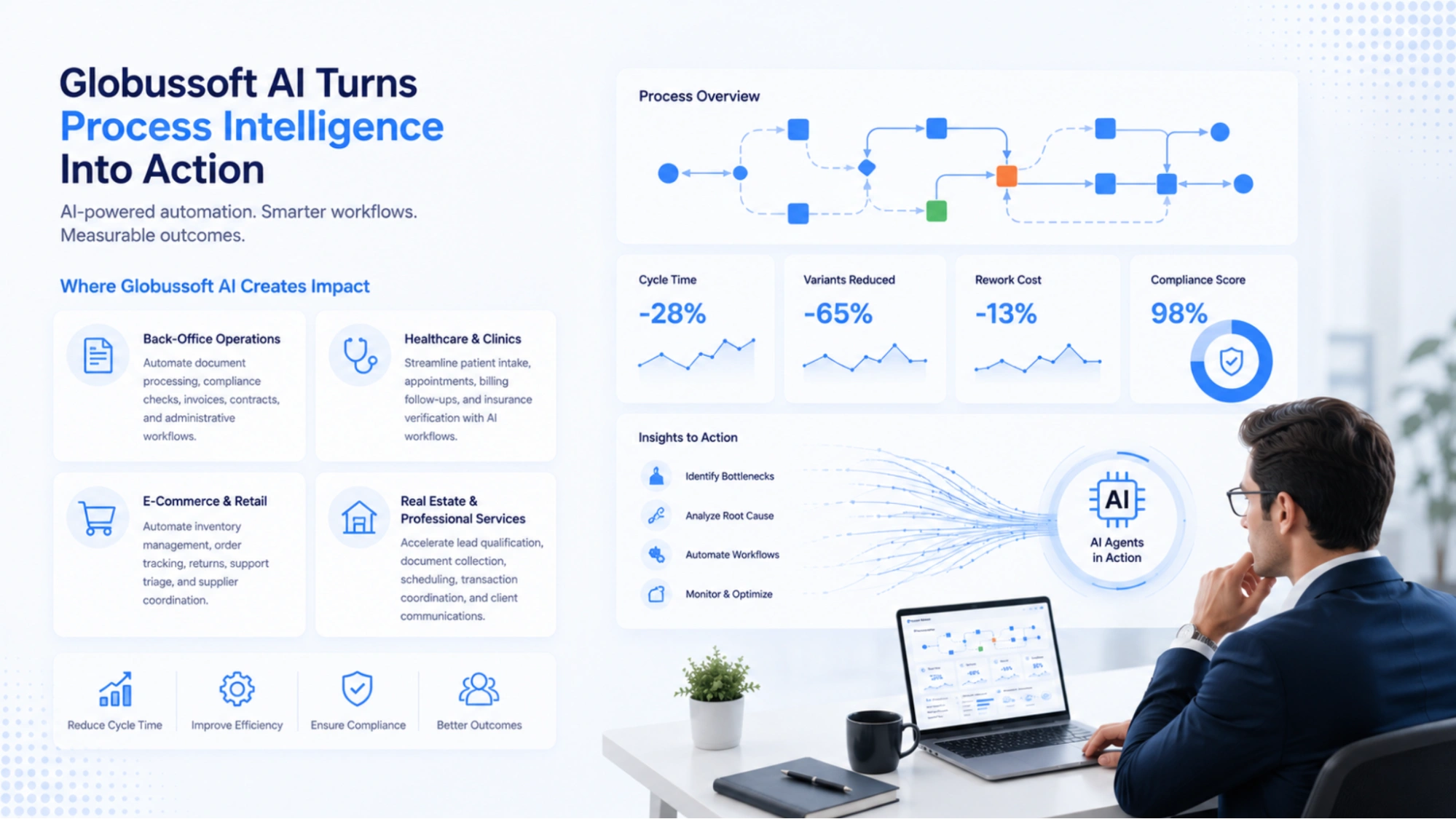
Most organizations already have the data needed for process intelligence. The challenge is transforming insights into measurable operational improvements. This is where implementation-focused AI platforms create value.
Globussoft AI helps businesses move beyond process visibility by combining AI-powered automation, workflow optimization, and intelligent decision-making capabilities. Instead of simply identifying bottlenecks, organizations can automate repetitive workflows, reduce manual intervention, and accelerate business outcomes.
Where Globussoft AI Creates Impact
Back-Office Operations
AI agents automate document processing, compliance checks, invoice handling, contract reviews, and administrative workflows that traditionally consume significant employee time.
Healthcare & Clinics
From patient intake and appointment scheduling to billing follow-ups and insurance verification, AI-powered workflows reduce administrative burden while improving service delivery.
E-Commerce & Retail
Inventory management, order tracking, returns processing, customer support triage, and supplier coordination can be streamlined through intelligent automation.
Real Estate & Professional Services
Lead qualification, document collection, scheduling, transaction coordination, and client communications become faster and more consistent with AI-driven workflows.
The Future of Process Intelligence (2026 and Beyond)
Four trends are reshaping the category:
- Agentic AI that executes process improvements autonomously rather than recommending them to humans.
- Object-centric process mining replaces case-centric models, allowing analysis across orders, invoices, deliveries, and returns simultaneously.
- Convergence with task mining (desktop-level data capture) for end-to-end visibility from system events to individual keystrokes.
- Process intelligence is the system of record for enterprise AI deployment decisions, telling leadership which processes are actually ready for automation, and which are too unstable to automate yet.
The trajectory is clear: from descriptive, to predictive, to autonomous.
Frequently Asked Questions
Q: What is the difference between process mining and process intelligence?
Process mining is retrospective; it analyzes completed cases to show what happened. intelligence is the broader, continuous layer that adds real-time monitoring, AI-driven root-cause analysis, and predictive forecasting on top of process mining.
Q: Is process intelligence the same as business process intelligence?
Yes. The terms are used interchangeably in the industry, though “business process intelligence” emphasizes the business-outcome orientation, while “process intelligence” is the dominant short form.
Q: What data do you need to start a process intelligence project?
At minimum, three fields per event: a Case ID, an Activity Name, and a Timestamp. Most enterprise systems already log all three.
Q: How long does a process intelligence implementation take?
First insights typically appear within 4–8 weeks; full enterprise rollouts run 6–18 months, depending on system complexity.
Q: Which process intelligence software is best for mid-market companies?
Microsoft Power Automate Process Mining and Apromore offer the lowest-friction entry points for mid-market organizations.
Conclusion
From raw event logs through discovery, conformance, and predictive analysis, process intelligence converts the invisible reality of how work actually flows into a continuous source of operational decisions. Companies that adopt it stop guessing about their own operations and start managing them on evidence. The process reality gap doesn’t close on its own; it closes when leadership can see it.