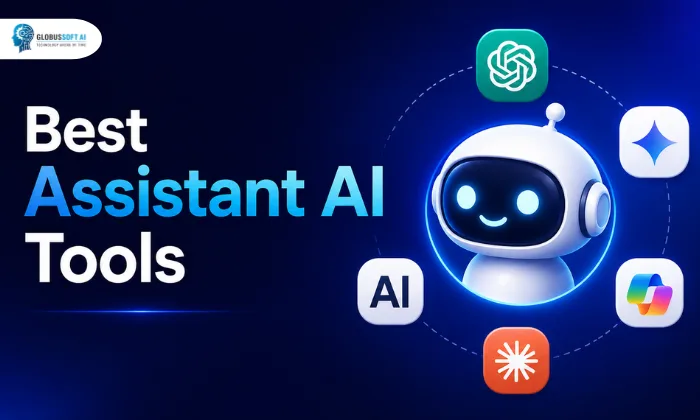
The market for assistant AI tools has exploded in 2026. From writing helpers and customer support bots to autonomous agents that manage entire business workflows, there are more options than ever and more noise, too. Choosing the right tool depends on what you actually need: a standalone productivity booster, a fully integrated virtual assistant, or a custom-built agent that runs inside your real business stack. This guide cuts through the clutter by comparing the most important categories of AI assistant technology, what each does best, who it’s designed for, and how to identify when an off-the-shelf tool stops being enough. Whether you’re a solopreneur or scaling a team, this is the clearest breakdown you’ll find in 2026.
Listen to the podcast!
What Is an Assistant AI and Why Does It Matter?
An assistant AI is any AI-powered system designed to help humans complete tasks more efficiently through conversation, automation, generation, or decision support. The category spans an enormous range: from simple chatbots that answer FAQs to sophisticated agents that manage pipelines, draft content, process data, and coordinate across tools without human input.
What makes this technology genuinely valuable is its compounding effect. A well-configured assistant doesn’t just save time on individual tasks; it removes entire categories of manual work from your week. Businesses that have implemented real AI assistants consistently report faster turnaround, lower operational costs, and teams freed up to focus on higher-value decisions instead of repetitive execution.
AI Writing Assistant: The Most Widely Used Category
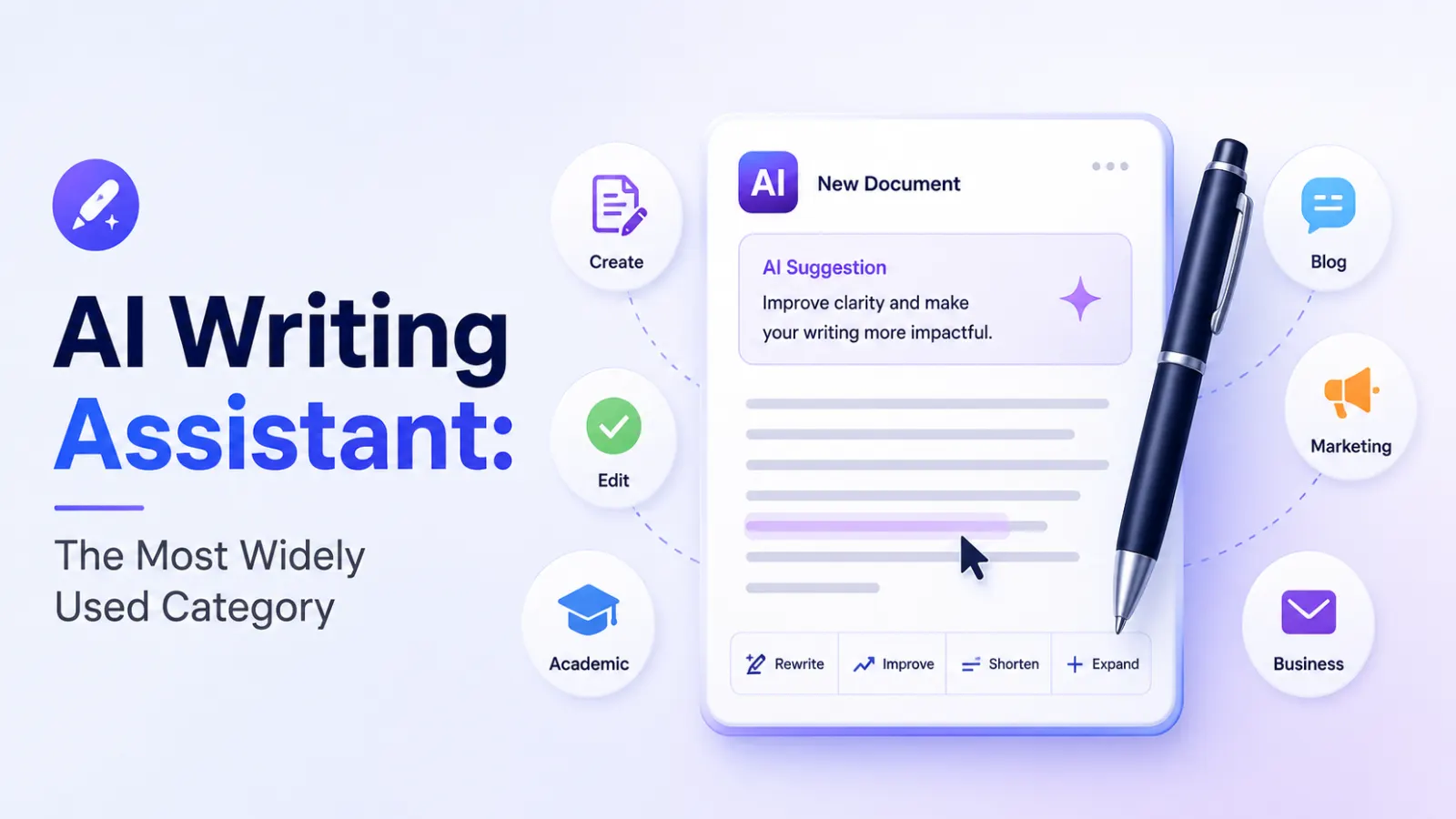
For most individuals and teams, an AI writing assistant is the first point of contact with the technology. These tools help draft emails, blog posts, product descriptions, reports, marketing copy, and social content, significantly reducing the time from idea to finished draft.
The best AI writing assistant tools in 2026 go beyond simple text generation. They understand context, match brand tone, generate structured content from prompts or outlines, and increasingly handle editing and optimisation alongside creation. For content teams, marketing departments, and solo creators, a strong AI writing assistant alone can replace several hours of work per day, making it one of the highest-ROI tools available at any price point.
Virtual AI Assistant: Beyond Writing Into Workflow
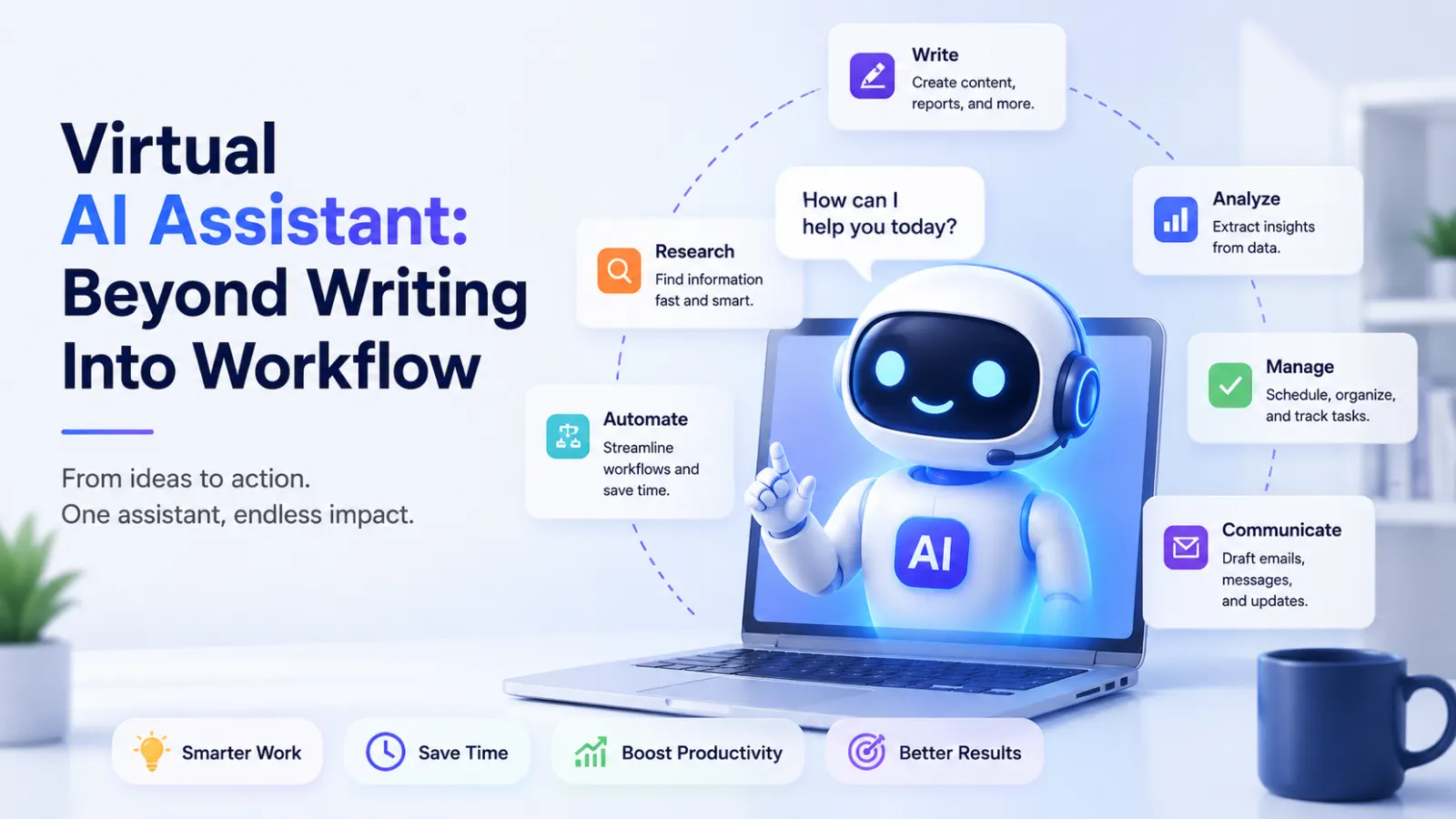
A virtual AI assistant operates at a broader level than a writing tool. Rather than generating content on request, it handles scheduling, research, email management, customer queries, data lookup, and multi-step workflow execution either autonomously or through conversation.
The most capable virtual AI assistant tools in 2026 can manage inboxes, produce morning briefings, flag high-priority items, monitor customer conversations for sentiment shifts, and coordinate between platforms without human initiation. For business owners and executives managing high-volume operations, a well-configured virtual assistant dramatically reduces cognitive load, shifting attention from managing tasks to making decisions.
AI Assistant Free: What You Get Without Paying
For users just starting out or exploring the category, AI assistant free tiers offer a meaningful starting point. Most major platforms, including ChatGPT, Claude, and Gemini, offer free access with usage limits, making them accessible for individuals and small teams testing the technology.
Free tiers are generally sufficient for occasional writing assistance, basic research, and simple question-answering. Where they fall short is in integration, customisation, and autonomy. An AI assistant free plan rarely connects to your CRM, doesn’t run on your data, and can’t act independently across your tools. For serious business use, free tiers are a starting point, not a destination.
AI Virtual Assistant: Purpose-Built vs Off-the-Shelf
There’s an important distinction between off-the-shelf AI virtual assistant tools and purpose-built ones. Off-the-shelf options like generic chatbot builders or productivity apps offer speed to deploy but limited fit for specific business workflows.
Purpose-built AI virtual assistant systems are designed around your actual data, your actual workflows, and your actual users. They handle the exceptions that generic tools can’t, integrate with the specific platforms your business runs on, and improve over time based on real interaction data. For businesses where the quality of AI output directly impacts revenue, sales, support, and customer experience, purpose-built systems consistently outperform generic alternatives by a significant margin.
How to Choose the Right Assistant AI Tool for Your Needs
Choosing between tools comes down to three honest questions: What specific outcome do I need? How complex is the workflow I’m trying to automate? And how much customisation will actually be required?
If your needs are primarily content-related and relatively simple, a quality AI writing assistant or general-purpose assistant AI subscription will serve you well at low cost. If you’re looking to automate multi-step business workflows, connect AI to your internal data, or build something that acts independently on your behalf, you need more than a SaaS subscription. You need engineering
Read More!
What is AI Technology? Benefits, Risks, Real-World Applications & AI Solutions
What Are Enterprise AI Agents and Why Use Them?
How Globussoft AI Builds Assistant AI That Actually Runs Your Business
If your requirements have moved beyond what off-the-shelf tools can deliver, Globussoft AI is the embedded AI engineering team that builds custom assistant AI systems and ships them in weeks, not quarters.
Here’s what Globussoft AI delivers for businesses that need a custom assistant AI:
- Inbox Intelligence Agent – Reads every message across mailboxes, applies priority labels, archives noise, and delivers a morning digest with only the items that need your attention.
- CRM Audit + Daily Call List Agent – Cross-references pipeline data with subscription platforms, builds a priority-ranked daily call list, and posts it to your sales channel with owner assignments.
- Customer Chat Monitor – Watches WhatsApp, Telegram, and in-app threads every 15 minutes, flagging silent conversations, escalations, and sentiment shifts before customers churn.
- Sales Activity Digest – End-of-day rollup of all rep activity: calls, notes, deals moved, posted to leadership with clear signals on performance and coaching needs.
- Outbound Lead-Gen Campaign Agent – Finds leads via Apollo/RocketReach, verifies emails, drafts personalized copy, sends via Gmail, tracks replies, and syncs to your CRM automatically.
- Executive Briefing Agent – Chief-of-staff agent that reads all other agent outputs, your calendar, and priority queues, delivering a single morning brief of the 3–5 things that need your attention today.
- Multi-Model Stack – All agents are built on Claude, GPT, Gemini, or Qwen, whichever is right for your use case, with full portability and no lock-in.
- Three Engagement Tiers – Sprint (4-week fixed scope, from ~$X), Embedded Pod (rolling, 3-month minimum), and Fractional CTO (strategic, 1 day/week with Sumit personally involved).
- Full IP Transfer – You own all source code. No black boxes, no vendor dependency, no ongoing platform fees to Globussoft once delivery is complete.
- Starts in 2 Weeks – Sprint engagements begin in 2 weeks. Embedded pods in 4 weeks. The first agent ships to production within 30 days of scoping.
Globussoft AI isn’t a tool; it’s the engineering team that builds the tools your business actually needs, working inside your stack from day one.
Real-World Use Cases for AI Assistants Across Industries
The most valuable AI deployments in 2026 are industry-specific and deeply integrated. Here’s where the ROI shows up clearly:
- Sales & Revenue Operations – Agents that manage lead qualification, CRM updates, follow-up sequencing, and daily call prioritisation, reducing manual admin by hours per rep per day.
- Customer Support – AI virtual assistant tools trained on your product data handle tier-1 queries, triage escalations, and monitor sentiment across channels without expanding headcount.
- Content & Marketing – AI writing assistant workflows that move from brief to draft to scheduled post with minimal human intervention, maintaining tone and brand consistency at scale.
- Executive Operations – Briefing agents, inbox triaging, and calendar-aware assistants that give founders and executives their focus back in a world of increasing information volume.
Conclusion
The best assistant AI tool is the one that fits your actual problem, not the most popular or the cheapest. For simple writing and productivity tasks, off-the-shelf tools deliver strong ROI quickly. For complex, multi-step, business-critical workflows, a custom-built assistant AI is the only option that truly scales.
Frequently Asked Questions (FAQs)
Q1. What is an assistant AI tool?
Assistant AI tool is any AI-powered system that helps users or teams complete tasks more efficiently, from writing and research to workflow automation and decision support.
Q2. Is there a good free AI assistant option available?
Yes. Tools like ChatGPT, Claude, and Gemini offer free tiers suitable for individual use. For business-grade automation and custom integrations, paid or purpose-built solutions are required.
Q3. What’s the difference between a virtual AI assistant and an AI agent?
A virtual AI assistant typically responds to user prompts. AI agent acts autonomously, initiating actions, processing data, and completing multi-step tasks without waiting for input.
Q4. How quickly can Globussoft AI build a custom AI agent for my business?
Sprint engagements start within 2 weeks and ship the first production agent within 30 days. Embedded pod engagements begin in 4 weeks with a rolling, multi-agent delivery cadence.