Digital marketing has become more complex than ever. Businesses today need to manage multiple channels, create personalised content, analyse customer behaviour, and continuously optimise campaigns.
For many marketing teams, the challenge is not finding ideas. It is managing the growing number of tasks required to execute those ideas effectively.
A single campaign may involve audience research, content planning, ad creation, social media posts, email communication, customer support, performance tracking, and constant improvements based on results. Managing all these activities manually can slow teams down and make it difficult to scale.
This is where AI agents are changing the way digital marketing workflows operate.
Unlike traditional AI tools that usually perform individual tasks, AI agents are designed to support broader workflows. They can understand goals, manage connected tasks, and assist teams across different stages of marketing operations.
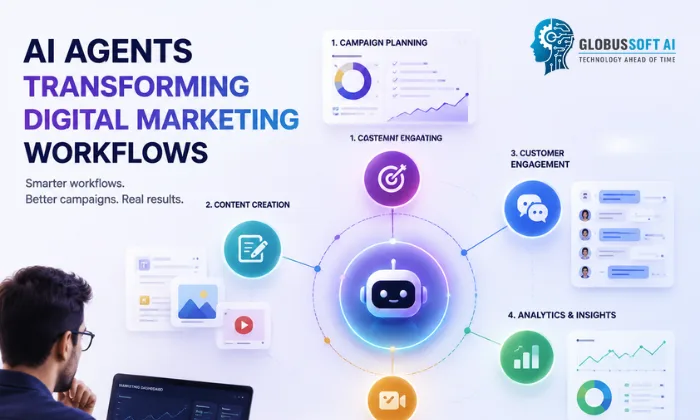
From planning campaigns to creating content and analysing performance, AI agents are helping businesses build faster, more efficient marketing systems.
What Are AI Agents in Digital Marketing?
AI agents are intelligent systems that can assist with multiple connected tasks instead of focusing on a single function.
Traditional marketing tools may help schedule posts, generate copy, or analyze data separately. AI agents work differently by connecting these activities into a more coordinated workflow. In more advanced systems, multiple AI agents can work together, with each agent handling a specialized role such as campaign planning, content creation, customer insights, analytics, or creative production. This multi-agent approach allows businesses to manage complex marketing workflows more efficiently, as different agents can collaborate while maintaining alignment with the overall campaign goal.
For example, a marketing team planning a product launch may need to:
- Research the audience
- Create campaign messaging
- Develop content ideas
- Produce marketing assets
- Monitor campaign performance
An AI agent can help support different stages of this process while maintaining context between tasks.
This allows marketers to spend less time managing repetitive work and more time focusing on strategy and creative decisions.
AI Agents and Campaign Planning
Campaign planning is one of the most important stages of digital marketing. A strong campaign requires understanding the audience, defining goals, choosing channels, and creating the right messaging.
AI agents can help marketers organise and improve this process by analysing information, identifying opportunities, and supporting campaign development.
For example, a company launching a new product can use AI assistance to explore customer segments, develop campaign ideas, and create structured plans across different channels.
Instead of starting every campaign from scratch, marketing teams can use AI-powered workflows to speed up research and planning while keeping their strategy focused.
How AI Agents Improve Content Creation
Content creation is one of the biggest challenges for modern marketing teams. Businesses need blogs, social media posts, advertisements, videos, emails, and other assets to maintain visibility.
Creating this amount of content consistently requires significant time and resources.
AI agents are helping businesses create more scalable content workflows by supporting different parts of production.
They can assist with:
- Content ideation
- Writing assistance
- Visual development
- Video creation
- Content adaptation
For example, a single campaign idea can be transformed into multiple content formats for different platforms.
This allows marketing teams to maintain a stronger content presence without increasing their workload at the same pace.
AI Agents in Creative Production Workflows
Creative production has traditionally required multiple teams working together. Designers, writers, video creators, and marketers often need to coordinate closely to produce campaign assets.
AI agents are helping simplify this process by connecting different creative stages.
Invideo Agent is an example of how AI agents can support creative production workflows by helping teams move from ideas, scripts, and references to complete video projects. It helps connect planning, visual development, generation, editing, and refinement so creators can manage video production more efficiently.
For digital marketing teams, this can be useful when creating advertisements, product videos, social media content, and campaign assets that need to maintain a consistent brand direction.
With invideo Agent Two, teams working on larger campaigns can manage more complex creative workflows involving visual planning, storytelling, cinematography, and effects while keeping production decisions aligned across different assets.
Improving Customer Engagement With AI Agents
Customer expectations are changing quickly. People expect faster responses, personalized recommendations, and relevant communication across different platforms.
AI agents are helping businesses improve customer engagement by supporting conversations, analyzing customer needs, and delivering more personalized experiences.
For example, AI-powered systems can assist with:
- Customer queries
- Product recommendations
- Personalized messages
- Support workflows
- Feedback analysis
This allows businesses to provide faster responses while helping marketing teams better understand customer behavior.
However, successful customer engagement still depends on maintaining a human understanding of customer needs. AI works best when it supports meaningful interactions rather than replacing them completely.
Using AI Agents for Marketing Analytics
Data plays a major role in digital marketing decisions. Businesses need to understand what campaigns are working, which audiences are responding, and where improvements can be made.
AI agents can help marketers analyze large amounts of data and identify useful patterns.
Instead of manually reviewing reports, teams can use AI assistance to understand:
- Campaign performance
- Customer behavior
- Content engagement
- Conversion trends
This helps marketers make faster decisions and improve campaigns based on real insights.
For example, an ecommerce brand can analyze customer interactions and identify which content formats, messages, or offers generate stronger engagement.
AI Agents and Personalised Marketing
Personalization has become an important part of modern marketing. Customers are more likely to engage with content that matches their interests, needs, and preferences.
AI agents can help businesses create more personalized experiences by combining customer data with marketing workflows.
A company can use AI assistance to create targeted campaigns, customize messaging, and deliver content that feels more relevant to specific audiences.
This is especially valuable for businesses managing large customer groups where creating individual experiences manually would not be practical.
Reducing Marketing Workflow Bottlenecks
One of the biggest benefits of AI agents is their ability to reduce repetitive work across marketing operations.
Marketing teams often spend significant time switching between tools, organizing information, and completing manual tasks.
AI agents help connect different parts of the workflow, reducing unnecessary delays.
For example, instead of creating a campaign plan, content calendar, advertisement concept, and video brief separately, teams can use connected AI workflows to move through these stages more efficiently.
This creates a more organized marketing process where teams can focus on higher-value decisions.
Challenges of Using AI Agents in Marketing
While AI agents offer significant advantages, businesses still need proper strategy and oversight.
AI-generated outputs need human review to ensure they match brand values, audience expectations, and business goals.
Some important considerations include:
- Maintaining brand voice
- Reviewing generated content
- Protecting customer data
- Ensuring accurate information
The most effective marketing teams use AI agents as collaborators rather than fully automated replacements.
The Future of AI Agents in Digital Marketing
AI agents are becoming an important part of the future marketing landscape.
As these systems become more advanced, they will support more areas of marketing, from campaign strategy and content production to customer relationships and performance optimization.
Future marketing teams will likely combine human creativity with AI-powered assistance to create more efficient and personalised experiences.
Businesses that adopt these workflows early will have more opportunities to experiment, adapt, and compete in an increasingly digital marketplace.
Read More!
How Startups Can Build a Scalable Content Marketing System With AI
Benefits of Intelligent Agent Systems for Business Automation
Final Thoughts
AI agents are transforming digital marketing workflows by connecting tasks that were previously handled separately.
From campaign planning and content creation to creative production, customer engagement, and analytics, AI agents are helping businesses operate more efficiently.
The biggest impact of AI agents is not simply automation. It is the ability to create smarter workflows where technology supports marketers in making better decisions, producing stronger content, and building better customer experiences.