Modern businesses generate enormous amounts of data, customer interactions, and operational workflows every day. Traditional automation tools work well for simple, repetitive tasks. But they tend to fall short when workflows become dynamic, unpredictable, or data-heavy.
This is where AI-driven automation systems are making a real difference. Unlike rule-based tools, these systems can perceive their environment, reason through complex scenarios, and take action on their own. They do not wait for instructions at every step. They adapt, learn, and execute.
From customer support to financial forecasting and enterprise workflow management, AI agents are helping businesses scale faster and operate more efficiently. This guide breaks down how these systems work, the different types available, and the concrete benefits they bring to business automation.
Read Aloud
What Is Intelligent Agent in AI?

An ai intelligent agent is a software system that perceives its environment, processes information, and takes actions to achieve specific goals. Unlike traditional programs that follow a fixed set of rules, such a system uses data, reasoning, and sometimes machine learning to make decisions on its own.
Think of it this way: a traditional automation tool is like a vending machine. You press a button, and you get a result. An AI agent is more like a trained employee. It understands context, handles exceptions, adjusts its approach based on new information, and works toward a goal even when the path is not fully defined.
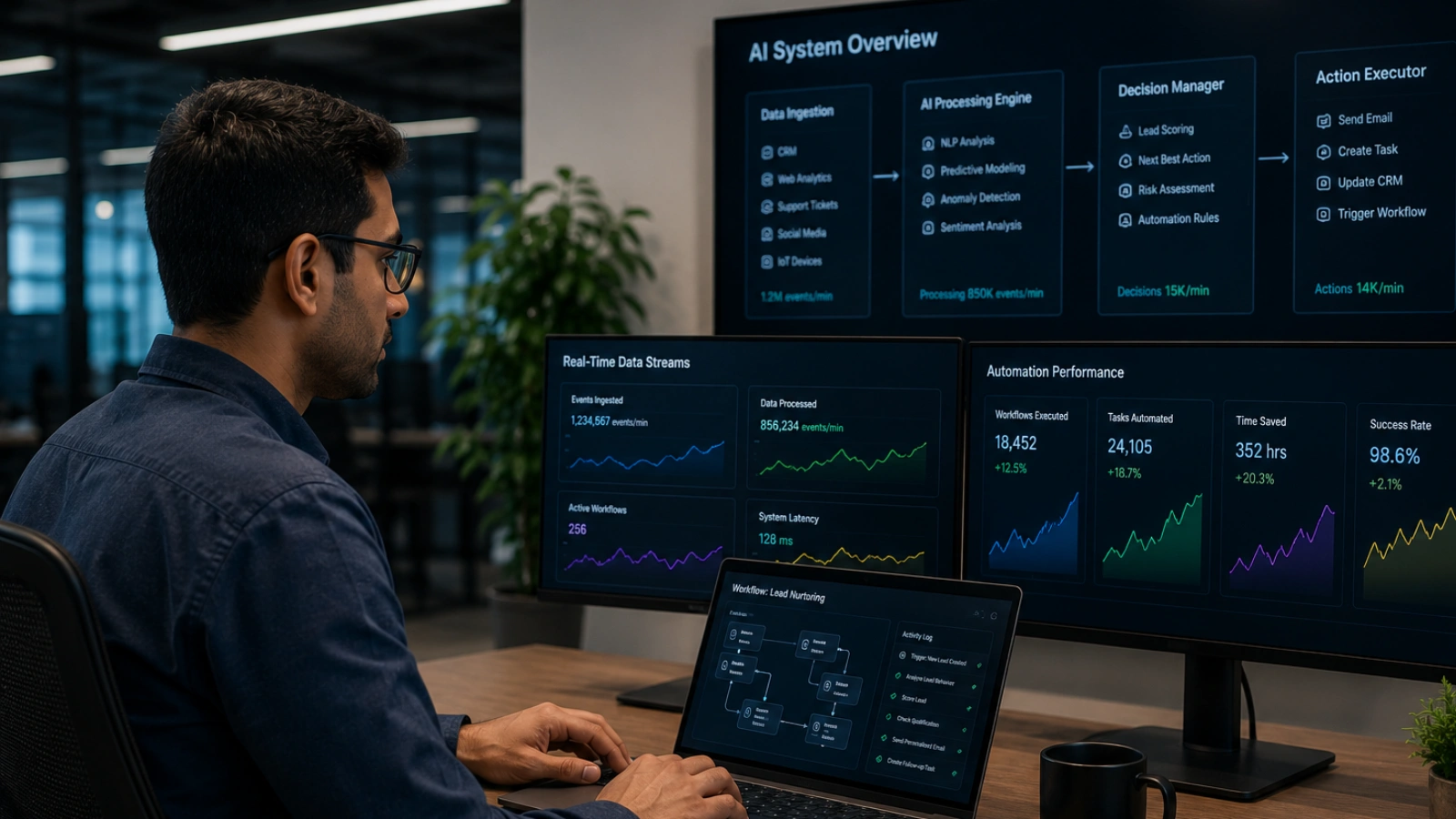
The core operating cycle of such a system looks like this:
- Perceive: The system collects data from its environment through sensors, APIs, or real-time data streams.
- Reason: It processes that data using AI models and contextual logic to evaluate the best course of action.
- Act: It executes the chosen action, whether that is sending a response, triggering a workflow, or updating a system.
- Learn: Over time, it refines its behavior based on feedback and outcomes.
This makes AI-driven automation fundamentally different from static rule-based tools. It is not just following orders. It is making informed decisions based on what it observes and what it has learned.
How These AI Systems Work

Understanding how these systems operate helps clarify why they are so effective for business automation. There are four key stages:
Data Collection and Perception
These systems start by gathering information. This can come from live data feeds, customer inputs, internal databases, third-party APIs, or even physical sensors in industrial environments. The quality and breadth of this data determines how well the system can reason about its situation.
Decision-Making and Reasoning
Once data is collected, the system applies AI models to analyze it. This could involve natural language processing to interpret a customer message, predictive analytics to forecast demand, or classification algorithms to detect anomalies. The system evaluates possible actions and selects the one most likely to achieve its goal.
Autonomous Action Execution
After making a decision, the system acts. This might mean automating a multi-step workflow, updating records in a CRM, routing a support ticket, or placing a supply chain order. Crucially, this happens without requiring human approval at each stage, which is what makes these systems so powerful for scaling operations.
Continuous Learning and Optimization
Many AI agents are built with machine learning capabilities. They track outcomes, learn from past decisions, and continuously improve their performance. Over time, this results in a system that becomes more accurate, more efficient, and better aligned with business goals.
Types of Intelligent Agent in AI
Not all AI automation systems are built the same. Understanding the types of intelligent agent in AI helps businesses choose the right solution for their specific needs.
Simple Reflex Agents
These operate purely on condition-action rules. If a certain event occurs, they respond in a predefined way. They are fast and effective for straightforward, repeatable tasks but cannot handle situations that fall outside their rule set.
Model-Based Reflex Agents
These systems maintain an internal model of their environment. This allows them to make better decisions in situations where the current state is not fully visible. For example, a system that tracks ongoing customer interactions across multiple sessions falls into this category.
Goal-Based Agents
Goal-based systems plan their actions with a specific outcome in mind. They evaluate multiple possible routes and choose the one most likely to achieve their objective. These are well-suited for tasks like scheduling, logistics planning, and resource allocation.
Utility-Based Agents
These go a step further by weighing outcomes against a utility function. Instead of simply reaching a goal, they aim to reach the best possible outcome given competing priorities. A pricing optimization engine that balances revenue, inventory levels, and customer demand is one example.
Learning Agents
Learning agents are the most advanced type. They improve over time by analyzing the results of past actions and adjusting their behavior accordingly. Recommendation engines, fraud detection systems, and adaptive customer support platforms are all examples in action.
Key Benefits of Intelligent Agent Systems for Business Automation
Businesses across industries are adopting these AI-driven systems not just because they are innovative but because they deliver measurable results. Here are the core benefits:
Improved Operational Efficiency
These systems automate repetitive, time-consuming workflows at a speed and scale that human teams simply cannot match. Tasks that once required hours of manual effort can be completed in seconds. This reduces bottlenecks, frees up employee time, and allows businesses to handle higher volumes without adding headcount.
Smarter, Faster Decision-Making
One of the most valuable capabilities of these AI systems is their ability to analyze large volumes of data in real time and surface actionable insights. Rather than waiting for a weekly report, businesses get continuous visibility into what is happening and what action to take next.
Significant Cost Reduction
By reducing manual intervention and automating complex processes, AI agents lower operational overhead considerably. Fewer errors mean less rework. Faster processing means lower cycle times. Smarter resource allocation means less waste. The financial impact compounds quickly, especially at enterprise scale.
Better Customer Experience
AI-powered customer support systems can handle thousands of queries simultaneously, respond instantly, and personalize each interaction based on customer history. This results in faster resolution times, higher satisfaction rates, and reduced pressure on human support teams.
Enterprise Scalability
Unlike human workflows that require proportional increases in staff to scale, these systems can be expanded to handle significantly greater volumes with minimal additional cost. They operate around the clock, across multiple departments, and can be deployed across geographies without logistical friction.
Reduced Human Error
Manual processes are inherently vulnerable to mistakes. Autonomous AI systems execute tasks consistently and accurately, improving data quality and compliance. For industries with strict regulatory requirements, this consistency is especially valuable.
Also Read
What Is Agentic AI? Everything You Need To Know
How To Understand Types Of Agent In AI? Complete Guide
Intelligent Agent vs Traditional Automation
To understand the step-change that AI-driven automation represents, it helps to compare it directly with traditional approaches like robotic process automation (RPA):
| Traditional Automation | Intelligent Agent Systems |
|---|---|
| Rule-based logic | Context-aware decision making |
| Static, fixed workflows | Adaptive, dynamic workflows |
| Requires manual intervention | Fully autonomous execution |
| Limited to preset responses | AI-powered reasoning |
| No learning capability | Continuous learning and improvement |
RPA tools are effective for structured, predictable tasks. But they break down when inputs vary or when decisions need to be made. AI agents handle this complexity natively. This is why many enterprises are now evolving beyond RPA toward agentic AI systems that can manage entire workflows end-to-end.
Real-World Applications of Intelligent Agents
The versatility of these AI-driven systems is one of their greatest strengths. Here is how they are being applied across major industries:
Healthcare
In healthcare, autonomous AI systems are being used to monitor patient vitals in real time, flag anomalies for clinical review, schedule follow-up appointments automatically, and assist with preliminary diagnostic triage. This reduces the administrative burden on clinical staff and improves patient outcomes.
Financial Services
Banks and financial institutions use AI agents for fraud detection, automated risk assessments, regulatory reporting, and portfolio analysis. These systems analyze thousands of transactions per second and surface patterns that human analysts would take days to identify.
Customer Service
Virtual assistants and AI chatbots built on agentic frameworks can handle first-line customer support across voice, chat, and email channels. They resolve common issues instantly and escalate complex cases to human staff with full context already attached.
Retail and E-Commerce
Retailers use AI automation systems to power product recommendation engines, optimize inventory levels dynamically, personalize marketing campaigns, and automate order fulfillment processes. The result is higher conversion rates, reduced stockouts, and better customer retention.
Cybersecurity
Security AI systems continuously monitor network activity for unusual patterns, respond to potential threats in real time, and trigger automated incident response protocols. This dramatically reduces the time between detection and containment.
Enterprise AI and the Rise of Agentic Automation
The next wave of business automation is not just about deploying isolated AI systems. It is about building connected ecosystems where multiple autonomous agents collaborate to manage entire business functions without constant human direction.
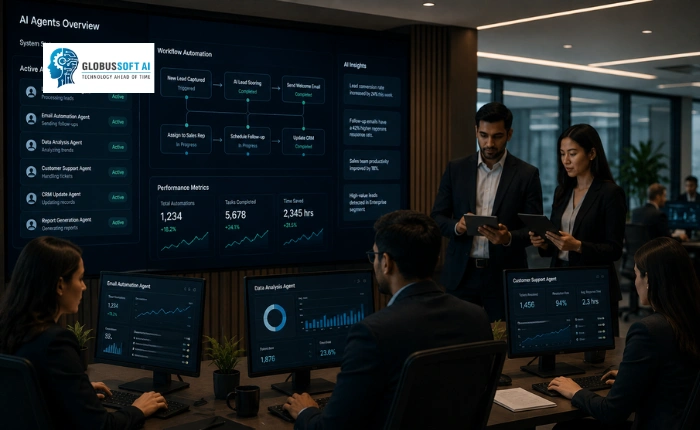
In an agentic AI architecture, one system might handle lead qualification while another manages follow-up communication and a third updates the CRM and triggers a pricing workflow. Each operates independently but contributes to a shared business objective.
Enterprises that have adopted this multi-agent approach are reporting measurable gains in productivity, faster go-to-market cycles, and significantly lower operational costs. As AI infrastructure matures, autonomous business operations are shifting from an ambitious vision to a practical reality for organizations of all sizes.
Challenges and Limitations of Intelligent Agents
Adopting these AI-driven systems requires realistic expectations. There are genuine challenges that businesses need to plan for:
Data Privacy and Security
These systems rely on access to large volumes of data. This creates obligations around data governance, storage, and access controls. Businesses must ensure their automation infrastructure complies with applicable data protection regulations and that sensitive information is handled appropriately.
AI Bias and Ethics
If a system is trained on biased data, it will produce biased outcomes. Responsible deployment requires regular auditing of AI behavior to ensure fairness and transparency, particularly in high-stakes applications like credit scoring or hiring support.
Integration Complexity
Deploying AI automation across existing enterprise systems can be technically complex. Legacy platforms may require custom connectors, and ensuring reliable data flows between systems demands careful architectural planning.
Operational Costs and Infrastructure
While these systems reduce long-term operational costs, the initial investment in infrastructure, implementation, and training can be significant. Businesses should model total cost of ownership carefully before committing to large-scale deployments.
Human Oversight
Even the most capable autonomous systems require human oversight, especially in the early stages of deployment. Building clear escalation paths and monitoring frameworks is essential to catching errors early and maintaining accountability.
How GlobussoftAI Helps Businesses Build Intelligent Automation Systems
GlobussoftAI specializes in designing and deploying intelligent agent systems tailored to the specific operational needs of enterprise clients. Their approach goes beyond off-the-shelf tools to deliver genuinely customized automation that integrates with existing workflows and scales with business growth.
AI-Powered Workflow Automation
GlobussoftAI helps organizations identify the workflows consuming the most time and resources, then builds AI-driven systems to automate them end-to-end. The result is faster execution, fewer errors, and significantly reduced manual overhead.
Custom Intelligent Agent Development
Every business has unique processes, and GlobussoftAI builds solutions designed to match them. Whether the requirement is for a goal-based planning system, a learning agent for customer personalization, or a utility-based system for resource optimization, their team delivers production-ready solutions built to scale.
Industry-Specific AI Solutions
GlobussoftAI has delivered AI automation solutions across healthcare, financial services, retail, customer support, and enterprise SaaS. This cross-industry experience means they understand the specific compliance requirements, data challenges, and performance benchmarks that matter in each sector.
Real-Time Analytics and Decision Intelligence
Beyond automation, GlobussoftAI integrates real-time analytics capabilities into their AI systems. Businesses gain continuous visibility into operational performance, automated reporting, and predictive insights that support faster, better-informed decisions at every level of the organization.
Discover how GlobussoftAI helps businesses deploy AI automation systems that streamline workflows, improve operational efficiency, and scale enterprise productivity. Contact GlobussoftAI today to explore AI automation solutions for your organization.
The Future of Intelligent Agent Systems
The trajectory of AI automation technology points toward increasingly autonomous enterprise operations. In the near future, AI agents will not just handle individual tasks. They will manage entire business functions, coordinate with each other across departments, and adapt in real time to shifting market conditions.
Key trends shaping the future include:
- Multi-agent orchestration, where networks of specialized systems collaborate on complex objectives
- Human-AI collaboration models where autonomous systems handle volume and speed while humans focus on judgment and creativity
- AI-native enterprises built from the ground up around autonomous workflows
- Predictive enterprise intelligence that anticipates problems before they arise and acts proactively
Businesses that invest in AI automation capabilities now are building an operational foundation that will remain competitive as these trends accelerate. Early adopters are already seeing the results in cost reduction, customer satisfaction, and speed to market.
Conclusion
AI-powered automation systems are fundamentally changing how businesses run their operations. By combining perception, reasoning, autonomous action, and continuous learning, these systems go far beyond what traditional automation tools can deliver.
The benefits are clear: greater efficiency, smarter decisions, lower costs, better customer experiences, and the ability to scale without proportional increases in overhead. For enterprises willing to move beyond rule-based automation and embrace agentic AI, the operational advantages are substantial.
Whether your organization is just beginning to explore automation or is ready to build a full multi-agent ecosystem, the time to act is now. Partners like GlobussoftAI are helping businesses across industries make this transition with solutions that are practical, scalable, and built for long-term performance.
Frequently Asked Questions
What is an intelligent agent in AI?
An intelligent agent in AI is a software system that perceives its environment, processes information, and takes autonomous actions to achieve a defined goal. Unlike traditional programs, it can handle dynamic conditions and improve over time through learning.
What are the types of intelligent agent in AI?
The main types of intelligent agent in AI are simple reflex agents, model-based reflex agents, goal-based agents, utility-based agents, and learning agents. Each type has different capabilities and is suited to different kinds of tasks.
How do intelligent agents improve business automation?
These systems improve business automation by handling complex, context-dependent tasks autonomously. They can make decisions in real time, adapt to new information, operate continuously, and learn from outcomes, all without requiring constant human oversight.
What is the difference between AI automation and intelligent agents?
Traditional AI automation follows fixed rules and handles predictable tasks. AI agents go further by reasoning through complex situations, adapting to changing conditions, and pursuing goals autonomously. The key difference is flexibility and the ability to operate without predefined rules for every scenario.
Can intelligent agents replace traditional workflow automation?
These systems can replace traditional automation for many use cases and significantly outperform it in complex, dynamic environments. That said, simpler rule-based automation still has its place for highly structured, repetitive tasks where flexibility is not required.
Which industries benefit most from intelligent agent systems?
Healthcare, financial services, retail, customer support, cybersecurity, and enterprise SaaS are among the industries seeing the greatest impact from these AI systems. Any sector with high data volumes, complex workflows, or a need for real-time decision-making stands to benefit significantly.