
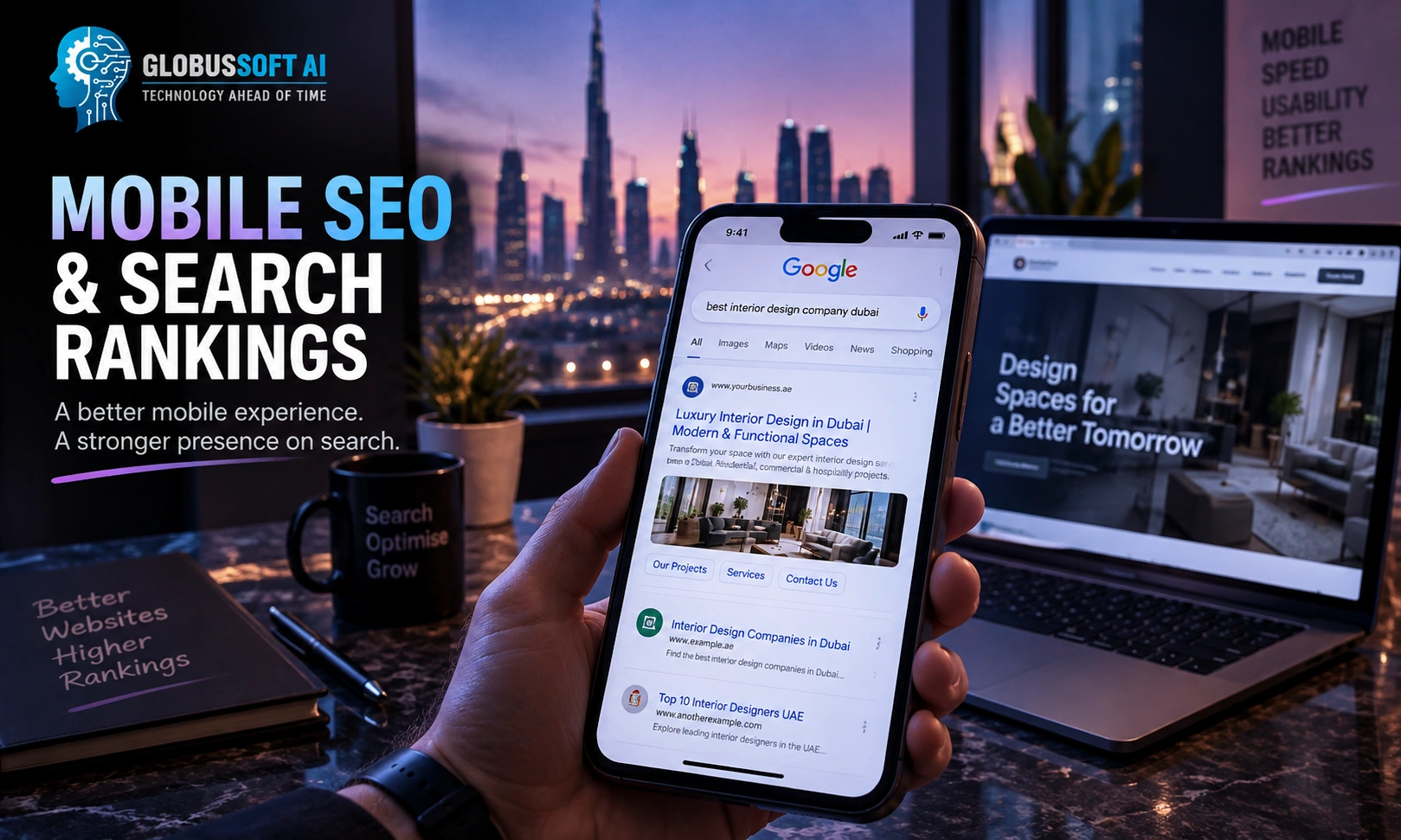
Mobile SEO isn’t about making your website look good on a phone. It’s about making sure Google can crawl, understand, and rank the version of your site that customers actually use every day.
That distinction matters more than most business owners realize. You can spend months polishing a desktop homepage, only to find Google barely looks at it anymore. Since mobile-first indexing became the default, the mobile version carries the weight in search results, not the desktop one.
For UAE businesses, this gets more interesting. Search behavior here mixes bilingual queries, location-based intent, and a habit of acting fast: calling, messaging on WhatsApp, or requesting directions within seconds. A strategy that ignores this context only solves half the problem.
Read Aloud!
Mobile SEO in Simple Terms
What Is Mobile SEO?
Mobile SEO is the practice of optimizing a website so its mobile version can be crawled, understood, ranked, and comfortably used by visitors on a smartphone. It covers technical setup, content, speed, and usability together, not one isolated fix.
Not the Same as a Mobile-Friendly Design
A responsive layout is a solid start, but not the whole job. Mobile-friendly design changes how a page looks; mobile SEO changes whether Google can crawl it, whether content matches desktop, and whether visitors can finish what they came to do.
Think of responsive design as the frame. Speed, crawlability, structured data, and content parity fill it in.
Why It Can Change Your Search Rankings
Google Uses the Mobile Version for Indexing
Google now crawls and indexes most sites using their mobile version first, a practice known as mobile-first indexing. That doesn’t make it one single ranking factor. It means the mobile page becomes the baseline Google judges everything against: structure, content, links, and technical health included.
Poor Mobile Experiences Weaken Organic Performance
When a page loads slowly, hides content behind extra taps, or breaks on a small screen, several things suffer at once: crawling gets harder, users bounce faster, and engagement signals drop. None decide rankings alone, but together they chip away at visibility.
Rankings Are Only Half the Story
Showing up in search results is step one. What happens after the click matters just as much. A visitor who lands on a slow, confusing page rarely sticks around to call, book, or buy, no matter where it ranks.
The Factors That Matter Most on Mobile
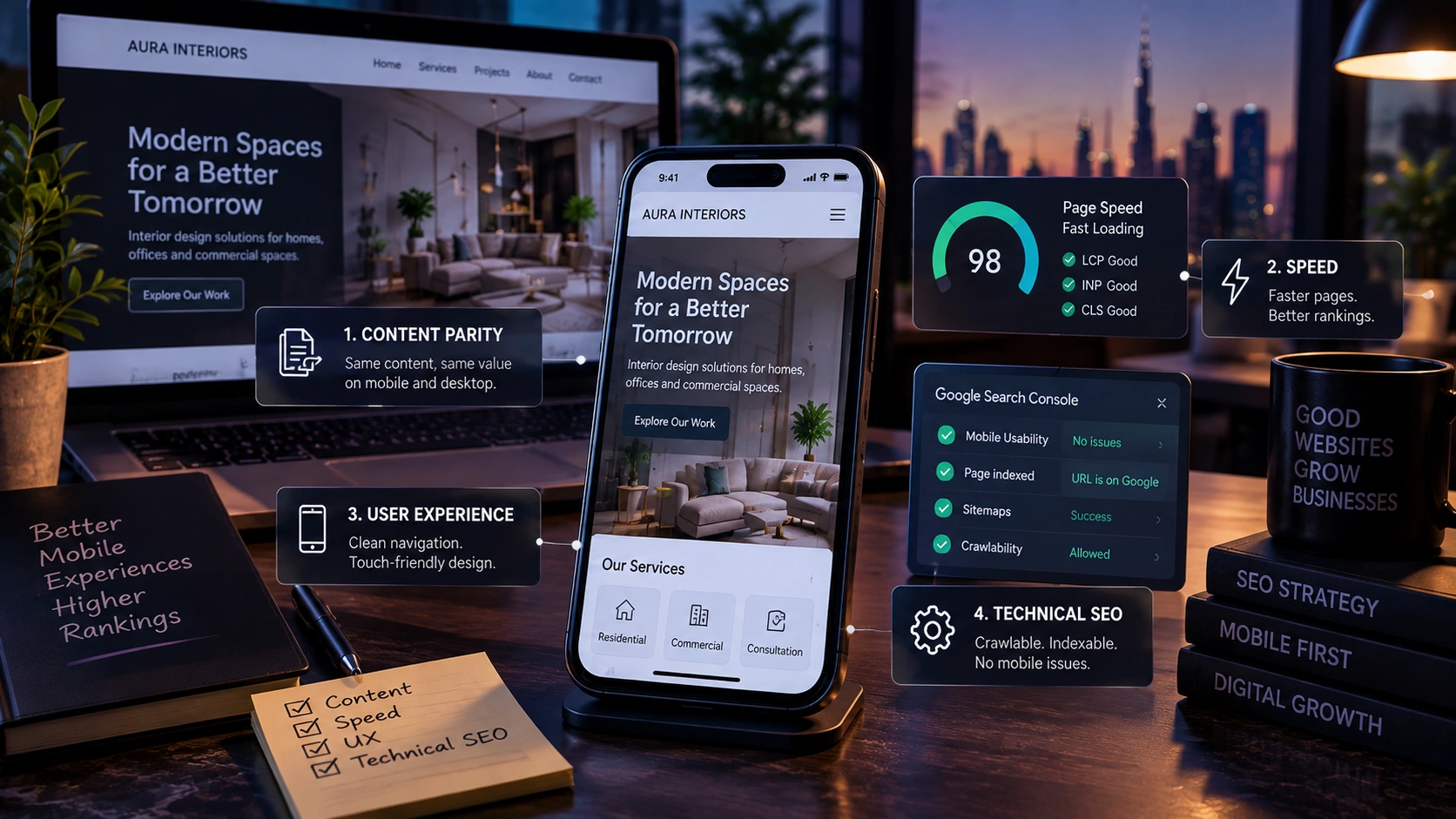
Rather than listing fifteen scattered tips, it helps to group what actually affects a mobile page into four categories.
Content parity. Your mobile page should carry the same headings, internal links, images, and structured data as desktop. Hiding content to “simplify” mobile often backfires.
Speed and Core Web Vitals. Largest Contentful Paint, Interaction to Next Paint, and Cumulative Layout Shift shape how a page feels to use. A perfect lab score won’t guarantee better rankings, but a genuinely slow page will hold you back.
UX and navigation. Readable text without zooming, touch-friendly buttons, logical menus, and forms that don’t demand ten fields before a submit button appears.
Crawlability and technical health. Robots directives, canonical tags, redirects, rendering, and sitemaps still apply on mobile. This is where mobile work overlaps with broader technical SEO rather than existing on its own.
Where Things Get Different in the UAE
Mobile and Local Search Work Together
A search for a dentist, a real estate agent, or a home service company in Dubai often starts and ends on a phone: mobile search, local result, website visit, then a call, a map click, or a WhatsApp message. If any link in that chain is slow or confusing, the lead disappears.
Arabic and English Need More Than Translation
Bilingual websites need more than a translated menu. Arabic pages need proper RTL layout, dedicated keyword research since Arabic search behavior isn’t a mirror of English, correct hreflang tags, and genuine content parity, not a thin page bolted onto a fuller English site.
Mobile SEO for MENA Markets
It’s tempting to treat the region as one audience, but mobile SEO for MENA markets needs nuance. Search habits, device preferences, and network speeds vary between the UAE, Saudi Arabia, and neighboring countries, so one generic approach rarely performs equally well everywhere.
From Search to Conversion
Make the Next Action Obvious
Every high-intent page should make the next step unmistakable: call, WhatsApp, request a quote, book an appointment, or find a location. Burying a phone number in a footer costs businesses real enquiries.
Reduce Friction on High-Intent Pages
Visitors shouldn’t need to zoom, hunt for contact details, or fill out a ten-field form just to ask a question. Every extra tap is a chance for someone to try a competitor instead.
Connect Mobile Optimization With Local Visibility
This is where mobile experience and local discovery meet. Businesses that pair Local SEO services with mobile optimization convert more of their visibility into enquiries, because the technical groundwork and the on-page experience pull in the same direction.
Read More!
What Is Link Building and Why Does It Matter in SEO?
Technical SEO Guide: How To Boost Your Website Rankings
A Practical Mobile Audit You Can Run
Step 1: Check what Google can access. Use Search Console to confirm pages are indexed, not blocked by robots directives, and rendering as expected.
Step 2: Compare mobile and desktop content. Open both versions side by side, checking for missing text, images, links, or structured data.
Step 3: Test real performance. Check LCP, INP, and CLS through PageSpeed Insights, looking at actual image sizes and script load, not just the headline score.
Step 4: Test the user journey. Walk the full path yourself: search, landing page, navigation, and the call-to-action. Note where you hesitate.
Step 5: Prioritize fixes. Sort issues into critical, high impact, medium, and cosmetic, and fix whatever blocks conversions or crawling first.
Common Mistakes That Quietly Cost Rankings
Responsive design solves how a page looks, not crawlability, missing content, or slow load times. Collapsing sections to “clean up” a page sometimes removes content Google needs to understand what it’s about, and a flawless speed score doesn’t always reflect what a real visitor feels on a mid-range phone.
Arabic versions of a site often get less attention than their English counterparts, which quietly undermines an otherwise solid effort. A missing click-to-call button or unclear address costs a local lead who wanted to act immediately, and duplicated mobile and desktop templates create confusion for users and for Google alike.
How GlobussoftAI Supports a Modern Mobile Workflow

Mobile SEO still needs human judgment, but AI can take the repetitive research off your plate:
- Keyword research that surfaces mobile search opportunities
- Competitor analysis that highlights content gaps worth closing
- Content ideation built around real mobile queries
- Trend analysis that catches emerging topics early
- Optimization support for clearer, better-structured pages
- Workflow automation for repetitive research tasks
None of this replaces a strategist. Technical implementation, UX decisions, and editorial judgment still need a human behind the wheel. For businesses comparing agencies and looking for some of the best SEO services in the Gulf, the right partner treats AI as a shortcut for research, not a replacement for strategy.
Optimize for the Moment, Not Just the Device
Here’s the part most guides skip. Mobile SEO isn’t really about screen size. It’s about context.
Someone searching from a phone might be comparing prices, looking for the nearest branch, or typing a question right before calling a business. That’s a different mindset from someone researching casually on a laptop.
For UAE businesses, the strongest mobile pages connect intent, local relevance, a fast answer, and an easy next step. Get that sequence right, and ranking improvements tend to follow.
Your Mobile Experience Is Part of Your Search Strategy
The goal was never to build a website that merely fits on a phone screen. It’s to build a mobile experience Google can understand, and visitors can act on without friction.
For UAE businesses, that means combining technical SEO, mobile UX, local intent, and bilingual search into one coherent strategy rather than separate projects. Get the mobile experience right, and rankings tend to follow the visitors, not the other way around.
FAQs About Mobile SEO
What is mobile SEO?
The process of optimizing a website’s mobile version so it can be crawled, indexed, ranked, and used comfortably by visitors on smartphones.
Does mobile SEO improve Google rankings?
Not as a single factor, but mobile-first indexing, speed, usability, crawlability, and content accessibility all influence how a page performs.
What is mobile-first indexing?
The practice Google uses to primarily crawl and index the mobile version of a website’s content for ranking purposes.
Is responsive design enough on its own?
No. It solves layout, but not crawlability, content parity, speed, or structured data, which all need separate attention.
How do I check whether my site is optimized for mobile?
Search Console, PageSpeed Insights, and manual testing across real devices will reveal most indexing, speed, and usability issues.
Does this matter for local businesses? Yes. Most local searches, especially “near me” queries, happen on mobile and lead directly to calls, directions, or visits.
Does Arabic SEO need special mobile treatment?
Yes. RTL layout, content parity, and Arabic-specific keyword research all need dedicated attention rather than a direct translation of English pages.
When should a business consider mobile SEO services?
Larger websites, multi-language sites, e-commerce stores, or businesses facing persistent mobile indexing issues usually benefit most from dedicated support.