Most websites have an SEO problem that no amount of content or backlinks will fix. Pages don’t rank because the topics are wrong, but because search engines can’t properly crawl, index, or understand the site in the first place.
That’s a technical problem, and it requires a technical solution.
Technical SEO is the layer of optimization most businesses either skip entirely or underestimate until rankings stall and they can’t figure out why. This guide covers what it actually involves, where it creates the most impact, how to run an audit without getting overwhelmed, and the mistakes that silently drag performance down even when everything else looks right.
Read Aloud!
What Is Technical SEO?
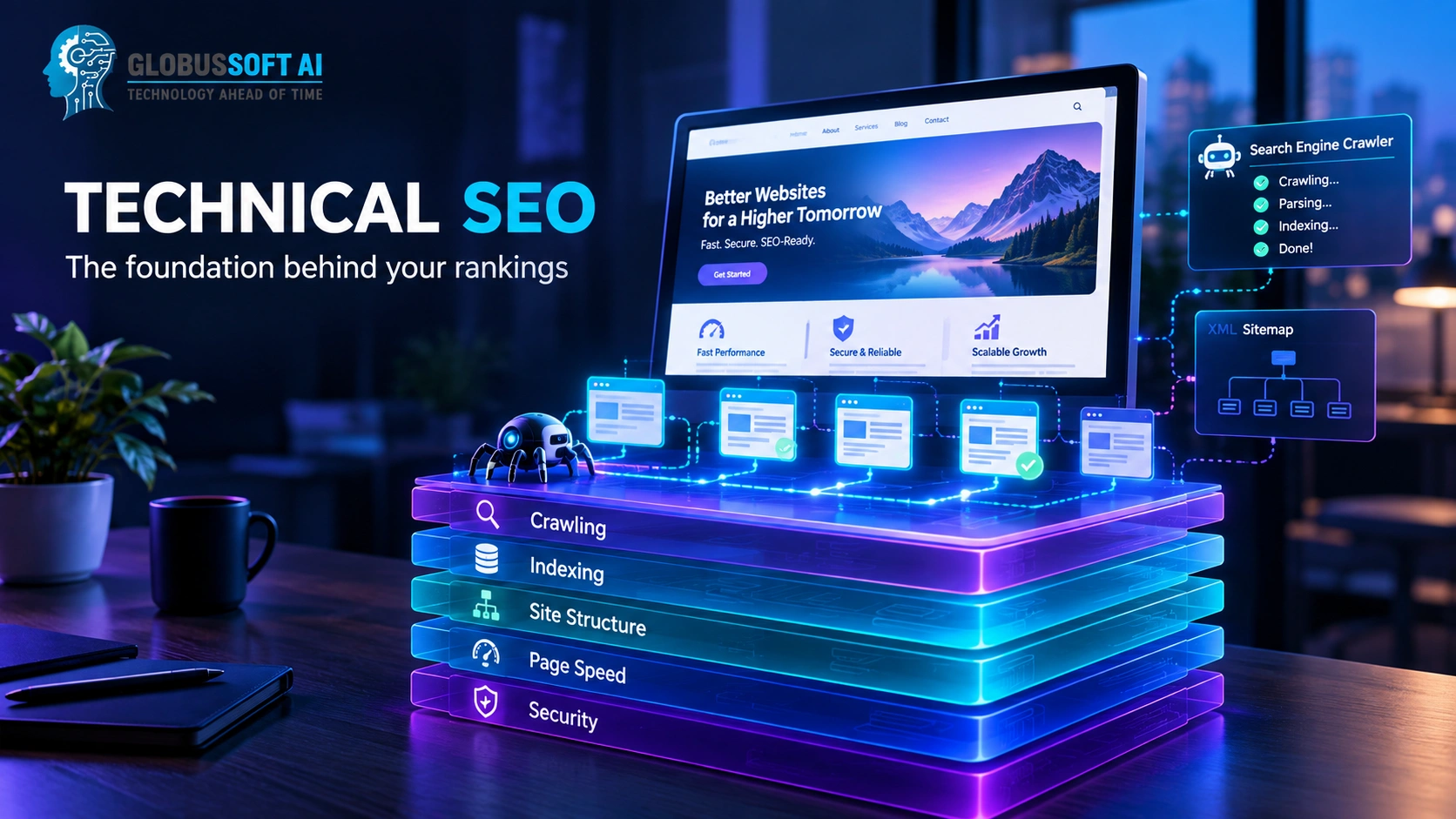
Technical SEO is the process of optimizing a website’s infrastructure so search engines can efficiently crawl, index, and rank its pages. While content SEO focuses on what a page says and off-page SEO focuses on who links to it, technical SEO focuses on how the site is built and whether it functions in ways that search engines reward.
What is technical SEO in practical terms? It’s the difference between a page that exists on your site and a page that search engines can actually find, process, and serve to users.
Common areas it covers include:
- Site architecture and internal linking structure.
- Crawlability and indexation control.
- Page speed and Core Web Vitals performance.
- Mobile responsiveness and usability.
- Structured data and schema markup.
- HTTPS security and canonical URL management.
- Duplicate content identification and resolution.
Where Technical SEO Creates the Most Impact
Most technical SEO value falls into three areas: making pages findable, making them fast, and making them interpretable. Nearly every fix in a technical audit traces back to one of these three.
-
Crawlability and Indexation
Search engines discover pages by following links. If your robots.txt file blocks key pages, or if your sitemap is outdated, or if your internal linking structure creates orphaned content, pages simply won’t be found no matter how good the content is. Fixing crawl paths is often the fastest way to recover hidden ranking potential.
-
Page Speed and Core Web Vitals
Google uses Core Web Vitals — Largest Contentful Paint (LCP), Interaction to Next Paint (INP), and Cumulative Layout Shift (CLS) — as direct ranking signals. Slow load times don’t just frustrate users. They actively suppress rankings. Image compression, server response optimization, render-blocking script removal, and caching each contribute to measurable speed improvements that translate into ranking gains.
-
Structured Data and Schema Markup
Search engines process text, but structured data gives them context. Schema markup tells Google what type of content a page contains — a product, a review, an article, an FAQ, a local business — and makes the page eligible for rich results that improve click-through rates. Most sites either use schema inconsistently or not at all, which is a straightforward opportunity to close.
-
Mobile Usability
Google indexes the mobile version of a site first. If your mobile experience is broken, slow, or difficult to navigate, it directly affects rankings across all devices. Responsive design, appropriate tap target sizing, legible fonts, and fast mobile load times are not optional considerations.
-
Duplicate Content and Canonicalization
Multiple URLs serving the same or near-identical content split ranking signals and confuse search engines about which version to index. Canonical tags, proper redirect chains, and consistent URL parameters prevent this fragmentation and consolidate authority to the correct pages.
The Right Technical Fix Depends on What’s Actually Broken
Rather than running a checklist of every possible optimization, it helps to start from what the data is telling you. This is exactly why smart technical SEO decisions start from a diagnosis, not a template.
| Technical Issue | Root Cause | Primary Fix |
| Pages not indexed | Crawl blocks or thin content | Robots.txt audit, sitemap update, internal link review |
| Slow load times | Unoptimized assets, server issues | Image compression, caching, CDN, script deferral |
| Poor Core Web Vitals | Render-blocking, layout instability | LCP, INP, CLS-specific optimization |
| Duplicate content | URL parameters, session IDs, near-identical pages | Canonical tags, 301 redirects, parameter handling |
| Mobile ranking drops | Non-responsive design or mobile-specific errors | Mobile usability fixes, responsive layout |
| Missing rich results | No schema or invalid markup | Structured data implementation and validation |
| Ranking drops after site changes | Broken redirects, lost internal links | Redirect audit, crawl comparison |
Some technical problems are high-impact but simple to fix. Others require deeper architectural changes. The priority should always be determined by the gap between current performance and what’s recoverable — not by what’s easiest to implement.
How to Run a Technical SEO Audit Without Getting Overwhelmed

Start With Crawl Data
Use a crawler like Screaming Frog, Sitebulb, or a technical SEO platform to map what search engines actually see when they visit your site. This surfaces broken links, redirect chains, missing meta tags, duplicate titles, and indexation issues in one pass.
Check Google Search Console First
Search Console is the most authoritative source of information about how Google specifically is interacting with your site. Coverage reports show which pages are indexed and why others aren’t. Core Web Vitals reports show performance by page group. The URL Inspection tool shows exactly what Google’s last crawl of a page found.
Prioritise by Traffic Impact
Not every technical issue carries equal weight. A broken redirect on a high-traffic page matters far more than a missing meta description on a page nobody visits. Rank issues by the gap between current performance and realistic recoverable traffic, not by how easy they are to fix.
Validate Before and After
Record baseline metrics — indexed pages, crawl errors, Core Web Vitals scores, organic traffic — before making changes. Validate fixes using Search Console’s URL Inspection and structured data testing tools. Track changes in rankings and traffic in the weeks following implementation.
A Simple 4-Step Framework for Technical SEO Implementation
- Audit before you touch anything. Run a full crawl, pull Search Console data, and document what exists before making changes. Fixing one thing blindly can break another.
- Prioritise by revenue impact. Identify which pages drive the most organic traffic and revenue. Start technical fixes there, not on low-value pages that won’t move the needle even when fixed.
- Fix, validate, then move on. Implement one category of fixes at a time — crawl issues, then speed, then structured data. Validate each before moving to the next so you can isolate what’s working.
- Monitor ongoing, not just at audit time. Technical SEO is not a one-time project. Crawl errors return, new pages break redirects, and site updates undo fixes. Schedule recurring audits and set up alerts for critical errors in Search Console.
When Does Technical SEO Require an Agency or Specialist?
There’s a meaningful difference between what a marketing generalist can handle with a tool and what requires a dedicated technical SEO services engagement.
Self-service tends to work for smaller sites with straightforward architectures, where issues are clearly visible in Search Console and fixes involve content, meta tags, or basic redirect management.
A technical SEO agency becomes the right call when:
- The site has complex infrastructure — JavaScript-heavy rendering, dynamic URL parameters, multi-language or multi-region setups, or enterprise-scale content.
- Rankings dropped after a site migration, redesign, or CMS change and the cause isn’t obvious.
- Core Web Vitals scores are poor and the fixes require development work beyond a marketing team’s scope.
- A technical SEO audit has been run but the team doesn’t have bandwidth or expertise to implement the findings.
- Structured data implementation requires validation across thousands of product, article, or local pages.
The value of working with a technical SEO agency is not just the audit findings. It’s the implementation experience, the ability to prioritize correctly under time and resource constraints, and the accountability for results.
This is where a team like Globussoft AI can help you. Rather than treating technical SEO as an isolated audit, Globussoft AI combines AI-driven research with hands-on execution, analyzing competitor content strategies, managing content publishing and scheduling, and handling on-page, off-page, and technical SEO together through a dedicated team of specialists. Instead of handing off a findings document and leaving implementation to your internal team, the same team that identifies the issues also fixes them.
Read More!
SEO vs PPC: Which Digital Marketing Strategy Works Better?
How to Get Recommended By AI Search: The Ultimate 2026 Guide on GEO Search
Common Technical SEO Mistakes That Quietly Kill Rankings
- Running an audit and filing it away. An audit with no implementation is a document, not a strategy. The findings are only as valuable as the fixes that follow them.
- Ignoring JavaScript rendering issues. If your site relies heavily on JavaScript to render content, search engines may not be processing that content the way you think. Server-side rendering or dynamic rendering is often required for JavaScript-heavy sites to rank correctly.
- Fixing redirects inconsistently. Redirect chains — where one redirect points to another, then another — dilute link equity and slow crawling. Every redirect should resolve to its final destination in a single hop.
- Treating canonical tags as optional. Many CMS platforms generate duplicate URLs by default for category pages, tag pages, print versions, and URL parameters. Without canonical tags, these fragments split authority rather than consolidating it.
- Assuming HTTPS means security is handled. Having an SSL certificate is a baseline requirement, not a complete solution. Mixed content warnings, insecure third-party resources, and HTTP to HTTPS redirect inconsistencies still occur on sites that consider themselves “secure.”
- Optimizing for desktop when Google uses mobile-first indexing. If your mobile site has less content, different structured data, or slower performance than the desktop version, the mobile version is what’s being evaluated and ranked.
Technical SEO Features You Get With Globussoft AI
Technical SEO becomes more effective when research, strategy, and implementation work together. Globussoft AI brings these capabilities under one team, helping businesses identify opportunities and execute SEO improvements without relying on separate specialists.
Key Features
- AI-Driven SEO Research: Uses AI-driven research to identify SEO opportunities and inform content and optimization strategies.
- Competitor Content Analysis: Analyzes competitor content strategies to understand what is working in the search landscape.
- Content Publishing & Scheduling: Manages content publishing and scheduling to maintain a consistent SEO workflow.
- On-Page SEO: Handles on-page optimization to improve how individual pages are structured and optimized for search.
- Off-Page SEO: Supports off-page SEO activities to strengthen the site’s overall search presence.
With Globussoft AI, businesses can approach SEO as a connected strategy rather than a collection of isolated tasks. The combination of AI-driven research and specialist execution helps turn SEO findings into actionable improvements.
The Next Level: From Individual Fixes to a Technical Foundation
Fixing individual technical issues is valuable. Building a site architecture that prevents them from recurring is where the long-term ranking advantage comes from.
Picture this: every new page is crawlable by default because the sitemap updates automatically, internal linking is systematically managed, canonical tags are applied by template, Core Web Vitals are monitored weekly, and structured data is deployed at the CMS level rather than page by page. No single fix does all of that. A well-structured technical foundation does.
Technical SEO becomes a durable competitive advantage when it stops being reactive — fixing errors after they cause damage — and becomes proactive, built into how the site operates from the start.
Technical SEO Is the Foundation Everything Else Depends On
Don’t start with “which keywords should we target?” Start with “can search engines actually access and understand what we’ve already built.”
Content and links matter. But they matter a lot less when the technical foundation is broken. A page that can’t be crawled can’t rank. A page that loads in six seconds won’t hold a position. A page with duplicate URL issues splits its own authority.
Fix the foundation first. Then build on it.
The goal was never to run a perfect audit. It’s to build a site that search engines can find, process, and rank — consistently, at scale, and without technical problems quietly eroding the work everything else is doing.
Frequently Asked Questions About Technical SEO
What is technical SEO and why does it matter?
Technical SEO is the process of optimizing a site’s infrastructure, so search engines can crawl, index, and rank it effectively. It matters because even the best content won’t rank if search engines can’t find, process, or understand the pages it lives on.
What does a technical SEO audit cover?
A technical SEO audit typically covers crawlability, indexation, page speed, Core Web Vitals, mobile usability, duplicate content, structured data, internal linking, redirect chains, canonical tags, and site architecture. The scope depends on the site’s size and complexity.
How long does a technical SEO audit take to show results?
Simple fixes like resolving crawl errors or updating a sitemap can show results within weeks once search engines re-crawl the site. Larger changes like improving Core Web Vitals or restructuring site architecture take longer to be recognized — typically one to three months.
When should I hire a technical SEO agency?
When your site has complex infrastructure, when a migration or redesign has caused ranking drops, when Core Web Vitals require development-level fixes, or when your team has an audit but lacks the bandwidth or expertise to implement it correctly.
What’s the difference between technical SEO services and general SEO?
General SEO covers content, keywords, and backlinks. Technical SEO services focus specifically on the infrastructure layer — how the site is built, how fast it loads, how search engines crawl it, and whether its architecture supports ranking at scale.
How often should a technical SEO audit be run?
For most sites, a comprehensive technical SEO audit should be run at minimum once per year, after any significant site migration or redesign, and after major CMS or platform updates. High-traffic or frequently updated sites benefit from quarterly audits and ongoing automated monitoring.