
Organic search is still the highest-converting traffic channel for most online stores, but only when done right. Ecommerce SEO is the practice of optimizing your product pages, category pages, and site structure so search engines can find, understand, and rank your store for the queries your customers are actually typing. Unlike paid ads that stop the moment you stop spending, this approach compounds over time, building visibility that delivers consistent traffic month after month. In 2026, AI-powered search engines are changing how results are served, competition in every category is intensifying, and the gap between stores that invest in organic search and those that don’t is widening fast. This guide covers what actually moves the needle from technical foundations to regional strategies for the GCC and Middle East.
Listen to this podcast!
Why Most Ecommerce Sites Underperform in Search
Before improving your store’s search presence, it helps to understand why most online stores struggle with organic visibility. The most common problems aren’t exotic; they’re structural and consistent across categories and markets.
Thin product descriptions that duplicate manufacturer copy. Unoptimized category pages with no unique content. Slow mobile load times that reduce conversion rates. Duplicate content created by filter and sorting parameters. Missing schema markup that prevents rich results. And no internal linking strategy connecting product pages to category authority. Each of these issues costs ranking positions silently, and fixing them systematically is where the fastest search ranking gains come from.
Keyword Strategy: Target Commercial Search Intent
The most important ecommerce SEO decision you make is which keywords to target, and more specifically, whether those keywords reflect commercial search intent. Commercial search intent means the user is in a buying mindset: comparing products, looking for prices, and ready to purchase or close to it.
Queries like “best wireless earphones under ₹5,000,” “buy men’s running shoes online,” or “Sony WH-1000XM5 price UAE” all carry commercial intent. These are the queries where ranking drives revenue. Informational queries drive traffic but rarely convert at the same rate. A strong search strategy maps commercial intent keywords to product and category pages and reserves informational keywords for blog content that builds topical authority rather than selling directly.
Product Page Optimization: Where Revenue Is Won or Lost
Your product pages are the commercial core of your search strategy. Every element title tag, meta description, H1, image alt text, product description, schema markup, and URL structure contributes to whether that page ranks and converts.
Product titles should lead with the search term, followed by the most commercially relevant descriptors. Descriptions should go beyond manufacturer specs; they should answer the questions buyers actually ask before purchasing. Schema markup (Product, Review, Offer) enables rich results showing price, availability, and ratings directly in search results. These rich snippets consistently outperform plain blue links in click-through rate, and click-through rate is a direct ranking signal.
Category Page SEO: The Most Underused Opportunity
Category pages carry more ranking potential than most e-commerce stores realize. They sit at the top of the purchase funnel, targeting broader commercial intent terms with high search volume, yet most stores treat them as nothing more than product grids with no unique content.
A well-optimized category page has a keyword-rich H1, a 150–200 word introductory paragraph with internal links, and structured content that signals topical authority to search engines. It also benefits from strong internal linking from blog content and relevant product pages. In competitive categories, category page optimization is often the single highest ROI investment a store can make because ranking improvements here affect every product listed beneath.
Technical Ecommerce SEO: The Foundation Everything Else Builds On
Technical SEO is the infrastructure layer that determines whether your other optimization efforts can actually take effect. Core Web Vitals scores directly affect rankings, particularly on mobile, where the majority of e-commerce traffic now arrives.
Key technical priorities for e-commerce sites include eliminating duplicate content from faceted navigation using canonical tags or noindex directives, implementing a clean URL structure without unnecessary parameters, ensuring every product and category page is indexed and crawlable, optimizing image file sizes for LCP performance, and deploying a comprehensive XML sitemap that reflects your current inventory accurately. These aren’t glamorous fixes, but they determine the ceiling for everything else you do.
E-commerce SEO for GCC and Middle East Markets
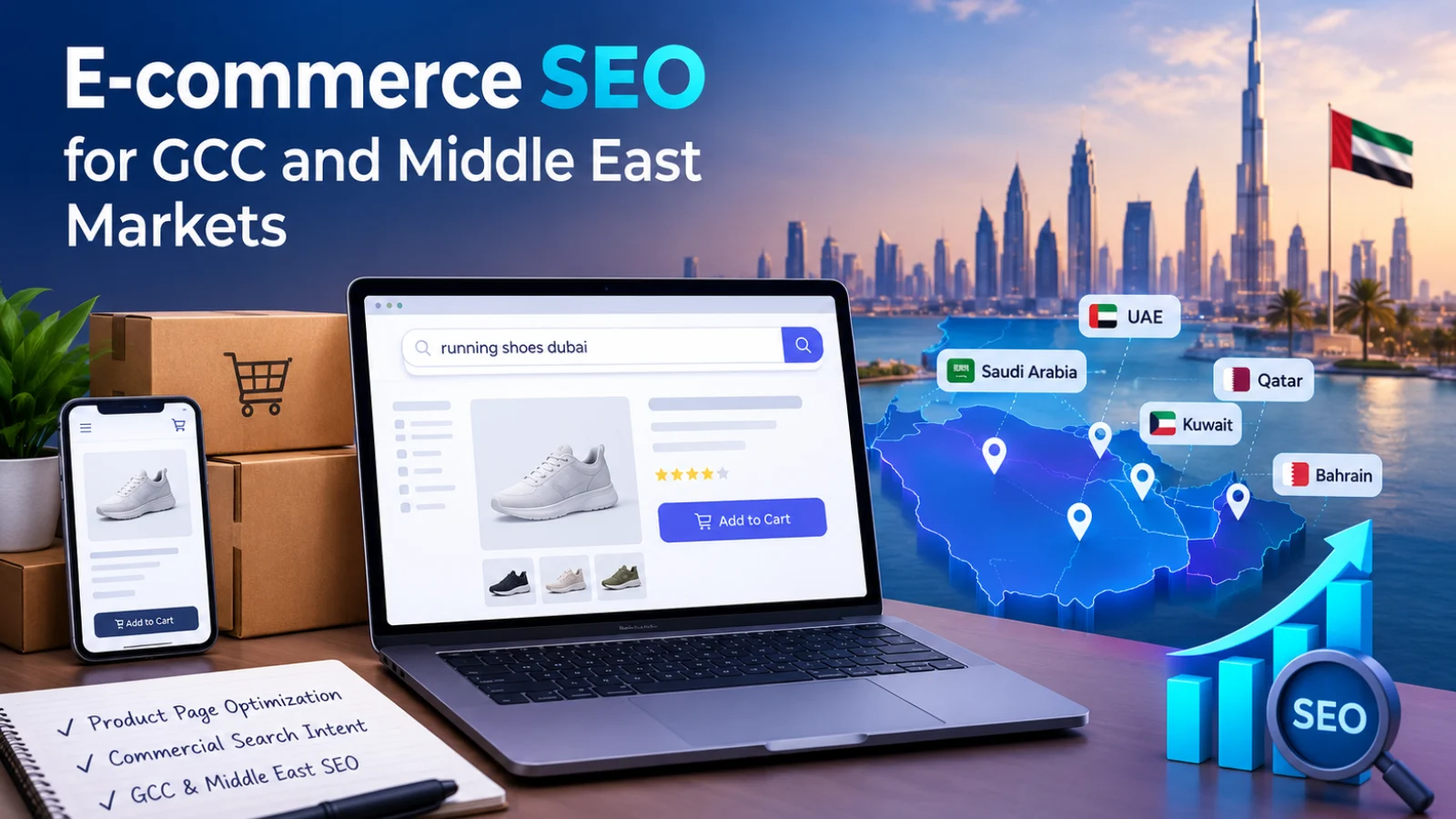
The GCC and the Middle East represent a high-opportunity, under-optimized ecommerce market. Ecommerce adoption across Saudi Arabia, UAE, Kuwait, Qatar, and Bahrain is growing at rates that consistently outpace global averages, yet most local and regional stores have underdeveloped ecommerce SEO compared to Western competitors entering the same market.
Middle East e-commerce SEO has three regional requirements that differ from global playbooks. First, bilingual optimization: Arabic and English content must be independently developed, not machine-translated, with correct hreflang implementation and schema applied to both language versions. Second, local commercial intent: UAE users searching for “buy laptop Dubai” or Saudi users searching for have geo-specific intent that generic global content doesn’t satisfy. Third, Bing indexation: in some GCC markets, Bing holds a higher market share than in Western markets, and with ChatGPT Search retrieving from Bing’s index, strong Bing presence has become an AI search visibility requirement, not just a secondary channel.
GCC e-commerce SEO also benefits from localized trust signals: Arabic reviews, local return policy content, GCC-specific payment method information (KNET, Mada, SADAD), and locally relevant product availability cues. These signals improve both conversion rates and AI search citation probability, creating a compounding advantage for stores that implement them over stores that rely on generic English content alone.
How Globussoft AI Builds Intelligent Systems for Ecommerce SEO Operations
Scaling search optimization across thousands of product pages, multiple markets, and two languages is a workflow problem as much as a strategy problem. That’s where Globussoft AI changes the equation, building custom AI systems that automate the intelligence and monitoring workflows that make serious search operations possible at scale.
Here’s what Globussoft AI builds for your search and content operations:
- Web Research Reader Agent – Continuously monitors competitor product pages, pricing changes, new content, and SERP shifts using Playwright for JS-heavy pages, delivering live competitive intelligence without manual research.
- Content Pipeline Watcher – Tracks product description and category page content across your CMS, flags stale or thin pages, and nudges owners before issues compound into ranking losses.
- Outbound Lead-Gen Campaign Agent – Identifies link-building prospects via Apollo and RocketReach, verifies emails, drafts personalised outreach, sends via Gmail, tracks replies, and syncs to CRM automatically.
- Executive Briefing Agent – Reads all agent outputs daily and delivers a single morning brief of the 3–5 actions that need attention, from content gaps to competitor movements to technical issues flagged overnight.
- Multi-Model Architecture – Claude, GPT, Gemini, and Qwen, whichever model fits each task, with no vendor lock-in and full IP transfer on every engagement.
- Three Engagement Tiers – Sprint (4-week fixed scope, working system in production), Embedded Pod (rolling 3-month minimum, weekly ship cadence), and Fractional CTO (1 day/week with Sumit personally on architecture).
- Full IP Transfer – You own all source code. No black boxes, no ongoing platform fees after delivery.
- Starts in 2 Weeks – Sprint engagements begin in 2 weeks. The first agent ships within 30 days of scoping.
Link Building and Authority for Ecommerce Sites
Off-page link building, acquiring the external links and brand signals that tell search engines your store is trustworthy and authoritative, is where many stores stop investing too early. Yet it’s what separates ranking on page three from ranking in position one for competitive commercial terms.
For ecommerce, the most effective link building comes from supplier and manufacturer partnerships, digital PR around product launches, comparison and review site placements, and category-specific resource pages. In the GCC and Middle East, citations from regional news outlets, Arabic-language tech and lifestyle publications, and local comparison platforms carry particular weight for geo-modified commercial queries.
Read More!
7 Common SEO Mistakes Beginners Make (And How to Fix Them)
Local SEO for Gulf Businesses: The Complete Guide for Winning Customers
Conclusion
Ecommerce SEO is a compounding investment; e-commerce stores that build strong foundations today will hold ranking positions that are very difficult for competitors to displace. From product page optimization and commercial intent targeting to bilingual GCC strategies and AI-powered operational workflows, the opportunity is clear.
Frequently Asked Questions
Q1. What is e-commerce SEO?
It is the process of optimizing an online store’s product pages, category pages, and site structure so search engines can rank them for commercial search queries that drive purchasing decisions.
Q2. Why is e-commerce SEO for GCC markets different?
E-commerce SEO for GCC markets differs because shoppers search in both Arabic and English, while search intent and buying behavior vary by country. Effective SEO requires localized keyword research, bilingual content, proper hreflang and regional targeting, and trust signals such as local currencies, payment methods, delivery details, and customer reviews.
Q3. How long does e-commerce SEO take to show results?
Technical fixes can show results within weeks. Category page improvements typically take two to three months. Domain-level authority improvements compound over six to twelve months of consistent investment.
Q4. Can Globussoft AI automate e-commerce SEO workflows?
Yes. Globussoft AI builds custom agents, competitive intelligence monitors, content pipeline watchers, and link-building outreach systems that automate the operational workflows underpinning effective search optimization at scale.