
The next evolution of enterprise AI isn’t about a single smart tool; it’s about intelligent systems that plan, delegate, and execute across your entire business. That’s exactly what agentic orchestration delivers. Rather than running one AI model in isolation, this approach connects multiple AI agents, each responsible for a distinct task, and coordinates them to complete complex, multi-step workflows without constant human intervention. For business leaders who have already explored basic AI automation and are asking, “What comes next?” this is the answer. Implementing agentic orchestration effectively can transform how your operations run, how your teams focus their time, and how quickly your business scales. This guide walks you through everything you need to know.
Listen to this podcast!
What Is Agentic Orchestration and How Is It Different?
Most businesses are familiar with chatbots, rule-based automation, and basic AI assistants. Agentic orchestration goes several layers deeper. It involves building systems where autonomous AI agents can reason, make decisions, call tools, and hand off tasks to other agents, all working toward a shared objective.
The key difference is autonomy plus coordination. A single AI agent can handle a defined task. This orchestration layer enables multiple agents to collaborate: one researching, one drafting, one validating, and another executing and completing end-to-end workflows that would otherwise require significant human effort and cross-team coordination.
Understanding AI Agent Architecture Before You Build
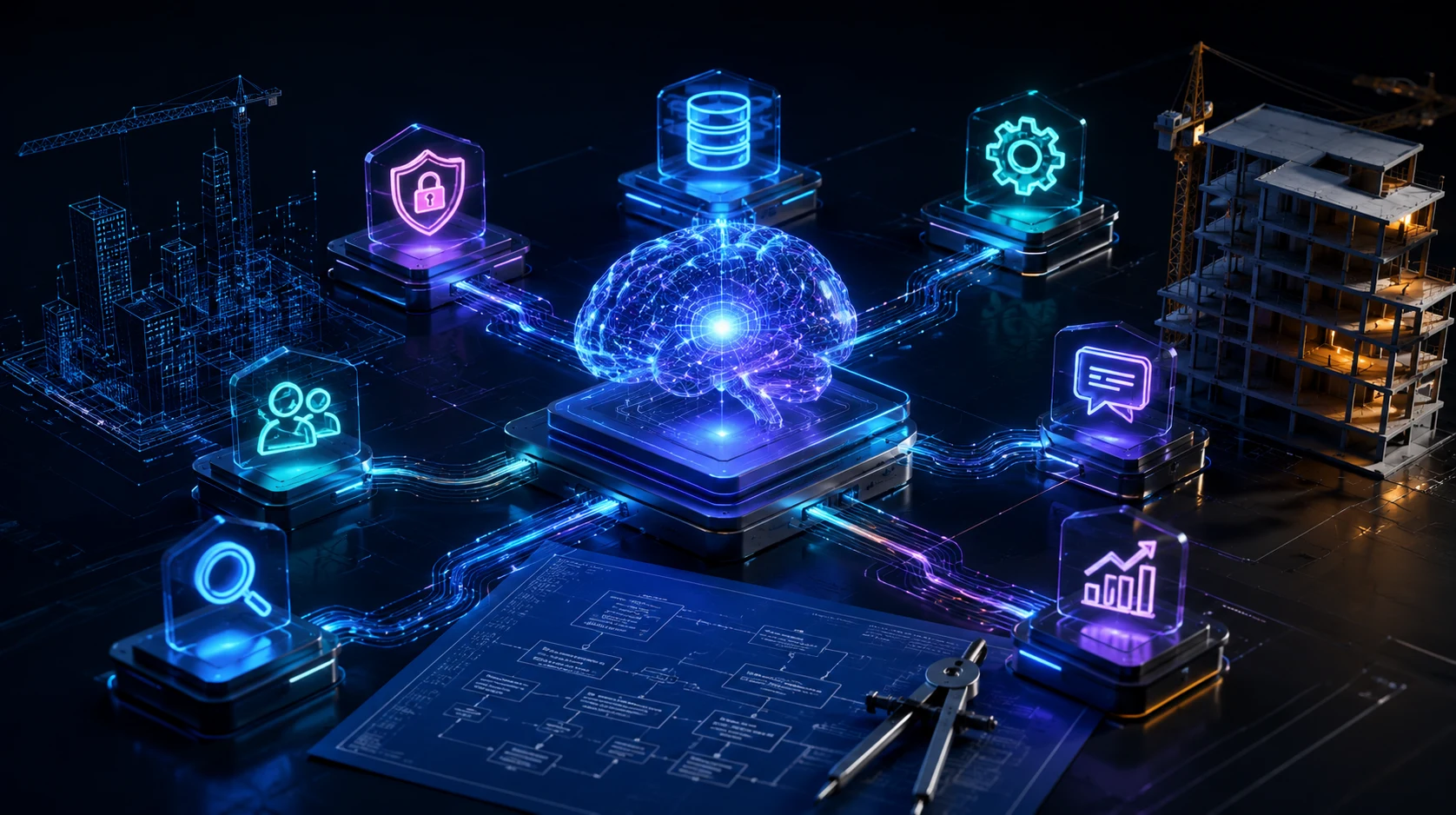
Before implementing anything, it helps to understand what sits underneath. AI agent architecture refers to the structural design of how individual agents are built, how they access information, and how they interact with other systems and agents.
A well-designed AI agent architecture typically includes a reasoning layer (the LLM), a memory system (short-term context and long-term knowledge retrieval), a tool layer (APIs, databases, and web access), and an orchestration layer that routes tasks, manages state, and coordinates agent handoffs. Getting this architecture right from the start is what separates a system that scales from one that breaks under real-world conditions.
The Core Components of Effective Agentic Orchestration
Knowing what makes an orchestrated agent system work helps you plan and evaluate implementations more clearly. The essential components include:
- Orchestrator Agent – The master controller that receives a high-level goal, breaks it into sub-tasks, and assigns them to specialist agents.
- Specialist Agents – Individual agents optimised for specific functions: data retrieval, content generation, analysis, communication, scheduling, and so on.
- Memory and Context Management – Mechanisms that allow agents to retain relevant information across steps without losing track of the broader objective.
- Tool Integrations – APIs, databases, CRM systems, and third-party platforms that agents can query and act upon.
- Human-in-the-Loop Checkpoints – Defined points where human review or approval is required before the workflow continues.
- Monitoring and Logging – Full observability of agent decisions, actions, and outputs for debugging, compliance, and continuous improvement.
Agentic AI Use Cases and Orchestration Across Industries
Understanding where this technology creates real value helps businesses prioritise where to start. Agentic AI use cases and orchestration span nearly every sector, but some of the most impactful applications include:
- Sales and Lead Generation – Orchestrated agents qualify leads, send personalised follow-ups, update CRM records, and schedule demos, completing an entire sales workflow without manual input at each step.
- Customer Support – A triage agent categorises incoming queries, routes them to specialist agents for resolution, and escalates complex cases to human agents with full context already assembled.
- Finance and Compliance – Agents extract data from invoices, cross-reference against purchase orders, flag discrepancies, and generate reconciliation reports, reducing a process that took days to hours.
- Healthcare Administration – Patient intake, appointment scheduling, insurance verification, and follow-up communication can all be orchestrated with minimal staff involvement.
How to Implement Agentic Orchestration: A Phased Approach
Jumping straight into a full-scale deployment is a common mistake. A phased implementation reduces risk and builds confidence across your team. Here’s how to approach it:
- Phase 1 – Discovery and Use Case Mapping: Identify the workflows in your business that are repetitive, rule-based, multi-step, and time-consuming. These are the highest-value candidates for agentic orchestration.
- Phase 2 – Architecture Design: Define how agents will be structured, what tools they will access, how memory will be managed, and where human checkpoints will sit. This is the foundation everything else builds on.
- Phase 3 – Pilot Deployment: Start with one well-defined workflow. Build, test, and iterate before expanding. A focused pilot delivers faster learning and a clearer ROI story to present internally.
- Phase 4 – Integration and Scaling: Connect your orchestrated agents to existing CRM, ERP, and communication tools. Expand to additional use cases with the architecture and governance model already in place.
- Phase 5 – Monitoring and Optimisation: Continuously review agent performance, flag errors, retrain where needed, and refine the orchestration logic based on real-world data and team feedback.
Common Mistakes Businesses Make When Deploying Agent Systems
Even well-resourced teams make avoidable errors when implementing agentic AI orchestration for the first time. Here’s what to watch for:
- Skipping architecture planning – Jumping to tool selection before designing the agent structure leads to systems that are difficult to scale or debug later.
- Over-automating too early – Trying to automate every workflow simultaneously spreads resources thin and makes it harder to identify what’s working.
- Ignoring observability – Without logging and monitoring, agent failures are invisible until they’ve already caused downstream problems.
- Underestimating integration complexity – Real enterprise environments have messy, legacy systems. Planning integrations carefully is as important as building the agents themselves.
- Choosing the wrong implementation partner – Agentic systems require deep expertise in LLMs, orchestration frameworks, and enterprise integration. Generic IT vendors often underdeliver.
Read More:
What Is Agentic AI? Everything You Need To Know
Benefits of Intelligent Agent Systems for Business Automation
How Globussoft AI Helps Businesses Build Intelligent Agent Systems
If you’re ready to move from strategy to execution, Globussoft AI is an enterprise-grade AI and ML services company with 16+ years of excellence, 1,000+ global clients, 200+ AI specialists, and a portfolio of 30,000+ AI-driven solutions delivered across industries.
Here’s how Globussoft AI directly supports your intelligent automation journey:
- AI Agent Development – Design and deploy intelligent agents that streamline customer support, internal operations, and complex multi-step workflows, reducing human error and boosting efficiency.
- AI/ML Consulting – End-to-end strategic guidance to identify the right orchestration use cases, design actionable roadmaps, and avoid the common pitfalls of early AI adoption.
- LLM and Knowledge Base-Powered Chatbots – Context-aware, human-like conversational agents that handle high query volumes while maintaining brand consistency and custom knowledge integration.
- LLM Testing and Fine-Tuning – Continuous model evaluation and domain-specific fine-tuning to ensure agent outputs remain accurate, reliable, and aligned with your business goals.
- AI/ML Pipeline Replication – Adapt proven frameworks and leading LLM capabilities to your business context for faster deployment and significantly reduced development costs.
- AI/ML Integration – Combine generative AI with machine learning frameworks to build adaptive, continuously improving agent systems that scale with your business.
- 5-Phase Enterprise Delivery – From strategic discovery and data architecture to model development, fine-tuning, and continuous post-deployment support, Globussoft AI manages every stage.
- 20% Faster Deployment – An agile delivery approach that minimises disruption to existing workflows while maximising time-to-value from day one.
- ISO, CMMI, NASSCOM, Microsoft Gold, and Google Cloud Certified – Independently verified for quality, security, and enterprise readiness across every engagement.
Globussoft AI has already delivered proven AI products across workforce management, video intelligence, ad optimisation, voice agents, and healthcare, all built on the same orchestration principles they bring to client projects.
Choosing the Right Partner for Agentic AI Implementation
Not every AI vendor can deliver true agentic orchestration. What separates capable partners from the rest is depth of experience across the full stack: LLMs, ML pipelines, enterprise integrations, observability, and domain-specific fine-tuning.
Look for a partner who starts with your business problem, not their preferred technology. One who designs architecture before recommending tools. One who can demonstrate real-world deployments across industries similar to yours. And one who offers ongoing support after deployment because agentic systems require continuous refinement, not a one-time handover.
Conclusion
Agentic orchestration is no longer a future concept reserved for tech giants; it’s an implementation decision that growing enterprises are making right now. The businesses that build well-architected, orchestrated agent systems today are creating a compounding operational advantage that becomes harder to close over time. With the right phased approach and the right partner, implementing agentic orchestration in your business is both achievable and transformative.
Frequently Asked Questions
Q1. What is agentic orchestration in simple terms?
Agentic orchestration is the coordination of multiple AI agents, each handling a specific task, to complete complex, multi-step business workflows automatically with minimal human intervention at each stage.
Q2. How is agentic AI orchestration different from standard automation?
Standard automation follows fixed rules. Agentic AI orchestration uses reasoning-capable AI agents that can adapt, make decisions, call tools, and collaborate dynamically to handle far more complex and variable workflows.
Q3. What industries benefit most from AI agent systems?
Sales, customer support, finance, healthcare, logistics, recruitment, and marketing all see significant impact. Any industry with repetitive, multi-step, rule-based workflows is a strong candidate.
Q4. Can Globussoft AI implement intelligent agent workflows for my business?
Yes. Globussoft AI offers end-to-end AI agent development, LLM integration, consulting, and ongoing optimisation with 16+ years of enterprise AI delivery experience and 1,000+ global clients.