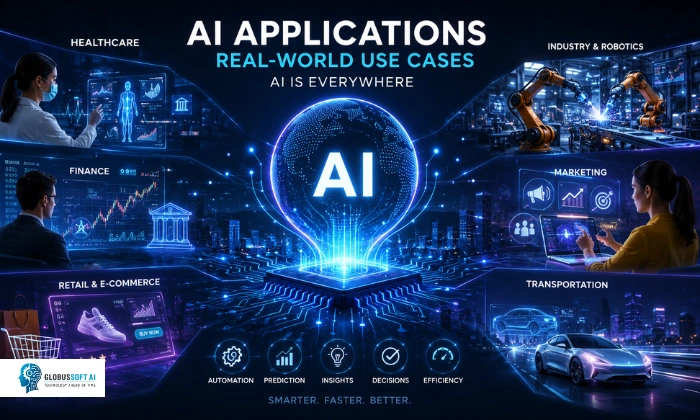
AI applications are software systems that use artificial intelligence to perform tasks that normally require human thinking. These systems can analyze data, understand language, generate content, recognize patterns, and even make decisions with limited human input.
You already interact with AI every day. They recommend videos, filter spam emails, detect fraud on bank cards, power chatbots, and help doctors analyze medical scans. The technology is no longer experimental. It is built into modern business operations and daily life.
When you look at real-world AI applications examples, the pattern becomes easier to understand because each system is designed around a specific capability rather than a single industry.
Read Aloud!
What Are AI Applications? (A Clear Definition)
If you’re wondering what is AI applications, the simplest answer is this: they are practical uses of artificial intelligence designed to solve real problems. Some focus on prediction, others on automation or content creation.
The applications of AI range from simple recommendation engines to advanced systems that generate code, images, and business insights. What matters most is not the complexity of the model, but the problem it solves.
Traditional AI vs. Generative AI vs. Agentic AI – What’s the Difference?
Many people confuse these categories because they often overlap. A customer support system, for example, may use predictive AI for routing tickets and generative AI for drafting responses.
That distinction matters because generative applications behave very differently from older machine learning systems. They create outputs instead of only analyzing inputs.
A Framework for Thinking About AI Applications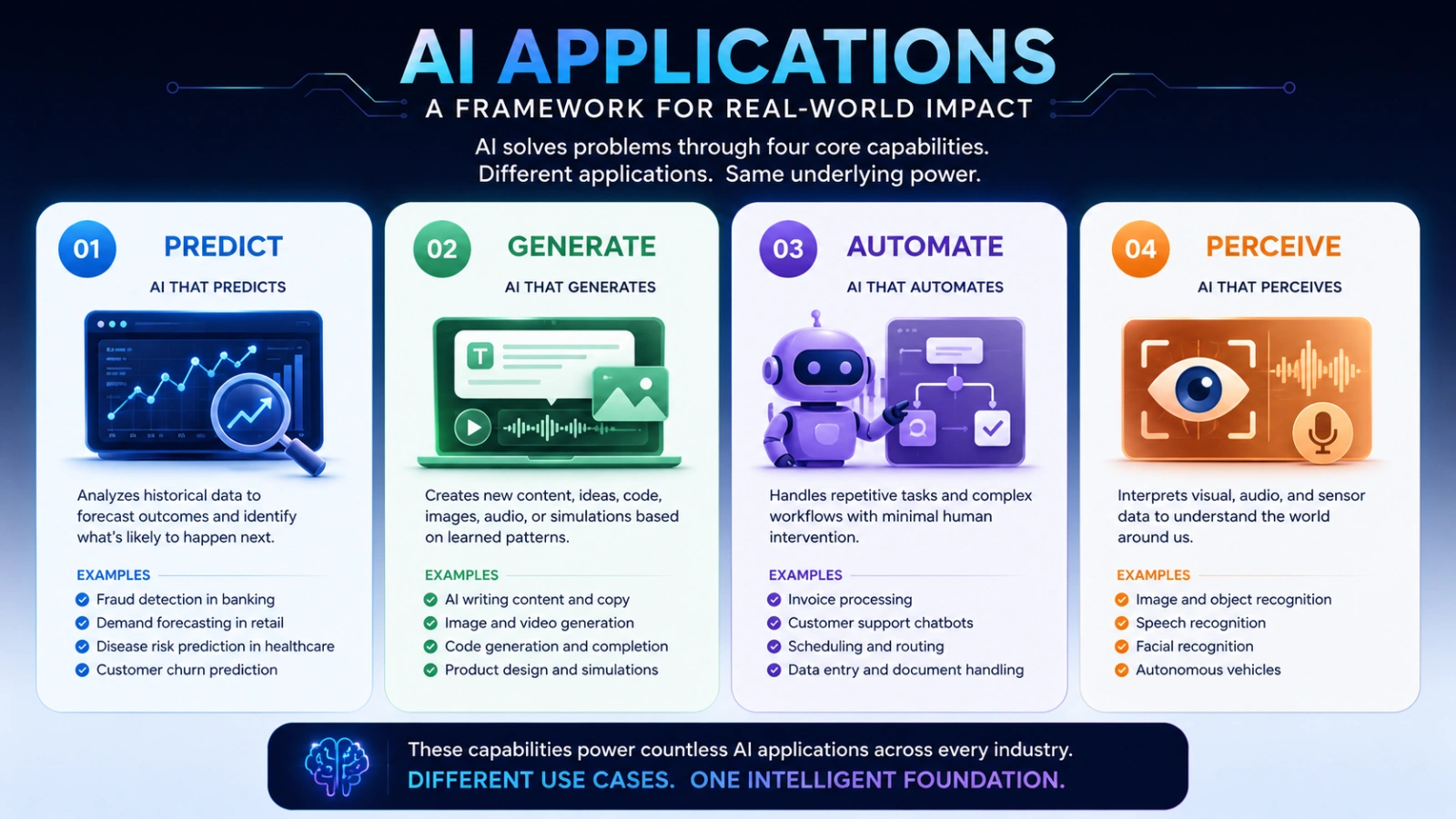
Most articles list industries without explaining how the technology actually works across them. A better approach is to organize them by capability.
AI That Predicts
These systems forecast outcomes based on historical data. Banks use them to detect suspicious transactions. Hospitals use them to identify disease risks earlier.
Prediction-focused applications of AI work best when patterns already exist in large datasets.
AI That Generates
Generative systems create text, code, images, audio, and simulations. This category exploded after large language models became mainstream.
Some generative AI applications can draft marketing campaigns in minutes. Others generate software code or realistic product designs.
AI That Automates
Automation-focused AI handles repetitive workflows with minimal human involvement. Think customer service bots, invoice processing, or scheduling assistants.
Businesses often adopt these AI applications first because they reduce operational costs quickly.
AI That Perceives
These systems interpret visual, audio, or sensor-based information. Facial recognition, voice assistants, and autonomous vehicles rely heavily on perception models.
Computer vision is one of the strongest application examples in manufacturing and healthcare today.
AI Applications Across Industries – With Real Examples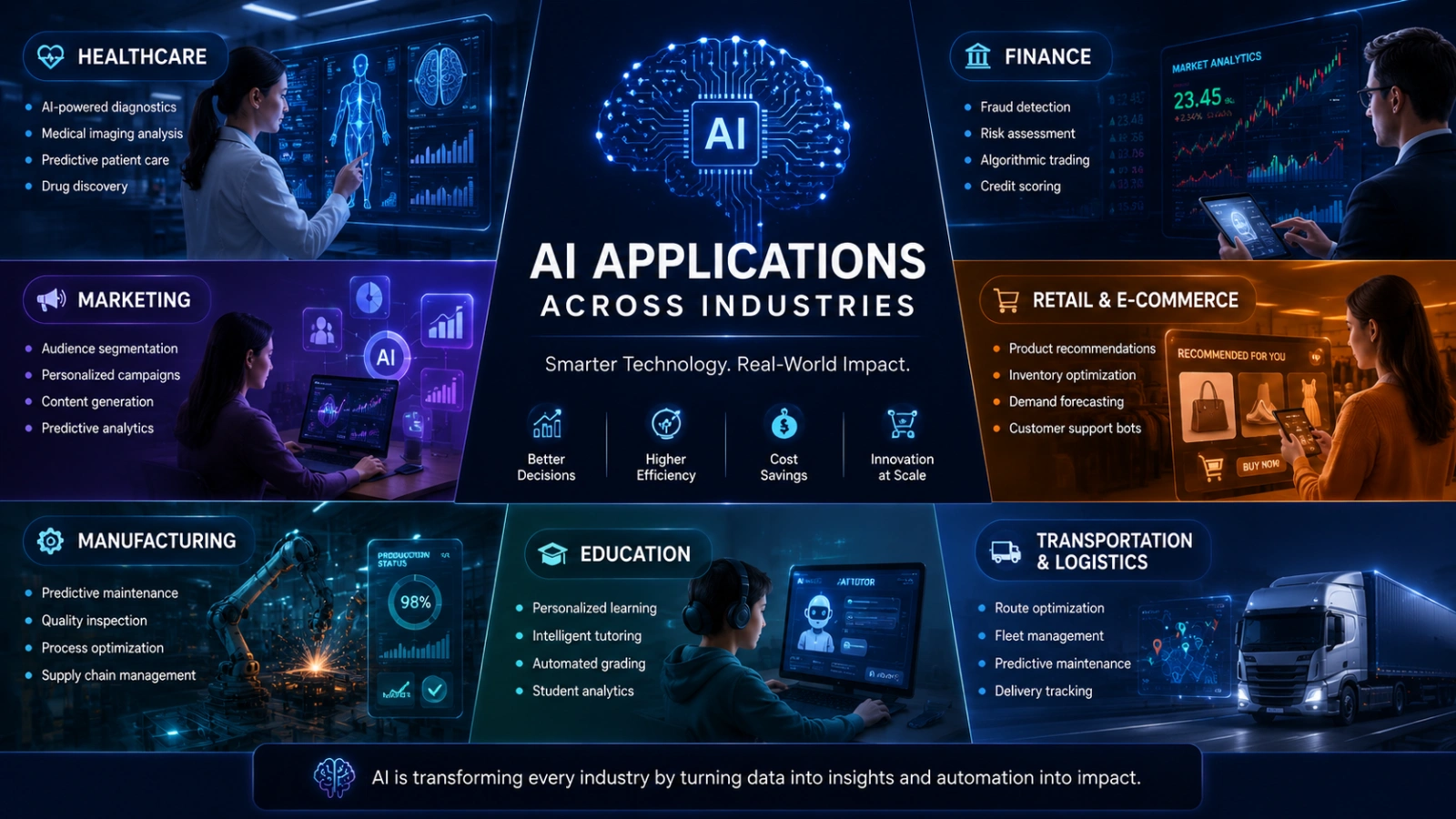
AI in Healthcare
Healthcare remains one of the most impactful areas for AI applications. Hospitals now use AI to analyze medical imaging, prioritize urgent cases, and support diagnosis.
In radiology, AI models can detect abnormalities in scans with accuracy levels approaching trained specialists in certain conditions. Drug discovery has also changed dramatically. Pharmaceutical companies use AI to identify promising compounds far faster than traditional research methods.
Virtual health assistants are growing as well. They help patients schedule appointments, monitor symptoms, and receive basic care guidance without waiting for human staff.
Still, healthcare AI works best as a support layer. Doctors remain essential for interpretation and final decisions.
AI in Finance and Banking
Banks adopted AI applications early because financial systems generate massive amounts of structured data.
Fraud detection systems monitor millions of transactions in real time. Instead of relying only on static rules, modern AI models identify unusual behavior patterns instantly.
Risk assessment has improved too. Lenders use AI to evaluate creditworthiness faster, while investment platforms personalize recommendations based on user behavior and market conditions.
One overlooked benefit is speed. AI systems process financial data in seconds, something manual teams could never scale efficiently.
AI in Marketing and Content Creation
Marketing changed rapidly once generative AI applications became widely accessible.
Teams now use tools like OpenAI ChatGPT, Anthropic Claude, and Jasper Jasper for blog drafting, campaign ideation, ad copy generation, and customer research.
AI also improves targeting and personalization. Recommendation systems analyze browsing behavior, purchase history, and engagement patterns to deliver tailored content.
The productivity gains are significant. A task that once took a full day may now take an hour. That does not mean human creativity disappears. Strong marketing still depends on strategy, positioning, and judgment.
AI in Education
Education-focused AI applications are becoming more personalized and accessible.
AI tutors can explain concepts at different difficulty levels depending on the student’s progress. Language learning platforms adapt lessons dynamically based on performance.
Accessibility tools are another major development. Speech-to-text systems, real-time translation, and AI-powered reading support help students with different learning needs participate more effectively.
Some educators worry about overreliance on AI-generated answers. That concern is valid. The best educational systems use AI to support learning, not replace thinking.
AI in Retail and E-Commerce
Retailers rely heavily on AI applications behind the scenes.
Recommendation engines increase average order value by suggesting relevant products at the right moment. Inventory forecasting systems help businesses reduce stock shortages and over-ordering.
Dynamic pricing tools adjust prices based on demand, competition, and purchasing trends. Customer service chatbots also handle large volumes of support requests without requiring massive teams.
Many consumers only notice the surface layer. The real AI infrastructure often operates quietly in logistics, warehousing, and demand planning.
AI in Manufacturing and Agriculture
Manufacturing and agriculture share a common challenge: efficiency at scale.
Factories use AI-powered computer vision systems for quality control. These systems detect defects faster and more consistently than manual inspections.
Predictive maintenance is another major use case. Machines equipped with sensors can warn operators before failures happen, reducing downtime.
In agriculture, AI applications analyze weather patterns, monitor soil conditions, and identify crop diseases early. Farmers can then make more accurate decisions about irrigation, fertilizer use, and pest control.
AI in Cybersecurity
Cybersecurity threats evolve too quickly for traditional defenses alone.
Modern AI applications monitor network activity continuously and identify suspicious behavior patterns in real time. Unlike older rule-based systems, AI adapts as threats change.
This matters because attacks are becoming more automated. Security teams increasingly rely on AI to respond faster than human analysts could manage manually.
At the same time, attackers also use AI. That creates an ongoing technological arms race.
Read More!
AI Integration: How to Bring AI Into Your Workflows
How Do Artificial Intelligence Services Drive Business Growth?
Generative AI Applications – A Category of Their Own
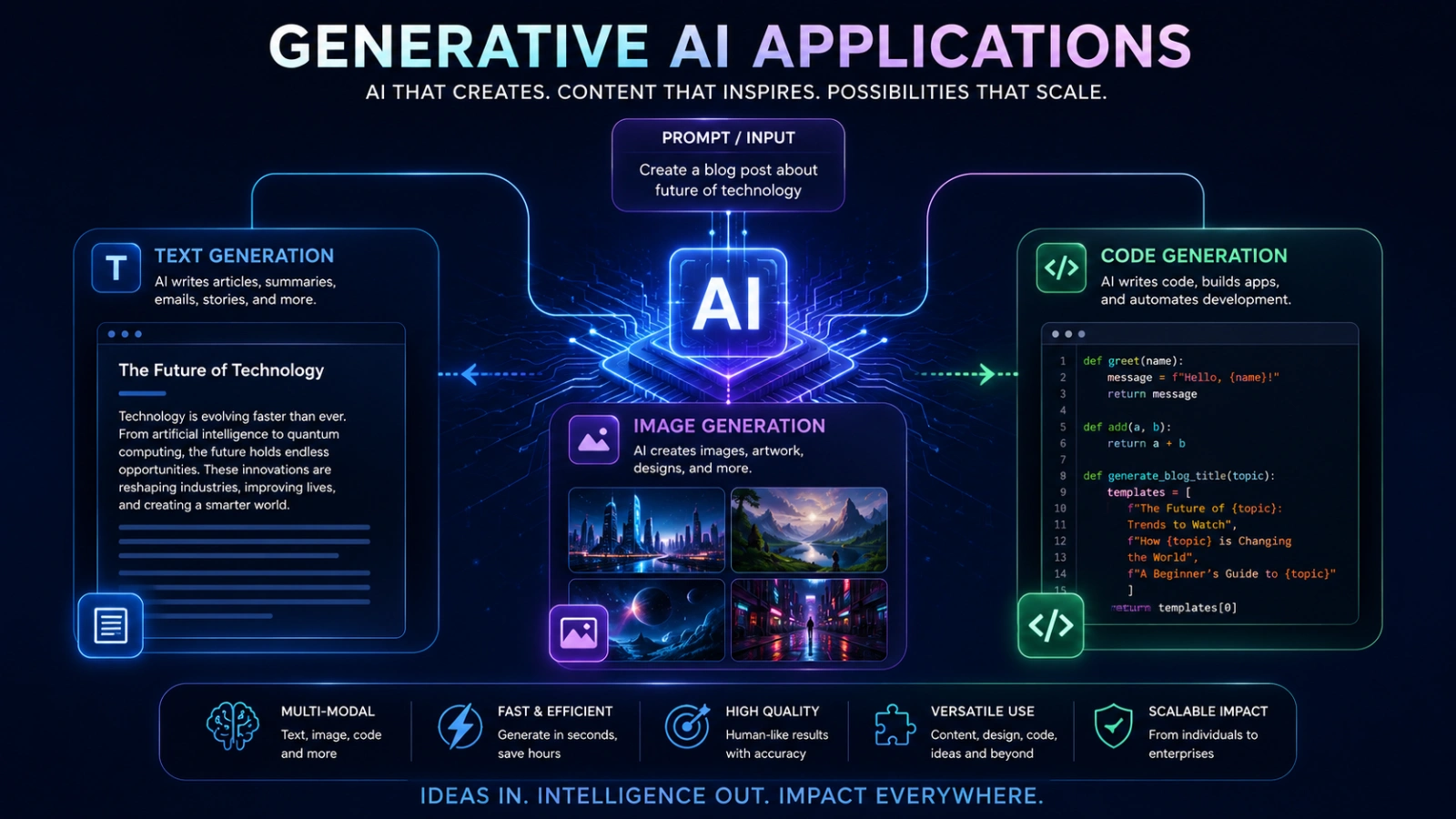
Generative applications deserve separate attention because they have fundamentally changed how people interact with software.
Traditional machine learning systems mostly classify, predict, or recommend. Generative models create entirely new outputs based on patterns learned during training.
Common generative AI use cases include:
- Text generation for blogs, emails, and reports
- AI image and video creation
- Code generation tools for developers
- Synthetic data generation for machine learning
- Drug molecule simulation in pharmaceutical research
Code assistants are especially influential. Developers now use AI to generate boilerplate functions, debug code, and explain unfamiliar syntax quickly.
That does not eliminate engineering expertise. It shifts the role toward reviewing, refining, and directing outputs effectively.
Agentic AI – The Next Wave of AI Applications
Agentic AI is emerging as the next major evolution in applications.
Unlike standard chatbots, AI agents can complete multi-step goals with limited supervision. They plan actions, gather information, and adjust based on feedback.
Research agents already summarize documents and organize findings automatically. Coding agents can analyze repositories, write updates, and test outputs across workflows.
Businesses are watching this category closely because it changes how software operates. Instead of waiting for commands, systems begin acting proactively within defined boundaries.
Many analysts expect agent-integrated software to expand rapidly through 2026 as enterprises look for productivity gains beyond basic automation.
Limitations and Risks of AI Applications
AI is powerful, but they are not consistently reliable.
Generative systems can hallucinate facts, invent sources, or produce inaccurate recommendations. That creates serious risks in healthcare, legal, and financial environments.
Bias is another challenge. AI systems trained on flawed datasets may reinforce unfair outcomes in hiring, lending, or policing.
Privacy concerns also continue to grow. Many organizations struggle with how customer data should be stored, processed, and protected inside AI systems.
There is also the ROI problem. Some companies invest heavily in AI without improving productivity meaningfully. Adoption alone does not guarantee results.
The strongest implementations usually combine AI efficiency with human oversight and clear operational goals.
FAQs
What is the most common application of AI today?
Recommendation engines and natural language processing systems lead everyday use. They power search results, streaming suggestions, chatbots, and voice assistants that most people interact with constantly.
What are generative AI applications, and how are they different?
Generative AI tools create new content such as text, images, code, and audio. Unlike traditional systems that analyze existing data, these models produce original outputs based on learned patterns.
How are AI systems used in business?
Companies rely on them for automation, fraud detection, customer support, forecasting, and content creation. The biggest impact usually comes from removing repetitive manual work and speeding up decision-making.
Are these systems safe to use for sensitive tasks?
They can be helpful in controlled environments, but human oversight is still necessary. Errors, hallucinations, and bias can appear in high-stakes areas like healthcare or finance.
What industries benefit most from them?
Healthcare, finance, retail, and manufacturing see some of the strongest results. At the same time, adoption is spreading quickly into education, marketing, and software development.