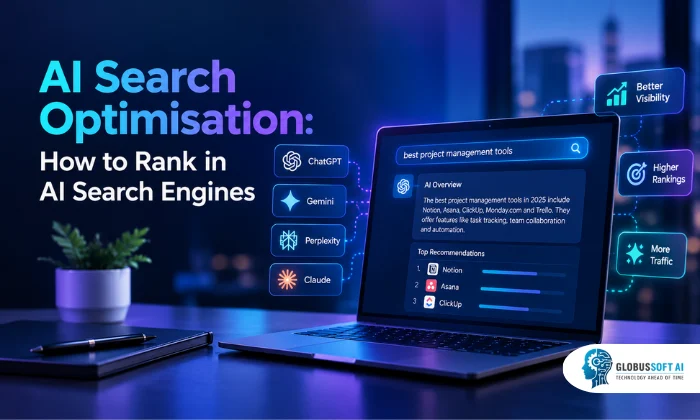
The way people find information online is shifting fast. The AI search engine is no longer a side project at major tech companies. It is becoming the primary way millions of users discover answers, products, and services. Google’s AI Overviews, ChatGPT Search, Perplexity, and Microsoft Copilot surface content directly in conversational responses. Often, the user never clicks a traditional search result.
That changes everything for businesses that depend on organic traffic. Old strategies are necessary but no longer sufficient. This guide covers what AI search optimisation involves and what your content needs to show up where it matters.
Listen to this podcast!
What Is an AI Search Engine?
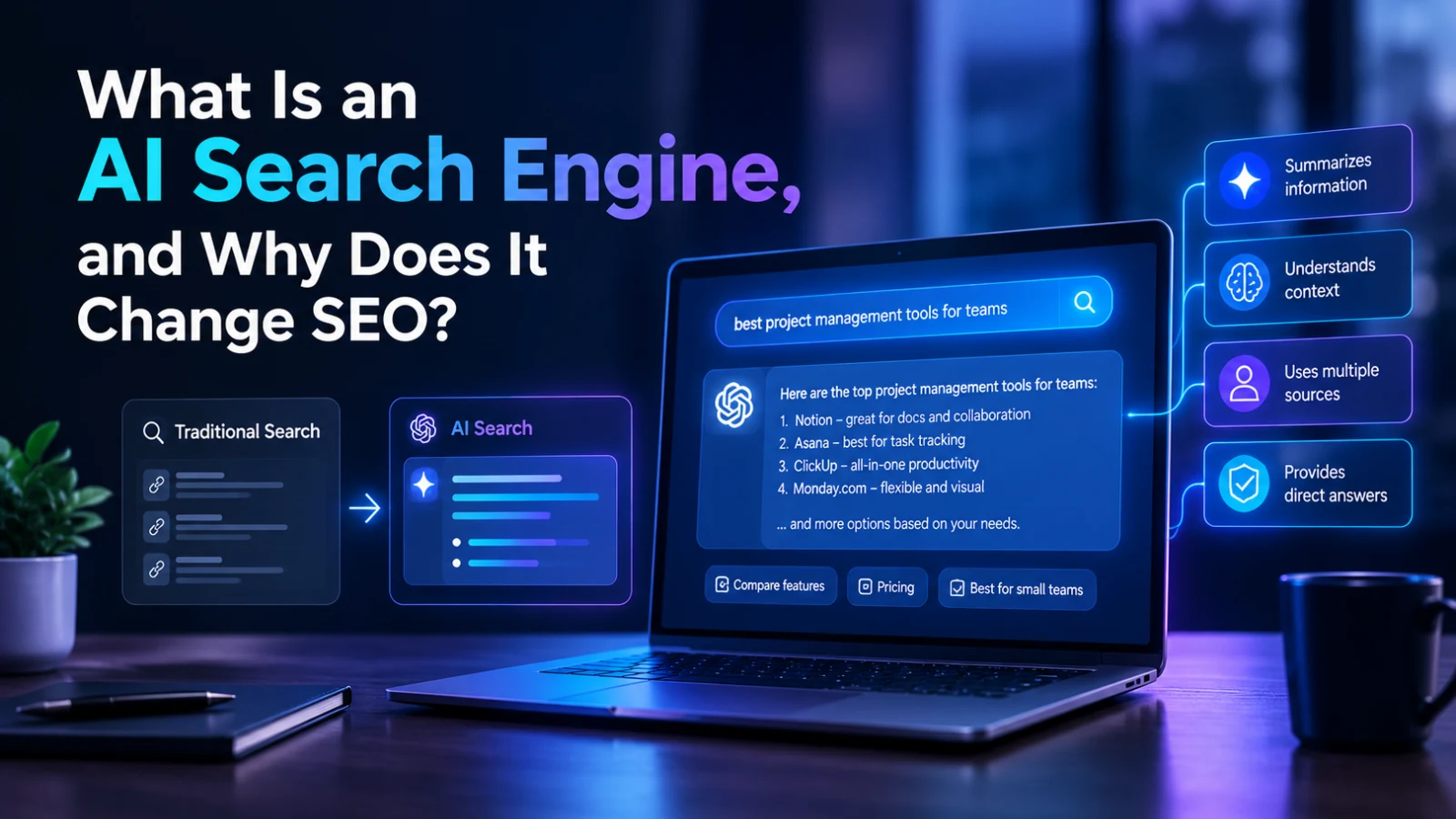
An AI search engine doesn’t return a list of links. It reads, synthesises, and summarises content from the web. Then it delivers a direct answer — often with citations. The user gets the response without visiting your page.
Why This Changes SEO
If your content isn’t structured so AI systems can parse and trust it, it won’t get cited. Traditional SEO optimises for clicks. AI search optimization means structuring content to get selected as a source. That is a meaningfully different target.
How AI Search Results Are Generated
Most AI search systems retrieve relevant content first. Then a language model synthesises an answer from it.
The Retrieval Step
This is where your SEO fundamentals still apply. The page must be crawlable, indexed, and associated with the right topic signals.
The Synthesis Step
This is where new optimisation work begins. AI systems favour content that directly answers a specific question. They also favour pages with strong topical authority, sources cited elsewhere on the web, and structured data that makes content type explicit. Vague content structured for keyword density gets passed over — regardless of its traditional ranking position.
The Four Pillars of AI Search Optimisation
- Answer-First Content Structure: Lead every section with a direct answer. AI systems extract the clearest available response. Burying your point three paragraphs in means losing the citation to a competitor who leads with it.
- Topical Authority: Build content clusters around your core subjects. This helps AI systems associate your domain with genuine expertise — not just individual keyword matches.
- Structured Data and Schema: FAQ schema, HowTo schema, and Article schema help AI systems categorise your content correctly. They also improve retrieval for the right queries.
- E-E-A-T Signals: Author credentials, original research, cited sources, and factual accuracy are the trust signals AI search systems use. They determine whether a source is worth citing.
GEO Strategy for the Middle East: UAE, Saudi Arabia, and Beyond
The Middle East is one of the fastest-growing digital markets in the world. AI search adoption here is outpacing many Western markets. Businesses in Dubai, Riyadh, and across the GCC that build their Generative Engine Optimization (GEO) strategy now will hold citation positions that are hard to displace later.
How to Optimise for Google AI Overviews in UAE
UAE users frequently search in mixed English and Arabic. To appear in AI Overviews, your content needs answer-first formatting and strong topical authority. Include FAQ schema matching conversational questions UAE users ask. Location-specific references — UAE regulations, local market context, regional examples — improve citation probability for geo-modified queries.
GEO Services in Dubai
A quality GEO service for the Dubai market should cover content restructuring for AI retrievability. It should also include bilingual schema implementation and citation monitoring across Google AI Overviews, Perplexity, and ChatGPT Search. Look for agencies that measure citation frequency as a primary KPI — not just traditional rankings.
How to Appear in ChatGPT Searches in Saudi Arabia
ChatGPT Search retrieves content from Bing’s index. For Saudi businesses, this requires strong Bing indexation. It also requires authoritative content in both Arabic and English. Structured data should make your location and expertise explicit. Direct answers to questions Saudi users are asking — in natural Arabic and English — are consistently prioritised by ChatGPT’s synthesis layer.
AI Search Strategy for Middle East E-Commerce
Product discovery is increasingly happening inside AI-generated responses. For Middle East e-commerce, combine Product schema and Review schema on key pages. Use answer-first category content that addresses buyer questions. Build separate localised content for UAE, Saudi Arabia, Kuwait, and Qatar. Do not rely on a single English-language site for the entire region.
Best GEO Agencies in Riyadh
When evaluating GEO agencies in Saudi Arabia, prioritise those with clear citation tracking methodology. They should have bilingual Arabic-English AI search expertise. Ask how they measure success. Agencies reporting only traditional keyword rankings are not yet operating in a GEO-first framework.
How to Rank for Real Estate in Dubai
For Dubai real estate, AI search optimisation should prioritise answer-first area guide content. Add Property schema across all key pages. Include FAQ sections in both English and Arabic. Build citations from credible UAE property portals. Hyper-local content — neighbourhood guides, tower-specific pages, RERA regulatory guidance — consistently outperforms generic Dubai content in AI citation contexts.
Bilingual GEO: Ranking English and Arabic Websites
Bilingual AI search optimization requires separate, fully developed content in both languages. Do not use machine-translated versions of the same page. Correct hreflang implementation is essential. Apply schema markup independently to both language versions. Build E-E-A-T signals on Arabic-relevant sources. AI systems evaluate Arabic content quality with the same rigour as English. Native Arabic content creation is the single highest-impact action most Middle East businesses can take.
Read More!
What Is Link Building and Why Does It Matter in SEO?
Technical SEO Guide: How To Boost Your Website Rankings
How Globussoft AI Helps You Build AI-Ready Systems
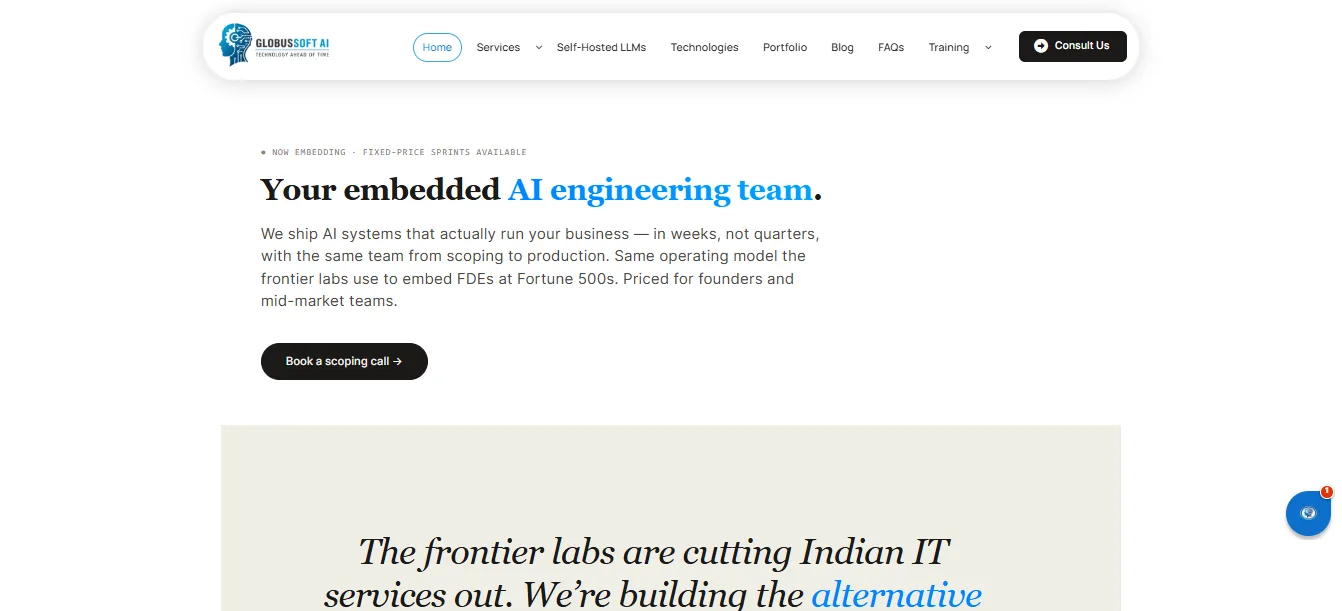
Most businesses adapting to AI search face the same problem. The required changes cut across content, technical infrastructure, and data systems at once. That is not a one-tool fix.
Globussoft AI is an embedded AI engineering team. They ship production-ready AI systems in weeks — not quarters. Here is what they bring:
- Embedded Engineering Pod — Senior engineers drop into your Slack and codebase. They own the outcome from scoping through deployment. Same team, no handoffs.
- Sprint Engagements (4 Weeks) — Working prototype in production within 30 days. Full IP transfer included from day one.
- Multi-Model Architecture — Claude, GPT-4, Gemini, and Qwen are all available. Model choice is driven by your needs — not vendor lock-in.
- Production AI Agents — Inbox intelligence, CRM audit agents, outbound lead-gen pipelines, and executive briefing agents — all running live inside Globussoft’s own operations.
- Full IP Transfer — You own all source code. No black boxes. No ongoing platform fees after delivery.
Conclusion
Ranking in an AI search engine requires technical SEO discipline. It also requires a new content strategy focused on being cited — not just visited. For Middle East businesses, adding a bilingual GEO strategy and regional content specificity creates a compounding advantage. The businesses that adapt earliest will hold citation positions that define their category for years.
FAQs
What is an AI search engine?
An AI search engine synthesises answers from web content. It generates a direct response with citations rather than returning a list of links.
Is there an AI search engine free to use?
Yes. Perplexity AI, Microsoft Copilot, and Google AI Overviews are all free. No subscription is required.
How is ranking in AI search different from traditional SEO?
Traditional SEO optimises for clicks. AI search optimization focuses on being cited as a source inside AI-generated answers. It requires answer-first structure, topical authority, and structured data.