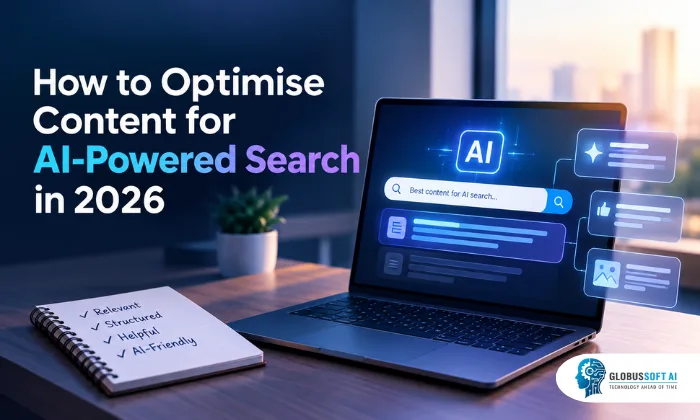
Search has fundamentally changed. In 2026, AI-powered engines don’t just match keywords; they understand intent, evaluate expertise, assess content structure, and synthesise answers from multiple sources before a user clicks anything. That means the optimisation strategies that dominated the last decade are no longer sufficient. AI SEO is the discipline of aligning your content, site architecture, and authority signals with the way AI-driven search systems actually evaluate and rank information. It’s not about gaming algorithms; it’s about producing genuinely useful, well-structured, credible content that AI search engines can confidently surface in response to complex, conversational queries. This guide covers exactly what that looks like in practice and how to build a strategy that works in the AI search era.
Listen to this podcast!
How AI-Powered Search Actually Works in 2026
To optimise effectively, you need to understand what AI search systems are actually doing when they process a query. Unlike traditional search engines that primarily matched keywords and counted links, AI-powered engines use large language models to interpret the intent behind a query, often without showing ten blue links at all.
Instead, they synthesise a direct answer, pulling from multiple sources, ranking them by relevance, authority, and structural clarity. Your content needs to answer specific questions clearly, demonstrate genuine expertise, and be structured in a way that AI systems can extract and trust. This shift from keyword matching to intent understanding is the core change that makes AI SEO a distinct discipline.
What Is AI SEO, and Why Does It Matter Now?
AI SEO is the practice of optimising content and digital presence specifically for AI-driven search environments, including Google’s AI Overviews, Bing Copilot search, Perplexity, ChatGPT search, and other AI-first discovery surfaces.
It matters because the stakes are higher. In traditional search, ranking on page two still drives some traffic. In AI search, if your content isn’t cited or surfaced in the AI’s synthesised answer, you effectively don’t exist for that query. Businesses that adapt their content strategy to AI search signals will compound their visibility. Those that don’t will find organic traffic declining regardless of how strong their traditional SEO metrics look.
Core AI SEO Strategies That Actually Work
Building an effective AI SEO strategy in 2026 requires focusing on the signals that AI search systems weight most heavily:
- Answer-first content structure: Lead every section with a direct, clear answer to the question it addresses. AI systems extract the clearest available answer. Burying your point three paragraphs in means getting passed over for a competitor who leads with it.
- Topical authority over keyword density: AI engines evaluate whether your site is a genuine authority on a topic, not whether a keyword appears a specific number of times. Build comprehensive content clusters that cover a subject from multiple angles.
- Structured data and schema markup: Help AI systems understand what type of content each page is, who wrote it, when it was published, and what it’s about. FAQ schema, HowTo schema, and article schema all improve AI extractability.
- First-hand expertise signals: AI search favours content that demonstrates direct experience. Case studies, real examples, original data, and named author credentials all contribute to the trust signals that AI systems reward.
AI SEO Tools: What to Use in 2026
The right AI SEO tools significantly reduce the time required to research, optimise, and monitor your content performance. Here’s what the most effective practitioners are using:
- AI content analysis tools: Platforms that analyse your content against top-ranking competitors for a query, identifying structural gaps, missing subtopics, and authority signals you’re not yet addressing.
- Schema markup generators: Tools that automate the creation and validation of structured data so every page is correctly annotated for AI extraction.
- AI perplexity and citation trackers: Newer tools that monitor whether your content is being cited or referenced in AI-generated answers across platforms like Perplexity and ChatGPT Search.
- Semantic search optimisers: Tools that expand your keyword research into entity relationships, helping you understand how AI search connects concepts rather than just matching terms.
- Performance monitoring dashboards: AI search changes fast. Real-time tracking of impressions, citations, and position in AI overviews is essential for knowing what’s working and what isn’t.
AI SEO Services: When to Bring in External Expertise
For many businesses, building AI SEO capability in-house from scratch is neither fast nor cost-effective. AI SEO services fill that gap, providing the expertise, tooling, and ongoing optimization effort that most marketing teams don’t have internally.
The right AI SEO services partner goes beyond tactical implementation. They analyze your competitive position in AI search, identify which queries your content could realistically be cited for, restructure existing content to improve AI extractability, and build systematic processes for ongoing monitoring and improvement. For businesses where organic search is a significant acquisition channel, this is an investment that pays back measurably in citation frequency and traffic quality.
How Globussoft AI Builds AI-Native Systems for Smarter SEO Operations
For businesses that want to go beyond manually optimised content and build intelligent, automated systems that power their entire content and search operation, Globussoft AI is the embedded AI engineering team that ships those systems in weeks, not quarters.
Here’s what Globussoft AI ships that directly supports AI-native content and SEO operations:
- Web Research Reader Agent – Continuously pulls live data from Twitter, Reddit, YouTube, GitHub, and the broader web using Playwright for JS-heavy pages, powering competitor watches, trend scans, and content intelligence in real time without manual research.
- Content Pipeline Watcher – Monitors content-team channels for published, scheduled, and stalled work; nudges owners on late items; and gives editorial a live board without status meetings.
- Outbound Lead-Gen Campaign Agent – Finds prospects via Apollo, RocketReach, and Prospeo; verifies emails; drafts personalized copy per contact; sends via Gmail; tracks replies; and syncs everything to your CRM automatically.
- Executive Briefing Agent – Chief-of-staff agent that reads all agent outputs, your calendar, and priority queues, delivering a single morning brief of the 3–5 things that need your attention, including content performance signals.
- Multi-Model Architecture – Claude, GPT, Gemini, and self-hosted Qwen, whichever model fits each task, with full portability and zero vendor lock-in.
- Three Engagement Tiers – Sprint (4-week fixed scope, working prototype in production), Embedded Pod (rolling 3-month minimum, weekly ship cadence), Fractional CTO (1 day/week with Sumit personally on architecture and roadmap).
- Full IP Transfer – You own all source code. No black boxes, no ongoing platform fees to Globussoft after delivery.
- Starts in 2 Weeks – Sprint engagements begin in 2 weeks. The first agent ships to production within 30 days of scoping. No offshore handoffs, no discovery-doc theatre.
Globussoft AI is not an AI SEO agency in the traditional sense; they are the engineering team that builds the AI-native infrastructure your content and SEO operations run on.
AI SEO Agency vs In-House vs Custom Build: Choosing the Right Model
The decision between hiring an AI SEO agency, building in-house capability, or commissioning a custom-built AI system depends on your scale, budget, and how central search is to your business model.
An AI SEO agency makes sense when you need expertise quickly, and your core team doesn’t have the bandwidth to develop it internally. In-house builds work when search is central enough to your business to justify a dedicated team. Custom AI builds like those Globussoft AI delivers make the most sense when your content operation is large enough that manual processes are the bottleneck and you need automation that fits your specific workflow rather than a generic SaaS tool.
Read More!
What Is AI Search? Everything You Need to Know
AI Search Engines 2026: RAG, Citations & Business Visibility
Conclusion
AI SEO is not a trend; it is the new baseline for organic search visibility in 2026. The businesses building their content strategy around AI search signals today are compounding an advantage that will be increasingly difficult to close. Whether you start with the right AI SEO tools, engage an expert team for AI SEO services, or commission a custom-built content intelligence system, the most important step is starting now.
Frequently Asked Questions
Q1. What is AI SEO?
AI SEO is the practice of optimising content, site structure, and authority signals specifically for AI-powered search engines, including Google AI Overviews, Bing Copilot, Perplexity, and ChatGPT Search, which evaluate content differently from traditional keyword-based systems.
Q2. What are the best AI SEO tools in 2026?
The most effective tools include AI content analysis platforms, schema markup generators, AI citation trackers for Perplexity and ChatGPT Search, semantic search optimisers, and real-time performance monitoring dashboards.
Q3. How is an AI SEO agency different from a traditional SEO agency?
An AI SEO agency specialises in optimising for AI-driven search surfaces, restructuring content for AI extractability, building authority signals AI systems recognise, and monitoring citation frequency across AI search platforms.
Q4. Can Globussoft AI help with AI SEO automation?
Yes. Globussoft AI builds custom AI agents, including web research readers, content pipeline watchers, and briefing agents that automate the intelligence and monitoring workflows underpinning effective AI SEO operations.