
Most custom AI projects don’t fail in the model. They fail in the meeting where someone says “let’s do a quick proof of concept” no success metric, no data audit, and a six-week deadline that quietly stretches to eighteen months. Globussoftai, an applied-AI engineering company, has shipped 40+ production AI products reaching more than 100 million users, and the failure pattern is almost always the same: good intentions, bad process. This guide gives you the process behind successful custom AI software development.
Read Aloud!
Build vs. buy: a 30-second decision test
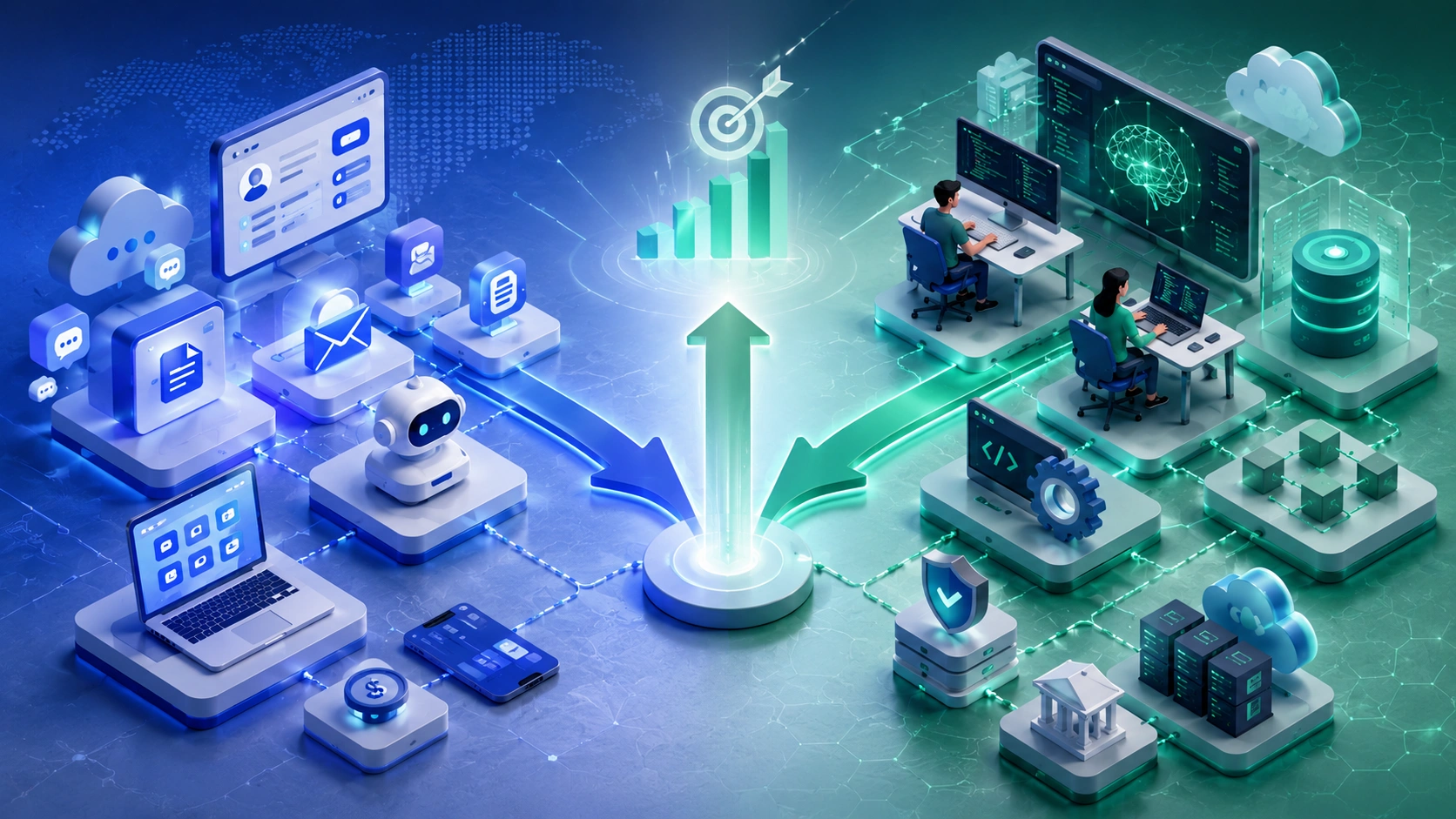
Off-the-shelf tools win when the problem is generic email drafting, meeting notes, and boilerplate support replies. Custom development earns its cost in three situations:
- Your data is the moat. A model trained on years of your proprietary transaction history, clinical notes, or settlement records will outperform any general-purpose tool, and no SaaS vendor will train on your data for you.
- Integration is non-negotiable. The AI has to write back into your ERP, EHR, or a 15-year-old mainframe with no public API.
- Compliance owns the roadmap. HIPAA, SOC 2, GDPR, or SEC rules dictate where data lives and who can see model outputs, constraints that most SaaS tools can’t satisfy.
If none of those apply, buy a tool. If one or more do, the rest of this guide covers exactly that. The following framework explains how successful custom AI software development projects move from planning to production.
One published heuristic worth anchoring to: if you’re paying a SaaS vendor more than $120K per year and still filing ignored feature requests, a custom build typically pays back inside 18 months. Below roughly 150–200 users, the per-seat math usually still favours an off-the-shelf tool.
What custom AI software development actually costs in 2026
Custom AI software development costs are driven more by scope and data maturity than almost any other variable. Broadly, engagements fall into three tiers:
- Proof of concept (6–10 weeks, typically low tens of thousands of dollars): One narrow use case, a working prototype on a sample of your data, and a clear go/no-go recommendation. A focused pilot covering one workflow and one integration typically runs in the low tens of thousands, enough to validate or kill the idea before committing a quarter’s budget.
- Production MVP (3–4 months): Hardened data pipelines, authentication, monitoring, and a UI that real users can touch. The Globussoftai custom AI software development buyer’s guide breaks down cost drivers in detail, including why data readiness alone can consume 30–40% of the project budget before any AI work starts.
- Enterprise platform (6–12 months): Multiple models, role-based access, audit logging, and deep integration into core systems of record. Large-scale custom AI software development also depends on infrastructure choices, cloud deployment targets on AWS, Azure, or GCP, orchestration layers, and retraining cadence, which determine the total cost of ownership more than the initial build price.
The biggest cost driver is rarely the model; it’s the plumbing: data cleaning, evaluation harnesses, guardrails, and the retraining loop. Teams that under-invest in data and infrastructure ship impressive demos that collapse under real production load.
For context on what premium alternatives cost: frontier-lab FDE programs run $500k–$2M per year per engineer, with contract minimums starting at $250,000. Globussoftai’s embedded engineering pod is priced at approximately one-tenth that cost and can start within two weeks.
A real result: what production AI actually delivers
Specifics matter more than ranges. One verified outcome: Globussoftai’s spam false-positive rescue agent recovers 100+ misclassified messages per day messages a standard spam filter would have silently buried. That’s not a demo metric. It runs in production, continuously. The mechanism: a secondary classification layer scores borderline-rejected emails against the user’s historical engagement patterns before archiving. A single false positive rescued from a high-value contact can be worth more than the entire monthly cost of running the agent.
That’s the kind of narrow, measurable outcome that makes custom AI defensible to a CFO. Pick one metric. Make it bleed if you don’t fix it.
Read More!
How OpenClaw AI Integration Helps Businesses Earn $10K+ in 7 Hours?
GlobussoftAI OpenClaw Services: Professional Installation & Custom Development
The 6-Step Custom AI Software Development Process
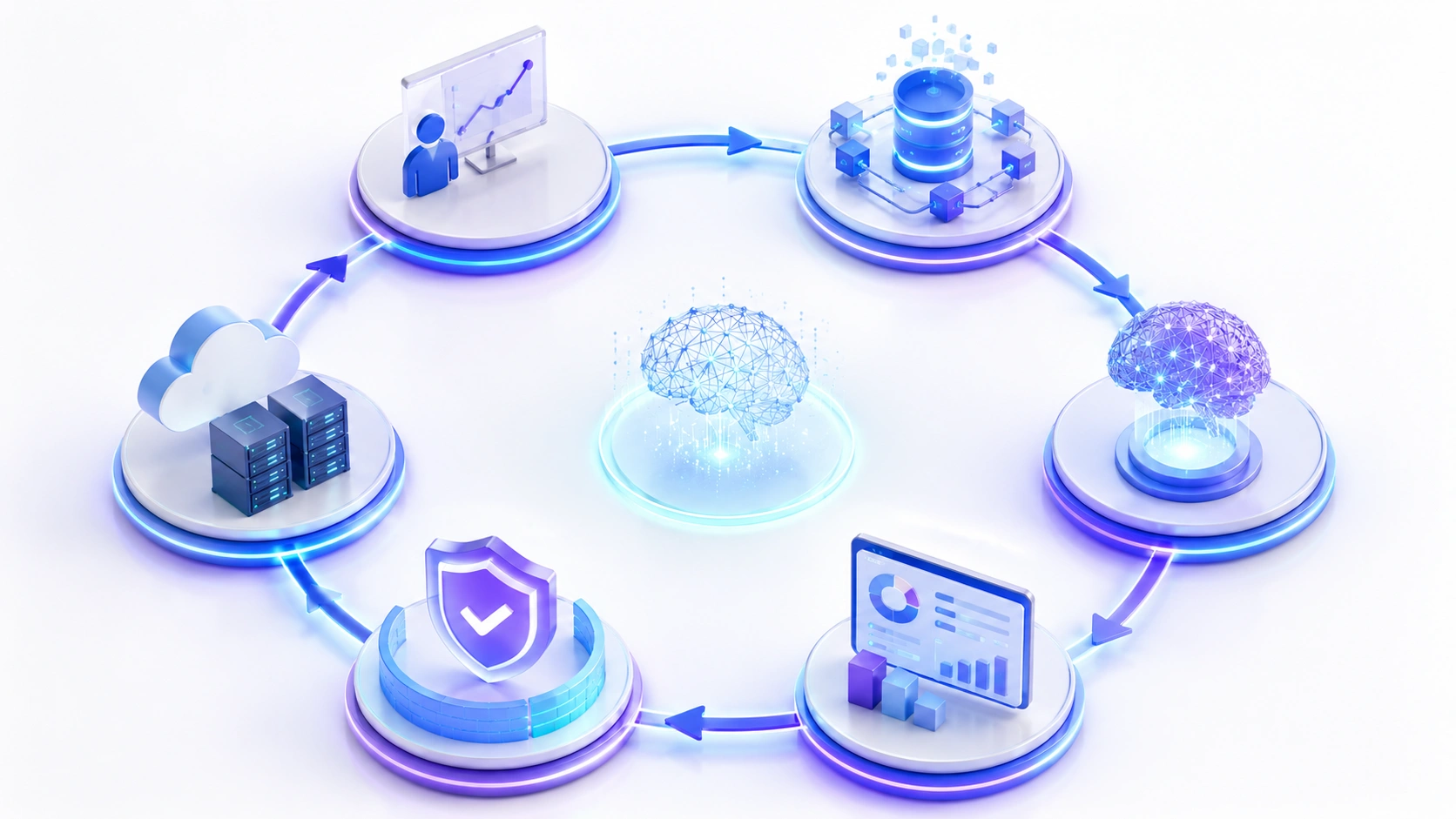
Every successful custom AI software development project follows these six stages.
1. Problem framing and success metrics (week 1)
Before a line of code, define the metric that decides success. “Reduce invoice-processing time” is a wish. “Cut average handling time from 9 minutes to under 90 seconds” is a spec. Pin the baseline on day one, and you’ll be judged against it every week after.
2. Data audit and pipeline build (weeks 2–4)
Most custom AI software development projects stall here. Front-load it. Inventory where data lives, how clean it is, and who owns access. Expect surprises: duplicate records, undocumented status codes, PII buried in free-text fields. A proper pipeline handles ingestion, deduplication, and PII redaction before anything reaches a model.
Scale puts this in sharp relief: in 2025, 78% of global companies report using AI in at least one business function, up from 55% in 2023, yet most of those deployments are narrow and exploratory, not production-hardened. The bottleneck blocking the rest is almost always data, not model capability.
3. Model selection and the RAG-vs-fine-tune call
Not every problem needs a fine-tuned model. Use retrieval-augmented generation (RAG) when answers must cite fresh, changing documents, policy manuals, product catalogs, and ticket histories. Reserve fine-tuning for fixed tasks with a stable format, like classifying support tickets into a known set of categories. And for RAG systems, chunking strategy and embedding quality drive more accuracy gains than the choice of foundation model, an often-ignored detail that separates vendors who’ve shipped from those who’ve only prototyped.
Many production agent systems combine a strong frontier model for generation with a smaller, task-specific classifier for routing and triage. That stack costs less to run, updates in hours rather than weeks, and is far more explainable to a compliance team than a monolithic custom model. See how this applies to custom AI agent architectures in practice.
4. Evaluation harness before scale
This is the step amateurs skip. Build a representative labeled test set, typically 100–500 real examples, and score every model change against it automatically. Track accuracy, hallucination rate, latency, and cost per request. Without this harness, you’re tuning blind, and you’ll never convince a risk committee that the system is safe.
One accuracy trap worth knowing: getting from 85% to 97% accuracy can cost more than the entire buildup to 85%. Set the required threshold before the build starts, not after the demo impresses someone in a boardroom.
5. Guardrails, monitoring, and human-in-the-loop
Production AI needs input validation, output filtering, and a fallback path when confidence drops. For high-stakes decisions, route low-confidence cases to a human reviewer and feed those corrections back into training. Log every prompt and response so you can reproduce any decision an auditor questions. In regulated industries, this is a compliance requirement, not a differentiator, not optional.
6. Deployment and the retraining loop
Ship to a small slice of real traffic first, watch the dashboards, then widen. Plan for drift: a model trained on last year’s data degrades as your business changes. A regular retraining cadence, triggered by monitored accuracy drops, keeps performance from quietly eroding without anyone noticing until it’s someone else’s problem.
What to include in an AI development RFP
Most buyers write RFPs that attract the wrong vendors. A strong AI development RFP does four things a generic software RFP doesn’t.
- Describe the data, not just the problem. State how many records exist, rough quality level, where they live, and any access restrictions. Vendors who don’t ask about data early won’t manage it well later.
- Require a stated evaluation methodology. Ask each bidder to describe how they’ll measure model accuracy before launch and at regular post-deployment intervals. Vague answers (“we’ll monitor performance”) reveal vendors who have never shipped a live model.
- Ask who owns the artifacts. Code, model weights, fine-tuned adapters, prompt templates, and evaluation datasets should all transfer to you at project close. Get it in the contract scope, not just a verbal assurance.
- Request references from production deployments, not pilots. A demo in a sandbox is easy. Ask specifically for a client who took a system from prototype to live traffic, with real users and real error rates. The shift from AI experiment to production AI service is where most vendors show their limits.
One heuristic: if a proposal doesn’t mention drift, retraining, or monitoring, the vendor has priced a build not a system.
Who’s on a Custom AI Software Development Team
A serious build isn’t one “AI engineer” wearing six hats and hoping no one checks. A right-sized production team usually includes:
- ML/AI engineer model architecture, prompting, fine-tuning, and evaluation.
- Data engineer pipelines, storage, and retrieval infrastructure.
- Backend engineer APIs, auth, system integration.
- MLOps/DevOps deployment, monitoring, and cost control.
- Domain expert from your side, to label data and sanity-check outputs.
On smaller projects, one person may cover two of those roles. If a vendor pitches a full platform staffed by a single generalist, that’s a red flag, not a cost saving.
Five Questions to Ask a Custom AI Software Development Partner
- How do you evaluate model quality? No test set, no metrics, they’re guessing.
- Where does our data live, and who can access it? The answer must map to your compliance requirements exactly.
- What happens when the model is wrong? Look for guardrails and human-in-the-loop fallbacks, not blind trust in the output.
- How will you handle model drift over 12 months? A retraining plan signals they’ve shipped before.
- Who owns the code, models, and weights? You should get it in the contract.
Three Patterns That Kill Custom AI Software Development Projects
Demo-driven development. A flashy prototype on cherry-picked data that never survives messy real inputs.
No evaluation baseline. Nobody can prove the system improved anything, so the project dies in the next budget review.
Ignoring the last mile. The AI produces a correct answer but can’t write it back into the system where work actually happens. Users copy-paste and quietly abandon the tool.
Each failure is avoidable and early killing is part of the design. Roughly 1 in 3 AI ideas are killed during discovery and feasibility. That’s not a failure rate to mourn; it’s the system doing its job. A few weeks of honest scoping costs far less than six months building the wrong thing.
Ready to scope your build?
Globussoftai designs and ships custom AI software end-to-end from a 4-week proof of concept to a fully integrated enterprise platform, with the evaluation harnesses, guardrails, and MLOps that keep production systems reliable. The co-design process maps your real bottleneck in week one and ships the first AI agent into your stack by week six. You get a live system with measurable baselines. Not a slide deck.