
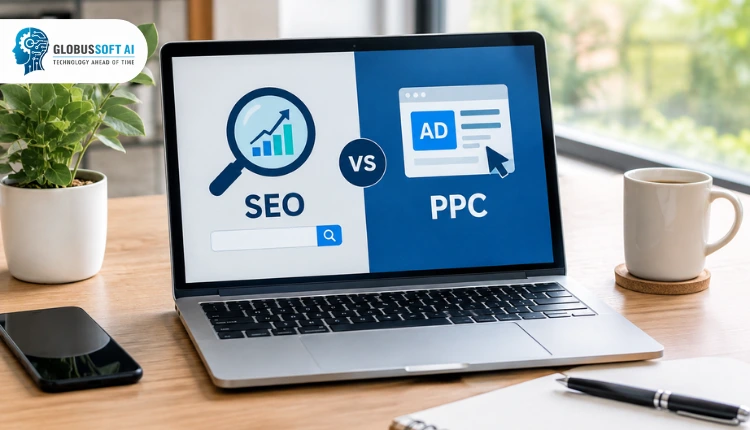
Digital marketing in 2026 isn’t just about SEO, as PPC (pay-per-click) is equally an asset.
Choosing the right digital marketing strategy is one of the most important decisions a business can make when trying to grow its online presence.
While SEO improves a website’s visibility in organic search results, PPC provides the paid advertisements that appear in search results and across advertising networks.
In the age of AI and quick searches, marketers might juggle between the two, deciding the most efficient way to generate traffic. Thus, ending up confused while choosing SEO vs PPC.
In this blog, we compare and discuss how SEO vs PPC could potentially help achieve marketing goals, for choosing the right one according to your requirements.
What Is Seo And Why Does It Work?
SEO (Search Engine Optimization) is the process of improving a website’s content so that search engines like Google can better understand, rank, and display its pages for relevant searches.
While planning an effective digital marketing strategy, SEO is one of the most trusted ways for brands to increase visibility.
SEO works best because search engines aim to provide users with relevant, useful, and trustworthy results. When a website is well-optimized and provides valuable content that matches what people are searching for, it has a better opportunity of appearing prominently in the organic search results.
For example, if someone searches for “best Instagram scheduler,” the website that has the exact information with well-structured content about Instagram schedulers by optimizing its SEO-friendliness has more chances of appearing in organic results.
If users find the content useful and the website meets other search-quality signals, that page can continue attracting relevant visitors without paying for every click.
Why Does SEO Work?
- Matches search intent: SEO helps align your content with what users are actually searching for.
- Builds organic visibility: Optimized pages can appear in search results without paying for individual clicks.
- Attracts targeted traffic: People arriving through relevant searches are already looking for information, products, or services related to your topic.
- Builds credibility: Consistently publishing useful, well-supported content can help establish a website as a reliable resource.
- Creates long-term value: A strong page can continue generating organic traffic long after it is published, although rankings can change over time.
What Is Ppc And Why Does It Work?
PPC (Pay-Per-Click) is a digital marketing strategy model where businesses pay a fee each time someone clicks on their advertisement. Instead of waiting for organic rankings, PPC allows businesses to place their ads in front of potential customers when they are actively searching for a product, service, or solution.
For example, if a business sells social media management software, it can create a PPC ad targeting searches such as “best social media management tool.”
When someone clicks the ad, the business pays for that click, and the user is directed to its website or landing page.
Why Does PPC Work?
- Provides immediate visibility: PPC ads can appear in front of relevant audiences as soon as a campaign is launched.
- Targets specific audiences: Advertisers can target users based on factors such as keywords, location, demographics, interests, and behavior, depending on the advertising platform.
- Reaches high-intent users: Search PPC can connect businesses with people who are already searching for related products or services.
- Offers budget control: Advertisers can set campaign budgets and adjust spending based on performance.
- Makes performance measurable: Metrics such as clicks, conversions, cost per click, and return on ad spend help businesses evaluate their campaigns.
- Supports quick testing: Businesses can test different keywords, headlines, offers, and landing pages to identify what generates better results.
Seo Vs Ppc: A Tabular Comparison.

| Comparison Factor | SEO | PPC |
| Definition | SEO improves a website’s visibility in organic search results. | PPC uses paid advertisements to appear in search results or across advertising networks. |
| Traffic | Generates organic traffic. | Generates paid traffic. |
| Cost | No cost for individual organic clicks, but requires investment in content, optimization, and tools. | You generally pay when someone clicks your advertisement. |
| Results | Results usually take time to develop. | Can generate traffic shortly after a campaign launches. |
| Long-Term Value | Can provide ongoing traffic when pages maintain strong organic rankings. | Traffic typically stops when the campaign or budget ends. |
| Visibility | Visibility is earned through organic search rankings. | Visibility is purchased through advertising platforms. |
| Targeting | Primarily targets users through search intent, keywords, and relevant content. | Allows advertisers to target audiences using keywords and other campaign settings. |
| Control | Businesses have less control over their exact organic ranking. | Businesses have greater control over budget, targeting, ad messaging, and campaign settings. |
| Click-Through Rate | Depends on organic ranking, search intent, title, meta description, and other factors. | Depends on factors such as ad relevance, targeting, offer, and ad placement. |
| Conversion Tracking | Can track organic traffic, conversions, engagement, and other SEO metrics. | Can track clicks, conversions, cost per click, cost per acquisition, and ROAS. |
| Content Requirement | Requires useful, relevant, and search-optimized content. | Requires compelling ad copy, targeting, and relevant landing pages. |
| Scalability | Organic growth can build gradually as more pages gain visibility. | Traffic can generally be scaled by adjusting campaign budgets and targeting. |
| Main Advantage | Builds sustainable organic visibility and can reduce reliance on paid traffic over time. | Provides faster visibility and greater control over paid campaigns. |
| Main Challenge | Requires consistent effort and patience before significant results may appear. | Requires ongoing spending and campaign optimization. |
Also read –
Best AI Tools for Creating UGC-Style Marketing Videos
Why IT School Graduates Should Consider a Career in SEO Services and Digital Marketing?
Which One Should You Choose: SEO vs PPC?

The SEO vs PPC comparison completely depends on one’s business goals, budget, timeline, and the target audience the organisation wants to reach.
- Choose SEO – if your goal is to build long-term organic visibility, attract consistent search traffic, and establish your website as a useful resource.
- Choose PPC if you need faster visibility, want more control over targeting and budget, or are promoting a time-sensitive offer, product, or service.
- Use both SEO and PPC – in most cases, marketers focus on both. PPC can help generate immediate traffic while SEO works toward building sustainable organic visibility. Working on utilizing both of them effectively is beneficial for marketers.
Ultimately, SEO and PPC serve different purposes rather than being direct substitutes. Clarity regarding the business’s digital marketing strategy and objectives can help determine how much emphasis to place on each channel.
About Globussoft AI.
Globussoft AI is an AI engineering and software development company that helps businesses build and deploy AI-powered systems, automation workflows, and intelligent software solutions.
They use an embedded AI engineering model, where their engineers work closely with a client’s team from initial planning through production deployment.
What Does Globussoft AI Do?
Globussoft AI focuses on developing practical AI systems for businesses rather than limiting its work to experimental prototypes. Its offerings include:
- AI agent development: Building AI agents that can automate business workflows and perform recurring tasks.
- AI/ML development: Developing machine-learning systems for areas such as classification, recommendations, and computer vision.
- LLM solutions: Working with models including GPT, Claude, Gemini, and Qwen depending on the project’s requirements.
- AI automation: Automating activities such as customer-support monitoring, sales reporting, email management, and lead generation.
- AI consulting: Helping businesses identify potential AI use cases and develop implementation strategies.
- AI testing and evaluation: Testing AI systems and monitoring their performance after deployment.
Why Choose Globussoft AI?
Here are some points that make Globussoft AI a priority for digital marketers.
1. AI-Powered Marketing Automation
Globussoft AI develops AI agents that can connect multiple marketing strategy tasks into a single workflow. These can support activities such as campaign planning, content creation, customer engagement, and performance analysis.
2. Smarter Content and SEO Workflows
Its AI SEO approach focuses on optimizing content for AI-powered search environments as well as traditional organic search. The company describes tools such as a Web Research Reader Agent and Content Pipeline Watcher for research, competitor monitoring, content operations, and workflow management.
3. Data-Driven Marketing Decisions
AI agents can analyze campaign performance, customer behavior, engagement, and conversion trends, optimizing the marketing strategy and helping teams process large amounts of information more efficiently.
4. Personalized Customer Engagement
Globussoft AI provides AI-powered systems for customer queries, recommendations, personalized messaging, and support workflows. These capabilities can help businesses create more personalized interactions at scale.
5. AI-Powered Advertising Capabilities
AdsGPT is an AI-powered platform for generating and optimizing advertising creatives using generative AI and LLM-based analysis.
Conclusion
A fruitful comparison between SEO and PPC is an essential activity when performed; it helps professionals understand and analyse their requirements that ultimately fulfill the marketing goal.
Both channels can potentially generate great results; a brief understanding of the needs results in a significant boost in the results.
While Globussoft AI provides one of the best AI-embedded systems for the marketing team to collaborate effectively and perform
Frequently Asked Questions
1. What is the difference between SEO and PPC?
SEO focuses on getting organic traffic from search engines, while PPC uses paid advertisements to bring visitors to a website.
2. Is SEO better than PPC?
Neither is universally better. SEO is useful for building long-term organic visibility, while PPC can provide faster paid visibility.
3. Is PPC faster than SEO?
Yes. PPC campaigns can start generating traffic soon after they are launched, while SEO usually takes more time to build organic rankings.
4. Can SEO and PPC be used together?
Yes. Businesses can use PPC for immediate visibility while using SEO to build long-term organic search traffic.
5. Which is more cost-effective, SEO or PPC?
It depends on the business, goals, competition, and strategy. SEO does not charge for individual organic clicks, while PPC generally involves paying for clicks or other ad interactions.