

Most AI startups look promising on paper, but execution is where things break down. What seems obvious at the idea stage quickly becomes messy once real users, data, and constraints enter the picture. The gap between building and scaling is where most founders get stuck, and it rarely comes down to technology alone.
Early traction can be misleading. A model that works in testing may struggle with real-world variability, and users quickly notice the gaps. That’s when the focus shifts from what the product can do to whether it can be trusted consistently.
Not in building the model, but in shaping a product that holds up under pressure. The founders who figure this out don’t just think in terms of capability. They think in terms of consistency, usability, and long-term value.
The next step is understanding what actually helps them move from early promise to reliable growth.
Read Aloud!
1. Start With a Painkiller, Not a Demo

A clever model is not a business. Real traction begins when your product removes a clear, costly problem.
Early-stage AI startups often build impressive demos that no one urgently needs. That leads to polite interest, not paying customers. Instead, ask yourself: what problem would someone pay to eliminate this quarter?
A strong example is automating repetitive support tickets instead of building a general chatbot. One saves money immediately. The other feels optional.
2. Narrow Scope Beats Broad Ambition
Trying to serve everyone usually means serving no one well.
The most effective AI startups begin with a tightly defined use case. It could be a legal contract review for mid-sized firms or invoice processing for logistics companies.
Why this works is simple. A narrow scope allows better accuracy, clearer messaging, and faster iteration. Broad platforms struggle to prove value early.
3. Distribution Matters More Than Model Quality
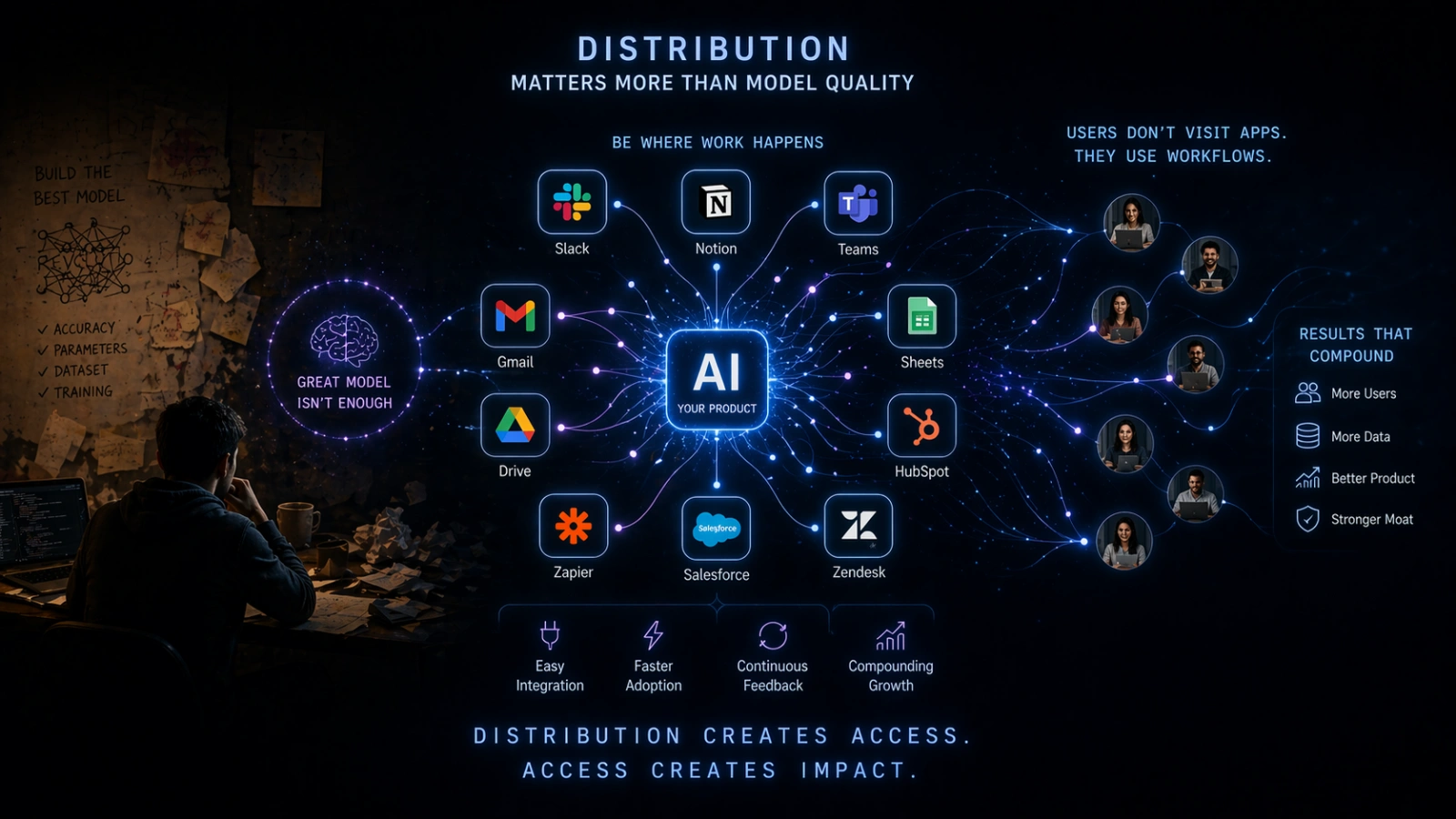
A slightly worse product with strong distribution often wins.
Many founders assume better AI will naturally attract users. In reality, AI startups grow when they plug into existing workflows. Think integrations with tools people already use.
If your product requires behavior change, adoption slows down. If it fits into current systems, growth feels natural.
There’s a hidden advantage here that many founders overlook. Distribution doesn’t just bring users, it shapes your product decisions.
When startups integrate into existing platforms, they get faster feedback loops. Users interact naturally, which reveals friction points early. Compare that to standalone tools, where usage is inconsistent and harder to interpret.
A simple question helps here. Are you building something users must learn, or something they can use immediately inside tools they already trust?
The second option almost always wins early.
4. Data Advantage Is Earned, Not Assumed
Owning data is not automatic. It is built over time.
Early AI startups often rely on public or generic datasets. That levels the playing field. The real advantage comes when your product starts generating proprietary data through usage.
This creates a feedback loop. Better data improves performance, which attracts more users, which generates even better data.
5. Pricing Should Reflect Outcomes, Not Features
Charging for features can limit growth.
Instead, successful startups align pricing with measurable results. For example, charging per processed document or per resolved ticket ties cost to value.
This makes buying decisions easier. Customers understand what they are paying for, and ROI becomes clearer.
6. Speed of Iteration Beats Initial Perfection
Waiting for a polished product can slow you down.
Strong AI startups release early versions, learn quickly, and refine based on real usage. This approach reveals issues no internal testing can catch.
There is always a risk of launching too early. But waiting too long usually costs more in lost learning.
Iteration is not just about speed; it’s about direction. Moving fast in the wrong direction still wastes time.
Strong startups don’t just ship quickly; they measure the right signals. Are users returning? Are they completing tasks faster? Are they willing to pay?
Without clear feedback loops, rapid iteration becomes noise. With the right signals, even small improvements compound into meaningful progress.
7. Human-in-the-Loop Is a Strength, Not a Weakness
Full automation sounds appealing, but it is rarely necessary at the start.
Many startups succeed by combining AI with human oversight. This improves reliability and builds trust, especially in critical tasks.
Over time, automation can increase. But early on, hybrid systems often perform better and reduce risk.
8. Positioning Is Half the Battle
How you describe your product shapes how people perceive it.
Some AI startups struggle not because the product is weak, but because the positioning is unclear. Are you saving time, reducing cost, or increasing revenue?
Clear positioning helps customers quickly understand why your product matters. Without it, even strong solutions get ignored.
9. Build for a Workflow, Not a Feature
Features can be copied. Workflows are harder to replace.
The most durable AI startups embed themselves deeply into how work gets done. They become part of daily operations, not just an add-on.
For example, instead of offering a standalone AI tool, integrate it into the full process from input to output. That increases stickiness and retention.
There’s a deeper layer to this idea. When you own a workflow, you gain visibility into what happens before and after your core feature.
This is where many startups unlock new opportunities. A tool that starts with one task can expand into adjacent steps, gradually becoming essential.
Think of it less as adding features and more as expanding control over outcomes. That shift changes how customers perceive your product.
10. Timing Shapes Everything
Even strong ideas fail if the market is not ready.
Some startups launch before infrastructure, awareness, or budgets align. Others arrive when demand is already proven.
Ask yourself: are customers actively looking for this solution, or do they need to be convinced first? The answer changes your entire strategy.
Real-World Patterns: What Successful AI Startups Do Differently
Looking at successful AI startups, certain patterns repeat regardless of industry.
They rarely begin with complex systems. Instead, they focus on one high-value task and execute it extremely well. This builds trust early.
They also stay close to users. Founders are often directly involved in conversations, especially in the early stages. This shortens the gap between feedback and improvement.
Another pattern is restraint. Instead of chasing every opportunity, they double down on what works. This focus creates depth, which is harder for competitors to replicate.
The Role of AI Tools for Startups in Early Growth
Choosing the right AI tools for startups can shape how quickly you move.
Early on, speed matters more than ownership. Using existing APIs, platforms, and frameworks allows founders to test ideas without heavy upfront investment. This reduces risk and accelerates learning.
However, there’s a trade-off. As your product matures, reliance on external tools can limit differentiation. That’s when startups begin building more in-house capabilities.
The key is timing. Build too early, and you slow down. Build too late, and you lose control.
A Quick Reality Check Most Founders Need
It’s easy to assume that the current wave of best AI startups succeeded because of superior technology.
In reality, many succeeded because they solved clear problems at the right time. Their execution was grounded, not flashy.
This matters because it resets expectations. You don’t need breakthrough research to build something valuable. You need clarity, consistency, and a strong understanding of user needs.
How Do AI Startups Make Money in Practice?
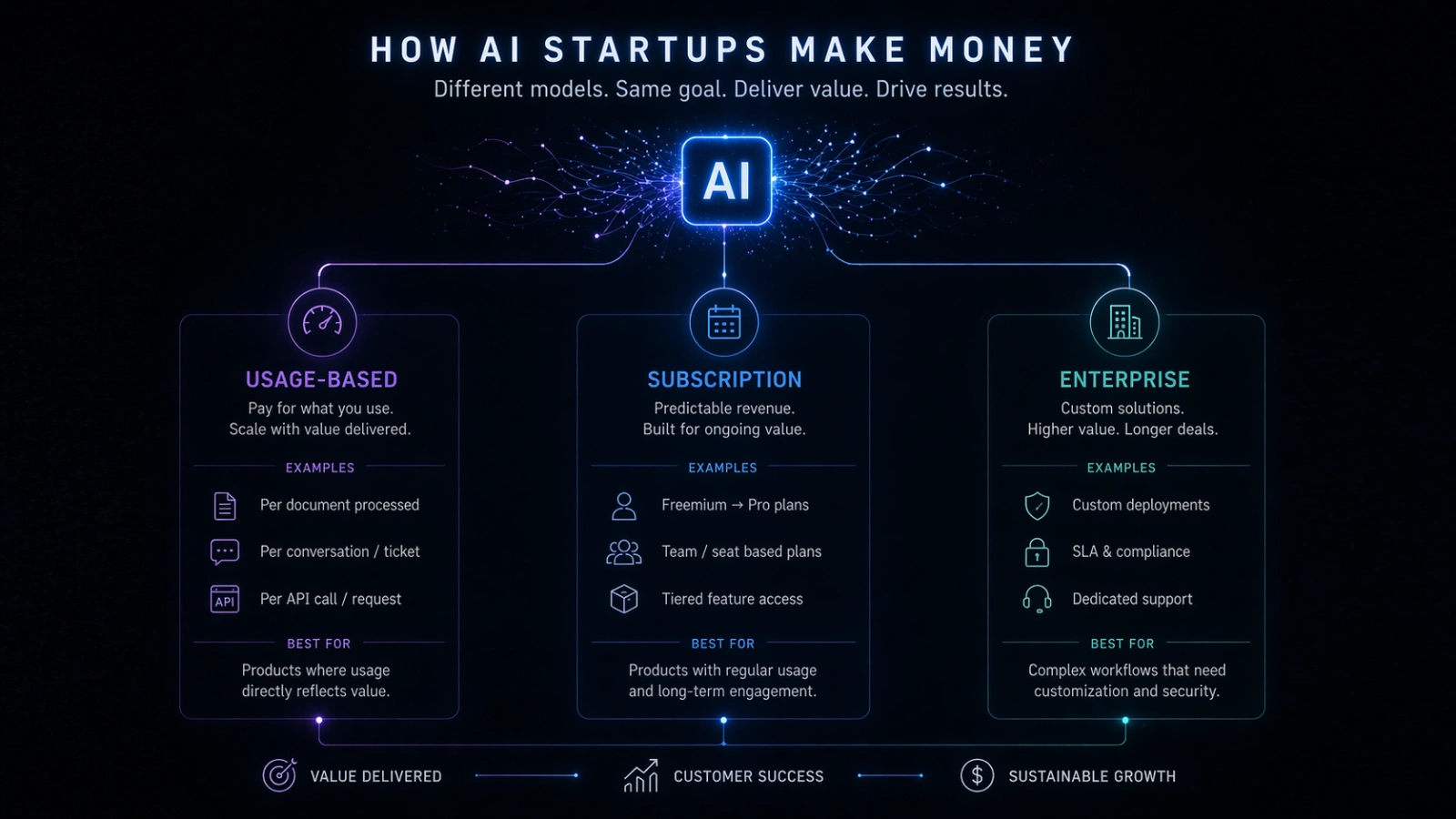
Understanding how do ai startups make money helps clarify strategy early.
Most successful models fall into a few categories:
- Usage-based pricing tied to outputs or actions
- Subscription models for ongoing access
- Enterprise contracts with customization
What matters is alignment. Revenue should scale with the value delivered. If customers see clear returns, pricing becomes easier to justify.
This is where many Artificial Intelligence startups struggle. They price based on effort or features instead of outcomes, which creates friction during sales.
There’s a tendency to over-focus on building and under-focus on refining.
The difference between average and exceptional AI startups often comes down to how long they stay in the refinement phase. Small improvements in accuracy, usability, and reliability can significantly impact adoption.
It’s not always about adding more. Sometimes it’s about making what already exists work better.
Conclusion
Building in this space is less about chasing what AI can do and more about understanding where it truly delivers value. The difference shows up in execution, how clearly you define the problem, how quickly you adapt, and how consistently your product performs in real conditions.
What often separates progress from stagnation is not a breakthrough idea, but a series of practical decisions made well. Choosing the right use case, focusing on distribution, and refining the product based on real feedback all compound over time.
There’s still plenty of room here, but the bar is higher now. The founders who succeed are not the ones following trends. They’re the ones building solutions people rely on, day after day.
FAQs
What are AI startups?
AI startups are companies that use artificial intelligence to solve specific problems, often by automating tasks, improving decision-making, or analyzing data at scale.
They usually focus on a narrow use case first, such as customer support automation or document processing, before expanding into broader solutions.
How do they make money?
Understanding how they make money comes down to how they deliver value.
Most generate revenue through usage-based pricing, subscriptions, or enterprise contracts. The key is aligning pricing with outcomes, such as charging per task completed or time saved.
What are the best AI startups to watch?
The best companies are not always the most visible ones. They are often solving specific, high-value problems in industries like healthcare, finance, or operations.
Instead of looking for hype, it helps to focus on startups with strong user adoption, clear business models, and consistent product improvement.
What are the best AI tools for startups?
Choosing the right AI tools for startups depends on your stage and goals.
Early-stage founders often rely on APIs, no-code platforms, and automation tools to move quickly. As the product grows, more custom-built solutions become important for differentiation.
How do you start an AI startup?
Starting AI startups begins with identifying a real problem that AI can solve more efficiently than existing methods.
From there, founders typically validate demand, build a simple version of the product, gather feedback, and iterate quickly. Strong distribution and clear positioning play a major role in early success.