Introduction: Why Traditional Inventory Management Is Quietly Failing
AI inventory management is no longer a future concept. It is becoming a necessity for businesses that want control over stock, costs, and customer expectations.
Many companies still rely on spreadsheets or basic systems. At first, they seem manageable. But as demand grows, problems start to surface. Stockouts frustrate customers. Overstock ties up cash. Manual errors creep in without warning.
What’s really happening is simple. Traditional systems react to what has already happened. They don’t predict what’s coming next.
That gap is where AI in inventory management changes everything. Instead of reacting, businesses begin anticipating demand, adjusting stock levels, and making decisions with confidence.
Read Aloud!
Quick Answer: What Does AI Inventory Management Actually Do?
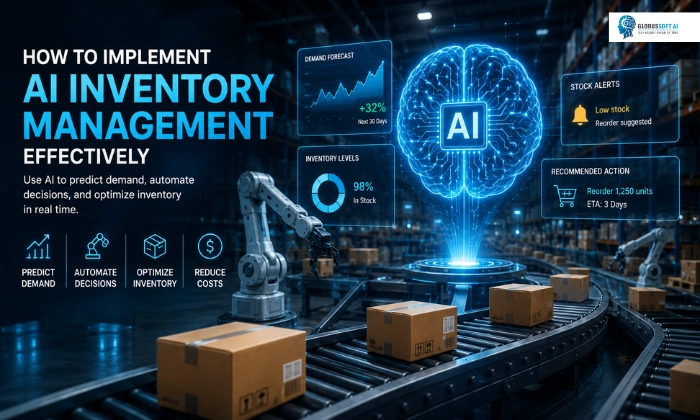
Inventory management uses machine learning and data analytics to predict demand, automate stock decisions, and optimize inventory levels in real time. This reduces costs, improves accuracy, and ensures products are available when customers need them.
What “AI in Inventory Management” Really Means (Beyond the Buzzword)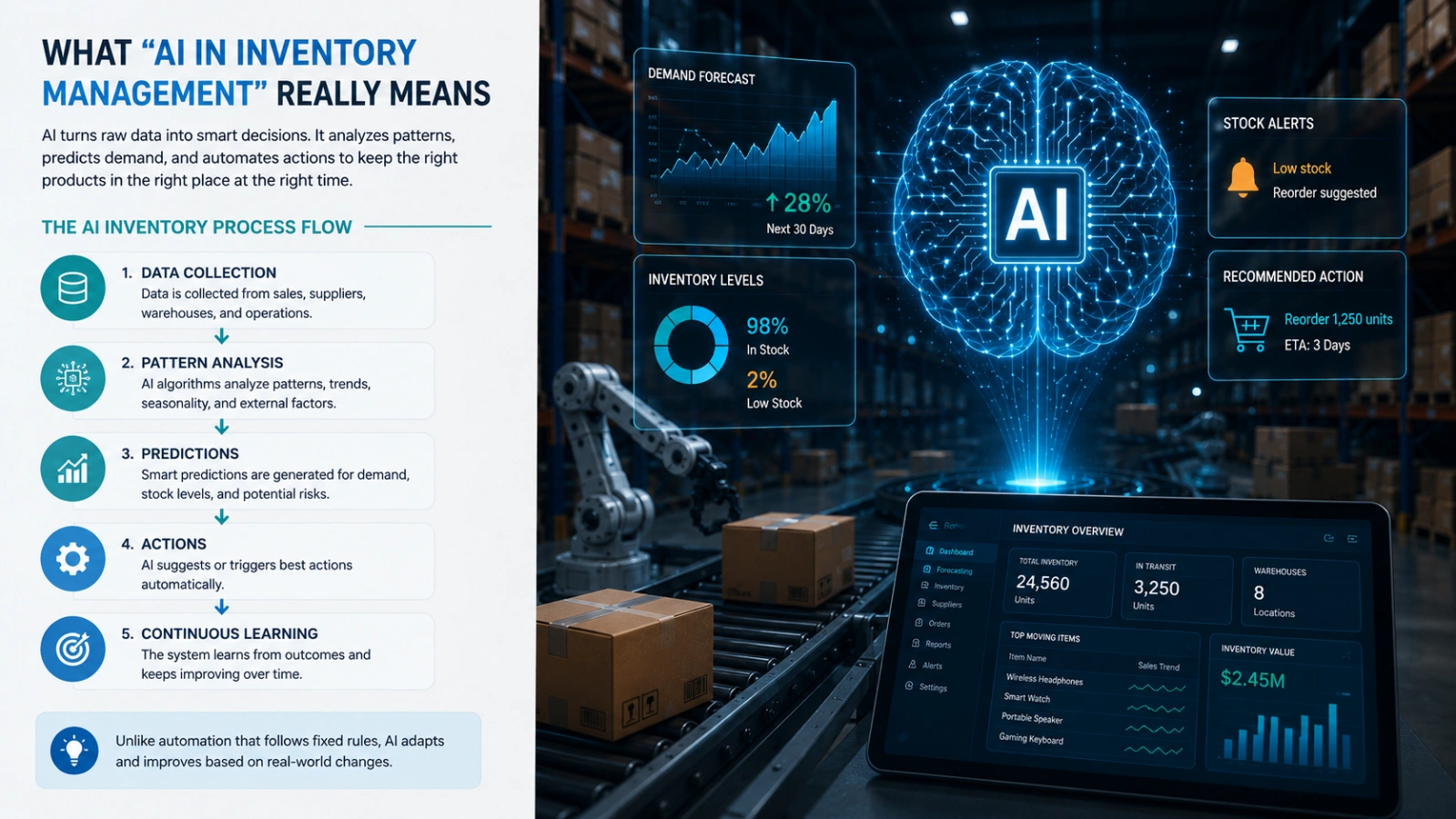
AI inventory management often sounds complex, but the core idea is straightforward. It turns raw data into smart decisions.
At its simplest, the process follows a clear flow:
- Data is collected from sales, suppliers, and operations
- Algorithms analyze patterns and trends
- Predictions are generated
- Actions are triggered automatically or suggested
The key difference between automation and AI is intelligence. Traditional inventory management automation follows fixed rules. For example, reorder when stock drops below a set level.
AI goes further. It adjusts those rules based on demand shifts, seasonality, and external factors. It learns and improves over time.
This is why inventory management AI feels less like a tool and more like a decision-making system.
Where AI Actually Impacts Your Inventory (Real Business Use Cases)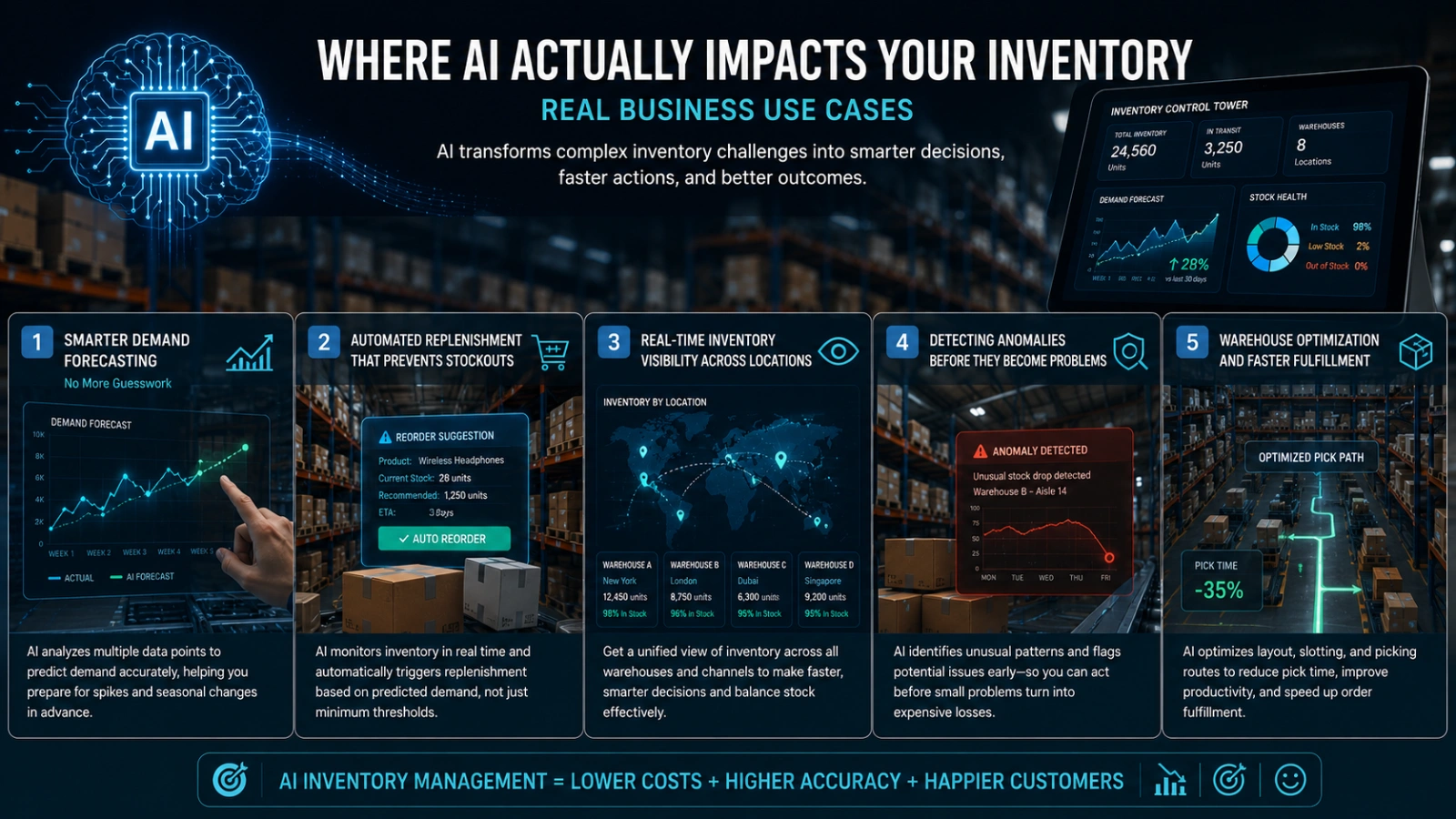
Smarter Demand Forecasting (No More Guesswork)
Forecasting used to depend on past sales alone. That works until patterns change.
AI inventory management analyzes multiple data points at once. It looks at trends, promotions, seasonality, and even external signals. The result is a forecast that adapts instead of staying fixed.
For example, an eCommerce store can predict spikes during a holiday sale and adjust stock in advance.
Automated Replenishment That Prevents Stockouts
Reordering manually often leads to delays or mistakes. Either you reorder too late or too much.
With AI in inventory management, systems monitor stock continuously. When levels drop, replenishment happens automatically based on predicted demand, not just thresholds.
This reduces both stockouts and excess inventory.
Real-Time Inventory Visibility Across Locations
Managing inventory across multiple warehouses can quickly become confusing.
AI inventory management provides a unified view. You can see what’s available, where it is, and how fast it’s moving. This helps businesses shift stock between locations instead of over-ordering.
Detecting Anomalies Before They Become Problems
Unexpected changes in inventory can signal deeper issues. Theft, data errors, or sudden demand spikes often go unnoticed until it’s too late.
AI identifies patterns that don’t fit. It flags them early, giving teams time to act before small issues grow into costly problems.
Warehouse Optimization and Faster Fulfillment
Warehouse operations are often overlooked, but they directly impact speed and cost.
AI analyzes product movement and suggests better layouts. High-demand items are placed closer to packing areas. This reduces picking time and improves efficiency.
The Real Benefits of AI Inventory Management (With Business Impact)
The value of AI inventory management becomes clear when you look at outcomes, not just features.
Cost reduction is one of the biggest gains. Businesses avoid tying up money in excess stock while reducing storage costs.
Accuracy improves because decisions rely on data, not guesswork. Fewer errors mean fewer disruptions.
Operations also become faster. Tasks that once took hours, like tracking or forecasting, happen instantly.
Customer satisfaction improves as well. Products are available when needed, and delivery timelines become more reliable.
Consider a retailer before and after adopting inventory management automation. Earlier, they struggled with frequent stockouts. After AI implementation, inventory levels aligned closely with demand, and missed sales dropped significantly.
Step-by-Step Framework to Implement AI Inventory Management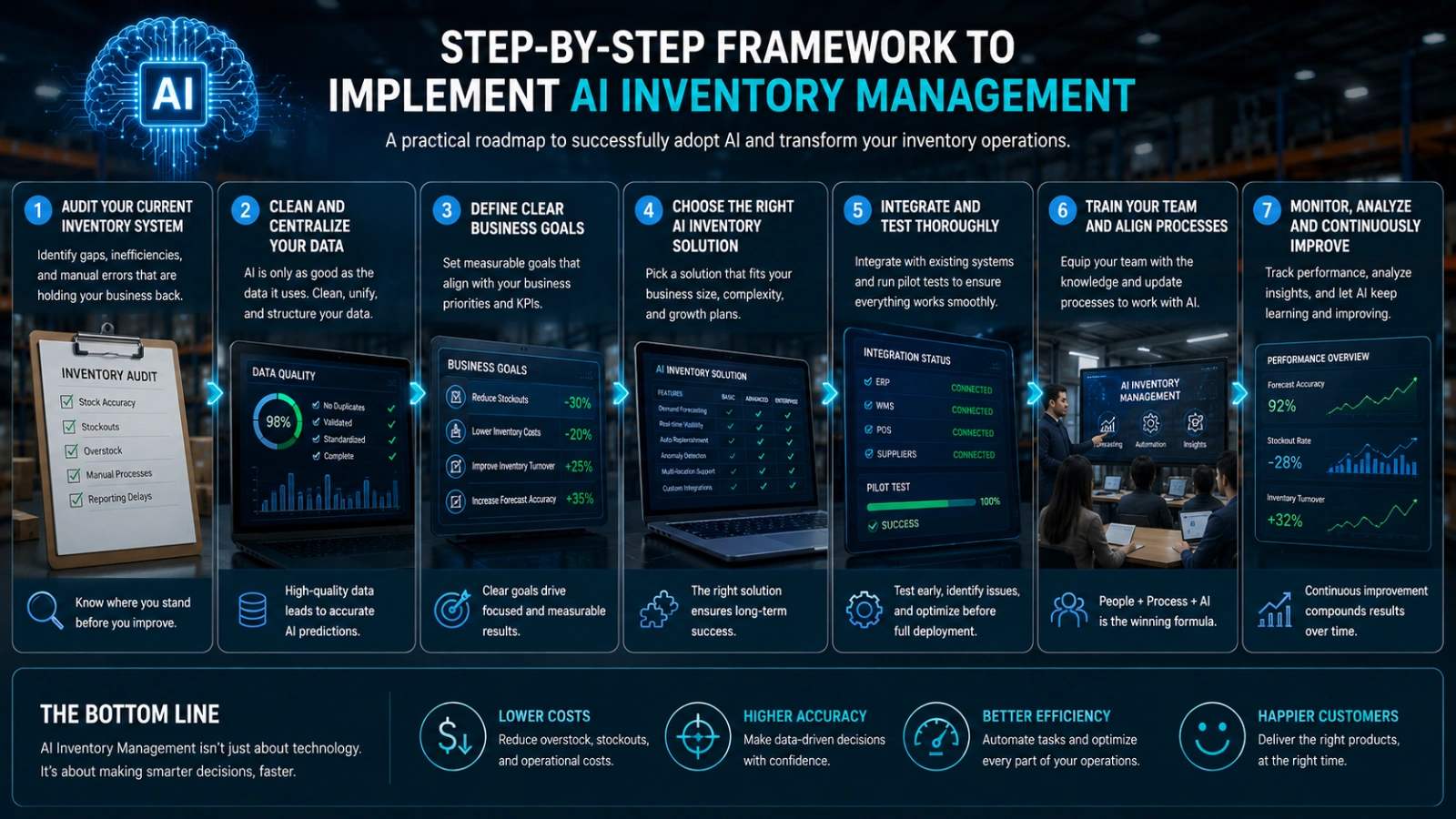
Step 1: Audit Your Current Inventory System
Start by understanding where things stand. Identify inefficiencies, delays, and common errors.
Without this clarity, it’s hard to measure improvement.
Step 2: Clean and Centralize Your Data
AI depends on data quality. If your data is incomplete or inconsistent, predictions will suffer.
Bring all inventory-related data into one system. Clean it before moving forward.
Step 3: Define Clear Business Goals
What do you want to improve? Lower costs, reduce stockouts, or increase turnover?
Clear goals help shape how AI inventory management is applied.
Step 4: Choose the Right AI Inventory Solution
Not every solution fits every business.
A small retailer may need a simple tool. A large enterprise may require advanced capabilities and integrations.
Step 5: Start Small (Pilot Program)
Avoid rolling out everything at once. Test AI in a controlled area, such as one product category or warehouse.
This reduces risk and builds confidence.
Step 6: Integrate With Existing Systems (ERP/WMS)
AI works best when connected to your current systems.
Integration ensures smooth data flow and avoids duplication.
Step 7: Train Teams and Align Processes
Technology alone doesn’t solve problems. People need to understand how to use it.
Training helps teams trust and adopt the system.
Step 8: Monitor, Learn, and Optimize Continuously
AI improves over time, but only if monitored.
Track performance, refine settings, and adjust strategies as needed.
How to Choose the Right AI Inventory Management Software
Choosing the right software can feel overwhelming. The best approach is to focus on fit, not features alone.
Start with your business size and complexity. A growing e-commerce business has different needs than a large supply chain network.
Industry also matters. Retail, manufacturing, and healthcare each have unique requirements.
Budget plays a role, but it should be balanced with long-term value.
Must-Have Features to Look For
- Predictive analytics for accurate forecasting
- Automation capabilities for stock control
- Integration with existing systems
- Real-time dashboards for visibility
The goal is to find a system that simplifies decisions, not complicates them.
Read More!
10 Powerful Features Of Openclaw AI Agents You Need To Know
Generative AI Development Services: Complete Guide
Common Mistakes Businesses Make When Adopting AI
One common issue is poor data quality. Even the best AI inventory management system cannot fix bad data.
Another mistake is expecting instant results. AI needs time to learn patterns and improve accuracy.
Some businesses automate too much without a strategy. This creates confusion instead of efficiency.
Ignoring employee adoption is another risk. If teams don’t trust the system, they won’t use it effectively.
Where GlobussoftAI Fits Into AI Inventory Management
GlobussoftAI enhances AI inventory management by combining automation, AI agents, and real-time workflows into one connected system. It helps businesses make faster, smarter inventory decisions while staying fully integrated across operations.
Key features include:
- OpenClaw AI Gateway – Connects inventory workflows across WhatsApp, Slack, Telegram, and more
- Custom AI Agents – Built for tasks like demand forecasting and stock monitoring
- Multi-Agent Orchestration – Handles complex workflows across departments
- Voice & Conversational AI – Enables voice-based inventory updates and queries
- AI Strategy & Consulting – Identifies high-impact automation opportunities
- Managed AI Operations – Ongoing monitoring, optimization, and scaling
- Self-Hosted & Secure – Full data control within your infrastructure
- Built-in Integrations – Connects with multiple tools and systems
- Automation & Scheduling – Handles recurring inventory tasks efficiently
- Multi-Model Support – Works with GPT-4, Claude, Llama, Gemini, and more
This makes GlobussoftAI a practical solution for building a smarter, more connected inventory system.
Advanced Insight: The Shift From Reactive Inventory to Predictive Supply Chains
Most businesses still operate reactively. They respond to demand after it happens.
AI inventory management shifts this approach. It predicts demand before it occurs and adjusts inventory accordingly.
This leads to a more proactive supply chain. Decisions are based on patterns, not assumptions.
Looking ahead, systems are moving toward full autonomy. Inventory decisions will increasingly happen with minimal human input, guided by continuous learning.
Conclusion: Turning Inventory Into a Competitive Advantage
AI inventory management changes how businesses think about stock. It shifts the focus from reacting to planning.
The transition does not need to be overwhelming. Starting small and building gradually often works best.
Over time, the benefits compound. Costs drop, efficiency improves, and decisions become clearer.
Inventory stops being a problem to manage and becomes an advantage to leverage.
FAQs About AI Inventory Management
How does AI improve inventory accuracy?
It analyzes large datasets and reduces human error, leading to more precise stock levels.
Is AI inventory management suitable for small businesses?
Yes, especially with scalable tools designed for smaller operations.
What data is required to implement AI in inventory?
Sales history, supplier data, stock levels, and operational data are essential.
How long does it take to see results?
Initial improvements can appear within weeks, but full optimization takes time.
What industries benefit most from AI inventory systems?
Retail, manufacturing, healthcare, and logistics see the most impact.