Artificial intelligence has already changed how businesses write content, answer customer queries, analyze data, and automate repetitive work. But a new wave of AI is moving far beyond simple prompts and responses.
That shift is called agentic AI.
Instead of waiting for instructions every few seconds, agentic systems can think through goals, make decisions, use tools, adapt to changing situations, and complete tasks with minimal supervision. In simple terms, this is where AI stops being just an assistant and starts behaving more like an autonomous digital worker.
And this is exactly why companies across industries are racing to explore AI agents, autonomous workflows, and intelligent automation systems.
From customer support and cybersecurity to logistics and finance, businesses are beginning to use agentic systems to handle complex tasks that once required entire teams.
So, what is agentic ai, how does it work, and why is everyone suddenly talking about it?
Let’s break it down.
Hit ‘Play’ Button & Tune Into The Blog!
What Is Agentic AI?

Agentic ai refers to artificial intelligence systems that can autonomously plan, make decisions, execute actions, and improve outcomes while working toward a defined goal.
Unlike traditional AI models that only generate responses, agentic systems can actually take action.
For example:
- A traditional chatbot may suggest the best flight options.
- An agentic AI system can search flights, compare prices, book tickets, reserve hotels, update calendars, and send confirmations automatically.
That difference is massive.
Traditional AI mostly turns data into information.
Agentic AI turns information into action.
At the center of these systems are intelligent AI agents, software entities designed to perceive situations, reason through problems, interact with tools, and execute workflows independently.
These agents can operate alone or collaborate with other agents inside larger systems to complete complex objectives.
Why Agentic AI Is Different From Traditional AI
Most AI tools today are reactive.
You ask a question.
The model gives an answer.
But agentic systems behave differently. They operate with objectives, memory, reasoning, and adaptability.
Here’s a simple comparison:
| Feature | Traditional AI | Agentic AI |
| Works on prompts | Yes | Yes |
| Takes autonomous actions | Limited | Yes |
| Handles multi-step workflows | Rarely | Easily |
| Learns from outcomes | Minimal | Continuous |
| Uses external tools/APIs | Limited | Extensively |
| Requires human supervision | High | Low |
| Adapts dynamically | Limited | Advanced |
This is why many businesses now see agentic AI as the next major leap after generative AI.
How Agentic AI Works
To understand the real power of agentic systems, you need to understand what happens behind the scenes.
Most agentic AI systems operate through six major stages.
1. Perception
The system first gathers information from different sources.
This may include:
- APIs
- Databases
- Emails
- Sensors
- CRM systems
- Documents
- Live user interactions
- Website activity
Unlike older automation systems that rely only on structured data, agentic systems can also process unstructured information like text, voice, images, and conversations.
That means the AI understands context instead of simply following rigid rules.
2. Reasoning
Once data is collected, the AI analyzes the situation.
Using large language models (LLMs), natural language processing, and reasoning frameworks, the system evaluates what’s happening and identifies possible actions.
For example, if a customer complains about a delayed shipment, the agent can:
- Check inventory
- Verify shipping status
- Analyze delivery timelines
- Identify the issue
- Decide the next best action
This is where agentic AI starts behaving more like a human decision-maker.
3. Goal Setting
Every agentic system operates around goals.
The AI breaks larger objectives into smaller tasks and creates an execution plan.
For example:
Goal: Improve customer onboarding.
Subtasks might include:
- Collecting user information
- Verifying documents
- Creating CRM entries
- Sending onboarding emails
- Scheduling welcome calls
- Tracking completion status
Instead of handling just one task, the system coordinates the entire workflow.
4. Decision-Making
The AI evaluates multiple possibilities and selects the best course of action.
This may involve:
- Predictive analytics
- Probability models
- Historical patterns
- Reinforcement learning
- Real-time conditions
Unlike static automation tools, agentic systems can adapt if conditions change midway.
If a vendor fails to respond, the AI may automatically switch suppliers or escalate the issue.
5. Execution
This is where the AI actually performs actions.
It can:
- Send emails
- Update dashboards
- Trigger workflows
- Call APIs
- Generate reports
- Book meetings
- Manage software systems
- Interact with enterprise tools
This ability to move from “thinking” to “doing” is what makes agentic systems revolutionary.
6. Learning and Adaptation
One of the biggest strengths of agentic AI is continuous improvement.
The system evaluates outcomes, learns from failures, collects feedback, and adjusts future actions accordingly.
Over time, the AI becomes more accurate, efficient, and context-aware.
This creates systems that evolve instead of remaining static.
Single-Agent vs Multi-Agent Systems
Not all agentic architectures work the same way.
Some systems use a single AI agent, while others use multiple specialized agents working together.
Single-Agent Systems
In this setup, one AI handles the entire workflow.
It manages planning, execution, reasoning, and decision-making.
Best for:
- Simple workflows
- Linear automation
- Defined business processes
Example:
An AI assistant that schedules meetings and sends reminders.
Multi-Agent Systems
This approach uses multiple specialized agents collaborating together.
One agent may handle research.
Another handles communication.
Another handles analytics.
A central orchestrator coordinates all agents.
Best for:
- Enterprise automation
- Complex operations
- Large-scale workflows
- Distributed systems
This architecture is becoming increasingly popular among businesses seeking Bespoke agentic AI solutions provider services for enterprise-grade automation.
Agentic AI vs Generative AI
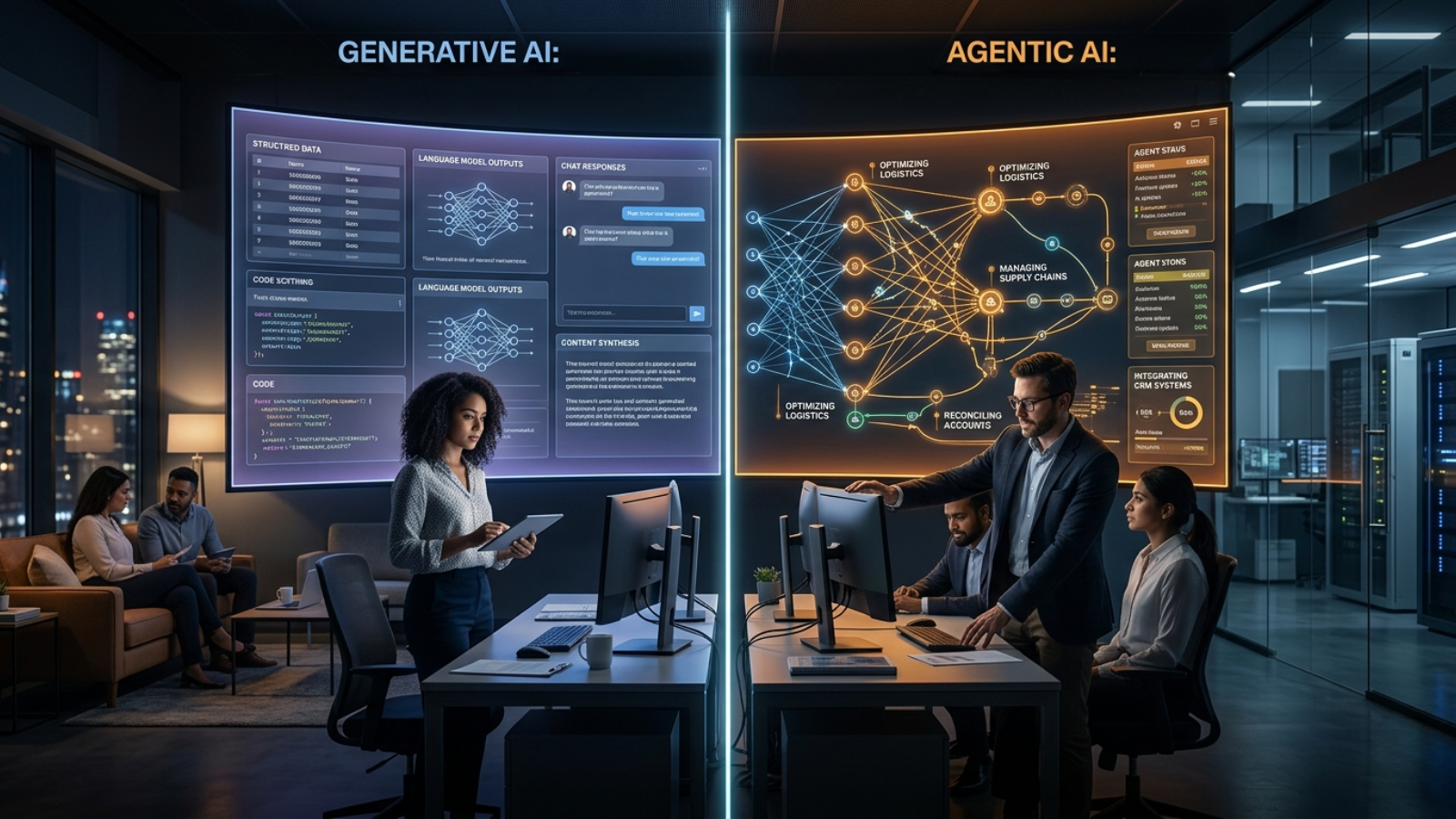
People often confuse generative AI with agentic AI.
They are connected, but not the same.
Here’s the easiest way to understand it:
| Generative AI | Agentic AI |
| Creates content | Executes actions |
| Answers questions | Solves workflows |
| Reactive | Proactive |
| Prompt-dependent | Goal-driven |
| Limited autonomy | High autonomy |
For example:
A generative AI tool may draft a customer support email.
An agentic AI system can:
- Draft the email
- Pull customer data
- Check order history
- Generate refunds
- Send responses
- Update CRM records
- Escalate issues if needed
That’s a completely different level of automation.
Real-World Applications of Agentic AI
The rise of ai agents is already transforming industries.
Here are some major applications of AI.
Financial Services
Agentic systems can:
- Detect fraud in real time
- Monitor transactions
- Analyze risks
- Automate compliance checks
- Execute trading decisions
Instead of only flagging suspicious activity, the AI can actively respond to threats.
Healthcare
Healthcare organizations use agentic systems for:
- Patient monitoring
- Appointment coordination
- Medical record analysis
- Treatment recommendations
- Insurance processing
AI agents can reduce administrative overload while helping clinicians focus on patient care.
Learn More:
Generative AI Development Services: Complete Guide
AI Applications: Real-World Use Cases, Industries, and Examples (2026 Guide)
Customer Support
Modern customer support is rapidly shifting toward autonomous systems.
Agentic AI can:
- Resolve tickets
- Verify refunds
- Generate responses
- Update systems
- Escalate sensitive cases
- Personalize interactions
The result is faster support with reduced operational costs.
Cybersecurity
Cybersecurity requires constant monitoring, which makes it ideal for agentic automation.
AI agents can:
- Detect suspicious behavior
- Isolate threats
- Block unauthorized access
- Monitor network activity
- Respond to incidents instantly
This reduces response times dramatically.
Supply Chain and Logistics
Supply chain management becomes far more adaptive with agentic systems.
AI can:
- Predict demand
- Detect bottlenecks
- Coordinate suppliers
- Optimize inventory
- Adjust shipping schedules
This allows businesses to respond dynamically instead of relying on rigid planning systems.
Benefits of Agentic AI for Businesses

Businesses are investing heavily in agentic AI because the operational impact is enormous.
1. Autonomous Workflow Execution
The biggest advantage is autonomy.
Tasks that once required manual coordination can now run independently.
This improves speed, consistency, and scalability.
2. Reduced Operational Costs
By automating repetitive cognitive tasks, businesses reduce:
- Labor costs
- Delays
- Human errors
- Manual oversight
- Process inefficiencies
3. Faster Decision-Making
Agentic systems analyze data in real time and act immediately.
This is critical for industries like finance, logistics, and cybersecurity where delays are costly.
4. Better Scalability
Unlike traditional teams, AI agents can scale rapidly without proportional increases in operational expenses.
This allows companies to handle growing workloads efficiently.
5. Improved Productivity
Employees spend less time on repetitive tasks and more time on strategic work.
This improves both innovation and operational efficiency.
Challenges and Risks of Agentic AI
Despite its potential, agentic AI also introduces serious risks.
1. Hallucinations and Poor Decisions
If training data is flawed or incomplete, AI systems may make incorrect decisions confidently.
This becomes dangerous when agents operate autonomously.
2. Over-Automation Risks
Too much autonomy without oversight can create operational problems.
For example:
- Financial agents making risky trades
- AI moderation systems censoring valid content
- Logistics systems prioritizing speed over safety
Guardrails are essential.
3. Data Privacy Concerns
Agentic systems often require access to sensitive enterprise data.
Without strong security measures, privacy risks increase significantly.
4. Ethical Concerns
As AI systems become more autonomous, businesses must address:
- Accountability
- Transparency
- Bias
- Governance
- Human oversight
This is why many organizations still maintain “human-in-the-loop” approval systems for critical decisions.
How Businesses Are Implementing Agentic AI
Many organizations are now looking for Custom AI agent development services to build industry-specific automation systems.
Implementation typically follows three stages.
Step 1: Identify High-Impact Workflows
Businesses first identify repetitive, time-consuming workflows suitable for automation.
Examples:
- Customer onboarding
- Invoice processing
- IT ticket handling
- Employee support
- Supply chain coordination
Step 2: Build AI Agent Infrastructure
This includes:
- API integrations
- LLM deployment
- Workflow orchestration
- Memory systems
- Security layers
- Decision frameworks
Companies often Hire AI agent developers for business operations to create customized enterprise-grade systems.
Step 3: Scale Multi-Agent Systems
Once initial systems succeed, businesses expand toward collaborative multi-agent ecosystems capable of handling broader operations autonomously.
This is where enterprises often partner with a Bespoke agentic AI solutions provider for large-scale deployment.
As businesses continue adopting agentic AI, one thing is becoming increasingly clear companies no longer need just AI tools. They need intelligent systems built around their workflows, operations, and business goals.
That’s why many organizations are now investing in Custom AI agent development services and scalable AI infrastructures that can automate real business processes efficiently.
Companies like Globussoft AI are helping businesses move beyond traditional automation with intelligent AI agents, workflow automation, voice AI systems, and multi-agent architectures designed for practical business use cases.
Why Businesses Choose Globussoft AI for Agentic AI Solutions
Globussoft AI helps businesses build scalable AI-powered systems that automate workflows, improve operational efficiency, and support enterprise-level automation with intelligent AI agents.
Custom AI Agent Development
Build AI agents tailored specifically for your business operations and workflows.
Multi-Agent Orchestration
Enable multiple AI agents to collaborate across complex tasks and departments.
LLM-Powered Chatbots
Deliver smarter customer interactions with contextual AI conversations.
Voice AI Automation
Automate voice support, outbound calling, and conversational workflows.
Workflow Automation
Reduce repetitive manual tasks and streamline business operations.
AI Consulting & Deployment
Get end-to-end support from strategy and development to deployment and scaling.
As agentic AI continues evolving, businesses that adopt intelligent automation early will gain a significant competitive advantage.
Ready to Build Smarter AI Workflows?
Looking to build scalable AI agents and autonomous workflows for your business? Explore Globussoft AI’s custom agentic AI solutions and start transforming your operations today.
The Future of Agentic AI
The future of AI is moving beyond assistants.
We are entering an era where AI systems can independently manage workflows, collaborate with other agents, optimize operations, and continuously improve without constant supervision.
In the coming years, businesses may operate with entire digital workforces powered by autonomous agents.
Instead of employees manually coordinating software tools, intelligent systems will manage operations behind the scenes.
The shift will likely redefine:
- Enterprise software
- Customer support
- Business operations
- Decision-making
- Productivity
- Workforce structures
And this transformation is only beginning.
Final Thoughts
So, what is agentic AI really about?
It’s about giving artificial intelligence the ability to think through problems, take action, adapt to situations, and achieve goals independently.
Unlike traditional systems that simply respond to prompts, agentic AI creates intelligent workflows capable of operating with autonomy, reasoning, and continuous learning.
For businesses, this means faster operations, smarter automation, reduced costs, and scalable productivity.
For industries, it signals the beginning of a major operational shift.
And for the future of AI, agentic systems may become the foundation of how modern enterprises function.
The companies exploring ai agents today are not just automating tasks.
They’re building the next generation of intelligent business infrastructure.
FAQs: –
1. What is agentic AI in simple terms?
Agentic AI refers to AI systems that can autonomously plan, make decisions, and execute tasks with minimal human supervision.
2. How is agentic AI different from generative AI?
Generative AI creates content, while agentic AI can take actions, automate workflows, and complete multi-step tasks independently.
3. What are AI agents used for in businesses?
Businesses use AI agents for customer support, workflow automation, data analysis, scheduling, cybersecurity, logistics, and operational management.
4. Can agentic AI automate entire business workflows?
Yes, agentic AI can manage complete workflows by combining reasoning, decision-making, tool usage, and automation across multiple systems.
5. Which industries benefit the most from agentic AI?
Industries like healthcare, finance, logistics, customer service, retail, and cybersecurity benefit heavily from agentic AI automation.