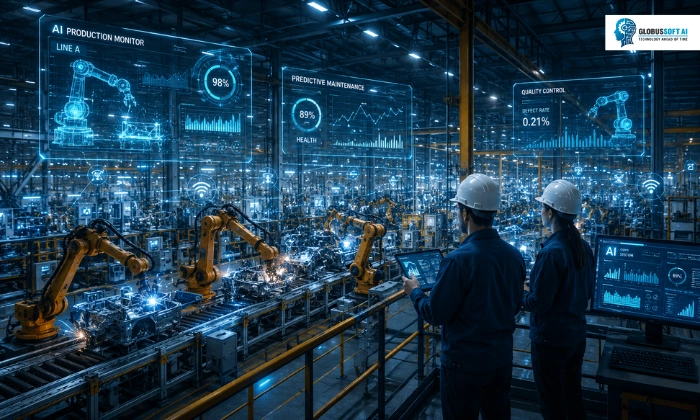
A machine on a production line can now detect its own future failure before a technician notices anything unusual. That shift captures why AI in manufacturing has moved from experimentation to operational reality.
Manufacturers are no longer exploring AI as a side initiative. They are using it to reduce downtime, improve quality control, stabilize supply chains, and make production decisions faster than traditional systems ever could. The pressure is practical, not theoretical. Margins are tighter, labor shortages continue, and production disruptions cost millions.
Read Aloud!
The 60-Second Answer: What AI in Manufacturing Actually Means
At its core, AI in manufacturing refers to machine learning, computer vision, predictive analytics, and intelligent automation applied to factory and operational data. These systems analyze production patterns, identify anomalies, and improve decision-making across manufacturing environments.
Instead of relying only on fixed programming, AI systems learn from historical and real-time data. That changes how factories respond to problems.
Here’s what manufacturers are using AI for right now:
- Predicting equipment failures before breakdowns occur
- Detecting product defects faster than human inspectors
- Optimizing inventory, production scheduling, and supply chains
The growth is accelerating quickly. Deloitte reports that most manufacturers now consider AI investment essential to long-term competitiveness.
From Robotics to Real Intelligence
Factories have used automation for decades. Robotic arms assembling vehicles are not new. What has changed is the layer of intelligence sitting atop those systems.
Traditional automation follows rules. If X happens, do Y. It cannot adapt beyond its programming.
Modern AI in manufacturing behaves differently. Systems learn from data over time. They identify patterns that humans might miss and continuously adjust recommendations.
Several technologies pushed this transition forward:
- Affordable IoT sensors collecting live machine data
- Cloud infrastructure capable of processing massive datasets
- Faster edge computing inside factories
- More accessible machine learning platforms
That combination created a turning point. Manufacturers now have enough usable data to train systems that improve operations in real time.
This is not simply smarter automation. It is operational learning at scale.
The 7 Ways AI Is Actually Being Used in Manufacturing Right Now
1. Predictive Maintenance Is Reducing Expensive Downtime
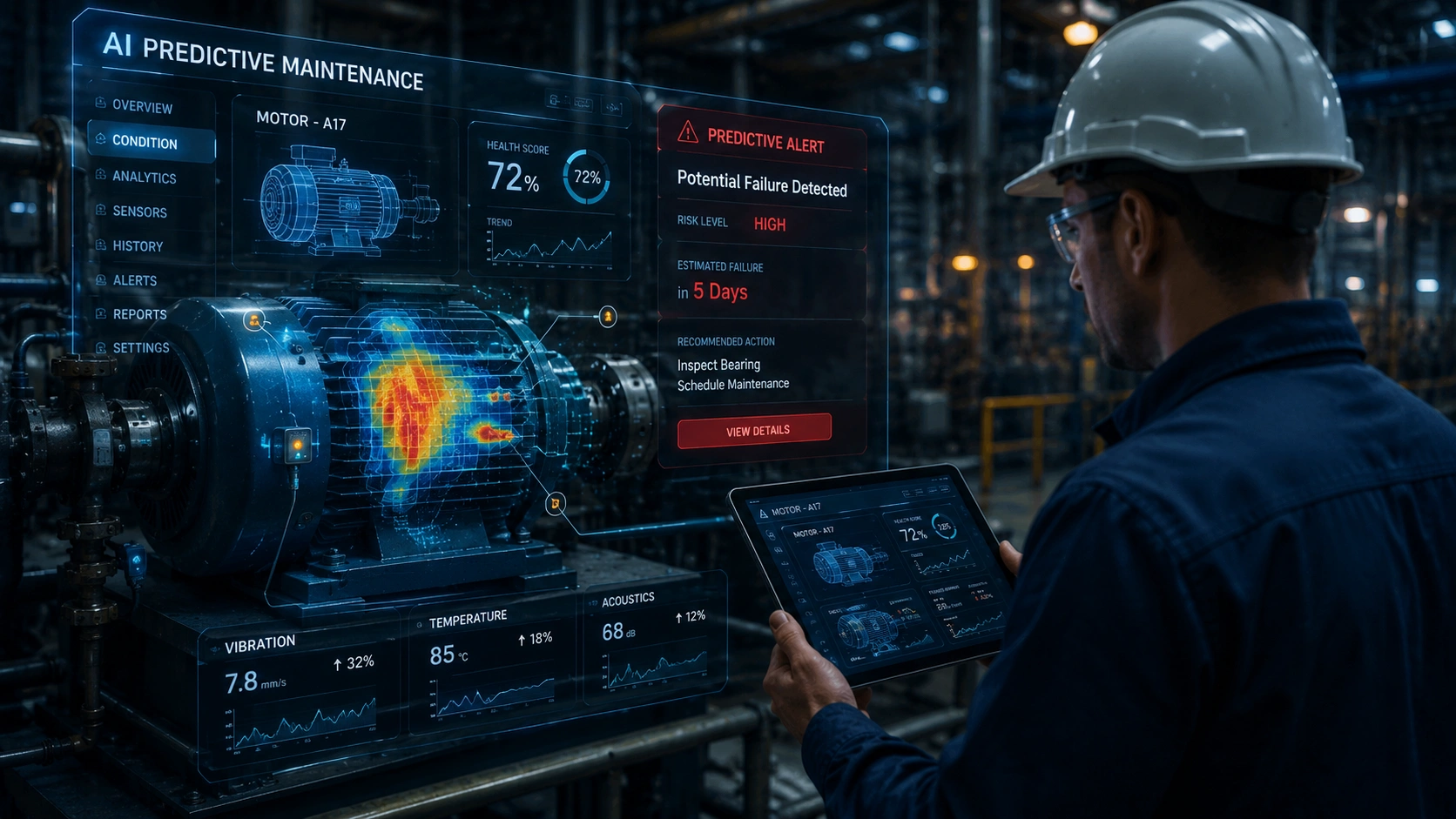
Unexpected downtime can stop an entire production line within minutes. For many manufacturers, that becomes the biggest operational cost nobody planned for.
This is where AI in manufacturing delivers immediate value.
Machine learning models analyze vibration data, temperature changes, pressure readings, and equipment behavior. When patterns suggest abnormal wear, maintenance teams receive warnings before failure occurs.
Rolls-Royce uses predictive systems to monitor engine performance continuously. Caterpillar applies AI-driven diagnostics to improve maintenance recommendations for equipment dealers and customers.
The financial logic is straightforward. Preventing one major failure often justifies the investment.
2. AI-Powered Quality Control Detects Defects Faster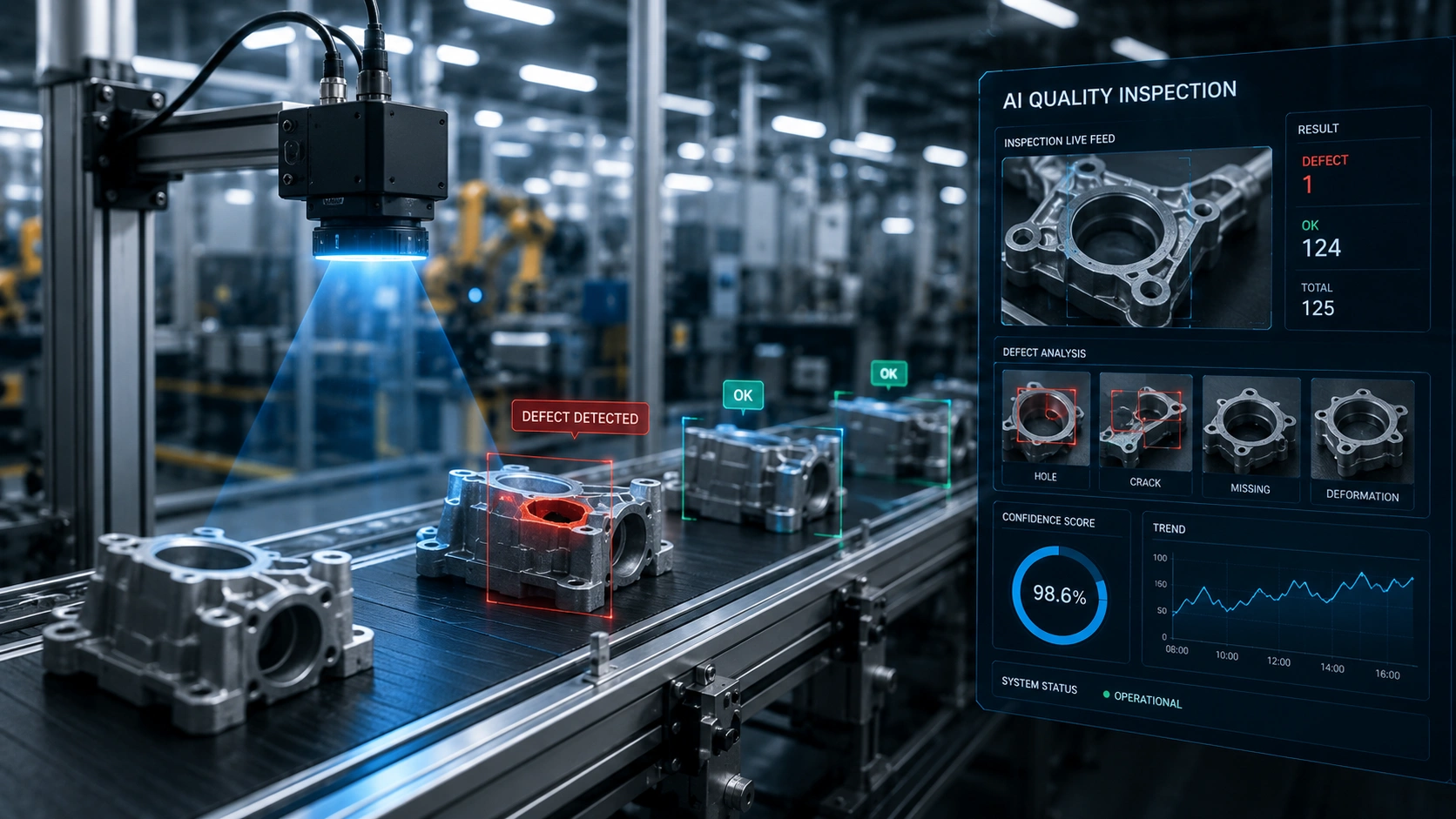
Human inspectors miss things. Fatigue, speed, and inconsistent visibility all affect accuracy.
Computer vision systems solve that differently.
AI models train on thousands of product images to learn what acceptable output looks like. Once trained, the system scans components at machine speed and flags defects instantly.
This approach allows manufacturers to inspect far more products without slowing production. Tiny cracks, alignment issues, or surface inconsistencies become easier to catch.
Many electronics and automotive companies now rely on AI in manufacturing to improve quality consistency while reducing waste.
3. Process Optimization Makes Production More Efficient
Manufacturing lines generate enormous amounts of operational data every hour. Most companies historically used only a fraction of it.
AI changes that equation.
Instead of reviewing reports after problems occur, intelligent systems monitor throughput, energy consumption, machine utilization, and bottlenecks continuously. The software then recommends workflow adjustments in real time.
That creates a major difference between static optimization and adaptive optimization.
A manually optimized process may improve once every few months. AI-driven systems improve continuously.
Energy efficiency also becomes easier to manage. Some manufacturers now use AI in manufacturing to reduce electricity usage during high-demand periods without slowing output.
4. Supply Chain Intelligence Is Becoming Predictive
Supply chain planning used to depend heavily on spreadsheets and historical assumptions. Recent disruptions exposed how fragile that approach could be.
AI forecasting tools now analyze supplier performance, shipping patterns, geopolitical risks, weather disruptions, and customer demand simultaneously.
That visibility allows companies to respond earlier instead of reacting late.
Amazon’s fulfillment operations demonstrate how advanced this can become. AI systems help optimize routing, inventory placement, warehouse movement, and delivery coordination across massive networks.
For manufacturers, supply chain resilience has become one of the strongest arguments for adopting AI in manufacturing solutions.
5. Digital Twins Allow Manufacturers to Test Changes Virtually
A digital twin is a virtual model of a physical system. That system could represent a machine, an assembly line, or an entire facility.
Real-time sensor data feeds into the model continuously. AI then simulates how operational changes might affect production.
Imagine adjusting a production schedule, changing machine speeds, or testing a facility redesign without touching the physical factory. That is the value digital twins provide.
Manufacturers can identify risks earlier, reduce testing costs, and improve planning accuracy.
As AI in manufacturing evolves, digital twins are becoming essential tools for operational strategy instead of experimental technology.
6. Worker Augmentation Is Replacing Repetitive Friction, Not People
One of the biggest misconceptions surrounding AI is the assumption that factories want fewer workers.
Most manufacturers actually face labor shortages and skills gaps.
That is why many AI systems focus on augmentation rather than replacement.
Technicians now use AR headsets that display guided repair instructions directly in their field of view. Voice assistants allow workers to retrieve operational data hands-free. Wearable systems monitor unsafe movement patterns before injuries occur.
The goal is not to remove human expertise. It is making experienced workers more effective.
This part of AI in manufacturing matters because adoption often fails when employees fear displacement instead of understanding the operational benefit.
7. AI Agents Are Expanding Beyond Simple Automation
AI agents represent the next phase of manufacturing intelligence.
Unlike traditional software tools, agents can analyze information, make decisions, and execute actions with minimal human involvement.
Some manufacturers are experimenting with agents that automatically assign maintenance teams, coordinate supplier communication, or recommend production adjustments during disruptions.
This moves AI from a passive analytics tool toward an operational collaborator.
That shift may redefine how decision-making works inside the broader AI industry over the next several years.
The Gap Nobody Talks About: Moving Beyond AI Pilots
Many manufacturers successfully test AI. Far fewer scale it across operations.
That gap matters.
McKinsey research shows early machine learning deployments often take over a year to implement. Once companies build the right infrastructure, later deployments happen much faster.
Three barriers appear repeatedly:
- Siloed operational data
- Weak sensor infrastructure
- Organizational resistance to process changes
The technical challenges are manageable. Cultural resistance is usually harder.
Successful companies treat AI in manufacturing as a business transformation initiative rather than a small technology experiment.
Without reliable data foundations, even strong AI tools struggle to deliver consistent results.
Read More!
From Automation To Innovation: Crafting A Powerful AI Strategy
What Is Generative AI & How To Use It?
Where Should Manufacturers Start?
The best starting point is usually the area where operational pain is already measurable.
For many factories, that means maintenance.
A practical rollout often follows three stages:
- Pilot one focused use case
- Integrate results into daily operations
- Scale across facilities or departments
Before investing heavily, manufacturers should ask a few important questions:
- Is production data reliable and accessible?
- Are sensor systems collecting usable information?
- Does the workforce understand how AI supports operations?
This is also where companies evaluate whether to build custom systems, purchase existing platforms, or partner with external providers specializing in AI for manufacturing environments.
Rushing into AI without fixing data quality usually creates disappointing outcomes.
5 Myths About AI in Manufacturing
“AI Will Replace Our Workforce”
Most manufacturers adopting AI are dealing with staffing shortages, not labor excess. AI helps existing teams operate more efficiently.
“Only Tech Companies Can Use AI”
Many modern platforms are designed specifically for mid-sized manufacturers with limited technical resources.
“AI Is Too Expensive”
Cloud-based pricing models lowered entry costs significantly. Smaller pilot projects are now financially realistic.
“Our Data Isn’t Good Enough”
Some AI systems are designed to improve performance even with incomplete operational data.
“AI Is a One-Time Project”
AI systems require monitoring, retraining, and ongoing refinement. Long-term success depends on continuous improvement.
These misconceptions continue to slow adoption even as AI in manufacturing becomes more accessible.
How GlobussoftAI Fits Into the AI-Powered Manufacturing Shift
Many manufacturers see the value of AI but struggle to connect it with existing workflows and factory systems. That is where GlobussoftAI becomes useful.
Instead of focusing on generic automation, the platform supports practical AI integration across operations, data systems, and production processes.
Its capabilities align well with the growth of AI in manufacturing, including:
- AI agents for automating repetitive operational tasks
- LLM-powered chatbots for faster access to SOPs and maintenance documentation
- Computer vision tools for inspection and monitoring workflows
- Integration support across APIs, cloud platforms, and enterprise systems
- Structured deployment covering data preparation, testing, optimization, and monitoring
- Continuous retraining support to keep AI systems accurate over time
Many AI projects fail because of weak implementation planning rather than poor models. Manufacturing environments involve legacy systems, fragmented data, and strict uptime demands.
As AI in manufacturing continues expanding, manufacturers increasingly need scalable integration and long-term operational support instead of isolated AI prototypes.
The Factory of Tomorrow Is Already Taking Shape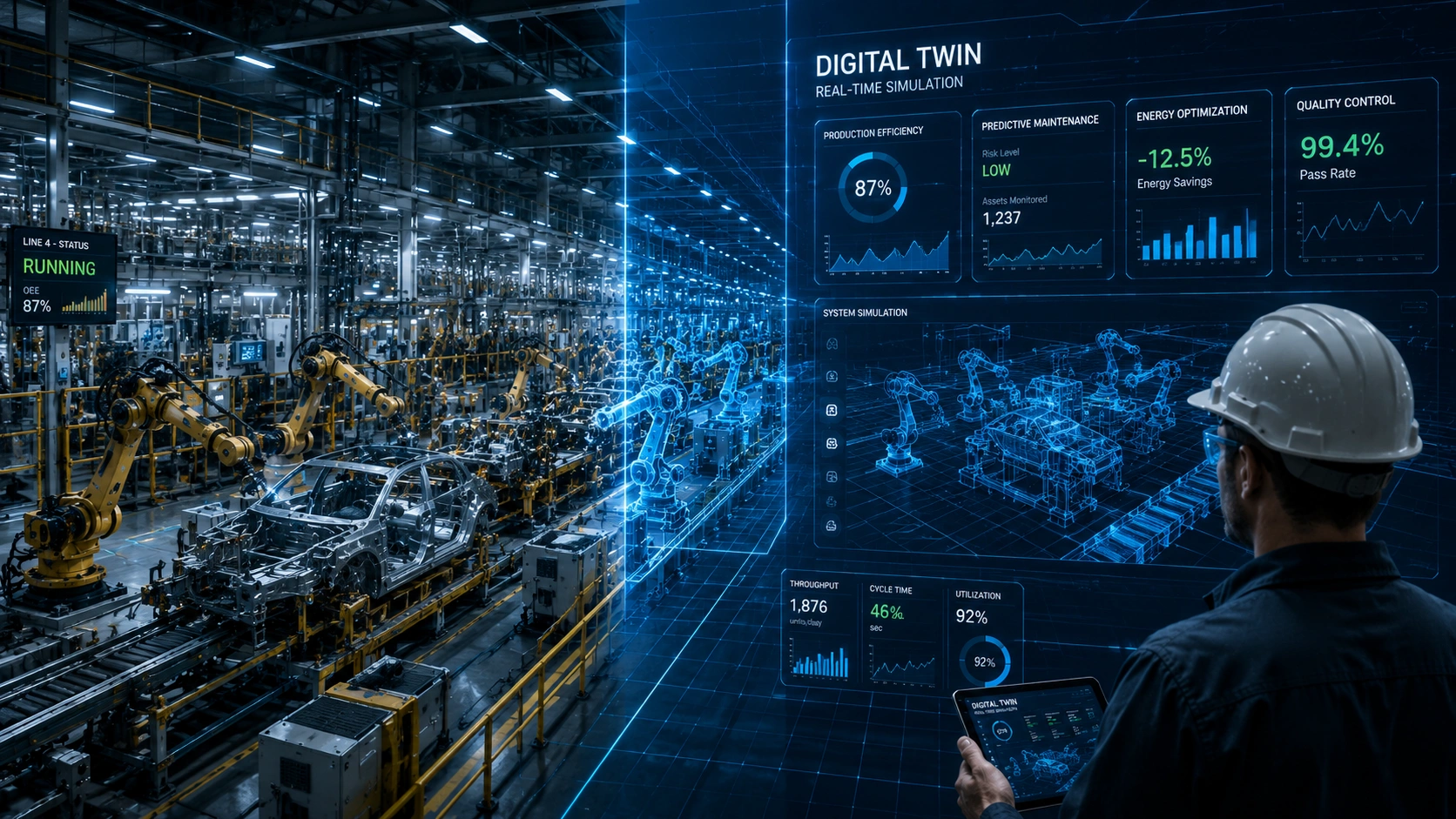
The next phase of manufacturing will not be defined by isolated AI tools. It will be shaped by organizations capable of building long-term operational intelligence.
AI combined with AR systems, digital twins, and autonomous agents will continue changing how factories operate. Sustainability pressures will accelerate that shift further.
The question is no longer whether AI belongs in manufacturing.
The real question is how quickly companies can adapt before competitors gain an operational advantage that becomes difficult to close.
Manufacturers leading the next decade are not waiting for perfect conditions. They are identifying one high-impact problem, applying AI carefully, and building capability from there.
That process has already started across the global AI industry. The companies moving now are shaping what production looks like next.
Frequently Asked Questions About AI in Manufacturing
What is AI in manufacturing?
AI in manufacturing refers to the use of machine learning, computer vision, predictive analytics, and automation systems to improve production operations. These technologies help manufacturers analyze data, predict failures, improve quality control, and optimize workflows.
How is AI used in manufacturing today?
Manufacturers use AI for predictive maintenance, visual defect detection, supply chain forecasting, digital twins, production optimization, and worker support systems. Many factories also use AI to reduce downtime and improve operational efficiency.
Does AI in manufacturing replace workers?
In most cases, AI supports workers rather than replacing them. Manufacturers often use AI to automate repetitive tasks, improve workplace safety, and help employees make faster decisions. Labor shortages are one reason many companies are adopting AI tools.
What are the biggest benefits of AI in manufacturing?
The biggest advantages include reduced equipment downtime, better product quality, lower operational costs, faster decision-making, and improved supply chain visibility. AI also helps manufacturers respond more quickly to disruptions.
How much does AI implementation cost for a manufacturing company?
Costs vary depending on the size of the company, data infrastructure, and use case. Smaller AI pilots may cost relatively little through cloud-based platforms, while enterprise-wide deployments require larger investments in systems and integration.