Enterprise AI Agents: The Quick Answer
Enterprise AI agents are intelligent software systems that understand goals, make decisions, access business tools, and complete multi-step tasks with minimal human intervention. Unlike chatbots, they can execute actions across enterprise systems such as CRMs, ERPs, databases, and internal workflows – not just respond to questions.
Read Aloud!
Why Enterprise AI Agents Are Becoming a Business Priority
Most organizations have already automated repetitive tasks. The next challenge is different. It’s not about doing the same things faster. It’s about building systems that can think, adapt, and act with real business context.
Behind every successful AI agent deployment is an enterprise AI platform that connects systems, enforces governance, maintains security, and supports scalable operations across the organization. Without this foundation, even promising AI initiatives can struggle to move beyond pilot projects and deliver measurable business value.
The Shift From AI Assistants to AI Workers
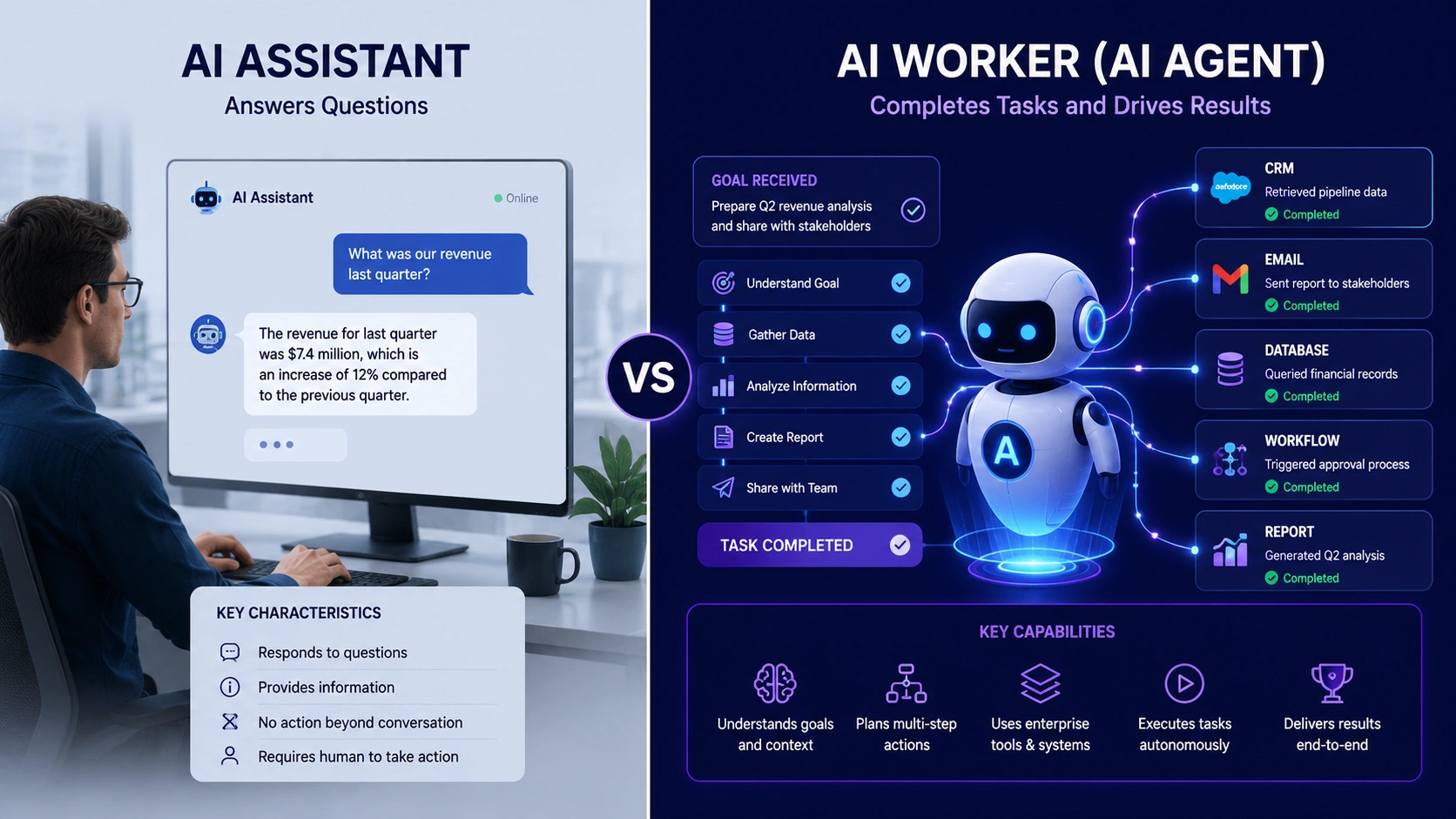
There’s a meaningful gap between an AI assistant and an AI worker. Assistants respond. Workers complete. Enterprise AI agents belong to the second category. They can receive a goal, figure out the steps needed to achieve it, and carry those steps out across multiple systems – without being guided through each one manually.
Why Traditional Automation Is No Longer Enough
Rule-based automation handles predictable paths. The moment an exception appears, it breaks. Modern enterprise operations are full of exceptions – changing customer requests, shifting priorities, and data that doesn’t fit neatly into predefined fields. AI agents for enterprise handle ambiguity in ways traditional automation simply cannot.
The Rise of Agentic Enterprises
Leading organizations are moving from AI experimentation to AI infrastructure. The shift isn’t just technological – it’s operational. When an AI agent can independently process a refund, escalate a complaint, and update a customer record in sequence, entire teams get freed for higher-value work.
What Exactly Are Enterprise AI Agents?
Core Components of an Enterprise AI Agent
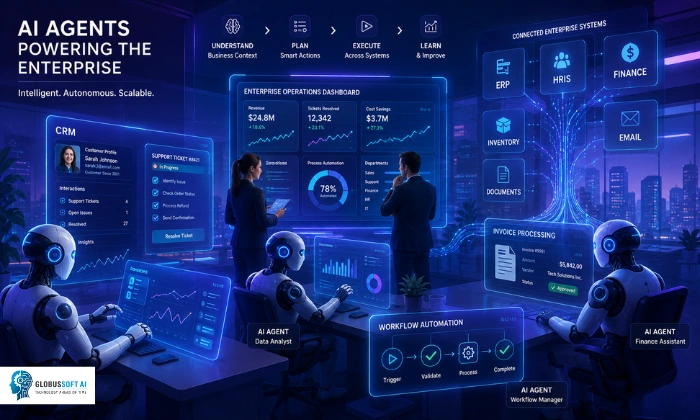
An enterprise AI agent is built from several key layers working together. At the foundation sits a large language model that interprets instructions and generates reasoning. Layered on top is memory – both short-term context and long-term recall. The planning layer translates goals into step-by-step actions. Then come tool integrations: APIs, databases, internal systems, and external services that the agent can actually act upon.
How Enterprise Agents Differ From Standard AI Tools
Standard AI tools respond to what you give them. Enterprise agents proactively interact with systems, retrieve the information they need, and take actions based on what they find. The distinction is agency – the capacity to do, not just to say.
How Enterprise AI Agents Actually Work Behind the Scenes
Understanding Goals and Context
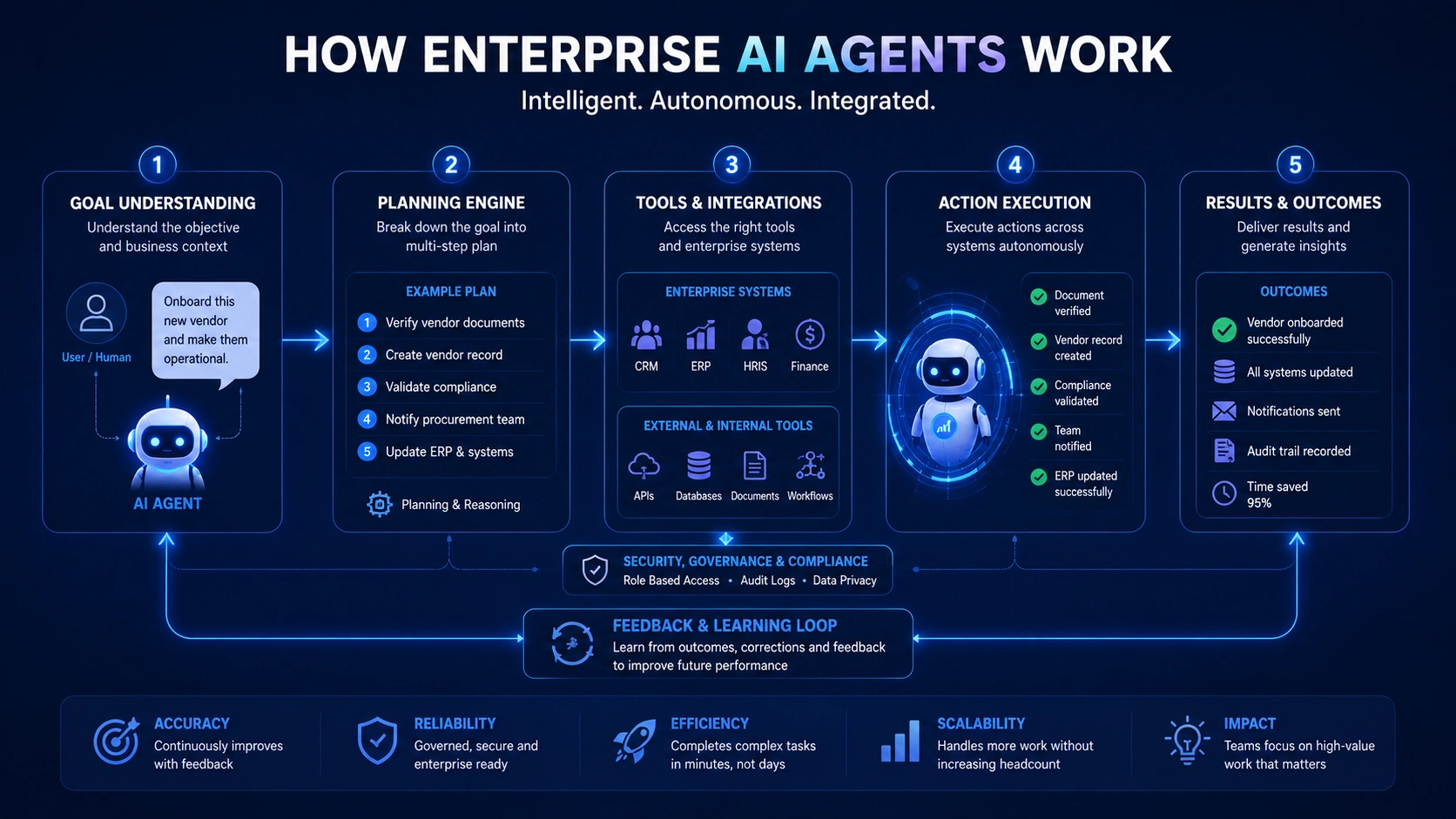
An agent starts by interpreting a high-level objective. “Onboard this new vendor” is the instruction. The agent understands what that means: verify documents, create a supplier record, notify procurement, and update the ERP. It builds a mental model of the task before taking a single action.
Planning Multi-Step Actions
Once the goal is clear, the agent breaks it into executable steps. This planning layer is what separates agents from simpler AI tools. Sequencing, dependencies, fallback options – these get handled automatically.
Connecting With Enterprise Systems
Agents access the tools they need: querying databases, calling APIs, filling forms, or triggering workflows. The breadth of integration is what makes them genuinely useful at enterprise scale.
Learning From Feedback and Outcomes
Most enterprise deployments include feedback loops. When an agent makes a decision that gets corrected, that correction informs future behavior. Over time, agents become more accurate on the specific tasks your organization handles most often.
Real Enterprise AI Agent Use Cases Delivering Results Today
Customer Support and Service Operations
Agents handle multi-step support tickets – pulling account history, checking order status, processing refunds, and closing cases – without a human touching the queue.
Sales and Lead Management
An agent can qualify leads by researching company data, scoring engagement signals, and drafting personalized outreach while syncing everything back to the CRM.
Human Resources and Employee Support
HR inquiries like leave balances, policy questions, onboarding checklists, and benefits enrollment can all be handled by agents integrated with HRIS platforms.
Finance and Accounting Workflows
Invoice matching, expense reconciliation, and payment approvals follow complex rules. Agents handle these processes end-to-end, flagging only genuine anomalies for human review.
IT Operations and Internal Helpdesks
From resetting access credentials to diagnosing network issues, IT agents reduce resolution time from hours to minutes.
Supply Chain and Procurement
Agents monitor inventory thresholds, trigger purchase orders, and track supplier commitments without manual intervention at each stage.
Read More!
10 Powerful Benefits of AI Chatbot for E-commerce
Enterprise OpenClaw Services – GlobusSoft.ai
The Business Benefits of Enterprise AI Agents
Speed is the most visible benefit – decisions and actions that once took days now complete in minutes. Cost reduction follows, since agents scale without proportional headcount growth. But the less obvious benefit is consistency. Agents apply the same logic every time, which reduces errors in high-volume processes.
Better customer experiences emerge from faster resolution times and more personalized interactions. Scalability becomes structural rather than a hiring challenge. When demand spikes, agents absorb the load without degrading performance.
Why Many Enterprise AI Projects Fail Before They Scale
This is where most guides go quiet. Understanding the failure patterns matters more than celebrating the potential.
Treating Agents Like Chatbots
Many teams deploy enterprise AI agents expecting them to behave like chatbots with extra features. They underestimate the need for structured task design, integration architecture, and fallback handling. Agents built without these foundations stall quickly.
Poor Data Infrastructure
An agent is only as useful as the data it can access. Siloed, inconsistent, or poorly structured data creates broken reasoning chains. Data readiness is a prerequisite, not an afterthought.
Lack of Governance
Without clear policies on what an agent can and cannot do – and audit trails for every action – organizations expose themselves to risk. Governance is what converts a prototype into a production-grade system.
Unrealistic Expectations
Expecting autonomous intelligence from day one sets projects up for disillusionment. Agents need to be scoped carefully, tested thoroughly, and improved incrementally.
Ignoring Human Oversight
Full autonomy sounds appealing. In practice, the highest-performing deployments maintain human oversight at decision boundaries. A well-designed human-in-the-loop model catches errors before they compound.
How GlobussoftAI Helps Organizations Build Enterprise AI Agents
GlobussoftAI helps businesses turn AI concepts into practical, enterprise-ready solutions. By combining custom development, system integration, and scalable deployment strategies, the company enables organizations to implement AI agents that fit their unique operational needs.
Key features and benefits include:
- Custom AI agent development tailored to specific business workflows
- Integration with enterprise systems, databases, and business applications
- Secure deployment architecture designed for enterprise environments
- Workflow automation across departments and operational processes
- Scalable multi-agent ecosystems for complex business operations
The Next Evolution: From Single Agents to Autonomous AI Teams
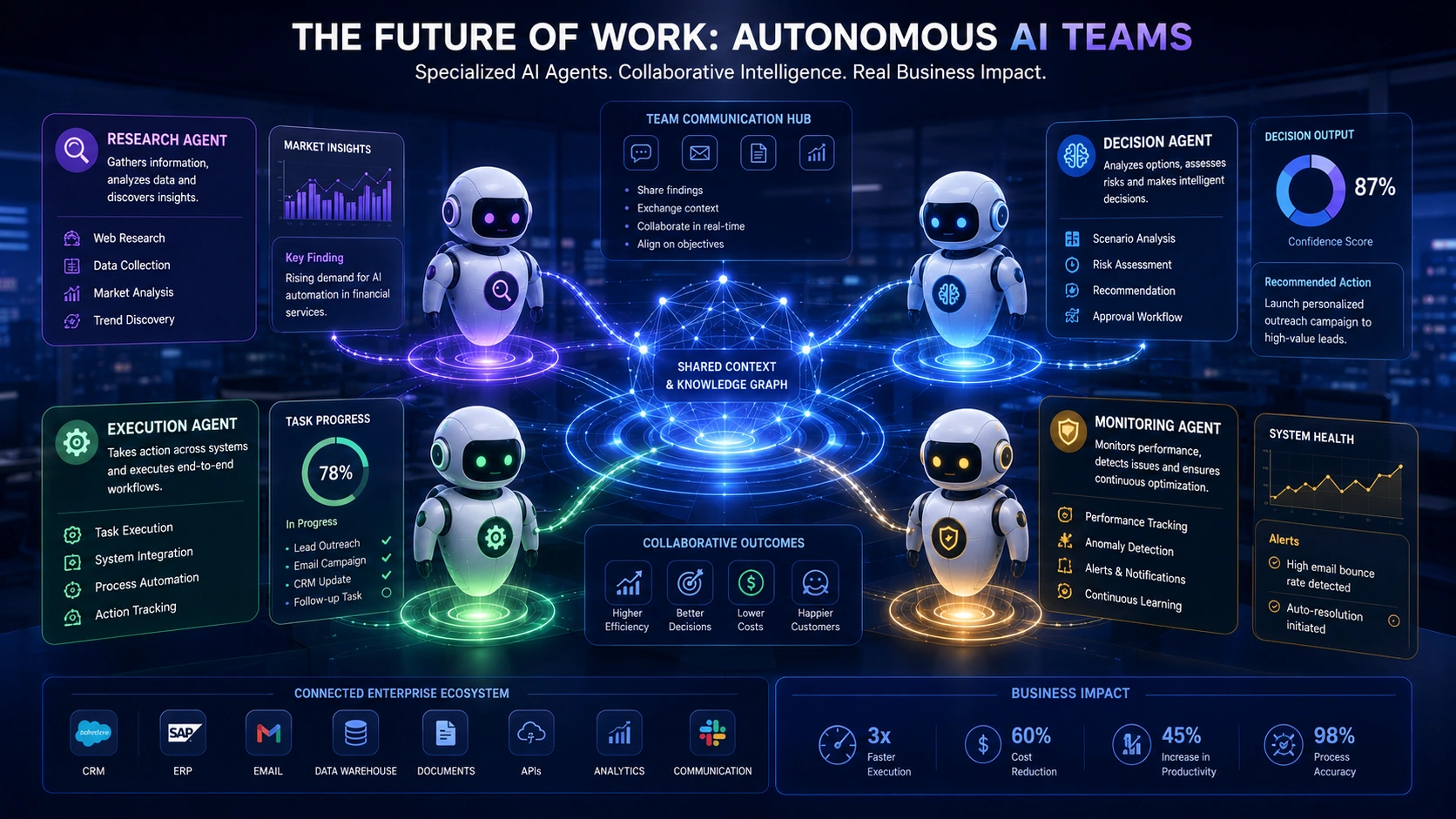
Single agents solve individual workflow problems. Multi-agent systems solve organizational ones. In a multi-agent environment, specialized agents hand off tasks between each other – a data-gathering agent feeds a decision agent, which hands off to an execution agent.
Enterprise AI maturity tends to progress in stages: from basic chatbots, to tool-enabled agents, to workflow automation, to multi-agent systems, and eventually toward what some are calling the agentic enterprise – organizations where AI-driven coordination handles the bulk of operational execution.
By 2030, the organizations furthest along this path will have fundamentally different operating models. Human teams will focus on judgment, relationships, and strategy. Agents will handle execution, coordination, and monitoring at scale.
Common Misconceptions About Enterprise AI Agents
AI Agents Replace Employees
Agents replace tasks, not roles. Most implementations free people from manual work rather than eliminating positions entirely.
More Autonomy Means Better Results
Unconstrained agents make more mistakes, not fewer. The best deployments find the right level of autonomy for each task type.
Enterprise AI Is Only for Large Companies
Mid-market organizations are deploying agents across finance, customer support, and operations effectively. Scale isn’t the barrier – readiness is.
AI Agents Work Without Human Governance
Governance isn’t optional. It’s what allows organizations to scale agent deployment with confidence rather than anxiety.
Final Thoughts: The Future Belongs to Agent-Driven Organizations
Enterprise AI agents are no longer experimental. The organizations seeing real returns are those that approach deployment seriously: starting with clear use cases, building on solid data infrastructure, and maintaining human oversight at the right points. Autonomy and accountability aren’t in conflict – the best implementations require both. The competitive gap between organizations that get this right and those still experimenting with chatbots will only widen from here.
Frequently Asked Questions
What are enterprise AI agents?
They are intelligent software systems capable of understanding business goals, planning multi-step actions, integrating with enterprise systems, and completing tasks with minimal human input.
How are enterprise AI agents different from chatbots?
Chatbots respond to queries. Agents take actions across systems, complete tasks end-to-end, and adapt when conditions change.
What industries benefit most from enterprise AI agents?
Financial services, healthcare, retail, logistics, and professional services see particularly strong returns – any industry with high-volume, rule-intensive workflows.
Can enterprise AI agents access company databases?
Yes. Through API integrations and secure connectors, agents can query, read, and in many cases write to enterprise databases and business systems.
How secure are enterprise AI agents?
Security depends on how they are built. Properly designed agents operate within permission boundaries, log every action, and comply with applicable data governance policies.
What are the best AI tools for enterprise agents?
The best AI tools for enterprise agents typically include large language models, workflow orchestration platforms, vector databases, enterprise integration tools, monitoring solutions, and agent management systems. The ideal choice depends on factors such as scalability, security requirements, integration capabilities, and the complexity of enterprise workflows.