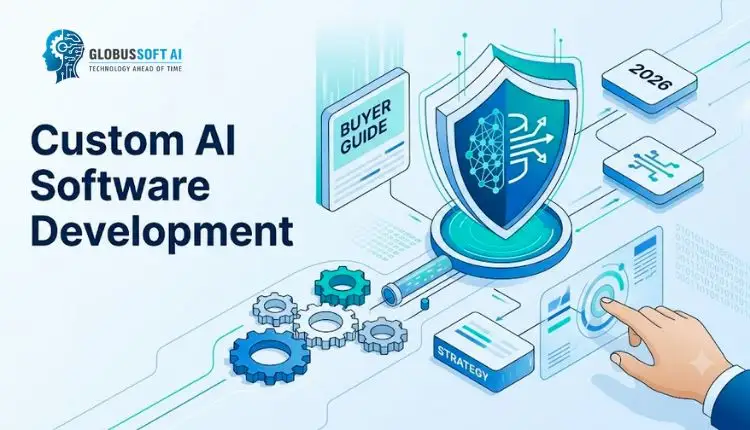
Custom AI software development is the process of designing, building, and deploying AI-powered applications around your own data, workflows, and infrastructure, instead of forcing your business into an off-the-shelf SaaS tool. If you’ve hit the ceiling of a no-code platform or a generic API wrapper and need something that actually fits how your company operates, this guide walks through the decision, the delivery lifecycle, real cost drivers, and how to vet a partner before you commit budget.
When Custom Beats Off-the-shelf (And When It Doesn’t)
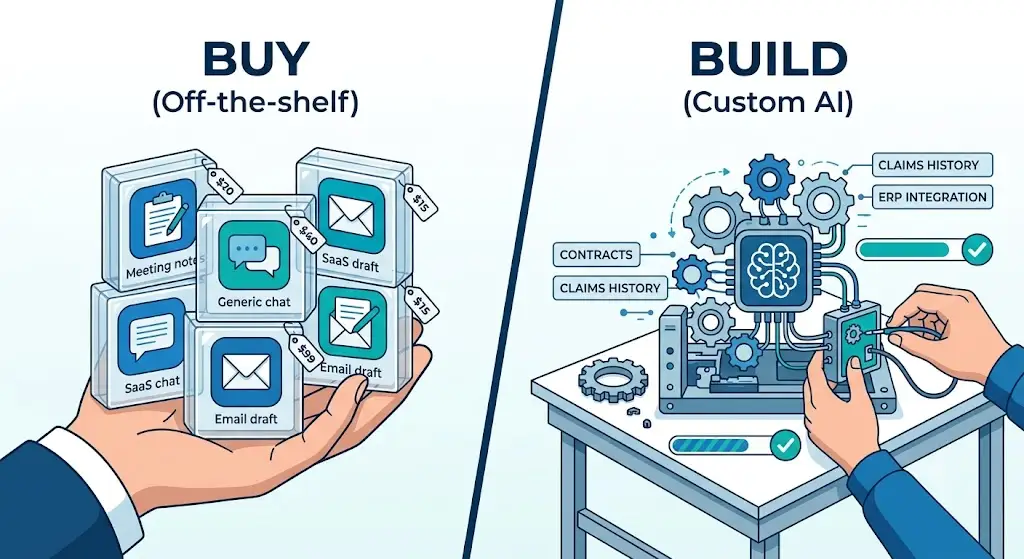
Not every AI problem deserves a custom build. Be honest about which bucket you’re in.
Buy off-the-shelf when: the workflow is generic (meeting notes, email drafting, standard chat support), your data isn’t a differentiator, and a $30/seat/month tool gets you 80% of the value this quarter.
Build custom when at least two of these are true:
- Your proprietary data (contracts, claims history, sensor logs, EHR records) is the product, and it can’t leave your VPC.
- The AI has to plug into 3+ internal systems: an ERP, a legacy Oracle DB, a homegrown CRM that no SaaS vendor integrates with.
- You need control over model behavior, audit logs, and data residency for SOC 2, HIPAA, or GDPR reasons.
- Per-seat pricing on a packaged tool would cost more than a build once you cross ~150–200 users.
A rough heuristic: if you’re paying a SaaS vendor more than $120K/year and still filing feature requests they ignore, a custom build usually pays back inside 18 months.
The Custom AI software Development Lifecycle
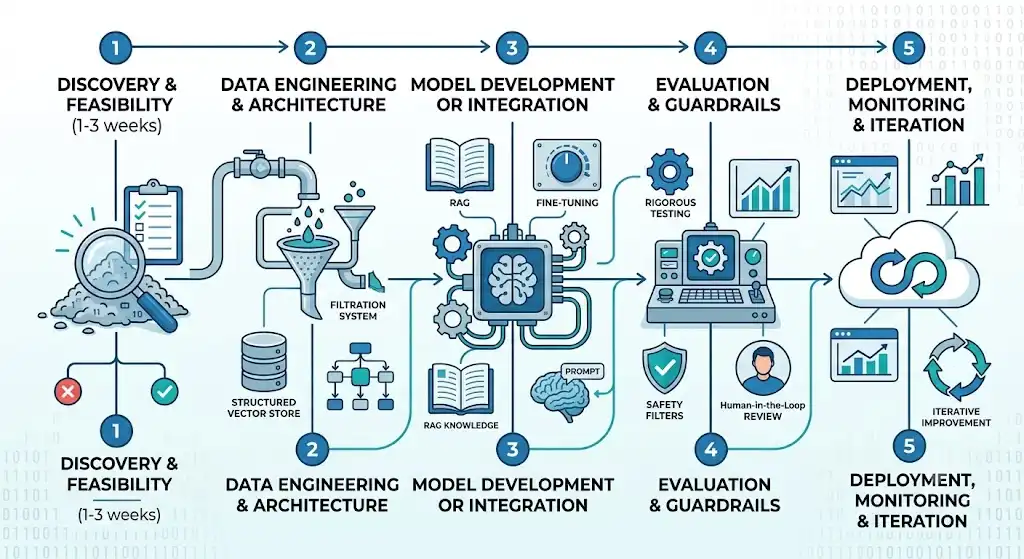
A serious project moves through five phases. Skipping the first one is the single most common reason AI builds fail.
1. Discovery and feasibility (1–3 weeks)
Before a line of code, you validate that the problem is AI-shaped and that your data can support it. This means auditing data volume and quality, defining a measurable success metric (“cut invoice-processing time from 9 minutes to under 90 seconds”), and running a quick spike to confirm a model can hit acceptable accuracy. Roughly 1 in 3 AI ideas die here, and that’s a good outcome, because killing them costs weeks, not quarters.
2. Data engineering and architecture
Most of the real work is plumbing. You build the pipelines that clean, label, and structure data; stand up a vector store for retrieval; and design the system so a model swap doesn’t require a rewrite. For retrieval-augmented generation (RAG) systems, chunking strategy and embedding quality drive more accuracy gains than the choice of foundation model.
3. Model development or integration
You rarely train a model from scratch in 2026; it’s usually one of three paths: prompt-engineer and orchestrate a foundation model (fastest), fine-tune an open-weight model on your data (best for narrow, repeatable tasks), or build a retrieval layer so a general model answers from your knowledge base (best for grounding and citations). Many production systems combine all three.
4. Evaluation and guardrails
This is where amateur projects and production systems diverge. You build an eval set of 100–500 real examples, measure accuracy and hallucination rate against it on every change, and add guardrails: input validation, output filtering, human-in-the-loop review for high-stakes actions, and fallback logic when confidence is low.
5. Deployment, monitoring, and iteration
You ship into your cloud (AWS, Azure, or GCP), wire up observability for latency, cost-per-request, and drift, then iterate on real usage. Model performance degrades as your data and user behavior shift; a system with no monitoring is a system quietly getting worse.
Also Read
Custom AI Chatbot Builder for Small Businesses (2026)
AI-powered CRM and business tool integration: OpenClaw vs HS
What Actually Drives Cost
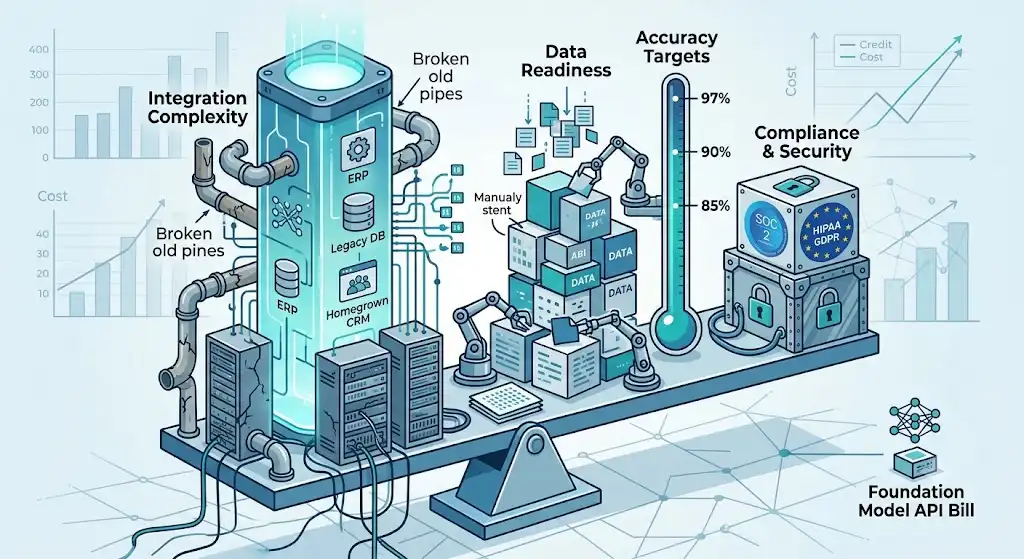
The foundation model API bill is usually the smallest line item. Here’s where the budget really goes:
- Integration complexity. Connecting to one clean REST API is cheap. Connecting to a 20-year-old system with no documentation is where weeks disappear.
- Data readiness. If your data is scattered, unlabeled, and inconsistent, expect 30–40% of the project to be data engineering before any AI work starts.
- Accuracy targets. Getting from 85% to 97% accuracy can cost more than the entire build-up to 85%. Define “good enough” early.
- Compliance and security. On-prem deployment, audit trails, and data-residency controls add real engineering, but they’re non-negotiable in regulated industries.
A focused pilot (one workflow, one integration) typically runs in the low tens of thousands and for 6–10 weeks. A production platform touching multiple systems is a multi-quarter engagement. Anyone quoting a fixed price before discovery is guessing.
How To Vet A Custom AI Development Partner
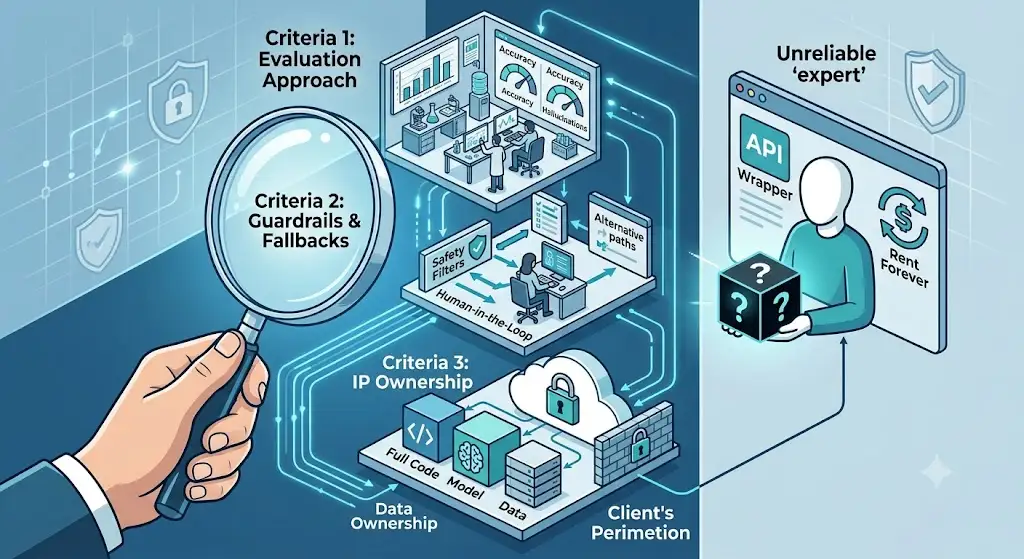
The market is full of teams that wrapped a chat API last year and rebranded as “AI experts.” Separate them with pointed questions:
- “Show me your evaluation approach.” If they can’t explain how they measure accuracy and catch hallucinations, they’ve never shipped anything that mattered.
- “What happens when the model is wrong?” Good teams talk about guardrails, fallbacks, and human review unprompted.
- “Who owns the code, models, and data?” Insist on full IP ownership and a deployment inside your cloud accounts, not a black box you rent forever.
- “Walk me through a project that underperformed.” Honest partners have war stories; vendors selling magic don’t.
- Ask about post-launch. A model handed over with no monitoring or retraining plan is a liability, not an asset.
A Realistic 90-Days Path To Production
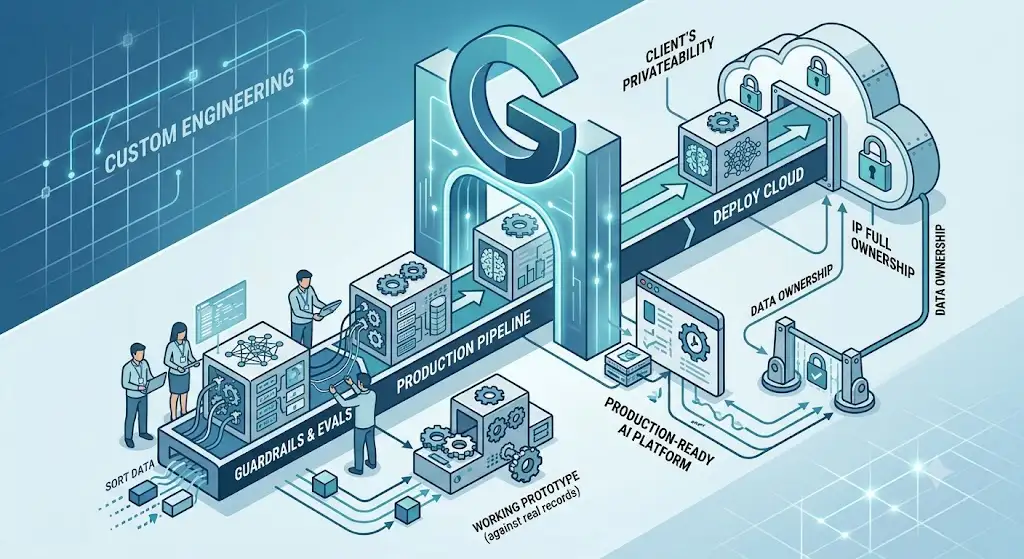
- Weeks 1–2: Discovery: pick one high-value workflow, define a hard success metric, audit the data.
- Weeks 3–6: Build the data pipeline and a working prototype against real records, not demo data.
- Weeks 7–9: Add evals, guardrails, and the integrations to your live systems.
- Weeks 10–12: Deploy to a limited user group, measure against the baseline, and decide whether to scale.
Ship one workflow end-to-end before you plan ten. A single AI feature running reliably in production teaches you more — about your data, your users, and your true costs than six months of roadmap slides.
Build It With A Team That Ships
Globussoftai builds custom AI software end-to-end from feasibility and data engineering through model development, evaluation, and deployment inside your own cloud. You keep full ownership of the code, models, and data, and you get a team that treats evals and guardrails as table stakes, not afterthoughts. If you’re weighing a build and want a straight answer on whether it’s worth it, book a scoping call with our engineering team we’ll pressure-test your use case and give you an honest feasibility read before anyone talks budget.