
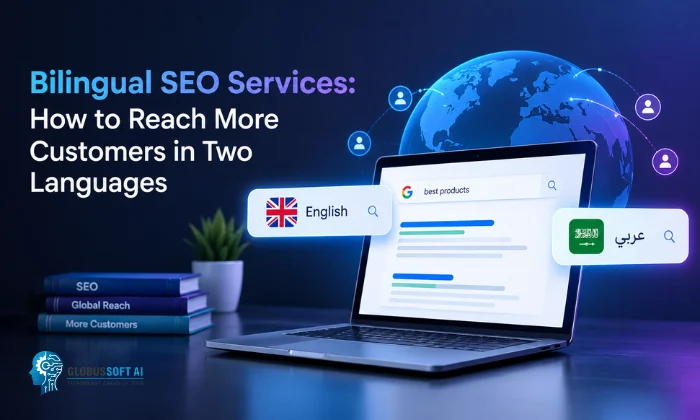
Businesses targeting the Gulf region can connect with customers in both Arabic and English. However, translating a website alone rarely attracts qualified visitors. Bilingual SEO services help businesses develop search strategies that reflect how people search, what they expect from content, and which language they prefer when making purchasing decisions. From keyword research and localised landing pages to technical optimisation, every element needs to work together. A customer searching in Arabic should find relevant information that feels natural, while an English-speaking visitor should experience the same level of clarity and trust. For companies expanding across the UAE, Saudi Arabia, Qatar, and other GCC markets, a thoughtful multilingual approach can improve discoverability and create more meaningful customer connections. The goal is not simply to publish two versions of a website but to make both versions useful, accessible, and easy to find.
Listen to this podcast!
1. What Are Bilingual SEO Services?
Bilingual SEO is the process of optimizing a website for two languages so that people can discover relevant content through search engines. It combines traditional search optimization with language-specific keyword research, content localization, technical implementation, and user experience improvements.
For example, a Dubai-based property company might publish English content for international investors and Arabic content for regional buyers. Both audiences may be interested in the same property, but their search terms, questions, and preferred information can differ.
Effective bilingual SEO services address these differences instead of treating translated pages as identical copies. The strategy considers search intent, local terminology, cultural context, and conversion paths.
The result is a website that communicates clearly with different audiences while maintaining a consistent brand identity.
2. Why GCC Businesses Need a Two-Language Search Strategy
The Gulf Cooperation Council includes diverse audiences with different language preferences, buying habits, and expectations. English is widely used in business and international communication, while Arabic remains essential for reaching many regional customers.
A company that relies exclusively on English may overlook Arabic-language searches. On the other hand, publishing Arabic pages without understanding the audience can lead to content that feels unnatural or fails to answer customer questions.
Businesses should examine their actual search data, customer inquiries, and market research before deciding how much investment each language deserves.
Bilingual SEO services can help identify which products, services, and locations need dedicated Arabic and English pages. This makes the strategy more focused and prevents businesses from spending resources on translations that do not serve a clear customer need.
3. Research Keywords in Arabic and English Separately
Keyword research should begin with customer intent rather than direct translation. A phrase that performs well in English may have a different natural equivalent in Arabic, and users may also search with regional expressions or alternative spellings.
Build separate keyword lists for each language. Look for informational queries, service-related searches, comparison terms, and location-specific phrases. Google Search Console can help identify queries already generating impressions, while keyword research tools can reveal additional opportunities.
For instance, a healthcare provider should investigate how people search for particular treatments in both languages. The English and Arabic pages should address the same core service but use wording that reflects real search behavior.
Bilingual SEO services should also account for spelling variations and transliterated terms where they are genuinely used. Avoid inserting every variation into the same page. Choose a primary topic for each URL and create content that answers its intended audience’s needs.
4. Create Content That Feels Local, Not Translated
Translation changes words. Localization adapts the complete message to the audience.
Arabic content should be reviewed by someone who understands the language, regional terminology, and the business context. Literal translations can sound awkward, confuse readers, or communicate a meaning different from the original.
Consider a financial services company explaining its products. The Arabic page may need different examples, explanations, and terminology to make the offer understandable to its intended audience. The English version should be equally complete, rather than treated as the original and only authoritative page.
A strong content process includes:
- Separate Arabic and English keyword research.
- Native-language editing and proofreading.
- Local examples, references, and terminology.
- Clear headings that reflect each audience’s questions.
- Consistent brand messaging across both versions.
These steps help build trust while making the content more relevant to users.
5. Set Up Hreflang Tags for the Right Audience
Search engines need clear signals about which language version of a page is intended for a particular audience. Hreflang annotations help identify relationships between localized URLs.
For example, an English page and its Arabic equivalent can reference each other using appropriate language codes. If the website targets a specific country, a regional code may also be suitable when the content genuinely differs for that market.
Hreflang Tags for Arabic and English should follow a consistent implementation across the site. Each localized page should include its own reference and links to the corresponding alternate versions. The URLs should be accessible to search engines and should not point to unrelated pages.
Google supports hreflang through HTML annotations, HTTP headers, or XML sitemaps. Choose a method that your team can maintain reliably, and check for missing or incorrect references during technical audits.
6. Build a Website Structure That Search Engines Can Understand
A clear URL structure makes it easier for visitors and search engines to identify language versions. Many businesses use language subdirectories because they are relatively simple to maintain.
For example:
- example.com/en/ for English content.
- example.com/ar/ for Arabic content.
- example.com/en/services/ for an English service page.
- example.com/ar/services/ for its Arabic counterpart.
The specific structure can vary, but consistency matters. Avoid placing both languages in one URL or relying on automatic browser translation as the only Arabic experience.
Use separate URLs for localized pages and ensure that navigation links lead to the correct version. A visible language selector can help users switch languages without losing their place.
7. Optimize the Arabic Website Experience
Arabic websites require more than translated text. The interface must support the language’s natural reading direction and remain comfortable to use across devices.
Right-to-Left (RTL) Website Optimization involves adjusting page layout so Arabic content reads from right to left. Menus, navigation, form fields, icons, and text alignment should follow the intended direction without making the interface confusing.
Pay attention to:
- Arabic fonts that remain readable on mobile screens.
- Correct text alignment and paragraph spacing.
- Forms that accept Arabic names and addresses.
- Buttons and navigation that follow RTL conventions.
- Responsive layouts that avoid horizontal scrolling.
Test the complete journey, including search, product selection, contact forms, and checkout. A page can look correct at first glance but still contain broken layouts or confusing interactions.
8. Understand Search Trends Across the GCC
Search behaviour varies by country, industry, and audience. Businesses should not assume that every GCC market uses the same expressions, product preferences, or commercial terminology.
GCC Search Engine Trends can be explored through Google Trends, Search Console, keyword research platforms, and customer feedback. Compare demand across countries and languages, and look for seasonal changes around Ramadan, Eid, major shopping events, and relevant industry periods.
For example, a travel business might see different search interest for family holidays, religious travel, or weekend destinations depending on the country and time of year.
Use these findings to guide content calendars and landing pages. Prioritize topics that match your business offerings and show meaningful customer interest, rather than creating dozens of pages simply to target different locations.
9. Connect Search Optimisation With Cultural Relevance
Search visibility is only one part of reaching a new audience. Content must also communicate in a way that reflects local expectations and builds confidence.
A cross-cultural digital marketing strategy considers the audience’s language, values, preferred communication style, and decision-making process. These factors influence the examples used in content, the images selected, the tone of calls to action, and the information customers need before contacting a business.
For example, a professional services company may need to explain its process, credentials, and local experience more clearly to one audience than another.
Avoid stereotypes or assumptions about Arabic-speaking customers. Use customer research, local feedback, and analytics to understand what actually matters to your audience.
The strongest approach combines cultural awareness with useful information, clear messaging, and consistent service quality.
10. Promote Your Bilingual Website to Reach More Customers
Publishing localized pages is the starting point. Businesses also need to help their intended audiences discover those pages and engage with the content.
Begin by promoting useful resources through relevant social media channels, email newsletters, and industry partnerships. Share Arabic content with audiences who prefer Arabic and English resources with those who prefer English. Where appropriate, build relationships with regional publications, professional communities, and local websites that can provide relevant references and links.
Paid search campaigns can help test demand for specific Arabic and English keywords while organic rankings develop. Use separate campaigns and landing pages so that language, messaging, and conversion data remain clear.
Monitor organic clicks, qualified leads, engagement, and conversions by language. Use these insights to improve content and promotion rather than judging success only by rankings or total traffic.
11. How Globussoft AI Can Support Your Growth

Expanding into new markets requires more than publishing additional website pages. Businesses need a coordinated approach to search visibility, content production, and digital customer acquisition. Globussoft AI works with businesses on AI engineering and digital growth initiatives, including search optimization and bilingual content for audiences across the Middle East.
Its website highlights capabilities and approaches relevant to businesses exploring this expansion:
- Arabic-English SEO: Search optimization designed around language-specific search behavior in the Middle East.
- GEO and AEO: Strategies intended to improve visibility in generative and answer-based search experiences.
- Bilingual content: Content structured for traditional search engines and AI-generated answers.
- AI-driven research: Research and competitor analysis to identify content opportunities.
- Multi-model AI expertise: Work involving Claude, GPT, Gemini, and Qwen for different project requirements.
Businesses can explore these capabilities at Globussoft AI and discuss their specific requirements before choosing a suitable strategy. The right scope depends on the website’s current performance, target markets, and available resources.
Read More!
How to Optimise Content for AI-Powered Search in 2026
SEO vs PPC: Which Digital Marketing Strategy Works Better?
Conclusion
Reaching customers in two languages requires a strategy that connects keyword research, localized content, technical SEO, and a comfortable website experience. Bilingual SEO services can help businesses build that foundation while making their content more relevant to customers across the GCC. Success depends on understanding real search behavior, maintaining accurate language versions, and continuously improving pages using performance data. Start with the markets and services that matter most, then expand as you learn what customers respond to.
Frequently Asked Questions
1. Is translating a website enough for bilingual SEO?
No. Translation should be supported by language-specific keyword research, localized content, technical SEO, and usability testing.
2. Should Arabic and English pages have separate URLs?
Yes. Separate URLs make language versions easier to crawl, manage, and connect using hreflang annotations.
3. How long does bilingual SEO take to show results?
There is no fixed timeline. Results depend on competition, website authority, content quality, technical health, and how consistently the strategy is implemented.
4. Can a business target multiple GCC countries with one Arabic website?
It can, if the content serves those audiences appropriately. Create separate country-specific pages when customer needs, services, or information genuinely differ.