

Up to 40% lower operating costs and a 30% productivity boost are real outcomes when AI is set up the right way. The best call in 2026 is to pick a system you control, not another closed chat widget that paints you into a corner. If you’re hunting for the best custom AI chatbot builder, you need proof it can handle your catalog, your order data, and your peak traffic without breaking your budget.
You’ve likely tried a bot that gave copy‑paste answers, bounced users between flows, and stalled on simple returns. It wasn’t you. It was the tool. Rigid logic trees can’t parse nuanced product questions or detect when a request is about an order, a return, or a recommendation. As a result, they loop customers, miss intent, and spike tickets.
This guide is education‑first and product‑second. You’ll see what matters in a build, how to assess options, and where an open, self‑hosted stack wins in 2026. We’ll also show a path to launch in days, not months, with costs usually under $10/month for infra and model usage, plus optional pro services if you want a team to do the heavy lifting.
For broad context on use cases, see our primer on AI chatbots for e-commerce. It covers patterns you can reuse across your store.
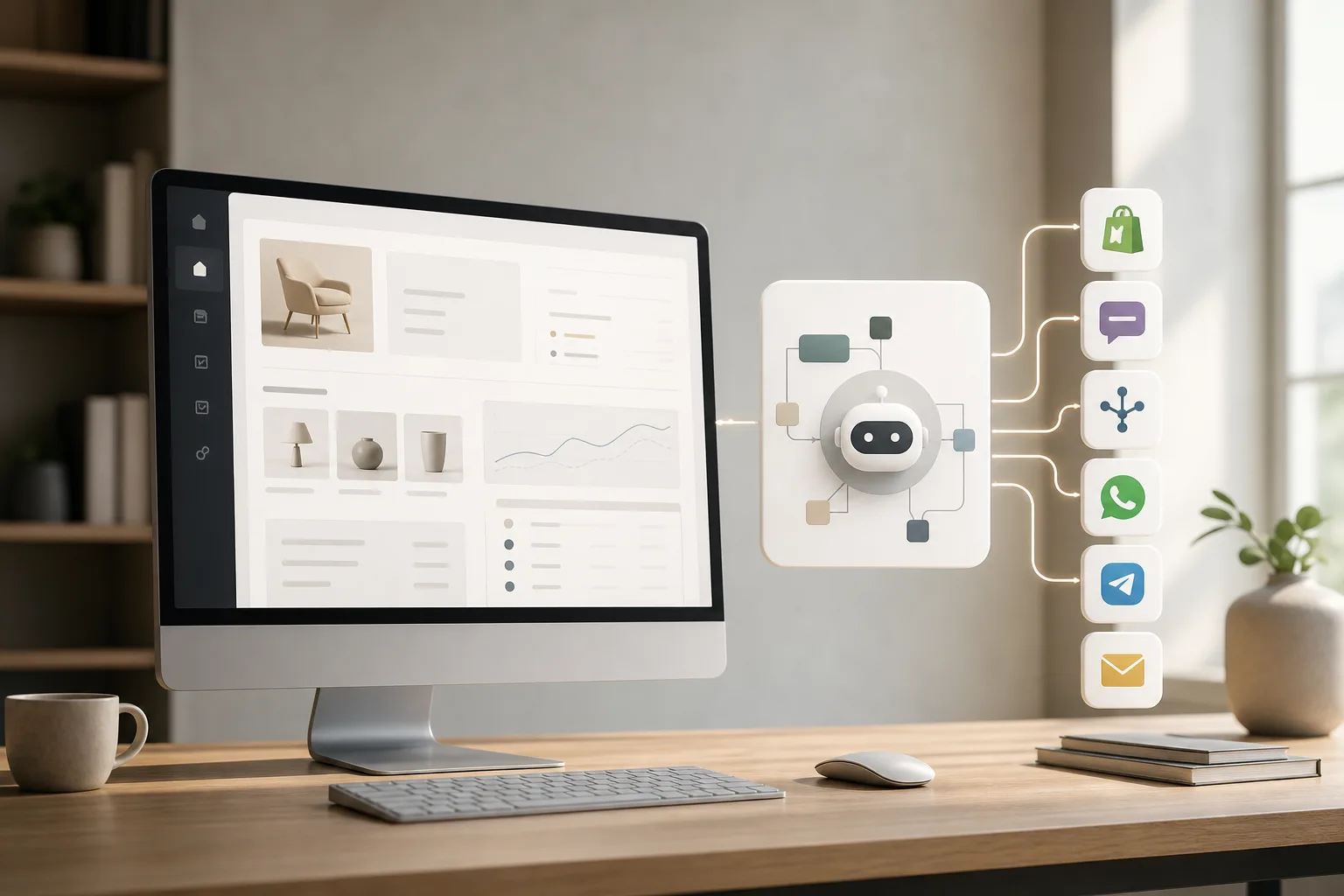
Why Ecommerce Brands Struggle With Off-the-Shelf Chatbots
You’ve seen it: a shopper asks, “Does the 128GB model ship before Friday if I add engraving?” The bot answers with a vague shipping policy. That’s not intent match. It’s a dead end. This is the core gap a custom AI chatbot builder must close: deep, context‑aware answers rooted in your live systems.
First, generic bots lack the product graph. They don’t know how colors map to SKUs, how bundles change stock, or how backorders tie to carriers. So they guess. And you pay in tickets and churn.
Second, order status and returns are not simple FAQs. Customers ask with half details: “I ordered two shirts last week, can I swap one for medium?” That needs identity, order lookup, RMA rules, and label creation. A template flow rarely covers all paths, so users get stuck in loops or are told to email support.
Third, weak integrations are costly. If your bot can’t read your Shopify or WooCommerce data or write notes back to your CRM, agents lose context. That adds 1–3 minutes per ticket. Over a month, that’s dozens of hours.
Where the loops start
- Catalog nuance: Variants, bundles, and preorders break simple Q&A bots.
- Policy nuance: Returns differ by category, region, or status; rigid flows miss edge cases.
- System walls: No real sync with ecommerce, CRM, or analytics means lost context.
- Channel gaps: Customers start on WhatsApp and end on web chat; the history vanishes.
The real cost you feel
- Refunds swell when bots misanswer sizing, shipping cutoffs, or restock dates.
- AOV drops when cross‑sell logic is static instead of context‑aware.
- CSAT dips as customers repeat details to a human after a failed bot loop.
To fix this, you need a builder that learns your catalog, routes tasks to the right agent (order, returns, recs), and plugs into your stack end‑to‑end. Anything less is a rerun of past pain.
What to Look for in a Custom AI Chatbot Builder for Ecommerce
Buying a platform is less about shinier chat bubbles and more about how well the system understands messy, real‑world questions and runs actions for you. Your short list should cover six areas: language depth, omnichannel reach, integration, hosting model, scale, and security.
First, the model. LLM‑powered NLP must handle complex, multi‑part questions and resolve pronouns, variants, and policies. It should reduce hallucinations with tools like retrieval or fine‑tuning on your product data. If you can’t teach it your catalog, you’ll end up with guesswork.
Second, channels. Customers reach you on web, email, WhatsApp, and Telegram. One engine should serve all of them, so history and context travel with the user. That’s how you cut repeat questions and keep the thread intact.
Third, integration. Tight links to your CRM and analytics are non‑negotiable. You should see which prompts drive orders, which intents spike tickets, and where conversion stalls. The bot must also read and write to ecommerce systems, not just scrape.
Self‑hosted vs. SaaS: control and cost
- Self‑hosted gives you data control and avoids per‑seat or per‑MAU fees that swell at scale.
- SaaS is quick to try but can lock data and limit deep customization.
- Hybrid is fine, but map where your data lives and who can see it.
Scale and security you can trust
- Traffic spikes matter. Your builder must hold up during Black Friday and drops.
- Look for encryption in transit and at rest. For a primer, see Transport Layer Security.
- Role‑based access keeps teams honest and audit‑ready.
Quick checklist for 2026
- LLM NLP that handles multi‑intent, multi‑turn queries
- Multi‑channel chat (WhatsApp, Telegram, email, web)
- CRM and analytics integration with intent and outcome tracking
- Self‑hosted option for data ownership and cost control
- Load handling under peak with failure testing
- Strong encryption and RBAC, with logs you can audit
If the platform can’t meet these six points, it isn’t the right fit for sustained growth or for the way your customers talk today.
For broader background on conversational design choices, you can also review our guide on AI-powered chatbot.
Also Read!
Best Predictive Analytics AI Tool for Ecommerce in 2026
How to Choose the Best Predictive Analytics AI Tool for Ecommerce
How GlobussoftAI OpenClaw Solves Ecommerce Chatbot Challenges
OpenClaw brings LLM‑powered chat that learns your catalog and runs tasks, not just answers them. It was built as an open‑source AI agent framework with self‑hosted deployment, so you own the stack and pay VPS pricing, not SaaS markups. For ecommerce teams that need a custom AI chatbot builder without runaway costs, this is where control and value meet.
First, the language layer. OpenClaw uses Large Language Models to parse complex, multi‑part prompts and give human‑like answers. Crucially, it supports training and fine‑tuning on your domain data. That means the bot “knows” variants, bundles, sizing notes, and policy rules that live in your catalog and docs.
Second, the agent layer. With Multi‑Agent Orchestration, a “front‑desk” agent can route to a Returns agent for RMAs, an Orders agent for status and edits, or a Recs agent for cross‑sells. Each agent has tools and guardrails. For example, the Returns agent can check RMA rules, create labels, and write back to your CRM, while the Recs agent can rank items by stock, margin, and user intent.
Third, channels and actions. OpenClaw runs instruction execution through WhatsApp, Telegram, and email. You can also run a web widget. Customers start in WhatsApp and finish on web without losing history. Agents can even trigger email tasks from a single WhatsApp message, like sending a return label, a receipt, or a care guide.
Moreover, integration is a core service. GlobussoftAI provides system integration with CRMs and analytics tools, so your team sees which intents convert and which need fixes. You can track intent‑to‑order paths and trim dead ends fast.
Real‑world results and cost
- Businesses using AI report up to a 40% reduction in operational costs and a 30% increase in productivity (Source: GlobussoftAI data).
- OpenClaw’s core is free. A typical VPS runs about $5/month, and total costs are usually under $10/month including model usage.
- You avoid per‑seat and per‑MAU fees that swell as your brand grows.
Built for ops teams, not just devs
OpenClaw includes plain‑English cron setup, proactive reminders, and GitHub status reporting via Telegram commands. While technical teams will love the controls, operators can still manage daily tweaks without code. If you prefer a partner, GlobussoftAI offers Managed AI Operations for ongoing tuning, monitoring, and reporting.
“We replaced a legacy bot and cut repeat tickets by a third in the first month. The returns agent paid for itself during our spring sale.” — Ecommerce Operations Lead
To explore more advanced patterns like multi‑agent design, review our service page on custom AI agent development. It shows how agent roles map to common store workflows.
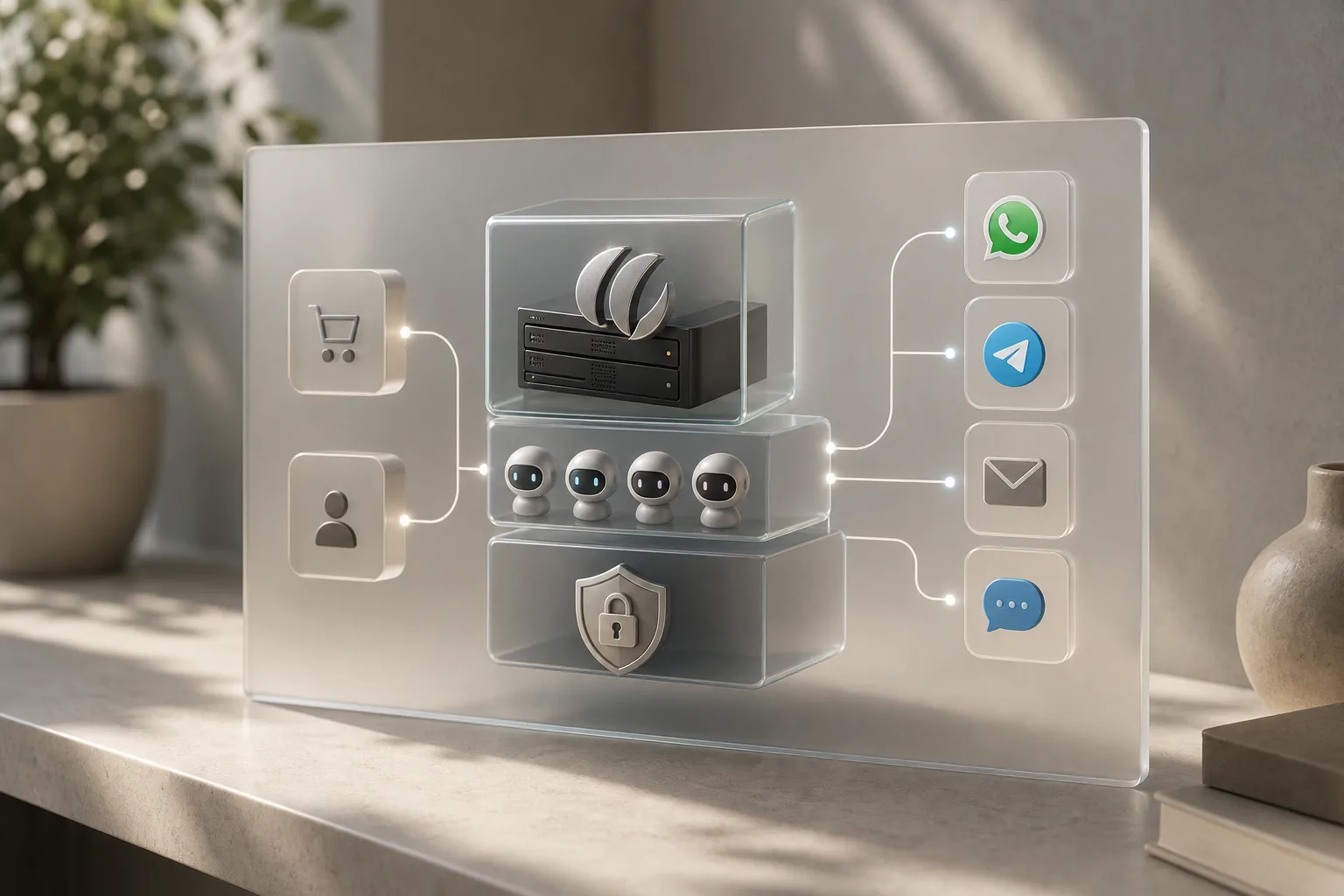
GlobussoftAI OpenClaw vs. Tidio and Intercom for Ecommerce
Tidio and Intercom are proven SaaS tools with strong UIs and quick setup. If you want a fast live chat plug‑in with basic AI and are fine with SaaS pricing, they can work well. However, compared to alternatives like those, OpenClaw’s open, self‑hosted model gives you full control, transparent costs, and deep customization.
Unlike Tidio, OpenClaw is an open-source AI agent framework that you can run on your own server. You can design autonomous workflows and add tools without waiting for a vendor to ship a feature. That matters when you need a returns agent that must talk to your WMS, not just your ecommerce platform.
Compared to Intercom, OpenClaw trades the closed ecosystem for complete ownership. You keep your data on your VPS, with end‑to‑end encryption and role‑based access controls. There’s no per‑seat math to justify during hiring waves. And because the core is free and a VPS is about $5/month, total costs are usually under $10/month, including model usage.
Feature and cost snapshot (2026)
| Area | OpenClaw (Self‑Hosted) | Tidio / Intercom (SaaS) |
|---|---|---|
| Data ownership | You host and control | Vendor‑hosted |
| Customization depth | Full LLM and agent control | Pre‑built flows with extensions |
| Cost curve | Core free; VPS ~$5/month; total under $10/month | Per‑seat and/or per‑MAU at scale |
| Security | End‑to‑end encryption + RBAC | Vendor‑managed controls |
| Ecosystem | Open-source, extensible | Closed, curated |
Furthermore, OpenClaw’s momentum is clear: it reached 100,000 GitHub stars in under eight weeks (Source: project repository metrics). That velocity signals active adoption and a fast‑moving ecosystem of contributors. For ecommerce teams in 2026, that matters. You gain features and fixes at the pace of the community, not only a vendor roadmap.
To be fair, Intercom’s strength is a polished suite with email, chat, and help center in one place, plus strong out‑of‑the‑box journeys. Tidio shines for quick install and SMB‑friendly flows. If you need speed to a basic bot, they’re solid picks. If you need deep control, self‑hosting, and sub‑$10/month costs at scale, OpenClaw is the better long‑term fit.

Trust, Security, and Proven Scale
Trust is earned with proof, not promises. OpenClaw includes end‑to‑end encryption and role‑based access controls for security. Data stays on your server, and access is scoped, logged, and auditable. For a refresher on encryption standards, see Transport Layer Security.
Scale is more than pageviews. It’s how a system behaves under heat: high‑volume loads, concurrent sessions, and failure injection scenarios. OpenClaw is built with high-volume handling and failure testing in mind, so your bot holds up during a surprise influencer shout‑out or a flash sale.
Social proof also matters. The project reached 100,000 GitHub stars in under eight weeks, showing broad interest and rapid growth. In addition, over 1,000 hours of testing data were used to validate how OpenClaw behaves under real‑world conditions.
Finally, GlobussoftAI includes scalability planning for long‑term growth. You’ll have a clear path from single‑node VPS to sharded services, plus performance optimization to keep response times tight as traffic climbs. During Black Friday, that can be the line between a smooth 4x surge and a support backlog that bleeds margin.
As a result, you get both sides of trust: strong security controls and proven scale under load. Your customers feel it as fast answers, and your team sees it as steady ops during peaks.
Also Read!
GlobussoftAI OpenClaw vs HubSpot AI for Ecommerce: Which Is Better for AI CRM Integration?
How to Choose and Integrate an AI CRM for Your Ecommerce Store
Getting Started: Deploying Your Ecommerce AI Chatbot
You shouldn’t need a six‑month project plan to launch. Here’s how brands go live in days with a custom AI chatbot builder that keeps costs low and control high.
Step‑by‑step onboarding
-
Book AI/ML consulting to map store workflows. Together, we’ll list your top intents (orders, returns, recs), your tools, and your data sources. You’ll get a roadmap with clear milestones and KPIs.
-
Professional deployment on your VPS. We set up the core framework, including security hardening, logs, and backups, tuned for your infra.
-
Integrate with Shopify or WooCommerce and your CRM. We build connectors and events so agents can read and write cleanly. Analytics hooks show which prompts, intents, and answers drive outcomes.
-
Train and fine‑tune on your catalog and policies. We feed product data, content, and policy docs. This reduces hallucinations and teaches agents how your store works.
-
Launch on your chosen channels. Start with web and WhatsApp, then add Telegram and email. We review early chats and refine prompts and tools.
Moreover, if you’d rather not manage day‑to‑day tuning, GlobussoftAI offers Managed AI Operations. That covers ongoing optimization, monitoring, and updates, so your team can focus on campaigns and growth, not on prompt tweaks.
If you want deeper design help for agents and tools, our team can extend flows beyond support into ops and marketing automations. That path is laid out in our custom AI agent development overview.

Frequently Asked Questions
How much does a custom AI chatbot for ecommerce actually cost?
OpenClaw’s core framework is free and open‑source. A typical self‑hosted VPS runs about $5/month, and total costs are usually under $10/month including AI model usage. Professional deployment services are quoted based on scope. As a result, you get enterprise‑grade control without per‑seat fees.
Can a custom chatbot integrate with Shopify or WooCommerce?
Yes. OpenClaw offers smooth integration services designed to fit into your current stack, including ecommerce platforms, CRMs, and analytics tools. Custom connectors are built during the deployment phase. Therefore, the bot can read orders, create RMAs, and write notes to your CRM from day one.
How accurate are LLM‑powered chatbots for product recommendations and order queries?
OpenClaw chatbots are fine‑tuned on your domain‑specific catalog data, which reduces hallucinations and vague answers. Multi‑Agent Orchestration routes complex queries to specialized agents for orders, returns, and recommendations. In addition, analytics help you spot and fix weak answers fast. As a result, quality improves week by week.
Is my customer data safe with a self‑hosted chatbot?
Self‑hosting means data never leaves your server. OpenClaw includes end‑to‑end encryption and role‑based access controls, so you can restrict who sees what. Unlike SaaS chatbots, you retain full ownership and compliance control. That clarity helps during audits and vendor reviews.
How does OpenClaw compare to Tidio or Intercom for ecommerce?
Tidio and Intercom are strong SaaS picks but cost more at scale and limit deep customization. OpenClaw is open‑source, self‑hosted, and fully customizable with LLM fine‑tuning, ideal for stores that need control at a fraction of the cost. In 2026, that balance of control and price is hard to beat.
Can the chatbot handle Black Friday or flash sale traffic spikes?
OpenClaw is tested for high‑volume loads and concurrent sessions, with over 1,000 hours of testing data behind it. Scalability planning is part of the deployment service to keep response times steady during peaks. Therefore, you can plan promos without fear of bot slowdowns.
Which messaging channels does an OpenClaw ecommerce chatbot support?
Out of the box, OpenClaw supports WhatsApp, Telegram, and email, plus web chat. Multi‑channel deployment means customers can choose where to chat, while you manage all threads in one system. Furthermore, you can add channels later without a full rebuild.
Do I need a developer to maintain the chatbot after launch?
GlobussoftAI offers Managed AI Operations for ongoing optimization, monitoring, and updates. You can also manage it in‑house, since the open‑source framework supports plain‑English configuration for tasks like cron job scheduling. As a result, you choose the ownership model that fits your team.
Final Takeaways
First, choose control and context. A self‑hosted, LLM‑driven builder that learns your catalog and talks to your stack will beat a generic bot every time. Second, plan for peaks. High‑volume, concurrent session handling and failure testing keep sales events smooth. Third, watch the math. With a free core and a ~$5/month VPS, you can ship a tailored bot for under $10/month plus optional services, even as you grow.
For a deeper sector view, see how healthcare teams assess their stack in our companion guide, Best Custom AI Chatbot Builder for Healthcare in 2026. The questions there mirror what high‑scale ecommerce teams ask in 2026.