
Businesses implementing AI services report up to a 40% reduction in operational costs and 30% increase in productivity. That prize is why teams compare predictive analytics and computer vision platforms like GlobussoftAI OpenClaw and Epic Cognitive Computing. If your hospital runs Epic and you want ready-to-use risk scores with deep chart context, Epic is the safe, faster path. If you need open, low-cost, self-hosted AI across clinical and admin workflows, OpenClaw is the better bet.
In 2026, the gap isn’t about hype. It’s about how fast you get to production without blowing up your security model or budget. Epic brings clinical depth and native EHR hooks you can trust. OpenClaw brings open-source speed, self-hosted control, and multi-agent workflows that you can mold to your stack.
However, you will trade convenience for control. OpenClaw requires integration work, especially for EHR data. Epic asks you to live in its ecosystem. The right choice depends on your stack, skills, and runway.
What Healthcare Organizations Need from a Predictive Analytics AI Tool
You need a clear buyer’s checklist before you compare models or demos. In 2026, predictive analytics and computer vision only pay off if the tool fits your risk model, EHR, and staff workflow. Start with six criteria that map to how hospitals actually buy.
First, HIPAA and compliance come first. You should expect end-to-end encryption, role-based access controls, audit trails, and safe model ops for PHI. For policy references, the U.S. Department of Health and Human Services outlines HIPAA rules and safeguards for protected data: HHS HIPAA overview.
Second, EHR integration drives adoption. If the output doesn’t show in-chart or feed your inbasket and order sets, clinicians will skip it. Deep hooks into encounters, orders, flowsheets, and imaging matter. Shortcuts fade fast; real EHR signals win.
Third, clinical model accuracy is not just AUC. You need explainable features, versioned training data, and drift checks. For healthcare organizations using AI for diagnostics, error modes must be traceable and triaged. Moreover, teams should track false alarms by unit and shift to tune alerts.
Operational Scale, Cost, and Deployment
Fourth, scalability is about pipelines and people. You’ll need ML pipelines, jobs that retrain on new data, and a queue that won’t stall under peak loads. In addition, think about model rollback and blue/green deploys for safe changes.
Fifth, cost is total cost of ownership, not a sticker price. Include infra, services, validation, updates, and staff time. As a result, a “free” framework without a team can still cost more than a managed module.
Sixth, deployment flexibility protects your path. On-prem for PHI? Cloud for burst jobs? Hybrid for research? Therefore, choose a platform that fits your data residency rules and your IT team’s tools.
Buyer’s Checklist for Predictive Analytics and Computer Vision (Print This)
- HIPAA guardrails: encryption, RBAC, audit, safe PHI flows
- EHR fit: in-chart views, orders, messages, imaging, and events
- Model quality: explainable scores, drift checks, rollback plan
- Scale: jobs, queues, retrain cycles, stress-tested loads
- TCO: infra + services + validation + upkeep + staff time
- Deploy: on-prem, cloud, or hybrid with clear change control
GlobussoftAI OpenClaw Overview — Strengths and Weaknesses for Healthcare Predictive Analytics and Computer Vision
OpenClaw is an open-source AI agent framework backed by GlobussoftAI’s professional services. It covers machine learning models, natural language systems, and computer vision applications under one roof. The core is free, and a typical VPS costs around $5/month, with total costs usually under $10/month with AI model usage. That price makes predictive analytics and computer vision work viable across many smaller projects, not just one flagship build.
More importantly, OpenClaw runs autonomous workflows on a self-hosted server. With end-to-end encryption and role-based access controls, you can keep PHI in your own network. Furthermore, the team offers AI/ML pipeline development, security-focused setups, and scalability planning so you can move from a pilot to a stable service without rework.
Integration and Workflow Orchestration
However, OpenClaw is not a healthcare-native product out of the box. You will need custom configuration to read and write EHR data, plus model tuning on your domain-specific data. That is the trade: more control and lower run rate, but more integration work up front.
OpenClaw shines where you want to tailor agents to your hospital workflows. For example, multi-agent orchestration can read notes, score risk, draft a message, and file the result into a work queue. In addition, you can blend computer vision for wound images with tabular risk models and send just one result to the chart.
For readers new to imaging AI, this short primer on computer vision explains how models read pixels and why context matters in clinical use.
Where OpenClaw Fits vs. What to Watch
- Fits: self-hosted builds, cross-department automations, rapid prototyping, and unique workflows
- Watch: EHR integration effort, model governance setup, and validation cycles before go-live
Also Read!
Best Predictive Analytics AI Tool for Healthcare in 2026
How to Choose and Integrate an AI CRM for Your Fintech Company
Epic Cognitive Computing Overview — Strengths and Weaknesses for Healthcare Predictive Analytics and Computer Vision
Epic Cognitive Computing lives inside the Epic EHR environment. You get native integration with orders, flowsheets, inbasket, and chart views, plus pre-built clinical models for risk scoring and care gaps. In many cases, you can also deploy FDA-cleared modules available in the Epic ecosystem, which helps reduce regulatory friction. For context on AI/ML medical software, see the FDA’s SaMD discussion: FDA AI/ML in SaMD.
Because Epic owns the workflow, model outputs show up where care teams already act. That is a real advantage. Moreover, Epic’s clinical datasets and mappings reduce the grunt work you’d face connecting encounters, diagnoses, labs, and orders.
On the other hand, there are trade-offs. You will face vendor lock-in and a higher price profile than open-source. Customization outside the Epic ecosystem can be limited, and moving models across environments takes planning. As a result, teams with heavy research and engineering talent sometimes feel boxed in.
Still, for risk scores tied to order pathways and chart views, Epic is hard to beat. The time to first value can be short if you stick with what is shipped or supported.
Epic’s Core Takeaways
- Strengths: native EHR hooks, pre-built clinical models, and access to FDA-cleared options
- Limits: ecosystem lock-in, higher costs, and tighter bounds on custom builds
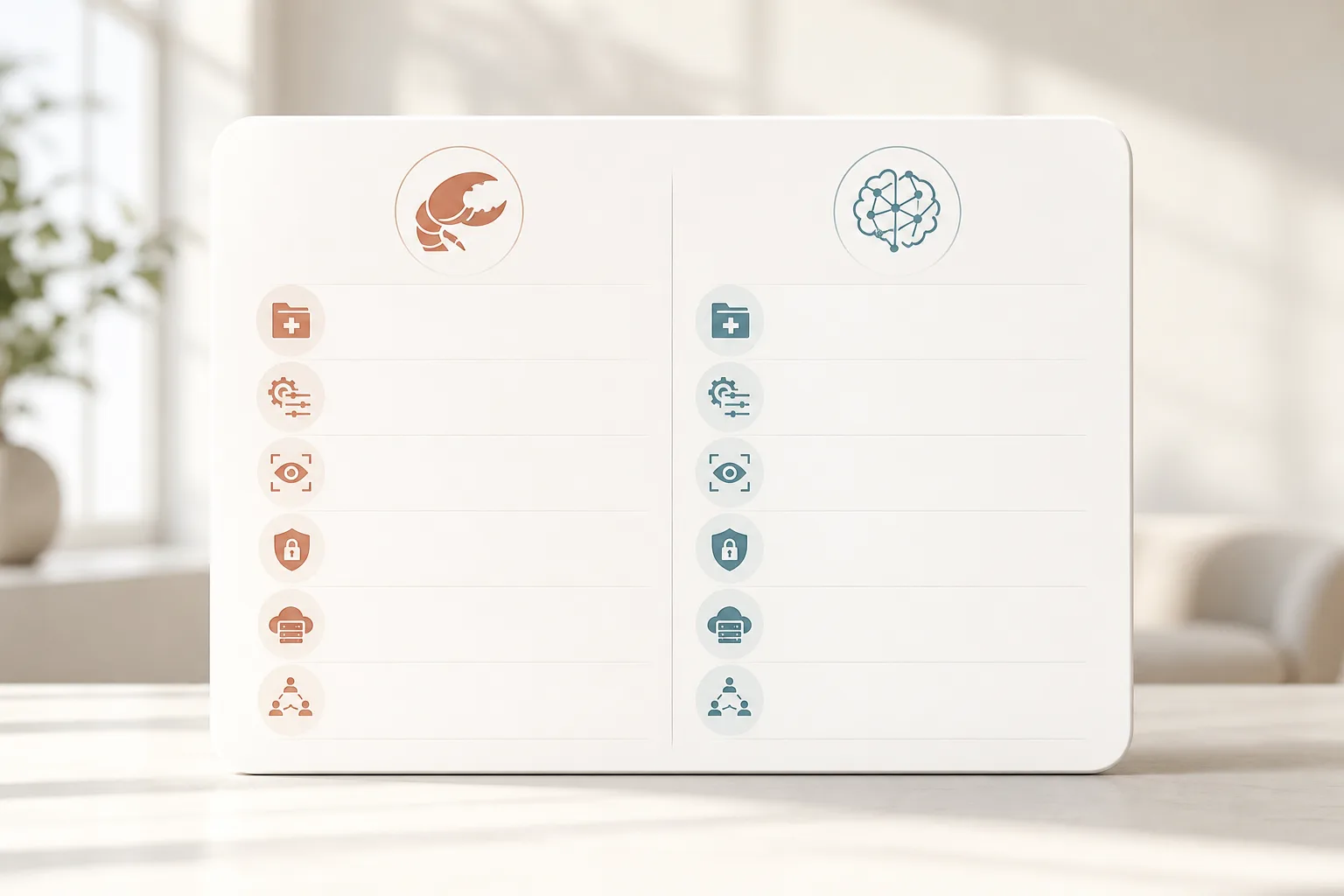
Feature-by-Feature Comparison for Predictive Analytics and Computer Vision: OpenClaw vs Epic Cognitive Computing
Both platforms support predictive analytics and computer vision, but they diverge on control, speed, and cost. Below is a buyer’s view across six dimensions, with a clear winner for each.
1) EHR Integration — Winner: Epic
Epic’s native hooks to encounters, orders, and inbasket views mean clinicians see scores where they work. Therefore, you get use faster with fewer glue layers. OpenClaw can reach parity, but you must build the connectors and data mappings.
2) Model Customization — Winner: OpenClaw
OpenClaw supports model training and fine-tuning on domain-specific data. Furthermore, GlobussoftAI offers custom development for workflow automation and AI-driven reporting. Epic allows tuning and model choice within its guardrails, but deep customization is easier on an open-source stack.
3) Computer Vision — Winner: OpenClaw
OpenClaw’s open-source base and self-hosted runs make it easier to launch imaging pipelines for triage or QA tasks. In addition, you can combine CV with text and tabular data in multi-agent flows. Epic can surface imaging-driven outputs, but the build path is tighter and favors supported modules.
4) Data Security — Winner: OpenClaw (for sovereign hosting)
With end-to-end encryption, role-based access controls, and on-prem deployment, OpenClaw keeps PHI inside your perimeter. Moreover, a security-focused setup including access control and encrypted communication is part of GlobussoftAI’s services. Epic offers enterprise-grade controls, yet full data residency and agent-level code ownership tilt in favor of a self-hosted stack.
5) Deployment Options — Winner: OpenClaw
OpenClaw runs on your servers or private cloud, with AI/ML pipeline development for scalable deployment. Therefore, you can design blue/green rollouts and failure injection to match your IT standards. Epic deployment is streamlined inside its ecosystem but less flexible for hybrid or non-Epic contexts.
6) Multi-Agent Orchestration — Winner: OpenClaw
OpenClaw’s Multi-Agent Orchestration lets you chain tasks across departments, from intake to follow-up. As a result, you can add new agents without breaking the core. Epic supports workflow logic, but agent-style orchestration at code level is OpenClaw’s home turf.
| Dimension | OpenClaw | Epic Cognitive Computing | Winner |
|---|---|---|---|
| EHR Integration | Custom connectors required | Native, deep hooks | Epic |
| Model Customization | Full control and fine-tuning | Tuning within ecosystem | OpenClaw |
| Computer Vision | Flexible, self-hosted CV pipelines | Supported modules, tighter path | OpenClaw |
| Data Security | On-prem, E2E encryption, RBAC | Enterprise controls, vendor-managed | OpenClaw |
| Deployment Options | On-prem/private cloud, hybrid-friendly | Inside Epic ecosystem | OpenClaw |
| Multi-Agent Orchestration | Native multi-agent framework | Workflow tools, less code-level agents | OpenClaw |

For teams weighing a broader buying journey, this concise guide shows how to frame trade-offs beyond healthcare: this buyer's guide for ecommerce. It maps well to governance and rollout concerns in hospitals too.
Get a tailored AI plan today →
Also Read!
GlobussoftAI OpenClaw vs Salesforce Einstein for Fintech: Which Is Better for AI CRM Integration?
Pricing Comparison for Predictive Analytics and Computer Vision: Open-Source Flexibility vs Enterprise Licensing
OpenClaw’s core framework is free. A typical VPS costs around $5/month, and total costs are usually under $10/month with AI model usage. That low base unlocks pilots without long approvals. In addition, you can reuse the same agents across admin and clinical side projects, which stretches your spend.
Of course, services matter. GlobussoftAI provides professional deployment and installation, system integration with analytics tools, custom development for workflow automation, and performance optimization. Furthermore, the team offers security-focused setup including access control and encrypted communication, plus scalability planning for long-term growth. These services reduce build risk and help you reach steady-state ops faster.
Epic, by contrast, follows enterprise licensing inside its ecosystem. You gain speed from pre-built models and native workflow views. However, the price profile is higher, and you will scope work inside Epic’s guardrails. For many hospitals, that trade is acceptable because it reduces integration risk and shortens time to first value.
Epic Licensing and Time-to-Value
As you plan TCO, include infra, services, model validation, and staff training. Businesses that add AI services report up to a 40% reduction in operational costs and a 30% increase in productivity. If you can hit even part of that, both options can pay back fast; the path you choose depends on your runway and the team you have today.
For a cross-industry view of imaging and scoring use cases that can inform your forecast, see this fintech deep-dive; the build-vs-buy math is strikingly similar.
Verdict: Which Predictive Analytics AI Tool Should Your Healthcare Organization Choose?
Both tools can deliver value in 2026. OpenClaw wins on cost, customization, and multi-use AI across departments. Epic wins on native clinical integration and regulatory pre-clearance within its ecosystem. In short, choose Epic if you want the shortest path to in-chart scores and care pathways; choose OpenClaw if you want self-hosted control, agent-based automation, and pricing you can scale.
Moreover, OpenClaw’s momentum is real. The project reached 100,000 GitHub stars in under eight weeks, and over 1,000 hours of testing data was used to explore OpenClaw’s capabilities. Those signals, plus end-to-end encryption and role-based access controls, make it credible for PHI on your servers.
However, Epic’s clinical depth deserves real credit. Its tight EHR fit reduces adoption risk. Therefore, if your clinicians live in Epic and you want plug-and-play scores with fewer moving parts, Epic is the easier road.
As a result, your decision should start with two questions: Where must PHI live, and who owns model lifecycle work? If your answers point to sovereign hosting and heavy customization, OpenClaw is a strong match. If they point to embedded workflows and supported modules, Epic fits better.
Quick Decision Guide
- Choose OpenClaw if you need self-hosted control, multi-agent automation, and low run-rate costs you can expand over time.
- Choose Epic if you need native EHR integration, pre-built clinical models, and access to FDA-cleared options inside a managed ecosystem.
- Consider a hybrid if you need Epic for in-chart scores but also want OpenClaw for research, back-office tasks, or specialized computer vision pilots.