

Schedule a secure demo today →
HIPAA violations can cost $50,000 to $1.5 million per incident. That’s why any ai-powered crm and business tool integration must earn your trust, not your risk budget.
In 2026, you face new pressure to improve patient access, close care gaps, and report on quality, all with fewer staff and tighter margins. AI looks like a fix for intake, follow-ups, and care coordination. However, you’re right to be cautious. PHI, audit duty, and the risk of model error make trust non‑negotiable.
This guide is education-first. You’ll see clear risks first, then how the data pipeline works and which safeguards matter. You’ll also get a vendor‑neutral checklist you can use in your next RFP. If you do decide to explore options, you can read more about AI integration approaches and what to expect in a real deployment.
The Concern: Why Healthcare Organizations Are Right to Be Skeptical About AI CRM Integration
You handle PHI every day. Adding an AI-driven bridge between your EHR and CRM feels like adding moving parts to a system that must not fail. The fear is valid: exposure risk, unclear model behavior, and data sprawl can multiply compliance gaps instead of closing them.
First, the stakes are high. HIPAA penalties range from $50,000 to $1.5 million per incident, and OCR has increased actions after large breaches. Meanwhile, attackers target tools near PHI, not just the EHR itself. For example, breaches tied to third‑party vendors, billing partners, file‑transfer tools, and analytics tags, have exposed patient data when single sign‑on, access scopes, or data sharing rules were weak.
Second, AI can be wrong. Hallucination or poor prompt control can label a message as “urgent symptom” when it’s a billing note, or worse, suggest edits that corrupt a record. If identity resolution fails, a CRM task might attach to the wrong patient. That is scary, and you should not accept “the model learns” as an answer.
Third, integrations can widen attack paths. An extra webhook, a broad API token, or unvetted plugins can bypass network policies. As a result, data minimization, encryption, and role scoping must be explicit and testable, not implied.
To ground this, here are practical failure modes you can audit now:
- Misrouted tasks: AI tags a care gap to the wrong MRN due to loose matching.
- Over-sharing PHI: A CRM note sync includes full clinical notes instead of a short summary.
- Shadow data: A “debug log” stores PHI in a vendor’s cloud without a BAA.
- Model drift: A scheduling model worsens no‑show risk after a template change and no one notices.
Therefore, any ai-powered crm and business tool integration you consider should prove guardrails for data scope, identity match, and write permissions, with logs you can verify in your own SIEM.
How AI-Powered CRM Integration Actually Works in Healthcare Environments
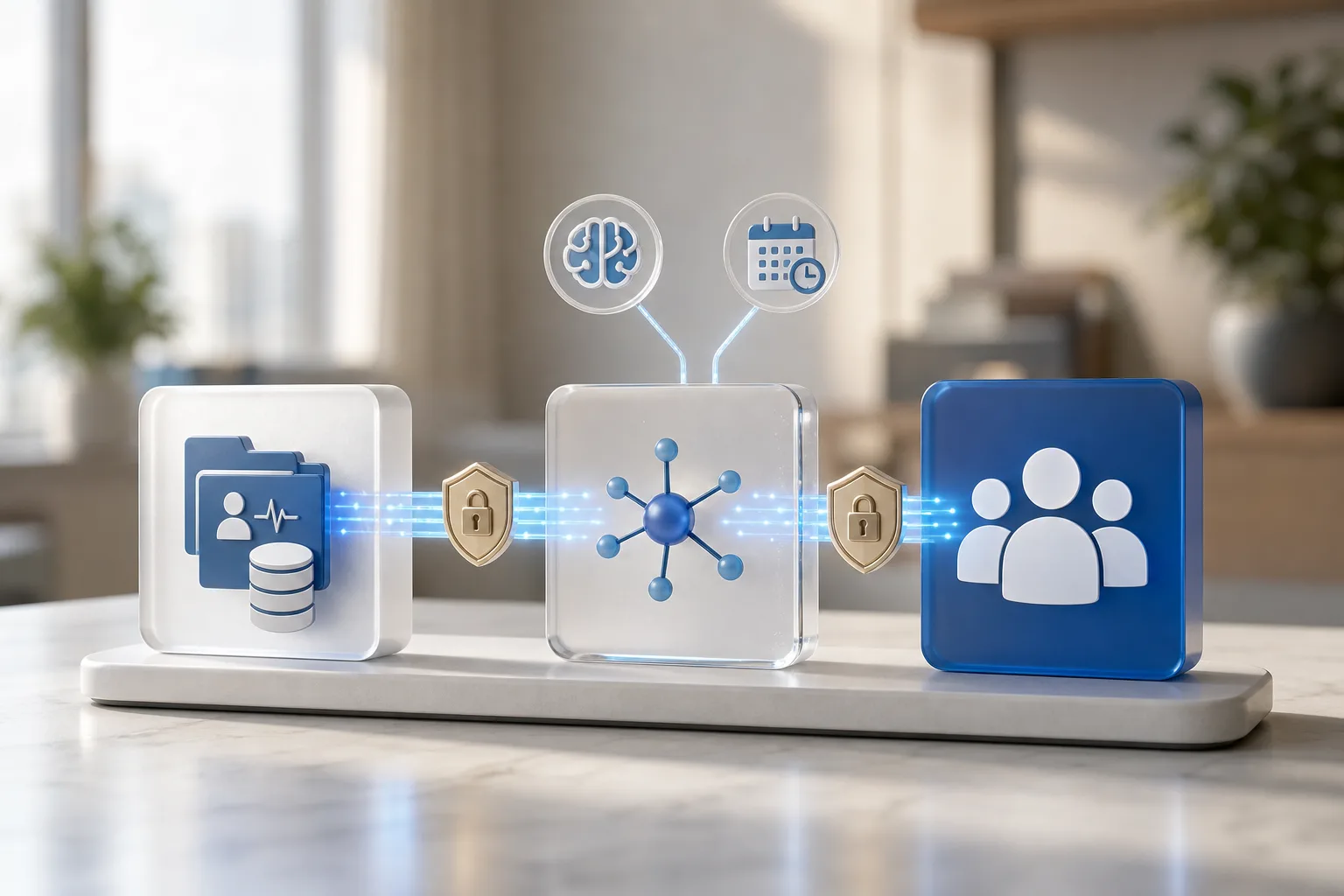
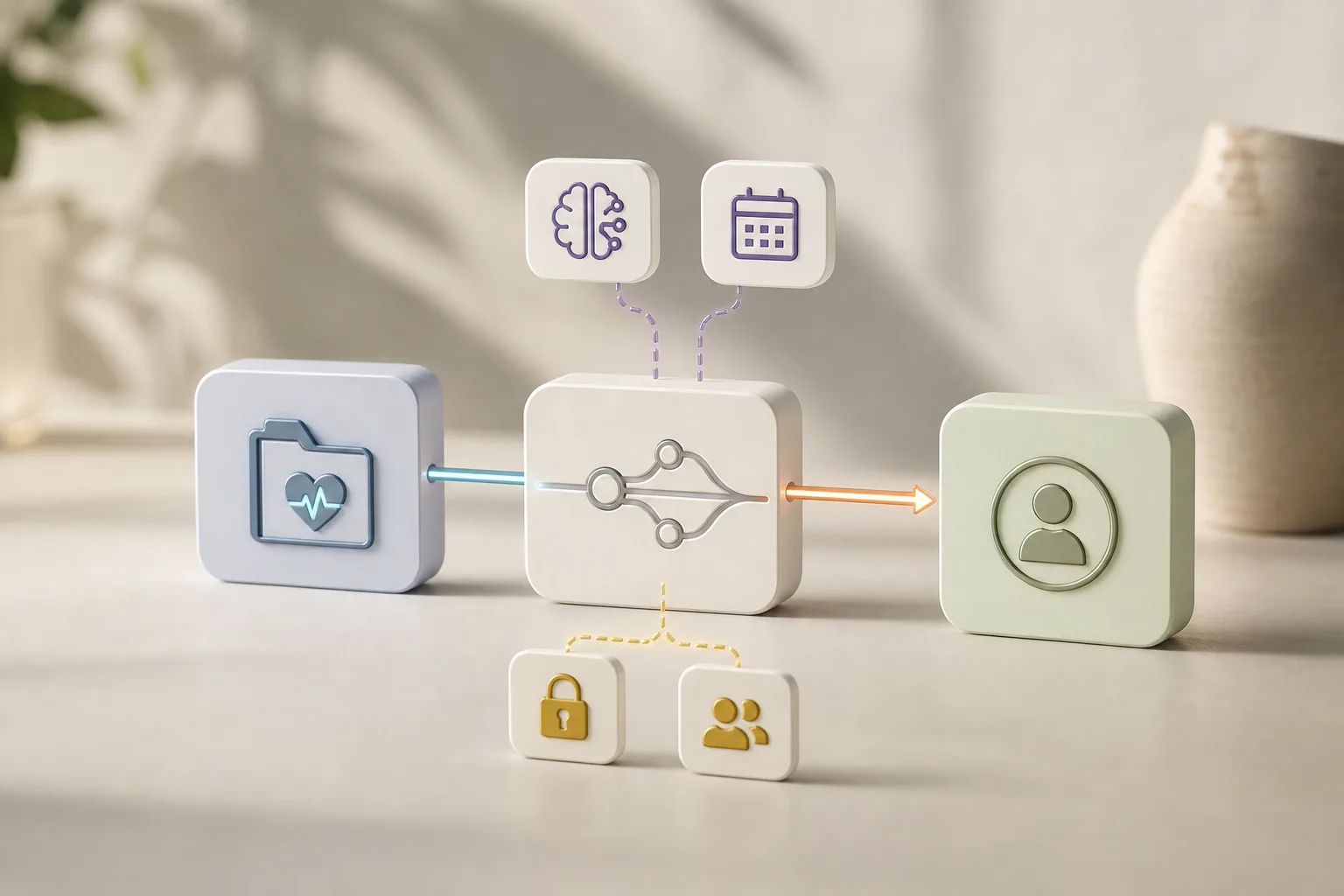
At a high level, the data path looks simple: EHR/EMR → integration layer → CRM. But the details decide whether the setup is safe, fast, and useful. Understanding where PHI lives, and how models touch it, is step one.
In a common pattern, the EHR (Epic, Oracle Health, athenahealth, or a homegrown system) emits events: new messages, labs posted, coverage updates. The integration layer receives these over secure channels, applies data mapping, and enforces scopes and consent. Only the minimum needed fields reach the CRM. The CRM then drives outreach, follow‑ups, or revenue tasks. Writes back to the EHR occur through controlled APIs with strict roles.
Natural language processing systems parse unstructured patient messages and voicemails into structured intents: “reschedule visit,” “medication refill,” or “billing dispute.” Then, machine learning models help with prioritization and load balancing: who needs a same‑day call versus a secure message, which time slots lower no‑show risk, and which scripted steps satisfy payor rules.
Data Flow at a Glance
- Source: EHR/EMR stores PHI as the system of record.
- Integration layer: De‑identifies or redacts when possible; enforces mapping and scopes.
- NLP/ML: Processes text for intent and routes tasks; runs with least privilege and no broad write access.
- CRM: Stores operational notes and task metadata; avoids clinical diagnoses unless policy allows.
- Write-backs: Limited, auditable, and idempotent updates to the EHR only.
Where is PHI stored versus processed? The EHR remains the source of truth. The integration layer may process PHI transiently in memory to create safe payloads. The CRM should hold only operational context, not full clinical narratives, unless your policy and BAA allow it. Moreover, models that summarize or triage should run either on self‑hosted infrastructure or in a covered environment with encryption at rest and in transit.
From a services standpoint, you want smooth integration services to fit AI solutions into existing systems. That includes system integration with CRMs and analytics tools you already use, plus clear support for message queues and retries. In short, the design should let you swap models without changing your security stance.
As you plan, map each component to named features: natural language processing systems for communications, machine learning models for scheduling and follow‑ups, and a thin integration layer to limit PHI spread. This is where ai-powered crm and business tool integration either earns your confidence or fails it.
Also Read!
How to Build a Custom AI Chatbot for Your Fintech Company
GlobussoftAI OpenClaw vs Botpress for Fintech: Which Is Better for Custom AI Chatbot Building?
Evidence and Standards: HIPAA, SOC 2, and the Regulatory Landscape for AI in Healthcare CRM
You do not need promises. You need mapped controls. The HIPAA Security Rule outlines technical safeguards like access control, audit controls, integrity, authentication, and transmission security. The official overview from HHS is here. Your vendor, and your own team, should show how each safeguard is met and tested.
A Business Associate Agreement (BAA) is table stakes if any PHI touches a vendor’s tools. The BAA must forbid secondary use of PHI (for model training or anything else), define breach notice times, and list where data sits. For SOC 2 Type II, ask for the most recent report date and which Trust Services Criteria are covered (security, availability, confidentiality, processing integrity, privacy). Then, verify that encryption keys are under your control or held in a covered KMS.
For AI- and software-related guidance, the FDA maintains resources on AI/ML-enabled medical devices and change management. While a CRM add‑on is not a device, your risk program benefits from the same disciplines: versioned models, documented changes, and performance monitoring.
On interoperability, the ONC lays out standards that shape safe data exchange, like FHIR and USCDI. These standards reduce custom work, which reduces risk.
Map Standards to Controls You Can See
- Access security: End-to-end encryption and role-based access controls for security; SSO with per‑role scopes.
- Network: Security-focused setup including access control and encrypted communication; private links or VPN.
- Auditing: Immutable logs, write‑back event IDs, and downstream proof in your SIEM.
- Data scope: PHI minimization in the integration layer; field-level allowlists.
- Operations: Change‑controlled model versions with rollback; performance SLAs.
By 2026, expect more audits to ask about model lineage and testing evidence. Therefore, push for run books, failure injection results, and run‑comparison tooling for benchmarks. When vendors already track that, you get fewer surprises and easier renewals. This is also a good point to review generative AI for business guidance and how it affects care operations.
How Services Like GlobussoftAI OpenClaw Address Healthcare Compliance Concerns
Services modeled on GlobussoftAI OpenClaw focus on enterprise deployment, not hobby scripts. The aim is to run autonomous workflows on self-hosted server infrastructure so PHI stays within your network and under your keys. That self‑hosted deployment keeps data within organizational boundaries and reduces third‑party residency risk.
From day one, a security-focused setup including access control and encrypted communication is configured. That includes end-to-end encryption and role-based access controls, plus isolated service accounts with the least privilege in your CRM. As a result, AI agents can read what they must, propose actions, and route for human review when data is clinical or high risk.
Custom development for workflow automation and AI-driven reporting matters too. For example, a care-gap close workflow can collect only diagnosis codes and due‑date metadata, not the full note. Every action keeps an audit trail. Your team can export logs, compare runs, and meet internal audit requests without a scramble. In fact, over 1,000 hours of testing data was used to validate platform features such as concurrency handling and failure injection, which helps you see how the system behaves under stress.
Scalability planning for long-term growth and professional deployment and installation reduce project risk. You get staging and production environments with environmental parity. Moreover, system integration with CRMs and analytics tools you already use means you do not have to rebuild dashboards to watch throughput and outcomes. For an overview of how such projects are structured, see the walkthrough on OpenClaw AI integration.
Finally, if you need to add a conversational agent for intake or reminders, link it under a signed BAA and with strict prompts and guardrails. For background on safer bot design choices, here’s a primer on an ai powered chatbot. This is where a careful ai-powered crm and business tool integration can reduce human toil without adding new risk.
“Self‑hosted deployment keeping data within organizational boundaries cuts third‑party exposure and gives your team end‑to‑end control.”
Also Read!
What to Look for in Any AI CRM Integration Service for Healthcare
Procurement is your chance to set ground rules. The goal is to make verification easy and surprises rare. Use this checklist in your RFPs and vendor reviews, and keep it for annual re‑assessments.
Vendor‑Neutral Checklist
- BAA: Signed BAA with breach notice times, data use limits, and sub‑processor list.
- Data residency: Control over where data sits; keys in your KMS; region pinning.
- Deployment: Self-hosting option versus cloud; clear network boundaries either way.
- Access: Role-based access, SSO, MFA, and per‑integration service accounts.
- Audit: Full audit logging with export to your SIEM; write‑back event IDs and rollback.
- Encryption: TLS 1.2+ in transit; strong encryption at rest; secrets management.
- Transparency: Model versioning, change logs, and performance dashboards.
- Human-in-the-loop: No autonomous edits to clinical records without review.
- Incident response: Documented runbooks; 24/7 contact; test of breach notification.
- Testing evidence: Over 1,000 hours of testing data or equivalent proof of scale behavior.
As you apply this list, request a walkthrough of one end‑to‑end flow: intake → AI triage → CRM task → human review → EHR write‑back. Then, ask the vendor to show you the logs and permissions at each step. If they can’t, reconsider. This is how you keep AI-powered CRM and business tool integration safe and measurable.
FAQ
Is AI CRM integration HIPAA compliant?
AI CRM integration can be HIPAA compliant if the vendor signs a BAA, encrypts PHI in transit and at rest, implements role-based access, and provides audit logs. Self-hosted deployments offer added control over data residency and keys.
What happens if the AI makes an error with patient data in the CRM?
Responsible setups include human-in-the-loop review for clinical data, plus rollback and audit trails. Errors in scheduling or follow‑ups are correctable. AI should never change clinical records on its own; a clinician must approve.
Is my patients' protected health information safe with an AI-powered CRM?
Safety depends on the build. Self-hosted options keep PHI inside your network, which reduces exposure. Verify end-to-end encryption, access controls, and that the AI provider does not use PHI for model training. Demand contractual guarantees in the BAA.
How accurate is AI when processing healthcare communications in a CRM?
Modern NLP models can exceed 90% accuracy on structured tasks such as appointment triage or follow‑up routing. Fine‑tuning on your data helps. Always run a pilot with benchmarks and validate results before full rollout.
Can a self-hosted AI CRM integration reduce compliance risk compared to cloud solutions?
Self‑hosting removes third‑party residency concerns and gives you full control of access logs, encryption keys, and network limits. It can reduce attack surface, but it does require your team to handle patching and uptime.
What certifications should I require from an AI CRM integration vendor for healthcare?
At minimum: a signed BAA and a SOC 2 Type II report. HITRUST CSF is preferred in healthcare. If you store signatures or validated data, check alignment with 21 CFR Part 11. Ask for recent penetration test results and incident response documents.
By now, you’ve seen the risks, the data path, and the controls that matter. If you want a hands‑on review of your current stack, bring this checklist to a demo and ask providers to prove each item live.
Get a risk‑aware walkthrough today →
Finally, remember: strong outcomes beat slogans. End-to-end encryption and role-based access controls, self-hosted deployment keeping data within organizational boundaries, a security-focused setup with encrypted communication channels, and custom workflow automation with audit trail support, these are the tangible signals that an AI-powered CRM and business tool integration is ready for your organization in 2026. Social proof helps too: over 1,000 hours of testing data used to validate platform behavior shows a team takes your risk as seriously as you do.