

Businesses that add AI report up to a 40% reduction in operational costs and a 30% lift in productivity, yet teams still ask how to choose a custom AI chatbot builder that won’t trigger audit findings. You don’t need hype in 2026, you need a bot that can pass PCI-DSS reviews, respect SOC 2 controls, and still answer “Where did my ACH go?” in plain English.
I’ll walk you through what “custom” really means in fintech, a step-by-step plan that engineering and risk can both sign off on, and the tools that make sense for your stack. As a result, you’ll ship faster and avoid the “pilot that never leaves the lab” trap.
 , gateway with rate limiting, NLU/LLM with RAG, policy guardrails, encryption at rest and in transit, audit log service, and integrations to core banking, KYC/AML, CRM; labeled data flows and RBAC layers; modern fintech dashboard styling)
Why Fintech Needs Purpose-Built AI Chatbots (Not Generic Ones)
Generic bots fail the minute real money, personal data, and audits show up. First, PCI-DSS sets strict rules for how card data flows and where it is stored. If your bot can see Primary Account Numbers without guardrails, you will get flagged.
For a primer, see the overview on Payment Card Industry Data Security Standard.
Second, SOC 2 expects strong access controls, tight change management, and proof that you follow your own policies. A “quick script” that calls an LLM without traceability won’t pass. Moreover, KYC/AML checks add identity proof steps, sanctions screening, and adverse media review. Your bot must know when to ask for more data and when to stop and hand off.
Third, money movement is sensitive. For example, a simple “freeze my card” command touches a critical system. Therefore, you need end-to-end encryption and role-based access controls for security, plus audit trails that show who did what and when. Without that, you can’t investigate disputes or meet evidence requests.
What “Custom” Actually Means in Fintech
“Custom” isn’t just a new theme. It means you shape behavior, data access, and guardrails around your bank-grade workflows.
- Data boundaries: redact, tokenize, or avoid raw PANs and PII wherever possible.
- Policy-first prompts: KYC/AML steps drive the flow, not the other way around.
- Human-in-the-loop: high-value actions always allow an agent takeover.
- Audit by design: every step logs inputs, outputs, and approvals.
- Controls: RBAC, IP allowlists, and key rotation by default.
On the other hand, some “AI help” can still live outside core systems. For instance, education tasks, like explaining fees, can use a safer lane. If you’re new to this space, this primer on an AI powered chatbot will help you spot which use cases fit low-risk lanes.
Finally, note that financial institutions embracing AI for fraud detection have raised the bar. As a result, your chatbot must also respect case management and evidence chains. A custom AI chatbot builder should give you hooks to your fraud queue and to your investigation tools while keeping logs tamper-evident.
Also Read!
GlobussoftAI OpenClaw vs Botpress for Fintech: Which Is Better for Custom AI Chatbot Building?
Step-by-Step: Building a Compliant AI Chatbot for Financial Services
You don’t need to guess. Use this 7-step plan and you’ll align product, risk, and engineering without churn. I’ll call out fintech examples at each step.
Step 1: Define Use Cases and Win Small
Start with 2–3 high-signal workflows.
- Support: “Where is my ACH?” Pull status from payments API, explain hold reasons.
- Onboarding: “What document do you need?” Guide uploads and clarity on KYC.
- Fraud alerts: “I didn’t make this charge.” File a case and lock the card.
Keep paths narrow. Therefore, you’ll ship in weeks, not quarters.
Step 2: Map Compliance Requirements to Each Flow
List which data fields the bot can touch and which systems it can call. Then, add controls.
- PCI-DSS scope? Keep the bot out of raw card data flows when you can.
- SOC 2? Add change tickets for prompt updates and model changes.
- AML? Log PEP/sanction checks and keep evidence.
As a result, risk signs off early, and you avoid rework later.
Step 3: Choose the NLP/LLM Architecture
Pick tools to fit risk, speed, and cost.
- Natural language processing systems: intent/classifier for known asks, RAG for policy recall.
- Chatbots powered by Large Language Models: handle complex questions and human-like replies, with guardrails.
- Model training and fine-tuning on domain-specific data: use policies, product docs, and past tickets — not generic web text.
For sensitive flows, keep prompts and embeddings in your VPC. If you need help with orchestration, see custom AI agent development for patterns that chain tools safely.
Step 4: Design Conversation and Escalation Flows
Map happy paths and “hard stops.” For example, allow the bot to explain a fee or fetch an ETA. However, require human review for chargebacks, credit line changes, or wire transfers. Add friction where needed: OTP, knowledge checks, or device checks.
Therefore, you’ll avoid letting a well-meaning bot take risky actions.
Step 5: Integrate with Core Banking and Payment APIs
Wire the bot to your systems with least-privilege keys. Then add a policy guard that checks each tool call: who asked, what scope, and why. System integration with CRMs and analytics tools matters as well, pipe every turn to your CRM and your data lake for review and coaching.
Step 6: Test with Domain-Specific Data
Don’t ship blind. Build a bench of golden paths and red-team prompts.
- AI/ML pipeline development for scalable deployment: keep train/val/test splits stable.
- Environmental parity for consistent test results: match prod auth and rate limits.
- Test case structuring in a hierarchical manner for clarity and reduced debug time.
Furthermore, add adversarial prompts: “Move $0 to test” or “My name is JSON.” Your bot should fail safe, not fail loud.
Step 7: Deploy with Monitoring and Guardrails
Ship behind flags. Watch latency, tool-call error rates, and handoff rates. Ability to handle high-volume loads, concurrent sessions, and failure injection scenarios will save you during a promo or outage. Finally, add a kill switch for any tool that misbehaves.
“We moved three support flows to the bot and cut handle time without extra headcount.” — Banking Ops Lead
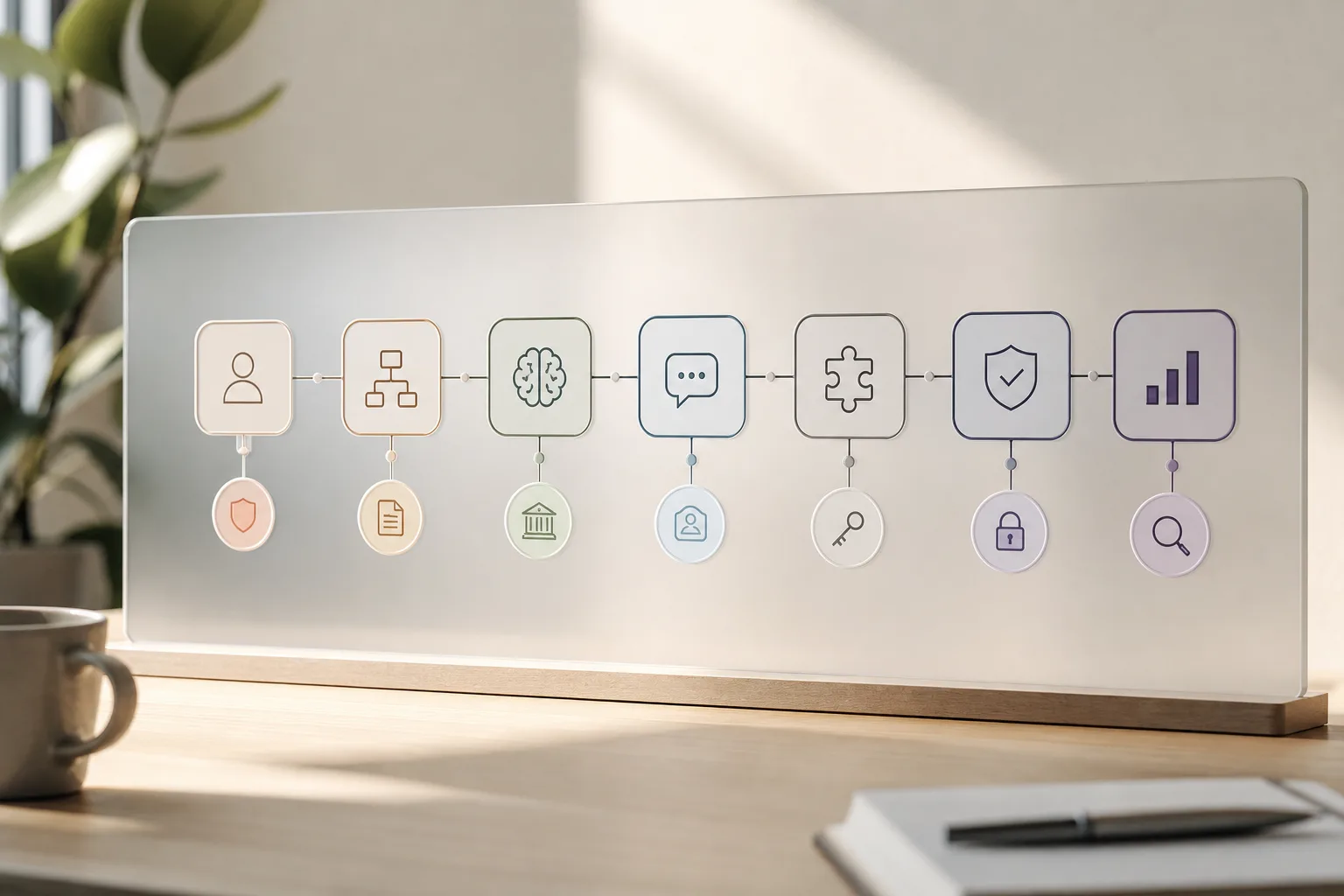
By the end of these steps, your team has a working lane and audit-ready logs. And yes, the same method works whether you use an open model or a hosted one. Use a custom AI chatbot builder mindset here: policy-first, tools-second.
5 Costly Mistakes Fintech Teams Make with AI Chatbots
First, ignoring regulatory audit trails. If you can’t show prompts, tool calls, and responses for six months or more, you’ll struggle with chargeback evidence and SOC 2 reviews. Security-focused setup including access control and encrypted communication is table stakes; logs need the same care.
Second, training on generic data. Your bot should learn from your policy deck, your core banking docs, and actual support tickets. Without domain data, it will “sound right” and still be wrong on fee logic or ACH cutoff times.
Third, no human escalation for high-value steps. For example, dispute filing needs consent capture, disclosures, and identity checks. Therefore, add a “transfer to agent” path with context so your team sees what the bot already did.
Fourth, underestimating latency. A chat feels slow long before a page load does. Plan for traffic spikes during payroll days or incidents. Ability to handle high-volume loads, concurrent sessions, and failure injection scenarios matters more than a tiny prompt win.
Fifth, skipping adversarial and failure injection tests. Your testers should try prompt jailbreaks, input bombs, and flaky API behavior. Then add guardrails and retries.
What Good Looks Like
- Expressive assertion engine for precise checks on outputs and tool calls.
- Includes run-comparison tooling for benchmark creation to catch regressions.
- Environmental parity to reduce “works on my machine” bugs.
As a result, you’ll spot drift early and avoid outages. You’ll also have the proof that risk and audit want.
Also Read!
How to Integrate AI with Your CRM as a Small Business
GlobussoftAI OpenClaw vs HubSpot AI for Small Businesses: Which Is Better for AI CRM Integration?
Tools and Frameworks Worth Evaluating
You have three broad lanes: open-source, cloud-native, and managed/self-hosted. Each has tradeoffs in cost, control, and compliance work in 2026.
Open-Source Frameworks
Rasa and Botpress give you control over NLU pipelines and on-prem runs. You can run them in your VPC, add your RAG layer, and keep data in your stack. However, you own upgrades, patching, and hardening.
Cloud Platforms
AWS Lex and Dialogflow slot into cloud stacks and bring speech and channel adapters. You’ll move fast on the basics. On the other hand, compliance scope may widen if transcripts or prompts leave your VPC, so check data processing addenda and redaction features.
Managed, Self-Hosted Services
Tools like GlobussoftAI OpenClaw Services focus on enterprise-grade, self-hosted deployments with Multi-Agent Orchestration. The free core framework can run on a typical VPS that costs around $5/month, with total costs usually under $10/month including AI model usage. It runs autonomous workflows on a self-hosted server and includes security-first setup. Over 1,000 hours of testing data was used to explore OpenClaw’s capabilities, and the team offers scalability planning for long-term growth.
If you want a side-by-side view for a nearby domain, see this comparison: GlobussoftAI OpenClaw vs Kommunicate for Healthcare: Which Is Better for Custom AI Chatbot Building?. The patterns carry over to fintech even though your controls are stricter.
Quick Tradeoff Matrix
| Option Type | Cost | Control | Compliance Burden | Notes |
|---|---|---|---|---|
| Open-source (Rasa, Botpress) | Low license, higher ops | High | Medium–High | Fine-grained NLU; you own hardening |
| Cloud (Lex, Dialogflow) | Pay-as-you-go | Medium | Medium | Fast to ship; check data residency |
| Managed Self-Hosted (OpenClaw Services) | Free core; VPS ≈ $5/mo | High | Low–Medium | Multi-agent flows; security-focused setup |

Pick the lane that matches your team size and audit posture. If you choose a managed self-hosted route, a custom AI chatbot builder approach means you keep data and policy control without building orchestration from scratch.
What to Do This Week: Your Chatbot Readiness Checklist
You can cut weeks off your timeline by doing a short prep sprint. Treat this like a pre-build readiness drill and share it with risk and support.
- Map customer touchpoints: list top 10 inbound intents across web, app, and phone.
- Pick your top 3 automatable workflows: e. g., card freeze, ACH status, fee explainer.
- Draft compliance notes per flow: PCI scope, SOC 2 controls, KYC/AML steps, data fields.
- Inventory APIs and scopes: core banking, payments, KYC, CRM, analytics.
- Gather training data: policy docs, product FAQs, redacted tickets, tone guide.
- Decide on the first lane: open-source, cloud, or managed self-hosted.
- Define handoff rules: which actions demand agent review.
- Write test cases: golden paths, red-team prompts, failure injection scenarios.
- Plan monitoring: alerts for error spikes, handoff rates, and tool failures.
- Set success metrics: containment rate, CSAT on bot chats, cost per chat.
If you lack in-house orchestration skills, ask for AI/ML consulting to build roadmaps and implement solutions. If you already picked a platform, book smooth integration services to fit AI solutions into existing systems, including CRMs and analytics. A custom AI chatbot builder mindset keeps you focused on policy and safety; tools are the means, not the end.
Schedule a free readiness review →

Key Takeaways
- Start with narrow, high-impact workflows and design for audit from day one.
- Choose architecture based on risk and control: RAG + guardrails beats “chatty” bots.
- Test with domain data and inject failures; log everything for reviews.
- Balance cost vs control: self-hosted managed tools can meet strict policies without heavy ops.
- Security isn’t optional: encryption, RBAC, and audit logs keep you out of trouble.
As you work through this guide, remember that businesses using AI have seen up to a 40% cost drop and a 30% productivity lift. Build toward that goal, but never at the expense of controls. If you want a primer to share with non-technical partners, point them to the AI chatbot for e-commerce article, the buyer logic applies well beyond retail.
Finally, this space will move fast through 2026, but the basics stay the same: scope data, enforce policy, test hard, and earn trust.