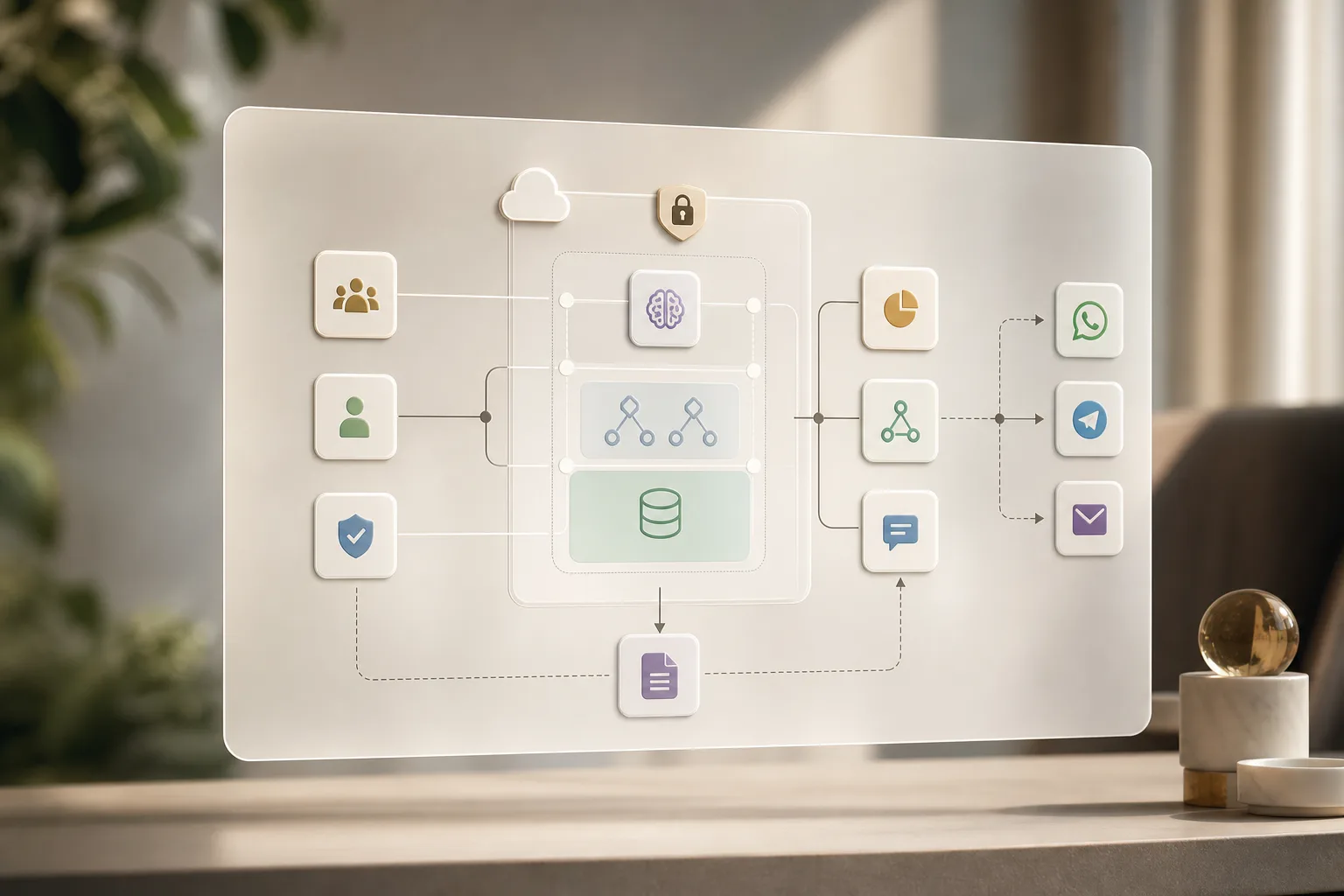

What Fintech Companies Actually Need from a Custom AI Chatbot Builder
Seventy percent of your chatbot’s value lives or dies on risk controls. That is why your choice of custom ai chatbot builder in 2026 should start with compliance, not features. You need proof that data stays where it should, that access is tight, and that audit trails are clear.
Compliance-first foundations
First, build around the rules you must meet. For banks and payment firms, that means GDPR, PCI DSS, SOC 2, and local guidance. For context, the General Data Protection Regulation sets strict limits on how you collect and store personal data.
Likewise, the Payment Card Industry Data Security Standard lays out hard lines for card data. Your chatbot must not weaken those lines.
- Practical artifacts to prepare early:
- A data inventory and Record of Processing Activities (ROPA) for chatbot interactions
- A Data Protection Impact Assessment (DPIA) covering prompts, logs, and integrations
- A PCI scope diagram clarifying where Primary Account Number (PAN) is excluded or tokenized
Security architecture essentials
Second, treat security as an end-to-end system. You need encryption in transit and at rest, role-based access controls, and tight secrets management. In addition, you need a plan for keys, certs, and rotations. Logs must be tamper-evident and easy to export for audits. Therefore, the stack you pick should include encryption defaults and clear access scopes.
- Core controls to insist on from day one:
- Mutual TLS or signed webhook validation on every external callback
- Key management with automated rotation and per-environment segregation
- Fine-grained RBAC with least-privilege scopes for admins, builders, and reviewers
Fraud and risk workflows
Third, fraud is not only a model problem. It is a workflow problem. Your bot must flag risky events and hand them off to rule engines or human review.
Moreover, it should fuse signals from CRM, KYC, and device data to catch context that a single system misses. AI helps by sorting noise. However, the design still needs crisp lines on when to auto-resolve and when to escalate.
Deployment and channel coverage
Finally, fintech agents must run where you can govern them. Some teams will prefer cloud speed. Others need self-hosting for data residency. Both paths should support WhatsApp, Telegram, web chat, email, and voice. As a result, multi-channel reach and deployment control sit beside the AI model on your short list.
Your evaluation checklist
- Regulatory mapping: GDPR, PCI DSS, SOC 2, audit exports
- Security: end-to-end encryption, role-based access, secrets vault
- Fraud: signals, risk rules, human handoff, case links
- Hosting: self-hosted or cloud, data residency, VPC options
- Channels: WhatsApp, Telegram, web, email, voice
- Total cost: infra, model usage, audits, people time
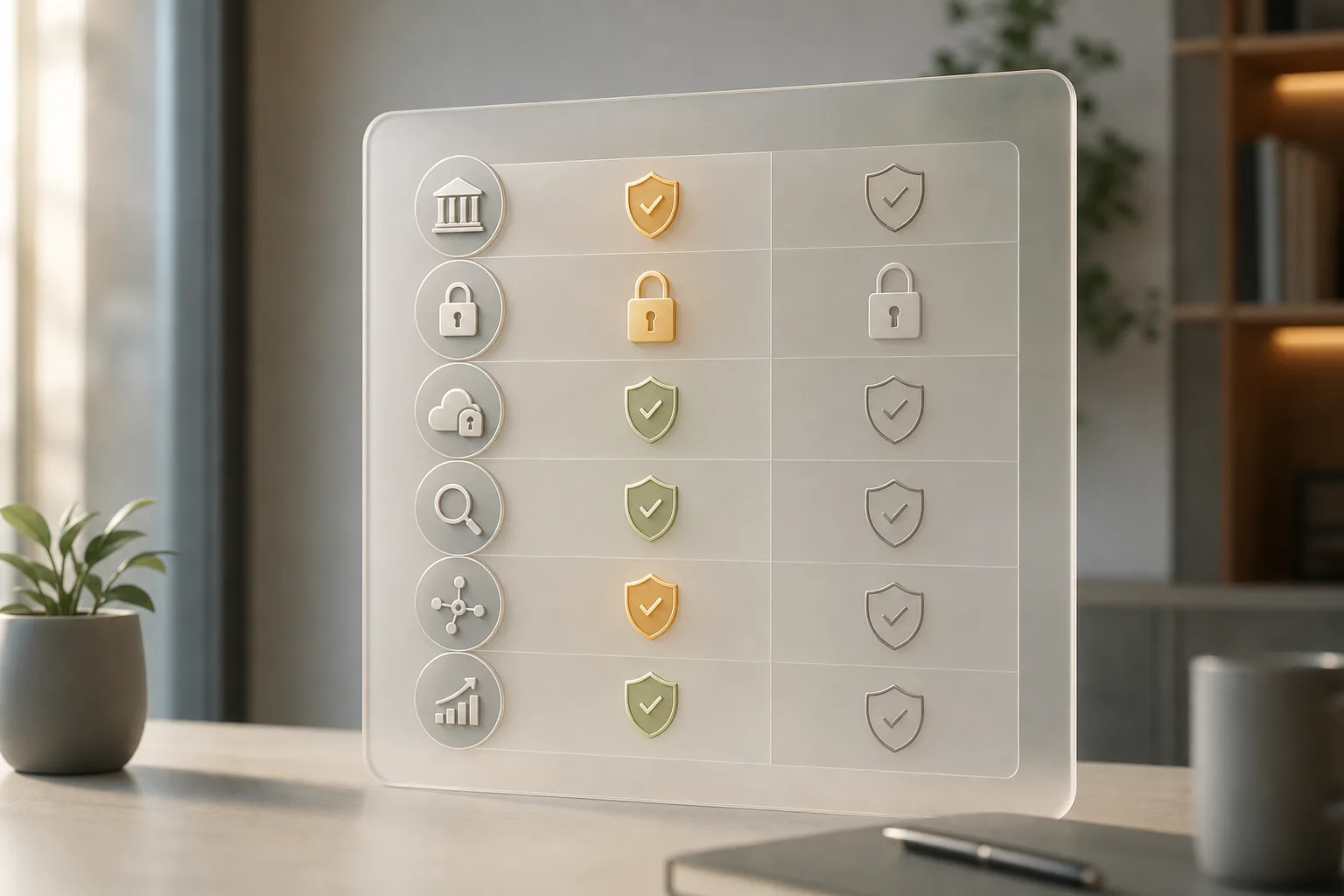
“Security-focused setup including access control and encrypted communication is the baseline, not a bonus.” — GlobussoftAI deployment guide
For deeper background on how AI bots fit in service flows, this primer on an ai powered chatbot breaks down key use cases and handoff patterns across support teams.
GlobussoftAI OpenClaw Overview: Strengths and Weaknesses for Fintech
OpenClaw is an open-source AI agent framework that you can self-host. It runs autonomous workflows on your own server and connects to channels like WhatsApp, Telegram, and email. For fintech, that design matters. You keep data in your VPC, set network policy, and control logs. If data sovereignty and audit depth are top concerns, this model fits.
On the AI side, OpenClaw powers chatbots with Large Language Models for complex queries and human-like responses. You can train and fine-tune on domain data, which is key for fees, chargebacks, or loan terms that vary by region. In addition, multi-agent orchestration lets you split tasks across agents: one to pull CRM context, one to score fraud risk, and one to draft the user reply. Therefore, you can scale from a simple FAQ bot to a process agent that closes loops.
OpenClaw’s services focus on professional deployment, system integration, and managed AI operations. That includes security-focused setup with access control and encrypted communication, plus performance tuning. Businesses that add AI services report up to a 40% cut in operational costs and a 30% rise in productivity. Those gains grow when agents handle both chat and back-office steps.
Tip: Separate dev, staging, and prod environments with distinct keys and datasets to keep experiments away from regulated traffic.
Where OpenClaw shines
- Self-hosted control: keep PII in your own cloud and meet data residency.
- Multi-agent design: orchestrate tasks like KYC checks, refunds, and ledger calls.
- Cost floor: free core framework; a typical VPS runs about $5/month and total costs usually stay under $10/month with AI model usage.
- Channel reach: instructions execution through WhatsApp, Telegram, and email; plus Voice & Conversational AI support.
Where OpenClaw falls short
OpenClaw has a steeper setup curve than a pure no-code tool. You will manage a VPS or container stack, handle SSL, and wire secrets. As a result, teams without DevOps skills may need help for day one. That said, GlobussoftAI offers professional deployment and installation, system integration with CRMs and analytics tools, and scalability planning for long-term growth. Over 1,000 hours of testing data were used to explore OpenClaw’s features, and the project reached 100,000 GitHub stars in under eight weeks, which signals broad interest in the open-source path.
- Typical prerequisites before launch:
- Container orchestration or a managed VPS with automated backups
- Observability stack (logs, metrics, traces) and alerting
- A security baseline checklist (CIS hardening, SSH policies, patch cadence)
For teams planning complex agents, the custom ai agent development guide shows how multi-agent orchestration maps to real support and fraud workflows.
Also Read!
Botpress Overview: Strengths and Weaknesses for Fintech
Botpress is known for its visual flow builder and fast path to a working bot. You get a no-code canvas, built-in NLU, and a large community. In effect, you can ship a prototype in days and plug into common tools through pre-made connectors. For fintech teams who need a quick pilot, that speed helps a lot.
Because Botpress runs in the cloud, you skip server setup. You also get a clean UI for intents, entities, and dialog paths. Moreover, teams can invite non-technical staff to tweak flows or content. That collaboration lowers the load on engineering. As a result, handoffs between product, ops, and legal tend to be smoother in the build phase.
However, cloud-only can limit data sovereignty. If you need to keep all user data in your own VPC or region, a hosted tool may not pass legal review. In addition, pricing can scale steeply as you add users or automations. That is not a knock on value; it is a reminder to model usage and growth ahead of time.
Botpress at a glance for fintech
- Strengths: visual builder, fast setup, built-in NLU, strong integrations, large community
- Risks: cloud-only limits hard data residency, vendor lock-in, higher costs at scale
If you want to compare cloud speed vs. self-hosted control in a different domain, this healthcare-focused piece, Best Custom AI Chatbot Builder for Healthcare in 2026, highlights similar trade-offs with sector-specific rules.
Feature-by-Feature Comparison: OpenClaw vs Botpress for Financial Services
Let’s compare across six dimensions that matter in 2026: data sovereignty/self-hosting, NLP quality, multi-agent ability, compliance readiness, channel support, and customization depth. Each category has a clear winner based on fintech needs.
Data sovereignty and self-hosting
First, data sovereignty and self-hosting. OpenClaw runs on your server. You can place it in your region, restrict egress, and control backups. That level of data control is hard to match in a cloud-only stack. Winner: OpenClaw.
- What to verify:
- Region pinning for storage and logs
- Network egress policies and IP allowlists
- Backup encryption keys controlled by your org
NLP quality and time-to-value
Second, NLP quality. Botpress brings built-in NLU with a visual layer that non-tech users grasp fast. OpenClaw supports LLM-powered chat and can train on domain-specific data, which can yield strong results with the right prompts and fine-tunes. For teams without ML talent, Botpress is faster to a good baseline. Winner: Botpress for speed; Tie on ultimate quality with fine-tuning.
- What to verify:
- Support for retrieval-augmented generation (RAG) with your policies and docs
- Evaluation harness: intent accuracy, hallucination rate, red-team prompts
- Versioning of prompts and NLU models for auditability
Multi-agent capability
Third, multi-agent capability. OpenClaw supports Multi-Agent Orchestration out of the box. You can route tasks between agents for customer support and process automation. For example, one agent listens on WhatsApp, another posts to a ledger API, and a third emails a receipt. Winner: OpenClaw.
- What to verify:
- Native support for function/tool calling across agents
- Transactional integrity when chaining steps (idempotency keys, retries)
- Observability of agent handoffs for debugging and audits
Compliance readiness
Fourth, compliance readiness. Both tools can help you design compliant flows. However, OpenClaw’s self-hosted model and security-focused setup (access control, encrypted communication) make it more straightforward to align with audits that require control over infra.
You still need the right process and evidence. But the architecture helps. Winner: OpenClaw.
- What to verify:
- Evidence exports: access logs, model versions, data retention settings
- Pseudonymization or tokenization at ingress where applicable
- Support for DSRs (access/erasure) across transcripts and embeddings
Channel support
Fifth, channel support. OpenClaw executes instructions through WhatsApp, Telegram, and email, with Voice & Conversational AI options. Botpress offers broad channel plugins as well. If you need direct server-side control of channel webhooks and retries, OpenClaw gives you that agency.
If you want a UI-first way to add channels fast, Botpress has an edge. Winner: Tie; choose based on control vs. convenience.
- What to verify:
- SLA for webhook retries and dead-letter queues
- Native handling of message templates (e. g.
- Support for identity binding across channels to the same customer record
Customization and systems integration
Sixth, customization depth and systems integration. OpenClaw supports model training and fine-tuning, AI/ML pipeline development, and system integration with CRMs and analytics tools. You can also add custom workflow automation and AI-driven reporting.
Botpress supports extensive integrations via marketplace items and APIs, which is great for speed. If you need to go deep on custom agents and back-office tasks, OpenClaw’s open-source base gives you fewer limits. Winner: OpenClaw for depth; Botpress for speed.
- What to verify:
- SDKs or hooks for custom tools, fraud engines, and ledger services
- CI/CD promotion of bots and prompts with approvals
- Test sandboxes and synthetic data generation for regulated flows
Summary table
| Dimension | Winner | Why it matters for fintech |
|---|---|---|
| Data sovereignty/self-hosting | OpenClaw | Keep PII in-region; tighter audit control |
| NLP quality (time-to-value) | Botpress | Built-in NLU, fast to tune |
| Multi-agent orchestration | OpenClaw | Split tasks: KYC, fraud, CRM, replies |
| Compliance readiness | OpenClaw | Encryption + RBAC + self-hosted evidence |
| Channel support | Tie | Both cover WhatsApp, Telegram, email, plus voice |
| Customization depth | OpenClaw | Fine-tuning, pipelines, deep system hooks |

As you weigh these, remember that a custom ai chatbot builder should match both your launch plan and your long-term runbook. Moreover, plan voice features early if phone support is part of your SLA. For a healthcare-focused comparison that echoes these themes, see the analysis on GlobussoftAI OpenClaw vs Kommunicate for Healthcare: Which Is Better for Custom AI Chatbot Building?.
Also Read!
GlobussoftAI OpenClaw vs HubSpot AI for Small Businesses: Which Is Better for AI CRM Integration?
Best AI CRM Integration Service for Small Businesses in 2026
Pricing Comparison: Total Cost of Ownership for Fintech Chatbots
OpenClaw’s cost base is simple. The core framework is free. A typical VPS costs around $5/month, and total costs usually stay under $10/month with AI model usage for modest workloads. You still pay for your time, security reviews, and any pro services, but the infra line is low.
By contrast, Botpress uses a freemium-to-enterprise model. You can start for little or no cost, then pay more as you scale usage, channels, and seats. In practice, this is great for a pilot yet can add up in production. Therefore, model your growth and plan capacity reviews on a fixed cadence.
Hidden costs exist on both sides. Compliance audits take staff time. Scaling adds monitoring and on-call.
Vendor management or self-hosted patching both require care. The difference is where you pay: infra and setup (OpenClaw) vs. subscriptions and overages (Botpress).
Cost items to plan for
- Compliance: audit prep, evidence exports, policy updates
- Scaling: load tests, failovers, concurrency limits
- People: prompt design, flow QA, red-team tests
- Pro services: deployment, integrations, fine-tuning

Businesses that add AI services report up to a 40% reduction in operational costs and a 30% increase in productivity. If you spread those gains over service tickets or back-office steps, the TCO picture can flip from “cost” to “savings” fast. For small fintechs, OpenClaw is the value winner thanks to its low infra cost. For large fintechs that prize speed-to-deploy and shared tooling across teams, Botpress can be the value winner due to faster rollout and governance in one place.
For teams who want a primer on channel tactics before pricing out stack choices, this case study on an ai chatbot for e-commerce shows how channel mix influences costs and results.
Verdict: Which Custom AI Chatbot Builder Should Your Fintech Choose?
Both tools can work for a bank, lender, or payments firm in 2026. Your choice hinges on control vs. speed.
OpenClaw wins on data control, cost floor, and deep customization through open-source code and multi-agent design. Botpress wins on speed-to-deploy, no-code accessibility, and a large integration set. You will not go wrong if you match the tool to your operating needs.
If your top risks are data residency and strict audits, OpenClaw’s self-hosting path is hard to beat. With Managed AI Operations and OpenClaw custom multi-agent designing and deployment, you can scale from a single bot to a fleet that runs fraud checks, KYC steps, and CRM updates. On the other hand, if you must show value this quarter and want non-technical teams in the driver’s seat, Botpress gives you a fast start and a familiar visual flow editor.
Quick Decision Guide
- Choose OpenClaw if you need strict data control, multi-agent workflows, and the lowest infra costs.
- Choose Botpress if you need a fast, no-code launch with built-in NLU and many integrations.
- Consider a hybrid if you need a quick pilot in the cloud now and a self-hosted path for production later.
Reminder: Write down your “must-pass” audit tests and a rollback plan before you pick tooling; it turns procurement from debate into checklist.
As you decide on a custom ai chatbot builder, map security first, then features. Also, plan for growth beyond month one, scalability planning for long-term growth turns a pilot into a stable program.